


Most advice on Amazon partner selection is too soft. It treats an SPN listing like a nice badge. It isn’t. For any serious brand, an Amazon Service Provider Network partner should be the starting filter, not the finish line.
If you’re handing over ad operations, catalog work, or account access, you need more than a polished pitch deck. You need evidence that Amazon has reviewed the provider inside its own ecosystem. Then you need to test whether that provider can operate with control, accountability, and commercial discipline.
Most brands hand over account access before they verify how a partner actually operates. That is where profit quietly leaks. We run the check first: access exposure, reporting gaps, and where your account is bleeding margin, before you commit to anyone.
Book Your Profit ROI Forecast 15-minute diagnostic. No pitch deck.
A Summary of the Amazon SPN
Table of Contents
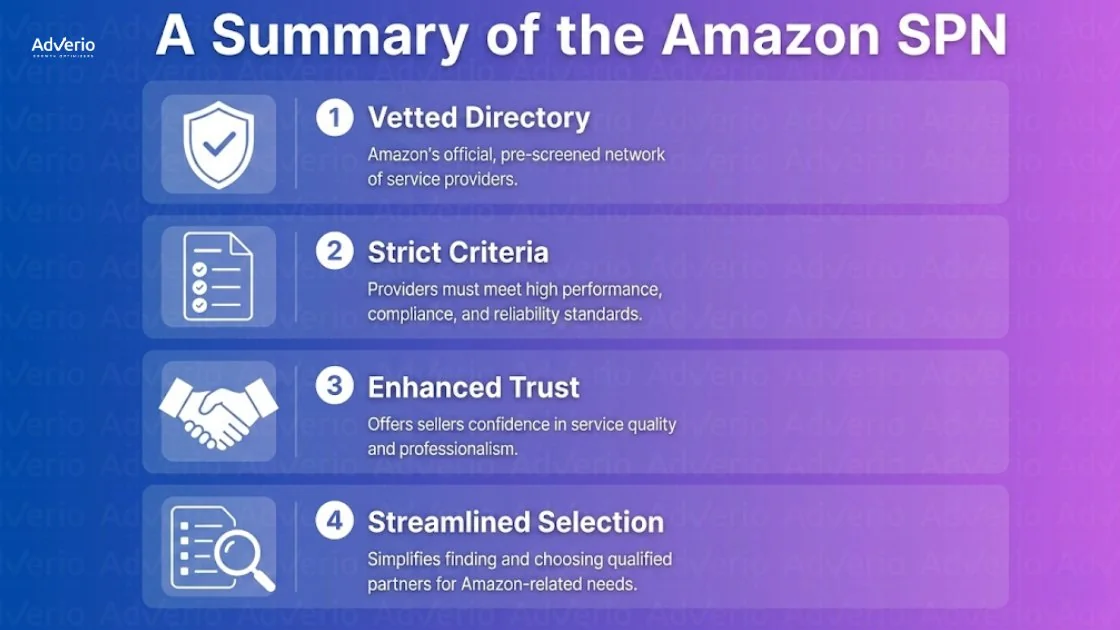
For busy operators, here’s the short version.
-
Amazon built SPN as its own vetted directory. Sellers use it to find third-party help across operational categories inside Amazon’s ecosystem.
-
Listing status isn’t self-awarded. Providers go through review, and Amazon ties the broader partner structure to controlled access, identity checks, and policy alignment.
-
A key value is risk reduction. A listed provider has cleared a baseline that unverified operators haven’t.
-
SPN still doesn’t replace due diligence. You still need to inspect process, access controls, reporting quality, and commercial fit.
-
That is why experienced teams start with vetted providers. If you’re evaluating partners, begin with firms already visible in Amazon’s system, including Adverio.
Bottom line: SPN status tells you Amazon has let the provider into the room. It does not tell you how well they’ll run your business once they’re there.
What the Amazon Service Provider Network Is
Amazon’s Service Provider Network is a vetted directory of third-party providers that sellers use to find help across operational categories. It spans cataloging, account management, advertising, imaging, FBA preparation, compliance, and tax services, according to Amazon’s SPN overview. Amazon describes the network as a way to help sellers launch, manage, and grow their business, and says its providers operate across the globe, according to the same overview.
That matters because Amazon didn’t create SPN for hobby sellers looking for random freelancers. It formalized the seller-services ecosystem because marketplace operations got complicated. Advertising got more technical. Catalog quality became a conversion issue. Compliance stopped being optional.
Why Amazon built a directory at all
Without a structured directory, brands had to rely on referrals, conference chatter, or agency websites making broad claims. SPN gave sellers a built-in place to compare providers by function.
For established operators, that’s practical. You can narrow the field based on actual service categories instead of vague promises. If your problem is suppressed listings, ad inefficiency, or cross-border complexity, you need the right operating specialist, not a generalist with a slick sales team.
This is also why the right partner selection framework matters. The selection mistake usually isn’t choosing a bad-looking partner. It’s choosing a partner with weak controls, weak process, and no genuine operating depth.
What sellers should take from it
SPN is Amazon acknowledging a simple truth. Serious sellers often need outside help. The platform is no longer purely self-serve in practice, even if it still looks that way from the outside.
So stop treating outside support like an informal vendor choice. Treat it like infrastructure.
How Amazon’s SPN Vetting Process Works
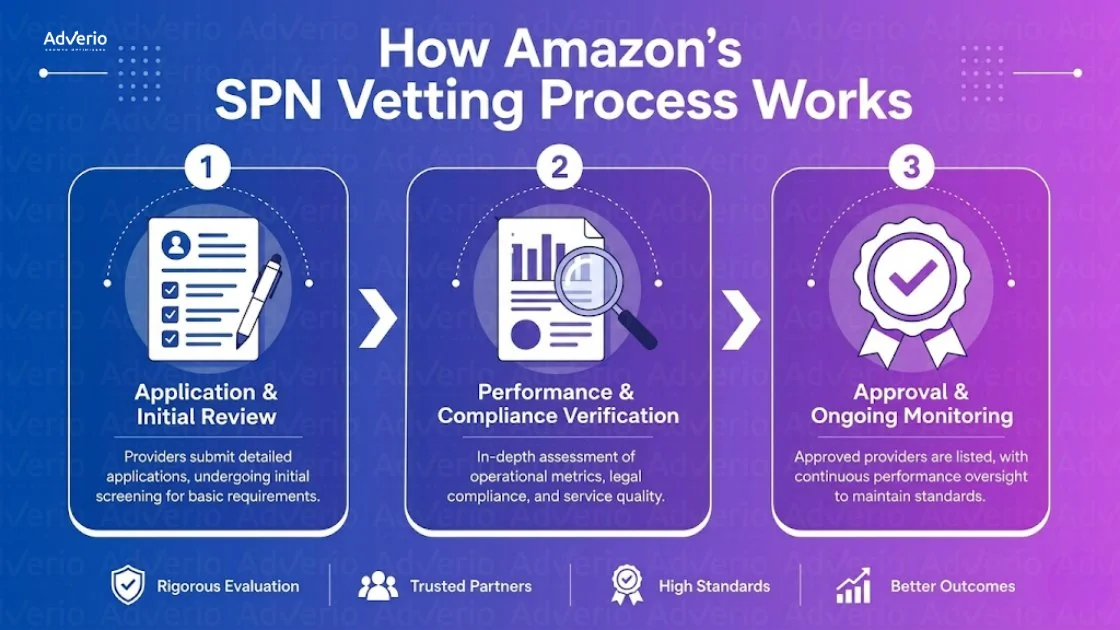
“SPN-vetted” sounds stronger than it is. Treat it as a baseline control check, not proof that a provider will protect your margin, your account, or your internal team from sloppy execution.
What Amazon has built is a formal partner framework with screening, category alignment, and permission-based operating paths. That matters because it forces providers into a system with clearer identity, clearer access rules, and less room for the casual chaos that still defines a lot of Amazon agency relationships.
Screening starts with fit, not marketing claims
Amazon does not surface providers randomly. A service provider has to apply into Amazon’s partner environment, align to specific service categories, and operate inside Amazon’s structure for seller support.
For a brand, the practical takeaway is simple. A listed provider has at least cleared an initial gate. An unlisted provider might still be competent, but now your team has to verify everything manually, including identity, process discipline, and whether they can work inside Amazon’s intended access model.
That is the point of the filter. It reduces one layer of unknown risk.
If a provider cannot or will not work through Amazon’s formal partner path, stop treating that as a small detail.
Verification and access controls are where the process gets useful
The provider-side process matters more than the directory listing itself. Amazon’s partner systems are built around permission-based access instead of shared credentials, and that changes the risk profile of the relationship.
A serious provider should be comfortable operating with defined roles, limited permissions, and clean account governance. If they ask for a shared login, they are showing you their standards. They are weak.
That is why smart operators press hard on access questions during choosing an Amazon agency. Ask for specifics:
-
What permissions will they request
-
Which team members need those permissions
-
Who needs edit rights versus admin rights
-
How access gets removed if the engagement ends
-
What record exists of changes made inside the account
Those questions affect more than security. They affect speed, accountability, and how much operational damage you can contain if the relationship goes bad.
The badge matters less than the operating discipline behind it
A provider can be listed and still underperform. A provider can be courteous on sales calls and still have terrible internal controls. SPN does not fix either problem.
What it does give you is a cleaner starting point. Amazon has already put the provider through a formal process instead of leaving you with a website, a pitch deck, and a few client logos. For a $3M-plus brand, that is not a final decision tool. It is the minimum standard for getting onto the shortlist at all.
Use SPN status the way experienced operators use any platform credential. As a first screen. Then verify process, reporting, access discipline, escalation paths, and category-specific execution before you hand over ad budgets or catalog control.
Why SPN Status Is a Critical Evaluation Filter
If you’re managing meaningful Amazon revenue, skipping SPN as a filter is lazy diligence.
There are too many agencies, consultants, and “growth partners” claiming Amazon expertise. Some are competent. Some are not. Without SPN, you’re relying more heavily on self-reported credibility.
An Amazon service provider network partner gives you a baseline signal that Amazon has reviewed the provider inside its own environment. That’s not the whole evaluation. It is the minimum threshold that removes one category of avoidable uncertainty.
Here’s the blunt version:
-
SPN-listed provider: vetted baseline, platform visibility, formal partner path
-
Non-SPN provider: possible capability, but more unknowns, more manual checking, more trust burden on you
That distinction matters when the provider will touch media budgets, listing content, compliance-sensitive workflows, and account permissions.
The common mistake is treating every agency shortlist the same. You shouldn’t. Start with providers Amazon has already surfaced through its own directory, then run a hard commercial review from there.
The full framework for that commercial review, how to separate activity-sellers from accountability-partners, what profit governance looks like in practice, and the five questions that decide agency vs in-house, lives in the Amazon agency vs in-house management guide. SPN status gets a provider onto the shortlist. That guide tells you how to evaluate what happens after.
Adverio’s Confirmed SPN Service Categories
SPN category coverage matters because it tells you what Amazon has recognized a provider to do. For a serious brand, that is the starting filter. If an agency claims full-funnel Amazon capability, check whether its SPN presence matches that claim.

For Adverio, the confirmed service categories that matter most to brand operators fall into three operational areas. These are the areas that directly affect revenue quality, margin control, and account stability.
Advertising optimization
This category covers campaign execution across Sponsored Products, Sponsored Brands, Sponsored Display, and the surrounding work required to keep ad spend tied to profit. A capable provider manages bids, search term structure, budget allocation, and retail-readiness in tandem. That matters because paid traffic only performs when the catalog, pricing, and conversion path are working with it.
Account management
Account management is where preventable P&L damage often starts. Suppressions, stranded listings, policy issues, contribution conflicts, catalog glitches, and slow case handling can gradually drag down sales long before anyone calls it a growth problem.
If your team needs outside support to manage your Amazon account, judge the provider on process control, escalation quality, and access discipline.
Good account management protects revenue. Bad account management creates expensive cleanup.
Catalog and listing services
Catalog work drives discoverability and conversion. That includes titles, bullets, images, A+ content, backend attributes, variation structure, and listing consistency across the catalog. Providers in this category should treat content as sales infrastructure, not brand decoration.
If you want a practical reference on execution standards for listings, the Amazon listing optimization guide covers the details that affect ranking and conversion.
Check the exact SPN categories for any provider you shortlist. Do not assume a general “Amazon agency” label means approved coverage across ads, account operations, and catalog work. For a $3M-plus brand, that assumption gets expensive fast.
The Practical Difference Between SPN and Non-SPN Providers
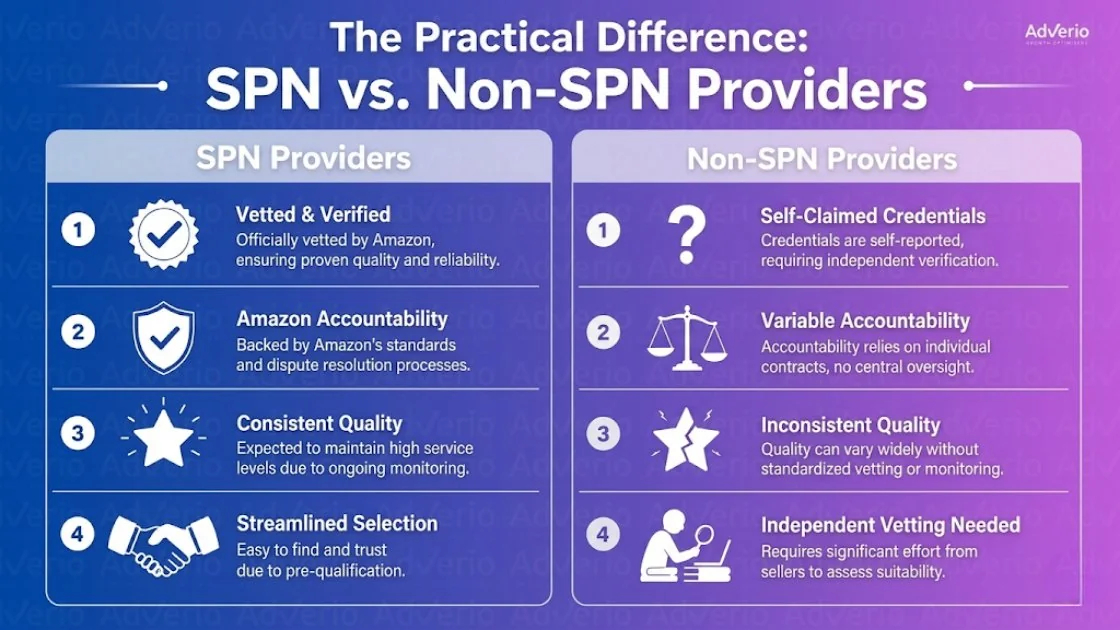
This isn’t a morality play. A non-SPN provider might still be excellent. The point is simpler. The verification burden shifts depending on who you hire.
| Evaluation factor | SPN provider | Non-SPN provider |
|---|---|---|
| Baseline review | Amazon has reviewed the provider for directory participation | You rely more on self-reported claims |
| Account access model | More likely to align with formal permission structures | Must be checked carefully |
| Discovery environment | Found inside Amazon’s seller ecosystem | Found elsewhere |
| Trust burden on the brand | Lower at the shortlist stage | Higher from day one |
Amazon’s own guidance supports the stronger due-diligence question. SPN listing is closer to a lead source than a quality guarantee. The core issue is what access, controls, and accountability come with the engagement. Amazon explicitly states it ‘does not endorse any service provider’ and provides listings as an informational resource, according to Amazon’s Service Provider Network page.
That is the contrarian view serious operators should adopt.
A listing can get a provider onto your shortlist. It cannot answer whether they run clean permissions, clean reporting, or clean execution.
The same logic applies to creative inputs. If a provider claims to improve conversion, inspect whether they understand assets that influence click and conversion behavior, including high-converting Amazon product images.
A badge cannot show you how a provider handles permissions, reporting, or execution. An account audit can. We map who holds access, where reporting hides waste, and which decisions are dragging margin.
Book Your Profit ROI Forecast → Free audit. No commitment.
When SPN Vetting Becomes Non-Negotiable
For some brands, SPN is helpful. For others, it’s mandatory.
You should treat it as essential if any of these describe your business:
-
Your Amazon operation is already meaningful. Once marketplace revenue becomes material to the P&L, informal vendor choices get expensive.
-
Your catalog is complex. Large variant structures, parent-child issues, and marketplace sprawl expose weak operators quickly.
-
Your category carries policy risk. Beauty, supplements, children’s products, electronics, and similar categories require tighter execution.
-
You’ve already been burned once. If a prior agency created reporting confusion, access messes, or account instability, don’t repeat the mistake.
-
Your internal team is overloaded. When staff are already juggling PPC, catalog, compliance, and retail readiness, they need structured partner support, not another source of chaos.
Brands around the $3M+ revenue mark often feel this first. Complexity shows up before systems do. That’s when bad partner selection starts damaging profit, not just productivity.
See Your Account’s True Profit Potential
The right next step isn’t a generic intro call. It’s a diagnostic.
A proper profit review should look at advertising efficiency, listing conversion friction, account health risk, and where operational drag is suppressing growth. That gives you something useful before any engagement starts.
One option is a Profit ROI Forecast from Adverio. The point isn’t the label. The point is getting a grounded view of where profit is leaking, what can realistically be improved, and what kind of partner model fits your business.
If a provider can’t explain your likely upside before the contract, they’re probably not ready to own the outcome after it.
Frequently Asked Questions About the Amazon SPN
What is an Amazon Service Provider Network partner?
An Amazon Service Provider Network partner is a third-party provider listed in Amazon’s SPN directory. Amazon uses that directory to surface agencies and operators across service categories like advertising, account management, catalog support, compliance, and other account functions.
For serious brands, that listing is a starting filter. It tells you the provider is inside Amazon’s system, not just claiming Amazon expertise on a sales page.
Does SPN status guarantee performance?
No. SPN status confirms baseline vetting. It does not confirm strategic judgment, clean execution, or commercial discipline.
That distinction matters more for larger brands. A weak operator can stay within policy and still waste ad spend, create reporting confusion, and slow down decision-making across the account.
How do I verify whether a provider is listed?
Check Seller Central in the Apps and Services area. Verify the provider there, then confirm the exact service categories attached to the listing.
Do not accept a badge on a website as proof. Verify it in Amazon’s environment.
Are non-SPN providers automatically a bad choice?
They are an unknown-risk option. Sometimes they are capable. You just have to do far more verification yourself.
That means checking security practices, permission controls, process ownership, escalation procedures, and offboarding terms before you hand over account access. If a provider cannot answer those questions clearly, move on.
What should I ask after confirming SPN status?
Stop asking whether they are vetted. Start asking how they operate.
Ask:
-
What access do you need?
-
Who on your team gets each permission level?
-
How are account changes approved?
-
How is work documented?
-
What is your offboarding process if we end the relationship?
-
Which SPN service categories are you listed under?
Is SPN enough for selecting an agency?
No. It is the minimum gate.
A disciplined selection process is simple:
-
Start with SPN-listed providers.
-
Confirm they are listed in the right service categories.
-
Review access controls, governance, and communication standards.
-
Test whether they can explain account decisions in profit terms.
-
Choose the team that can protect the account and improve the P&L.
If a provider can’t explain your likely upside before the contract, they’re probably not ready to own the outcome after it. So get the grounded view first: where profit is leaking, what can realistically be improved, and what partner model fits your business.
Book Your Profit ROI Forecast→ We either find leaks or confirm you are already optimized.