



Table of Contents
Most brands treat Target 1P vs 3P like an account setup decision. That’s amateur thinking.
This choice decides who controls your pricing, who owns the customer relationship, who dictates assortment, and how much margin you keep after the platform takes its share. If you get it wrong, you don’t just create operational friction. You hardwire weaker economics into the business.
For brands that want profitable marketplace growth, the question isn’t “Which model is easier?” It’s “Which model gives us tighter control over margin, data, and brand equity over time?” That’s the core boardroom question.
No pitch. Just a clear view of where your Target channel is leaking margin.
The Multi-Million Dollar Question Most Brands Get Wrong
The Target 1P vs 3P decision can add millions to enterprise value or drain it out of the channel year after year. Treat it like a setup choice and you will accept weaker margins, slower cash recovery, and less control over how your brand shows up.
Brands often end up in one model for accidental reasons. A retail buyer opens the door. An internal team picks the path with less day-to-day work. Finance focuses on top-line volume and misses what happens to contribution margin, pricing power, and cash conversion once the business scales.

That is the mistake.
A key question is who owns the economics of the channel. In 1P, you sell to the retailer and give up meaningful control in exchange for wholesale simplicity. In 3P, you take on more operating responsibility, but you keep far more influence over margin structure, pricing, inventory posture, and customer-level signals. For established brands, the smartest answer is often not pure 1P or pure 3P. It is a hybrid model built around what each channel role should do for profit, coverage, and brand protection.
If you sell across multiple marketplaces, this gets harder and more important. A weak Target structure can create channel conflict, distort your pricing architecture, and break consistency across retail media and assortment strategy. Smart operators compare channels side by side, not one at a time, as shown in Amazon vs Walmart vs Target.
What CEOs should care about
A CEO does not need another debate about portals, workflows, or account labels. Focus on the levers that change long-term profitability and brand equity.
| Strategic lever | 1P implication | 3P implication |
|---|---|---|
| Margin structure | Wholesale terms cap upside and shift economics to the retailer | Retail economics give the brand more upside after fees and operating costs |
| Cash conversion cycle | Payment timing follows retailer terms and deductions | Cash recovery is often faster because the brand sells through the platform directly |
| Pricing control | Retailer has wider latitude to set shelf price | Brand sets price and can protect its architecture more directly |
| Assortment control | Buyer approval shapes what gets listed and reordered | Brand decides what to launch, test, expand, or cut |
| Data ownership | Customer and performance visibility is narrower | Seller-side reporting gives the brand better operating signals |
| Brand stewardship | Content, positioning, and availability are influenced by the retailer | The brand manages the presentation more directly |
One bad model choice creates second-order costs. Lower visibility into demand leads to slower decisions. Weaker pricing control creates channel conflict. Longer cash cycles limit how aggressively you can fund inventory and media. Over time, those tradeoffs show up in EBITDA and brand strength, not just marketplace ops.
If your leadership team has not modeled Target around margin retention, cash conversion, and data ownership, you are not making a strategy decision. You are inheriting one.
Target 1P vs 3P The Core Mechanics
Target 1P vs 3P is not an account setup choice. It is a control system for your business.
In 1P, Target is your customer. In 3P, the shopper is your customer and Target is the platform.
That distinction drives everything downstream. Your operating model, your speed of decision-making, your inventory risk, your pricing authority, and the quality of the data your team can act on all change based on who owns the transaction.
What 1P actually looks like
A 1P model works like a wholesale business inside a modern retail environment. You sell into Target. Target places purchase orders, sets retail pricing, owns the shopper relationship, and decides how aggressively your assortment earns space.
Your team is managing a buyer, terms, fill rates, deductions, and replenishment patterns. That can reduce day-to-day marketplace work. It also puts your growth in the hands of a retail partner whose priorities are not the same as yours.
The operational appeal is obvious. The strategic cost is bigger than most brands discover too late.
A 1P structure usually fits brands that want retail distribution with less direct channel management, have the internal discipline to handle wholesale complexity, and can tolerate less control over how the brand shows up.
What 3P actually looks like
A 3P model puts your team in the operator seat.
You manage listings, pricing, inventory availability, content quality, and performance response times. If a product is underpriced, out of stock, poorly merchandised, or missing from a campaign, your team can fix it directly instead of waiting on a buyer or retailer workflow.
That is why 3P tends to suit brands that care about speed and precision. The brand that owns the offer usually has more room to protect margin, test assortment, and correct problems before they become revenue leaks.
Control creates work. It also creates options.
The real strategic divide
The weak way to frame 1P vs 3P is convenience versus complexity. The right way to frame it is delegated control versus retained control.
In 1P, you are outsourcing major commercial levers to Target. In 3P, you keep those levers and accept the operational burden that comes with them. For established brands, that often leads to a hybrid structure where 1P handles selected volume-driving items and 3P handles newer products, long-tail assortment, or categories where tighter pricing and content control matter more.
That is the advanced play. It lets you use 1P for reach and 3P for margin protection, testing speed, and cleaner market feedback.
If you want a parallel example, Adverio’s Walmart 1P vs 3P guide shows the same pattern across another major retail platform. The mechanics differ by marketplace. The strategic tradeoff does not.
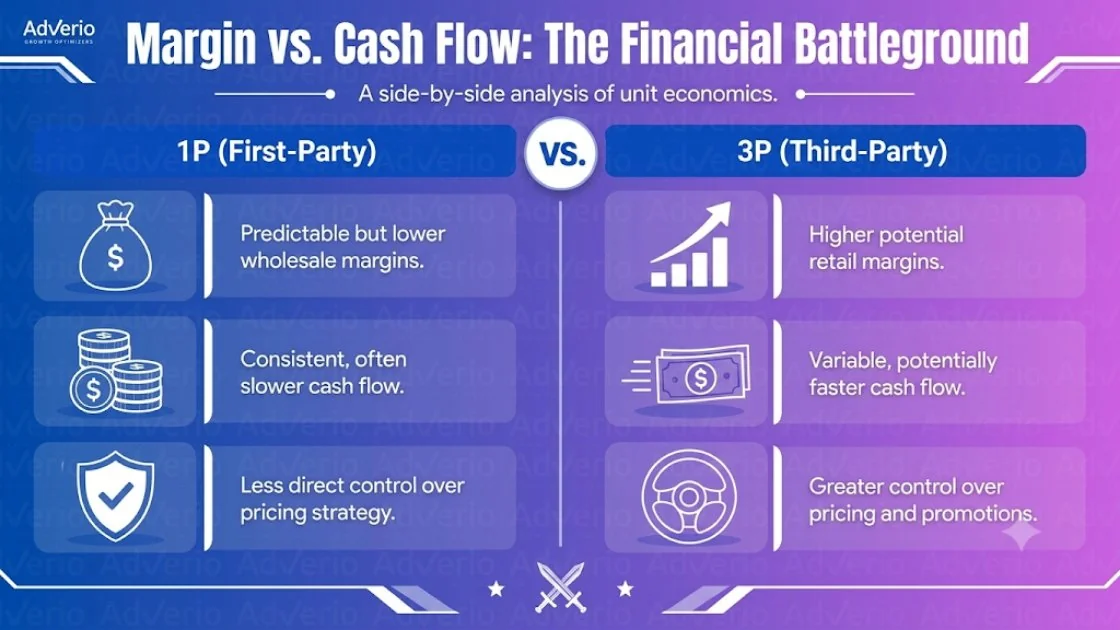
Margin vs Cash Flow The Financial Battleground
The cleanest reason brands move toward 3P is margin. The smarter reason is cash flow.
Too many operators stop at per-unit economics and miss the cash flow story. That’s not enough. A business can look better on margin and still create unnecessary working-capital stress if inventory turns are slow or media support is too heavy.
The unit economics are usually better in 3P
The broad rule is straightforward. In 3P, the brand sells at retail and pays marketplace fees. In 1P, the brand sells wholesale and gives up the retail margin.
A worked example from Feedvisor’s Amazon 1P vs 3P analysis shows a $30 retail item yielding about $20 before COGS in 3P versus $15 in 1P, roughly a $5 per-unit advantage or about 33% more gross margin before product cost. This is an Amazon example. Target fee structures differ and brands should model their own Target-specific unit economics.
Cash flow is where weak models get exposed
The payment profile matters just as much as the margin profile.
Feedvisor’s analysis notes that vendors are typically paid on net 60 to 90 day terms, while 3P sellers generally receive bi-weekly payouts. If your business is funding inventory, promotions, and marketplace growth at the same time, that timing gap matters.
Here’s the blunt version:
| Financial issue | 1P | 3P |
|---|---|---|
| Revenue capture | Wholesale | Retail less fees |
| Payout timing | Often slower | Usually faster |
| Working capital pressure | Receivables drag | Inventory and ad-spend drag |
| Margin upside | Lower | Higher if managed well |
Don’t analyze margin in isolation
The key question is not “Which model has better gross economics?” The key question is “Which model produces the better cash conversion cycle after fees, ad spend, and inventory turns?”
That distinction matters on Target because your actual profitability lives in the operating model, not the top-line story.
A lower-margin model with cleaner turns can outperform a higher-margin model that burns cash. Finance teams know this. Marketplace teams should act like they know it too.
Who Controls Your Brand Pricing and Assortment
A lot of brands fool themselves.
They say they care about premium positioning, channel harmony, and MAP discipline. Then they choose a model that weakens their control over retail pricing. Those two beliefs don’t coexist for long.
Adverio’s analysis of Amazon 1P vs 3P selling models notes that 3P is now the default path for many brands seeking profitable growth because it offers higher margin potential, better inventory control, and direct customer data access. That same strategic logic matters when evaluating Target.
Pricing control is not a cosmetic issue
In 1P, the retailer has more control over the retail price. That can create:
-
Price erosion across channels
-
MAP pressure with other retail partners
-
Brand dilution if premium items get trained into discount expectations
If your brand wins because of positioning, not just availability, giving away that control is risky.
Assortment control matters more than most teams admit
Assortment decisions shape discoverability, merchandising, and profitability.
In 1P, breadth often depends on what the retailer wants to buy, stock, and support. In 3P, you can shape the assortment more deliberately. You can protect hero SKUs, test new bundles, control long-tail exposure, and adapt faster when performance shifts.
Here’s the practical comparison:
| Control area | 1P posture | 3P posture |
|---|---|---|
| Retail pricing | Retailer-led | Brand-led |
| Assortment breadth | Buyer-approved | Operator-managed |
| Content updates | More constrained | More flexible |
| Merchandising pace | Slower | Faster |
Convenience is attractive until it starts discounting your brand for you.
Book Your Profit ROI Forecast and get a clear read on which model fits your catalog before you commit.
Growth Levers: Advertising and Data Control

Advertising does not create control. It amplifies whatever operating model you chose.
If your Target structure limits access to SKU-level performance, slows content changes, or blurs true contribution after fees and inventory costs, more media spend will not fix the problem. It will scale the inefficiency.
Data control sets the ceiling
The primary growth issue is not ad access alone. It is whether your team owns enough data to make fast, profitable decisions.
1P vendors are typically paid on net 60 to 90 day terms, while 3P sellers receive bi-weekly disbursements but carry marketplace fees, storage costs, and heavier day-to-day operational responsibility. That is why smart operators judge the model by cash conversion cycle, not by gross margin headlines. After ad spend, inventory carrying cost, and return behavior, the better model is the one that gives you cleaner economics and faster corrective action.
3P usually gives growth teams better operating range
For brands trying to drive profitable scale, 3P is usually the stronger machine because it gives the team more room to act:
-
Test offers and pricing faster
-
Shift budget based on SKU performance
-
Update content from live performance signals
-
Push new bundles or seasonal assortments without waiting for retail approval
-
Tie ad efficiency back to inventory reality and contribution margin
That speed matters. Retail media works best when merchandising, pricing, and inventory decisions move with it. If those functions are disconnected, your ad program turns into a tax on poor execution.
Better ads on a weak ownership model usually produce more spend, not more profit.
If your team is serious about retail media, build the structure first and the campaign plan second. Brands that need sharper reporting, tighter campaign control, and cleaner SKU-level execution should grow their sales on Target.
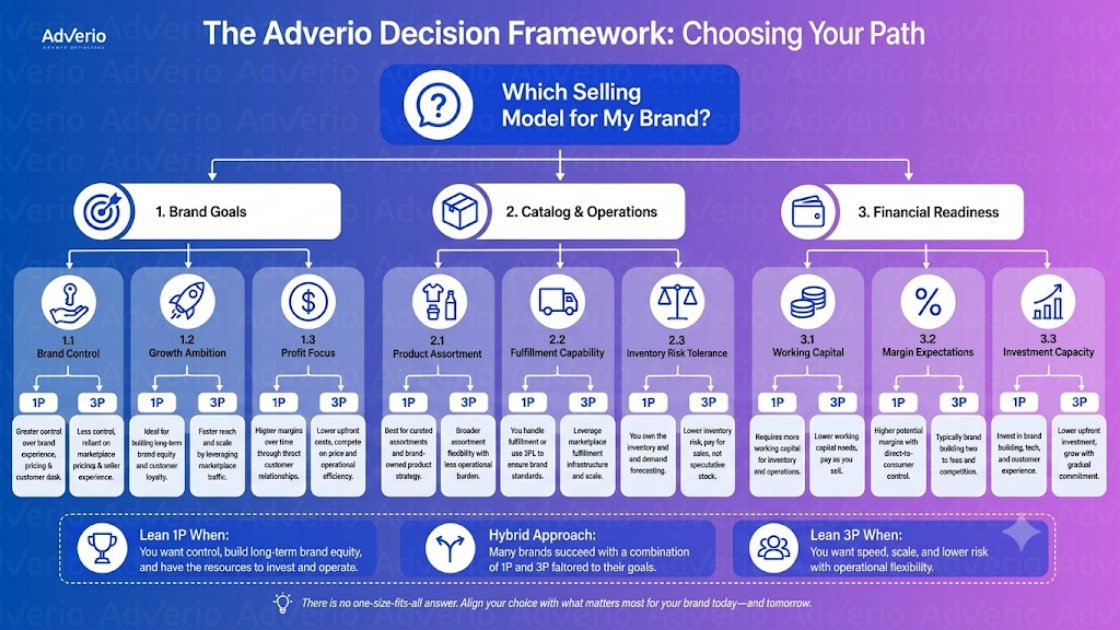
The Adverio Decision Framework: Choosing Your Path
This decision shapes margin structure, pricing authority, cash timing, and brand equity. Treat it like a capital allocation choice, because that is what it is.
For established brands, the strongest answer is often a hybrid model. Put predictable, wholesale-friendly SKUs in 1P if the economics hold. Keep margin-rich, brand-sensitive, or fast-changing products in 3P, where your team controls pricing, assortment, and execution.
Ask the questions that change the outcome
Start with control. If a SKU cannot tolerate outside pricing pressure, delayed content changes, or retail-led assortment decisions, it belongs in the 3P column.
Then look at cash conversion. If the product turns steadily, carries low brand risk, and works well in a wholesale structure, 1P can make sense. If it needs tighter inventory decisions, faster offer changes, or closer margin management, 3P usually wins.
Use this filter:
-
Does this SKU require pricing control to protect brand position or channel health? If yes, default to 3P.
-
Does this SKU produce enough margin to justify direct ownership? Low-margin items with stable demand often fit 1P better.
-
Will speed of testing change the profit outcome? New products, seasonal items, bundles, and hero SKUs usually benefit from 3P control.
-
Can your team operate the model well? Control without execution discipline is just overhead.
Hybrid is the adult strategy
A single model across the whole catalog is usually lazy strategy. Different SKUs do different jobs. Some are built for scale and operational simplicity. Others carry your brand story, defend premium pricing, or create the best contribution after media. Those should not be handed over to a structure that limits your options.
That is why strategic brands split the portfolio on purpose. They use 1P where retail efficiency is good enough. They use 3P where control creates more profit, better data, and stronger long-term brand value.
Adverio ties marketplace management to business intelligence so brands can evaluate where each SKU belongs and what each model does to profit, cash flow, and reporting clarity.
If you are preparing to add 3P to the mix, build the operational foundation first. Brands planning that move should prepare for Target Plus launch before they scale it.
Negotiating Your Terms or Making the Switch
If you’re leaning 1P, negotiate like margin matters because it does. Watch for terms that reduce your pricing influence, compress wholesale economics, or limit assortment flexibility. If the account looks simple on paper but keeps taking control away from your brand, it’s not simple. It’s expensive.
If you’re leaning 3P, don’t launch half-prepared. Make sure your catalog is retail-ready, your pricing rules are clear, your fulfillment and inventory workflows are stable, and your media plan can support the assortment you’re pushing. More control only pays off when your operators can use it.
A practical next move
If you’re staying in your current model, optimize the weak points.
-
1P brands should protect profitability by tightening assortment, monitoring price impact across channels, and pushing for terms that reduce unnecessary margin leakage.
-
3P brands should use their control advantage properly. Better listings, sharper pricing governance, smarter inventory decisions, and stronger retail media discipline.
If you’re moving toward marketplace selling, prepare the infrastructure first. A rushed transition creates catalog issues, fulfillment mistakes, and pricing instability. Brands planning that path should prepare for Target Plus launch before they try to scale it.
Pick the model that protects margin, preserves control, and fits how your brand wins.
Your Target channel should not run on assumptions. Adverio helps brands evaluate marketplace structure through a profit lens so leadership teams can decide where 1P, 3P, or hybrid makes financial sense. Book Your Profit ROI Forecast and get a clear roadmap for profitable growth on Target.