


Amazon Rufus AI is changing how buyers actually find and choose products by replacing keyword search with conversation-driven discovery. Forget static keyword searches. Shoppers now have a full-blown conversation with an AI, asking complex questions, comparing items on the fly, and getting hyper-personalized recommendations.
For established Amazon brands, this is a margin-and-market-share problem, not a feature update: the quality and structure of your listing data are no longer just important; they are the entire game. Ignoring this shift isn’t an option; it’s a direct threat to your market share.
If you’re running a multi-SKU Amazon catalog and already investing in PPC, Rufus will either amplify your advantage or quietly hand it to better-structured competitors.
Rufus doesn’t search your listing. It synthesizes it, pulling signals from bullets, A+ Content, Q&As, backend attributes, and reviews simultaneously. If any layer is incomplete or inconsistent, Rufus fills the gap with a competitor’s product instead of yours.
We run an LQS audit across your catalog to identify exactly which listings Rufus can’t confidently recommend. No pitch deck. No commitment.
The New Gatekeeper to Product Discovery
Table of Contents
Think of Rufus as a hyper-intelligent personal shopper baked into the Amazon mobile app. It’s powered by large language models (LLMs) trained on Amazon’s entire product catalog, a mountain of customer reviews, Q&As, and web data. This isn’t just a search bar tweak; it’s a fundamental pivot from transactional keyword matching to conversational, intent-driven commerce.
Your visibility no longer hinges on ranking for a few high-volume keywords. Rufus acts as the new gatekeeper, synthesizing information from every corner of your product detail page to answer nuanced customer questions.
Rufus is Amazon’s AI shopping assistant that answers buyer questions by extracting content directly from your listing. If your listing does not contain clean, extractable answers to common use-case questions, Rufus either skips your product or surfaces a competitor.
How Rufus Redefines the Buyer Journey
The old path to purchase is obsolete. Shoppers can now ask questions that would shatter a standard search algorithm. To grasp the implications, you must understand the larger landscape of search marketing intelligence in the AI era.
Rufus fields complex, multi-part queries like:
-
“What are the best waterproof hiking boots for wide feet under $150?”
-
“Compare this laptop to the one I was looking at yesterday for video editing.”
-
“What do I need to host a birthday party for a 7-year-old who loves dinosaurs?”
This shift means the depth and clarity of your product information—from hidden backend attributes to the fine print in your A+ Content—are now the primary fuel for discovery.
Traditional Search vs. Conversational Commerce with Rufus
| Aspect | Traditional Amazon Search | Amazon Rufus AI Experience |
|---|---|---|
| User Input | Short-tail keywords (“running shoes”) | Natural language questions (“What are the best running shoes for marathon training with flat feet?”) |
| Discovery Process | Scrolling through endless pages of results | A curated dialogue with tailored product suggestions and comparisons. |
| Basis for Ranking | Keyword relevance, sales velocity, reviews. | Deep product attributes, contextual relevance, and user-generated content. |
| Brand Control | Focus on keyword optimization and ad bidding. | Focus on comprehensive, accurate, and structured product data across the entire listing. |
The takeaway is blunt: the game has moved from winning keywords to winning the conversation.
Why This Demands Immediate Attention
The numbers don’t lie. Rufus is already embedded across Amazon’s shopping experience, influencing how millions of buyers research and compare products. For brands that adapt, this translates directly to revenue growth. Those who don’t will be rendered invisible.
This shift mirrors what we’re already seeing across the broader AI ecosystem—where discovery is increasingly controlled by assistants, not search results. The same principles apply to how to be the brand AI assistants recommend.
Ready to see how your brand stacks up in the AI era?
 Free guide: get AI assistants to recommend your brand →
How Rufus Rewrites the Rules of Amazon SEO
The old Amazon SEO playbook is dead. For years, brands won by mastering short-tail keywords and gaming a predictable algorithm. Rufus has shattered that model, shifting the game from simple keyword matching to semantic relevance and deep contextual understanding.
It’s no longer about stuffing your listing with terms. It’s about answering the customer’s unspoken questions before they even think to ask.
Rufus doesn’t just scan your title. It acts like a detective, piecing together signals from every part of your product detail page. It synthesizes data from your bullet points, A+ Content, customer Q&As, backend attributes, and customer reviews, which makes a disciplined Amazon backend keyword strategy essential for feeding Rufus clean, structured inputs.
This creates a new hierarchy where comprehensive, well-structured, and accurate data isn’t optional it’s the price of entry.
The New Currency of Visibility
In an AI-driven marketplace, the quality of your catalog data becomes your most valuable asset.
Brands with messy, incomplete catalogs aren’t just losing keyword rank. They’re being excluded from AI-generated recommendations entirely. That’s a visibility gap that no amount of ad spend closes because Rufus surfaces answers before the shopper ever runs a search.
Profit-Driven Catalog Optimization turns that asset into an advantage by structuring listings so Rufus can easily read, interpret, and confidently recommend your products. A disciplined approach to catalog management is no longer operational hygiene, it’s a durable competitive edge.
That discipline starts at the listing level. The structure of your titles, bullets, backend attributes, and A+ content is what determines both Rufus visibility and organic rank, which is the full scope of Amazon listing optimization.
Think of it this way: a shallow, keyword-stuffed listing is a brochure. A fully optimized, data-rich listing is an expert salesperson, ready to answer any question Rufus throws its way. Your job is to equip that salesperson to close the deal.
For brands, this means strategies like Profit-Driven Catalog Optimization are now mission-critical. It demands a meticulous focus on achieving a high Listing Quality Score (LQS) by ensuring every attribute is filled out and every piece of content speaks in natural, human language. A messy, incomplete catalog isn’t just a minor issue; it’s a direct handicap to your visibility.
Data-Driven Answers Win the Sale
The impact on conversions is already clear: a massive 60% uplift in purchase completion rates or shoppers who engage with Rufus. It transforms a static search bar into a dynamic dialogue, fielding complex queries like “Compare iPad Air vs. Pro for travel” by pulling insights from millions of listings and reviews to give shoppers the confidence they need.
The lesson is simple: the brands providing the clearest, most comprehensive data are the ones whose products get recommended. You can’t just focus on the frontend; a deep understanding of your Amazon backend keyword strategy is essential for feeding the AI the structured data it craves.
Using modern AI competitor analysis tools provides a crucial window into how rivals are adapting, helping you stay one step ahead. Ultimately, the brands that treat their entire listing as a single, cohesive data source will dominate the new AI-powered search results.
Amazon Rufus is Amazon’s generative AI shopping assistant, integrated into Amazon’s search experience, that answers buyer questions by extracting and synthesizing information from product detail pages and A+ content. Listings are now evaluated by their ability to answer buyer questions in extractable, structured language.
Your Four-Step Playbook for Rufus AI Optimization
Adapting to Amazon’s AI-powered reality isn’t about chasing secret algorithm hacks. It’s about a disciplined, data-first mindset that flips the old SEO script. Forget keyword stuffing. Winning in the age of Rufus means winning the conversation by feeding the AI a steady diet of clear, structured, and context-rich information.
Here’s a straightforward, four-step framework to get your listings ready.
This diagram shows how Rufus thinks, moving from the raw data on your listing, to AI synthesis, and finally to a conversational answer for the shopper.
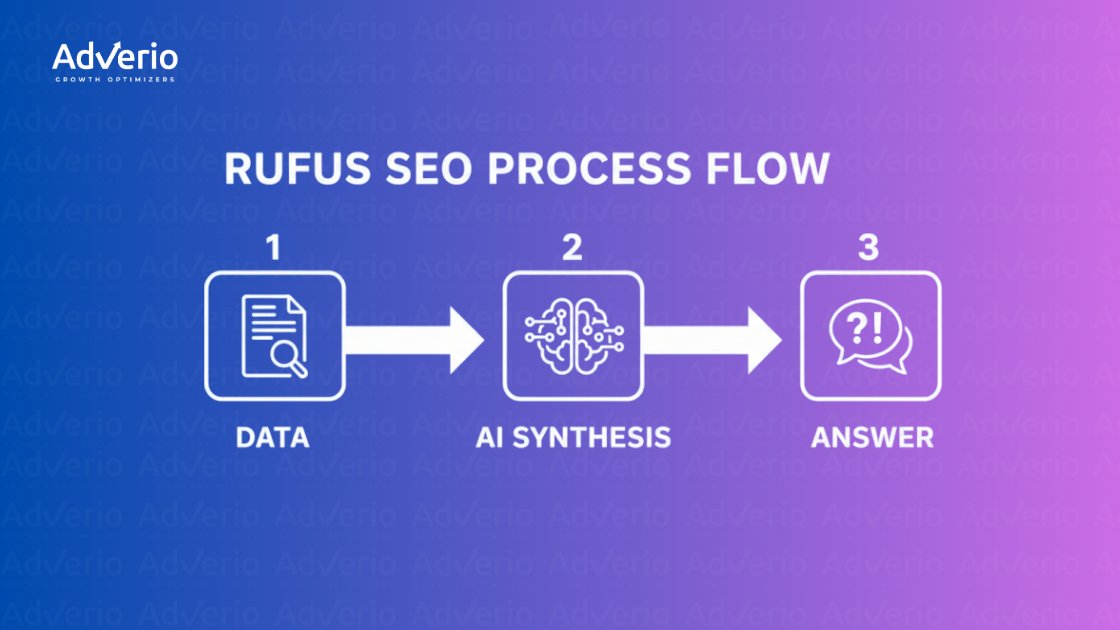
The key takeaway is simple: the quality of the data you feed it directly determines the quality of the AI’s recommendation. Garbage in, garbage out.
Step 1: Conduct a Full-Funnel Content Audit
Before you can optimize, you need a brutally honest baseline. Perform a rigorous audit of your entire product listing through the cold, logical eyes of an AI. This goes far beyond checking for keywords.
Your mission is to assess every data point for completeness, accuracy, and natural language. A structured Amazon listing audit is the fastest way to expose the blind spots that are quietly killing your Rufus visibility.
-
Titles and Bullets: Are they written for a human, or are they a jumbled mess of keywords? Rufus prioritizes clear, descriptive language that explains benefits, not just features.
-
A+ Content: Does it actually answer pre-purchase questions, or is it just brand-focused fluff? Use this real estate to explain use cases, compatibility, and what makes your product different.
-
Backend Attributes: This is the hidden goldmine for AI. Attributes like material, style, color, and size are the structured data Rufus leans on for sharp comparisons. Gaps here are a massive liability.
A thorough review is the only way to spot the blind spots, making your products invisible to conversational queries. For a structured approach, our guide on conducting an effective Amazon listing audit breaks down the entire process.
Step 2: Mine Customer Data for Conversational Gold
The best source for understanding how real people talk about your products is… real people. Your reviews and customer Q&A sections are a treasure trove of the exact conversational, long-tail queries you need.
Stop guessing what shoppers might ask and start analyzing what they are asking. Hunt for recurring questions, common frustrations, and the specific language they use to describe their problems. These are the exact phrases Rufus is being trained to understand.
Your customer reviews are no longer just social proof. They are your primary research tool for understanding the real-world language that will fuel your entire Rufus AI optimization strategy.
The four-step framework works. But running it across a large catalog without a structured audit baseline is where most brands stall. The LQS diagnostic maps every ASIN against Rufus readiness criteria, copy quality, attribute completeness, review signal strength, and backend structure, before you invest time rewriting content that isn’t the constraint.
We run the Rufus readiness audit across your catalog and tell you which ASINs to fix first.
Step 3: Structure Your Content for AI Comprehension
Once you know what questions customers are asking, you must structure your listing content to provide clear, direct answers. AI models like Rufus perform best when information is organized logically.
This means using smart formatting and dedicated sections to tackle specific topics. Think like a librarian, not a marketer.
-
Use Question-and-Answer Formats: Build a mini-FAQ directly into your A+ Content or product description. Frame headers as questions (“Is this coffee grinder easy to clean?”) and then provide a direct, no-nonsense answer.
-
Lean on Clear Headings and Bullets: Break down complex information into digestible chunks. Use descriptive subheadings that clearly signal what each section is about. This helps both the AI and human shoppers find what they need, fast.
A well-structured listing is a well-understood listing. Here’s a checklist summarizing the key areas of focus.
The Rufus AI Optimization Checklist
This checklist breaks down the critical components of your product detail page and the specific actions needed to make them AI-friendly.
| Listing Component | Key Optimization Tactic for Rufus | Why It Matters |
|---|---|---|
| Product Title | Write clear, descriptive titles using natural language. Avoid keyword stuffing. | Rufus prioritizes human-readable titles that accurately describe the product. |
| Bullet Points | Focus on benefit-driven language. Answer “what’s in it for me?” for the customer. | AI connects benefits to shopper needs, matching queries like “best camera for travel.” |
| A+ Content | Use modules to answer specific questions, show use cases, and compare models. | This provides the deep, structured context Rufus uses for complex queries. |
| Product Images | Use infographics and lifestyle shots that visually answer common questions. | Visual data provides another layer of context for the AI and helps shoppers understand features. |
| Backend Attributes | Fill out every relevant field (material, dimensions, compatibility, etc.). | This is the structured “fact sheet” Rufus relies on for filtering and direct comparisons. |
| Customer Q&A | Proactively answer questions with clear, detailed, and keyword-rich responses. | Each answered question becomes a permanent, indexable data point for the AI. |
| Reviews | Encourage detailed reviews that mention specific use cases or features. | Real-world language from customers trains the AI on how people actually talk about your product. |
By systematically working through this list, you’re not just “doing SEO”—you’re building a comprehensive information ecosystem around your product that Rufus can confidently rely on.
Step 4: Weaponize Your Reviews and Q&A
Finally, treat your user-generated content as a dynamic, strategic asset. Don’t just let reviews and questions sit unanswered. Proactively engage with this content to feed Rufus more positive and accurate data.
Encourage customers to leave detailed reviews that talk about how they used the product. When a question is asked, provide a thorough, helpful answer that not only satisfies that customer but also serves as a permanent data point for the AI.
Every answered question strengthens your product’s profile in the eyes of Rufus, making it more likely to get recommended.

Integrating Rufus Insights into Your PPC and DSP Strategy
If you think optimizing organic listings for Amazon Rufus AI is the whole game, you’re missing half the picture. Your paid and organic efforts are two sides of the same coin, and without disciplined Amazon PPC management, even the best Rufus-optimized listings struggle to capture demand at scale. The conversational questions Rufus encourages don’t just shake up SEO; they fundamentally change how you need to run your PPC and DSP campaigns.
Sticking to an exact-match keyword strategy is a recipe for getting left behind. As shoppers shift from typing product names to asking complex questions, your PPC campaigns must evolve. This means leaning into broader match types and building campaigns around customer intent, not just isolated keywords. The goal isn’t just to show up; it’s to capture the entire spectrum of conversational searches.
Moving Beyond ACoS Myopia
The rise of AI search is the final nail in the coffin for Optimization Myopia—that dangerous, tunnel-vision focus on a single metric like ACoS while your total market share shrinks. ACoS is an important metric, but it tells you nothing about whether you’re actually growing your footprint.
In an AI-driven marketplace, your true north isn’t just campaign efficiency; it’s total market dominance. Metrics like Share of Voice (SOV) become critical indicators of whether you are winning the war, not just a single battle.
A low ACoS is meaningless if Rufus constantly recommends your competitor’s products because their listings are better aligned with how people actually ask questions. A holistic view isn’t just nice to have; it’s non-negotiable.
Unlocking Advanced Audience Targeting with DSP
The data from Rufus interactions is a goldmine for sophisticated advertising. Every question a shopper asks is a clear signal of their needs, priorities, and buying journey. You can use this rich, intent-driven data to build incredibly precise audience segments for your DSP campaigns.
Imagine creating audiences based on shoppers who asked Rufus to compare your product against a key competitor, or those who asked about a specific high-value feature. This level of granularity lets you deliver hyper-relevant ads both on and off Amazon, taking your remarketing from good to unbeatable. To master this, learn the ins and outs of Amazon DSP ads.
A winning Rufus strategy demands a single, unified approach. Your organic optimization efforts feed your paid campaigns with better-converting landing pages, and the data from those paid campaigns helps you refine your organic content. Adverio’s integrated model—managing PPC, DSP, and organic optimization under one roof—ensures every piece of your Amazon presence works together to dominate in the age of AI.
Building a Foundation for AI-Driven Growth
The buzz around Amazon Rufus AI has every brand scrambling for the next hack or magic bullet. This is a classic case of Shiny Object Syndrome, where the frantic chase for a new tool completely overshadows the strategy required to make it work.
Let’s be clear: there is no trick to winning with Rufus. The brands that dominate this conversational era won’t be the ones with the cleverest AI workaround. They’ll be the ones who mastered the fundamentals of marketplace excellence long before Rufus showed up.
AI doesn’t invent information out of thin air; it synthesizes what’s already there. If your catalog is a mess, your creative is uninspired, and your review strategy is an afterthought, Rufus won’t just penalize you—it will simply ignore you. A clean, meticulously structured catalog and high-quality content are the non-negotiable foundations for AI success.
Ditch the Hacks, Build the Engine
Success with Amazon Rufus AI isn’t about layering a new tactic onto a broken foundation. It’s about building a robust, data-driven growth engine that makes advanced tools like AI effective by default. This is the philosophy behind Adverio’s Growth Cultivator framework—getting the core pillars right so that any new feature, including Rufus, becomes a competitive advantage, not another operational headache.
The hard truth is that AI rewards discipline, not desperation. Your ability to feed Rufus clean, structured, and compelling data is the single biggest factor that will determine whether it recommends your products or your competitors’.
This means committing to the unglamorous but essential work:
-
Immaculate Catalog Management: Ensuring every single backend attribute is complete and accurate. No shortcuts.
-
Conversion-Focused Creative: Using A+ Content and imagery to answer questions before shoppers ask them.
-
Proactive Review Strategy: Mining customer feedback for the exact language that fuels conversational search.
This foundational work is precisely what our proprietary COSMO Framework is designed to perfect, ensuring your brand’s data is structured for both human shoppers and AI assistants. Optimizing for Rufus isn’t a separate project; it’s the natural outcome of a well-run Amazon operation.
Instead of chasing the latest shiny object, focus on building the machine that powers sustainable growth. The first step is understanding exactly where your current strategy falls short.
Rufus is already making product recommendations for your category. The brands getting cited aren’t necessarily the best products; they’re the ones with the cleanest, most complete, most structured catalog data.
If you don’t know how your listings score against Rufus readiness criteria right now, that’s the diagnostic gap we close first.
Your Questions About Amazon Rufus AI, Answered
Navigating the shift to conversational commerce means asking the right questions. Here are straight answers to what brand leaders are asking about Rufus AI and what it means for your growth strategy.
What Is Amazon Rufus AI, Really?
Think of Amazon Rufus AI as a generative AI shopping expert built directly into the Amazon app. Its job is to kill the traditional keyword search and replace it with a natural conversation. So instead of a shopper typing “waterproof hiking boots,” they can ask, “What are the best waterproof hiking boots for wide feet under $150?”
Rufus doesn’t just scan keywords. It dives into product listings, customer reviews, and Q&As to pull together a genuinely helpful, curated recommendation.
How Does Rufus Decide Which Products to Show?
Rufus is hungry for data, and it heavily favors listings that are complete, accurate, and structured logically. It’s pulling information from every field you can possibly fill out:
-
Product Attributes: Those backend details like material, dimensions, and compatibility are no longer optional. They’re critical for head-to-head comparisons.
-
A+ Content: This is where Rufus learns about use cases, key features, and the real-world benefits of your product.
-
Customer Reviews and Q&As: The AI learns natural language from real shoppers here. It’s mining this data to understand common questions and what people actually care about.
A shallow, keyword-stuffed listing will get ignored. The new currency for visibility on Amazon is informational depth, period.
Is This a Big Deal? Isn’t Optimizing for Rufus Just More Amazon SEO?
Yes, it’s a big deal, and no, it’s fundamentally different. Traditional Amazon SEO was a game of matching and ranking for specific keywords. Optimizing for the Amazon Rufus AI shopping assistant is about building a complete information ecosystem for your product.
The focus is shifting from keyword density to true semantic relevance and data completeness. You’re not trying to trick a simple search algorithm anymore; you’re effectively training an AI to become a sales expert for your product.
The old playbook was about winning keywords. The new playbook is about winning the conversation. If your product data doesn’t directly answer a shopper’s nuanced question, you’ve already lost the sale.
My PPC Campaigns Are Crushing It. Can I Just Ignore Rufus for Now?
Ignoring Rufus is a massive strategic mistake, even if your paid ads are performing well. Conversational search is fundamentally changing how shoppers discover products at the very top of the funnel.
Relying solely on paid ads while your organic visibility with AI assistants plummets is a textbook case of Optimization Myopia. A winning strategy uses the insights from these new conversational queries to fuel both your PPC and your organic optimization. You have to dominate the entire customer journey, not just pay for the final click.
Your brand’s readiness for this AI-driven marketplace hinges on the strength of your data foundation. At Adverio, we build the strategic growth engine that ensures you don’t just survive this shift, you dominate it.
