



Table of Contents
Most advice on Walmart Connect is wrong. It tells Amazon brands to start fresh, test broad, and let the platform teach them what works. That’s expensive nonsense.
If you already sell on Amazon, you’re not starting from zero. You already own the search intent, conversion patterns, and customer signals that should shape your Walmart playbook. Ignore that, and you’re paying to rediscover what your own data already proved. If you’re still planning Amazon to Walmart expansion, start there first. Then use this as the operating manual.
If your Walmart campaigns are already live and underperforming, we can tell you exactly why within the first diagnostic call.
Get My Profit ROI Forecast
15-minute call. No pitch deck. No commitment.
At a Glance Your Amazon to Walmart Playbook
-
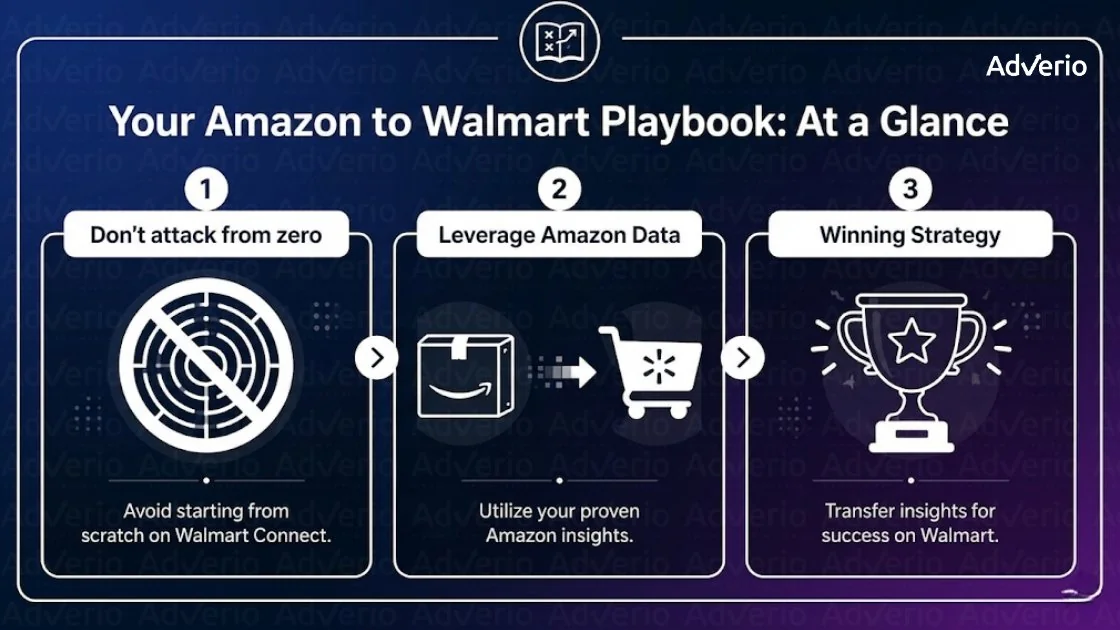
Stop launching Walmart like it’s a blank slate: Your Amazon data already tells you which products, search terms, and audience patterns deserve budget.
-
Use Amazon search intent first: Seed Walmart campaigns with proven Amazon terms instead of guessing with generic discovery lists.
-
Fund the right catalog: Products that convert on Amazon usually deserve first priority on Walmart, but only if the Walmart listing is ready.
-
Treat audience learnings as strategy, not a direct import: The cohort insight transfers. The audience file usually doesn’t.
-
Move faster than competitors: Brands that build a coherent multi-marketplace strategy and use Amazon data intelligently cut wasted learning time and protect margin.
Why Walmart Connect Underperforms for Most Amazon Brands
The platform isn’t the problem. Your setup is.
Too many Amazon operators launch Walmart the same way they launched Amazon years ago. They build broad auto campaigns, dump in a generic keyword list, and wait for data. That approach might feel cautious. It’s wasteful.
Walmart Connect has scale. Its ad business grew 46% in 2025 to $6.4 billion, and Q2 2024 ad sales were up 36% year over year according to Statista’s Walmart Connect market data. If your Walmart campaigns are flat, blaming the channel is lazy analysis.
The real issue is how teams are set up. Your Amazon team builds a full picture of what works. Your Walmart team starts from scratch and rebuilds it from memory. That is how brands lose quarters to avoidable waste.
Three common mistakes show up fast:
-
Starting with discovery instead of transfer: You already know which search themes convert. Acting like you don’t is self-inflicted waste.
-
Funding weak listings: Traffic won’t fix a Walmart PDP that lacks the right attributes, content depth, or trust signals.
-
Managing channels in silos: Separate marketplace thinking creates duplicate testing and messy reporting. The cost of managing Amazon and Walmart in silos is usually hidden inside wasted ad spend, slow learning cycles, and poor budget allocation.
Walmart underperformance usually isn’t a Walmart problem. It’s an operating model problem.
If that’s where you are, don’t ask whether Walmart works. Ask why your team is relearning what your Amazon business already knows. If you’re thinking, “I need to fix my ads on Walmart,” you’re already asking the right question.
The Amazon Data Assets You Already Have and How They Transfer
Amazon gives you a bigger pool of intent data than almost any retailer. Amazon processes over 9.7 billion shopping queries monthly and uses purchase history from more than 300 million active customers, as Amazon processes over 9.7 billion shopping queries monthly and has purchase history from more than 300 million active customers. Your own account sits inside that ecosystem.
You start with stronger signals than most Walmart-first brands. That matters because your own account history sits inside that environment. You already have stronger signals than most Walmart-first brands.
Search Query Performance data as your Walmart keyword foundation
Your Search Query Performance reports are the starting point. Not clicks. Not impressions. Purchases.
Export the terms that already produce orders on Amazon and use them as the first draft of your Walmart exact match structure.
This is the same process that a structured Amazon PPC management approach applies before any new marketplace launch.
This is the cleanest way to improve Amazon ad performance and turn that work into something useful beyond Amazon.
What matters here is intent translation. If a term closes on Amazon, it deserves validation on Walmart before you waste money on broad exploration.
Conversion rate by ASIN as your Walmart catalog prioritisation signal
Not every SKU deserves day-one budget. Your Amazon catalog already tells you which products win on merit.
A product with strong conversion behavior on Amazon has earned attention. That doesn’t guarantee the same result on Walmart, but it does tell you where to start. If you spread budget across your whole catalog, you flatten your signal and slow your learning. Strong operators narrow the field first.
Review velocity and star rating as your Walmart listing readiness filter
A high-converting Amazon ASIN can still fail on Walmart if the Walmart listing looks unfinished or untrusted.
Brands often get reckless at this stage. They assume Amazon proof equals Walmart readiness, but it doesn’t. If the Walmart review base is thin, the content is incomplete, or the listing lacks polish, paid traffic just exposes the weakness faster. That’s when a product needs Walmart review syndication and listing cleanup before meaningful spend.
Audience data from DSP as your Walmart Connect targeting head start
Your DSP audience work matters, but not in the way most brands think.
The value is in the customer pattern, not the direct audience import. If Amazon DSP has already shown you which shopper cohorts engage with premium bundles, replenishable items, or family-oriented packs, use that insight to shape Walmart targeting and messaging. Don’t rebuild your audience strategy from scratch when your existing campaign history has already narrowed the field.
Brands running Amazon DSP management at scale already have the audience segmentation logic that should seed Walmart Connect targeting.
Practical rule: Transfer the insight first, then test the platform-specific execution.
The Amazon to Walmart Data Transfer Framework
This is the part many organizations overlook. They discuss cross-platform strategy, then manage each marketplace like a separate country with isolated intelligence. That is how margin disappears.
A more disciplined launch sequence already exists. Quartile notes that a proven Walmart launch flow uses Auto Sponsored Products for 4 to 6 weeks to harvest converting terms, and that discovery phase can yield 1.7x ROAS before those learnings are pushed into manual campaigns in a structure that mirrors Amazon success patterns, as outlined in this Walmart Connect vs Amazon advertising workflow.
Step 1 Extract your top converting Amazon search terms
Pull your top Amazon search terms by purchases. Keep it tight. You want proven buyers, not vanity traffic.
Do this
-
Rank by orders: Start with the terms that drove purchases.
-
Trim aggressively: Focus on your clearest winners first.
-
Keep product relevance tight: Match term groups to the right SKUs.
Avoid this
-
Chasing click-heavy terms: Click volume without purchase behavior creates fake confidence.
-
Dumping huge exports into Walmart: More terms doesn’t mean more signal.
Step 2 Map them to Walmart search taxonomy
Amazon language and Walmart language overlap, but they are not identical. Some terms carry. Some don’t.
Review each imported term against Walmart search behavior and category language. Cull anything that looks like Amazon-specific phrasing or weak retail intent. Discipline matters during this process. You are translating, not copying.
Do this
-
Check fit by product type: Make sure the term reflects how Walmart shoppers search that category.
-
Protect campaign clarity: Keep exact-match seeds clean.
Avoid this
-
Assuming every Amazon winner belongs on Walmart
-
Using broad campaign sprawl to compensate for poor term mapping
Step 3 Prioritise your catalog by Amazon conversion rate
Budget follows proof. If your Amazon conversion data says a subset of ASINs closes efficiently, start there.
Don’t fund the whole line. Give your first Walmart budget to the products most likely to repay it. This keeps your testing environment clean and your early signal readable.
Do this
-
Pick your strongest closing products first
-
Align spend with listing quality
Avoid this
-
Launching every SKU at once
-
Using paid traffic to solve assortment confusion
Step 4 Set TACoS targets informed by Amazon margin data
Your Walmart targets should be stricter than your Amazon habits. That forces better discipline.
Walmart CPCs can start at 50 to 60% of Amazon according to Quartile’s comparison, which means your profit guardrails should reflect that platform dynamic. Don’t carry sloppy Amazon tolerance into Walmart. Use your own margin structure to set a lower TACoS expectation from day one.
Do this
-
Anchor targets to contribution margin
-
Use Amazon economics as the baseline, not the final answer
Avoid this
-
Obsessing over ACoS in isolation
-
Treating lower CPC as permission to waste spend
Step 5 Build your first Walmart Connect campaign structure
Start simple and intentional. For each priority SKU, split campaigns by job.
Use one auto campaign for term discovery, one manual exact campaign built from transferred Amazon search terms, and one product targeting campaign for competitive and complementary placement logic.
If you want clean cross-platform reporting while doing this, a full-service Amazon account management system can connect attribution logic across marketplaces instead of forcing your team into spreadsheet archaeology.
Do this
-
Give each campaign one role
-
Separate discovery from precision
-
Review search term flow before expanding budget
Avoid this
-
Combining all match types in one bucket
-
Making structure so complex your team can’t diagnose waste
Run your Walmart Connect campaign for 30 days before touching bids. The platform needs data to optimize. Brands that make bid changes in week two are optimizing noise, not signal.
What Does Not Transfer and Why
This strategy has limits. Ignore them and your forecast gets sloppy fast.

First, Amazon DSP audiences do not activate directly inside Walmart Connect. The audience insight transfers. The audience file does not.
Second, Amazon organic rank tells you almost nothing about Walmart organic rank. The platforms weigh different listing signals, and Walmart’s structure puts more pressure on item setup quality and attribute completeness.
Third, Amazon review count does not move over. A product with strong Amazon social proof can still look unproven on Walmart.
There’s also a plumbing problem. Digiday notes a lack of standardized APIs connecting Amazon Search Query Performance data with Walmart Luminate analytics, which forces manual transfers and can create a 20 to 30% drop in attribution accuracy. That challenge is described in this Digiday analysis of Walmart Connect’s push against Amazon.
If you want a sharper explanation of where brands scale and where they stall, this Walmart advertising guide for Amazon sellers lays out the operational gap.
Cross-platform strategy works best when you respect the handoff points instead of pretending the platforms are interchangeable.
How to Measure Walmart Connect Performance Against Amazon Benchmarks
Don’t ask whether Walmart matches Amazon. Ask what the gap is telling you.
If a proven Amazon product converts worse on Walmart, that doesn’t automatically mean Walmart is weak. It usually points to a listing, review, taxonomy, or targeting issue. That’s how benchmarking should work. As a diagnosis tool, not a vanity scoreboard.
Cross-Platform Performance Diagnostics
| Metric | Amazon Benchmark | Walmart Connect Benchmark | What a Gap Signals |
|---|---|---|---|
| TACoS | Your established Amazon baseline | Walmart should trend in line with your profit guardrails, not your hope | Higher Walmart TACoS usually points to poor keyword transfer, weak listing conversion, or messy campaign structure |
| CVR | Best read at ASIN level | Compare only for equivalent products and listing readiness | Lower Walmart CVR often signals PDP weakness, review trust issues, or poor search intent matching |
| CPC | Use your Amazon paid search baseline | Walmart often starts lower than Amazon | If Walmart CPC is not giving you efficiency, your targeting and product selection are probably off |
| Organic Share | Track your Amazon visibility trend | Track Walmart organic movement separately | Weak Walmart organic traction usually means listing structure or item setup is holding back paid gains |
A clean comparison matters more than a perfect comparison. If your reporting can’t explain why the gap exists, the dashboard is decoration.
How Adverio Manages Cross-Platform Data Strategy
Adverio runs Amazon and Walmart from one operating model. The team maps Amazon search term performance, product economics, and conversion history into Walmart campaign decisions before spend goes live.
That prevents the dumbest mistake brands make on Walmart. They pay to relearn demand patterns, product priorities, and budget thresholds they already proved on Amazon.
The work starts with shared definitions and one scorecard. If your team cannot agree on contribution margin, efficiency targets, or what qualifies as a profitable product push, campaign reporting turns into politics.
From there, Adverio assigns clear roles. Amazon performance history sets the starting assumptions. Walmart execution adapts those assumptions to the retailer’s ad formats, item setup, and reporting limits. Analysts review variance between the two platforms, identify what broke in transfer, and reallocate spend fast. That is how you avoid wasting a quarter on “platform learning” that should have taken a week. Brands with large, multi-marketplace catalogs need a full Amazon account management system that connects performance data across channels instead of treating each one like a separate business.
Get My Profit ROI Forecast
15-minute call. No pitch deck.
Frequently Asked Questions
Can I copy my Amazon campaigns directly into Walmart Connect?
You can copy the shell. You should not copy the logic. Port the proven inputs instead: winning search terms, products with real conversion history, and budget priorities based on margin. Then rebuild for Walmart’s taxonomy, item pages, and reporting limits.
Which Amazon data should I move first?
Move the data that cuts wasted spend fastest. Start with search term purchase data, product-level conversion signals, and DSP audience insights. Those inputs tell you what deserves budget, which SKUs can carry paid traffic, and where early targeting should start.
Should I launch all my Walmart SKUs at once?
No. Launch the products that already earned the right to be advertised. If the item does not convert on Amazon, or the Walmart listing is not ready, paid traffic will only expose the weakness faster.
Why does a strong Amazon product still struggle on Walmart?
Because platform proof is not the same as platform fit. Walmart can break the transfer through weaker content, lower review depth, different search behavior, pricing gaps, or inventory instability.
How long should I wait before optimizing new Walmart campaigns?
Wait long enough to get a usable signal, then act fast. Early overreaction ruins launch data. Waiting too long burns cash. Review against your Amazon baseline and optimize once the variance is clear enough to explain, not guess.
If your team is still funding Walmart like a blank slate, you’re paying twice for data you already own. Amazon already told you which products convert, which terms drive real buyers, and where margin can actually hold.
Adverio helps established brands apply Amazon proof to Walmart Connect before wasted spend becomes a quarterly problem. If you want to know exactly what your current setup is costing you, run a profit diagnostic first.
Get My Profit ROI Forecast
15-minute call. Free diagnostic. No retainer required upfront.