


Table of Contents
Most Walmart listing advice starts with keywords. That is the wrong starting point. The real problem is that you copied your Amazon listing structure into a system that scores product data, offer quality, and selling performance on completely different rules.
That mistake is expensive. A weak Walmart listing forces ads to carry the load, compresses margin, and turns every incremental sale into a paid sale. If you are already operating at scale on Amazon, you do not need more activity. You need a Walmart-specific operating model that protects organic visibility and conversion at the same time.
This guide is built around one specific problem: the habits Amazon-trained teams bring to Walmart that actively suppress performance. If you want the broader Walmart SEO mechanics, keyword strategy, and algorithm deep-dive, that reference lives in Adverio’s Walmart SEO guide. What follows here is the migration diagnostic. Why Amazon copy-paste fails on Walmart and the exact fix sequence to correct it.
If you are deciding whether to expand to Walmart at all, start with Adverio’s expansion timing guide first.
Get My Profit ROI Forecast
Skip the sales pitch. Get a clear view of where Walmart profit is leaking.
Why Amazon-Optimized Listings Underperform on Walmart
The most common Walmart listing mistake is simple. Brands import the Amazon listing, clean up a few words, then wonder why rank and conversion stay flat.
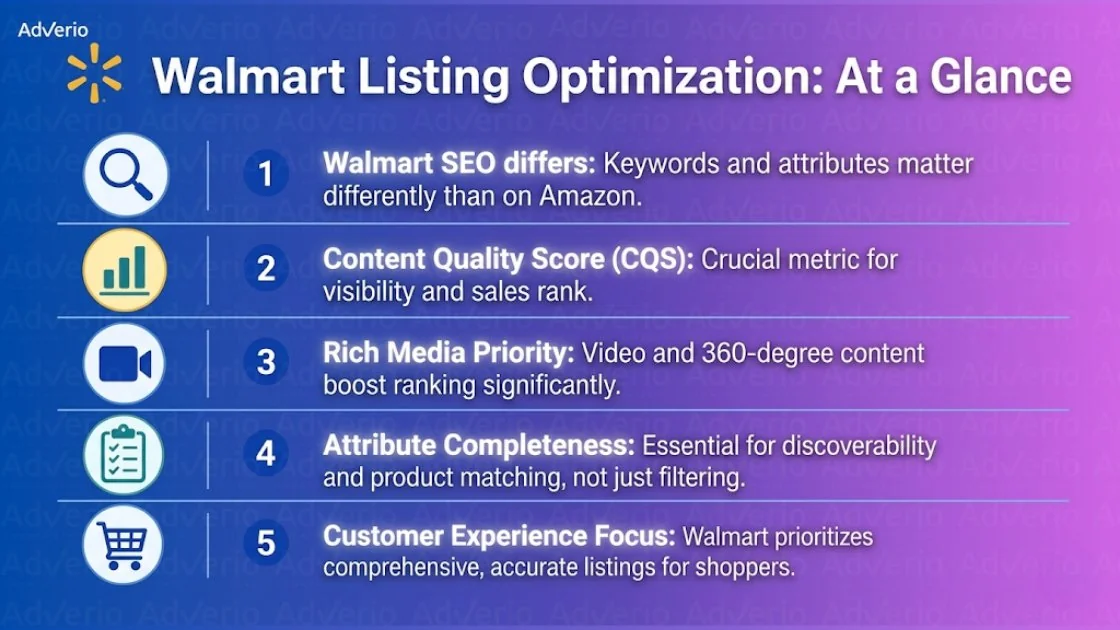
That fails because Walmart listing optimization is less about writing better copy and more about managing Walmart’s content quality signals across the full product page. Walmart’s own listing quality guidance frames listing quality around content, offer, and performance in its optimization triangle. Amazon-trained teams usually overweight title keywords and backend indexing. Walmart puts more pressure on structured attributes, offer competitiveness, in-stock stability, and shopper-ready content. The exact habits that worked on Amazon can drag performance down on Walmart.
Here is where the copy-paste playbook specifically breaks on Walmart:
-
Titles get bloated. Amazon-style strings with model numbers, variant callouts, and keyword repetition hurt readability and taxonomy fit on Walmart.
-
Attributes stay incomplete. Amazon teams often treat structured data as a setup task done at launch. Walmart treats it as ongoing discoverability infrastructure that affects search, filtering, and browse paths.
-
Images stay too sterile. A full white-background set may pass Amazon compliance. It does not build the same merchandising strength or listing quality score on Walmart.
-
Operations get ignored. Price, inventory, and shipping discipline are not separate from SEO on Walmart. They are inputs to the same ranking score.
If you are still treating Walmart as a secondary feed instead of a distinct marketplace with its own scoring logic, the multi-marketplace strategy guide explains the structural differences. The short version: one catalog strategy across multiple marketplaces sounds efficient, but lazy standardization usually costs more than it saves.
How Walmart’s Algorithm Evaluates Listings
Walmart is not asking whether you inserted enough keywords. It is asking whether the item is complete, competitive, and reliable enough to show shoppers with confidence.
Content Quality Score: Walmart’s primary listing health metric
Treat listing quality as a P&L lever. It is not a vanity score. Walmart’s listing quality framework defines quality through content, offer, and performance. Public guidance tied to that framework commonly points to titles around 50 to 75 characters, descriptions of at least 150 words, and 3 to 10 key features as alignment targets for Walmart’s search and merchandising expectations.
What matters financially is straightforward. If your listing quality is weak, organic visibility becomes harder to sustain, which means paid traffic has to do more work. That drives up customer acquisition cost and pressures margin on every order.
Use Seller Center’s listing quality views as a recurring management tool. If your team only checks it during item setup, you are already behind.
Item attribute completeness
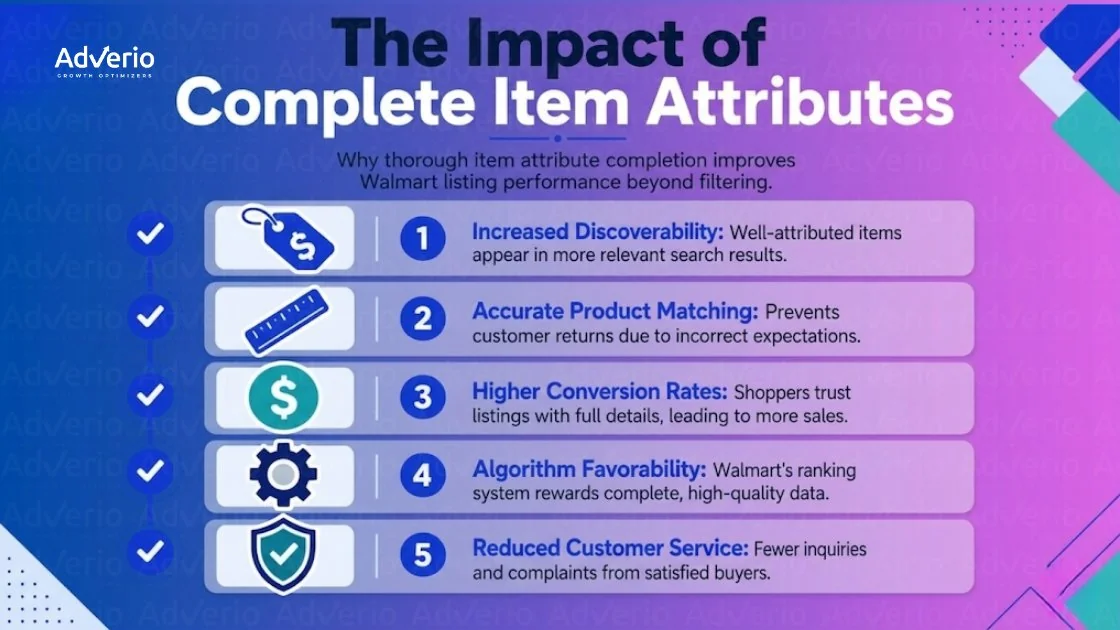
This is where many brands lose profit without noticing. Material, dimensions, compatibility, care instructions, and category-specific fields are not admin trivia. They help Walmart place your product in the right filters, browse paths, and product matches.
A major shift in Walmart item setup has been the standardization of Item Spec requirements, with Item Spec 5.0 compliance now tied to listing visibility and stability. Public guidance warns that contradictory claims between titles, bullets, and structured attributes can suppress or disqualify a listing. If your catalog says one thing in the title and another in the specs, Walmart has no reason to trust it.
Rich media: video and 360-degree content
Most Amazon operators think of richer content as a conversion layer. On Walmart, it is also a catalog quality signal that affects the listing quality score directly.
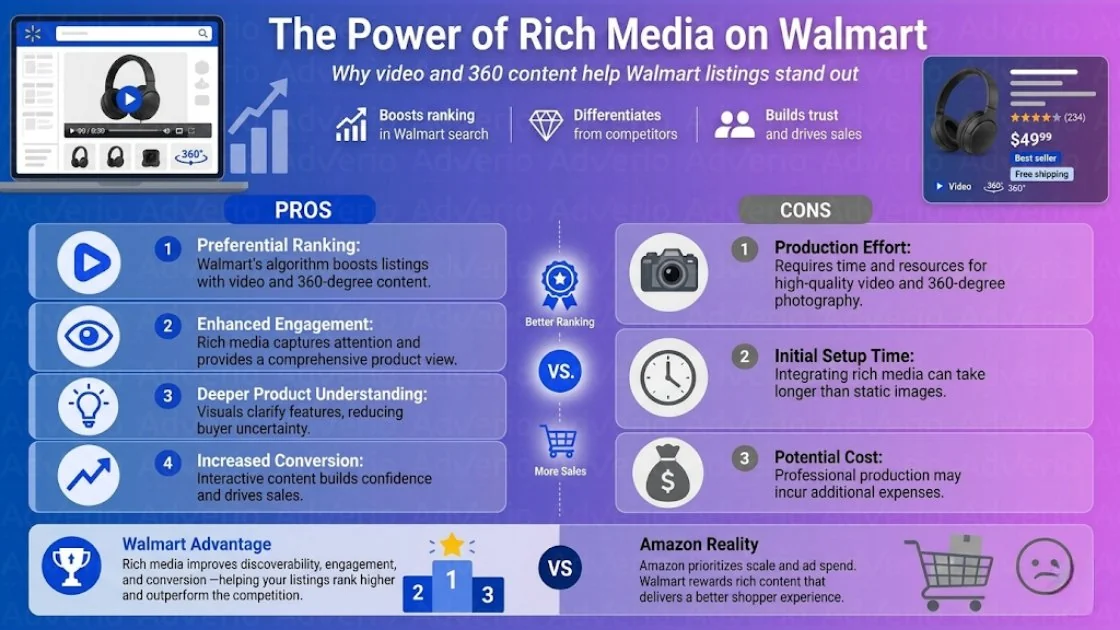
Walmart-focused guidance commonly recommends at least four images at 1000 x 1000 pixels or larger, with optional rich media such as video or 360-degree assets for stronger conversion potential, according to Inriver’s Walmart listing optimization guidance. If your page only shows static packshots, you are asking the shopper to imagine fit, use case, and product detail on their own. That raises friction. Friction kills conversion. Low conversion weakens the listing’s economics and quality score simultaneously.
Rich media is not a branding luxury on Walmart. It is a conversion and discoverability asset that feeds the content dimension of the optimization triangle.
Fulfillment method signal
Walmart’s ranking logic does not stop at content. The offer matters. So does the buying experience attached to that offer.
Walmart’s listing quality framework explicitly ties discoverability to content, offer, and performance. Price competitiveness, in-stock status, and shipping quality can affect visibility alongside copy and images. The practical implication is direct: if your fulfillment setup creates slower delivery, unstable inventory, or weak Buy Box consistency, your listing can look fine and still underperform because the offer and performance dimensions of the scoring triangle are dragging down the overall quality score.
If your ad strategy is trying to compensate for weak fulfillment economics, you are paying to cover an operations problem. Fix the offer layer first, then push media spend. Once the listing is retail-ready, Walmart Connect strategy covers how to scale ads on a solid foundation.
Before you book a call, see the profit model.
The Walmart Listing Optimization Framework: 5 Steps in Sequence
This is the fix sequence that makes the fastest financial sense for Amazon operators migrating to Walmart. The order matters because each step removes a different category of margin drag.
| Step | What to fix | Why it matters for margin |
|---|---|---|
| 1 | Title structure | Improves readability, taxonomy fit, and scan value for Walmart’s search system |
| 2 | Attributes | Strengthens discoverability and catalog integrity across filters and browse paths |
| 3 | Images and rich media | Reduces buyer hesitation, improves content quality score, supports conversion |
| 4 | Description and key features | Answers objections and brings the description field to the 150-word threshold |
| 5 | Reviews before scaling ads | Prevents wasted spend on low-converting traffic before proof is established |
Step 1: Title optimization for Walmart search taxonomy
Your Walmart title should read like retail merchandising, not like an Amazon indexing experiment.
A structured title format that works well on Walmart follows the pattern: Brand + Item Name + Model + Style + Key Attribute + Pack Count + Size. Walmart guidance commonly points to titles in the 50 to 75 character range. That is significantly shorter than the Amazon titles most teams start with.
Do this:
-
Lead with the actual product. Make the item understandable on first read.
-
Keep it tight. Walmart’s search taxonomy rewards clarity over keyword density.
-
Use one clean structure across the catalog. Consistency reduces setup chaos and attribute conflicts.
Avoid this:
-
Keyword stuffing. Repeating synonyms makes the title worse on Walmart, not better.
-
Variant clutter. Do not cram every color, size, and model note into the parent title.
-
Amazon leftovers. If the title reads like backend search terms escaped into the frontend, rewrite it from scratch for Walmart’s taxonomy.
Step 2: Attribute completion to 100 percent
If you want the fastest operational win on Walmart, start here. Pull the Item Quality report. Find incomplete attributes. Fix them all.
This is not glamorous work. It is high-ROI work because Walmart uses attributes to determine where products appear and how they are interpreted across filters and browse paths. An Amazon team that treats attribute fields as optional admin is leaving organic rank on the table every day those fields stay empty.
Do this:
-
Download the attribute gap report from Item Quality in Seller Center. Work SKU by SKU.
-
Correct category assignment first. Wrong categories lock you into the wrong attribute set entirely.
-
Fill every required field. Then clean up optional fields that affect shopper understanding.
Avoid this:
-
Ignoring backend fields. If Walmart asks for it, it affects rank and listing quality score.
-
Letting title and specs disagree. Contradictions can suppress the listing.
-
Treating launch as done. Attribute quality decays when catalogs change and nobody governs them.
The fastest Content Quality Score improvement is completing missing required attributes. Most brands see meaningful score improvement from this alone without changing a single image or title.
Step 3: Image and rich media standards
Your image stack should sell the product before the shopper reads a word. Walmart-focused guidance recommends at least four images at 1000 x 1000 pixels or larger, with optional rich media for stronger conversion potential. Video and 360-degree assets strengthen the page and feed the content quality score.
Do this:
-
Use multiple high-resolution images. Show front, back, detail, scale, and use case.
-
Add contextual visuals. Lifestyle or in-use images reduce uncertainty at the moment of decision.
-
Include rich media when possible. Video and 360-degree assets are optional but reward listing quality.
Avoid this:
-
All-white-background galleries. Compliance is not merchandising.
-
Low-information images. If the shopper cannot understand texture, size, or function from the images, the page is weak regardless of title or copy quality.
-
Reusing the same asset set across variants without checking fit. That creates confusion and variant-level conversion problems.
Step 4: Description and key features optimization
Amazon operators often waste the Walmart description field by pasting bullets into it. That is lazy and expensive on Walmart, where the description field is weighted differently in the quality score than it is on Amazon.
Use the description to answer the top purchase objections. Material quality. Compatibility. Care. Setup. What the customer receives. Why this SKU is different from the cheaper alternative in the same search results. A practical Walmart workflow audits each SKU for a description of at least 150 words and 3 to 10 key features.
Do this:
-
Write for decision support. Handle pre-sale objections in plain English.
-
Keep key features concise. Walmart guidance commonly points to 3 to 10 features as the target range.
-
Map copy to ad intent. If Walmart Connect terms drive traffic, the page should answer those shopper expectations directly.
-
The same logic applies if you are running Amazon PPC management in parallel. Copy must support paid intent, not fight it.
Avoid this:
-
Dumping Amazon bullets into the description box.
-
Writing fluffy brand copy that sounds like a press release.
-
Repeating the title or key features inside the description field.
Step 5: Review seeding before ad spend
Do not pay for traffic to a listing that has not earned trust yet.
On Walmart, reviews support shopper confidence and are part of the broader listing quality picture. If your page has thin review coverage, ads become less efficient because the listing has less proof at the moment of click. Every dollar of Walmart Connect spend is worth less on a page with weak social proof than on a page that has already built credibility.
Do this:
-
If your review base is too thin to support paid scale, Amazon review removal and proactive review health work the same way on Walmart logic.
-
Use compliant systems to accelerate proof on priority SKUs.
-
Prioritize hero SKUs first. That is where wasted spend hurts most.
Avoid this:
-
Launching heavy ad spend on weak pages.
-
Treating reviews as an afterthought after listing setup is complete.
-
Waiting for organic review flow if the category is already competitive.
If this is your bottleneck, use a structured process to get reviews on Walmart.
Content Quality Score: How to Check and Fix Yours
Many teams say they care about Walmart listing optimization, then never look at the diagnostic layer that tells them where the page is actually failing.

Run this process every week for core SKUs and every month for the full catalog:
-
Open Seller Center and review listing quality by item.
-
Sort for underperforming SKUs first. Do not spread effort evenly.
-
Audit category assignment and attribute gaps.
-
Check whether the page meets common Walmart thresholds: title in the 50 to 75 character range, description with at least 150 words, 3 to 10 key features, and image coverage at 1000 x 1000 pixels or larger.
-
Fix the page before scaling traffic.
If your team needs a tighter remediation process, start here to fix your Walmart listings.
The highest-ROI fix is also the most boring one. Fix catalog data before you touch media spend.
How Adverio Optimizes Walmart Listings
You can run Walmart listing optimization in-house if you have tight catalog governance, real media production, and clean coordination between merchandising, ops, and paid. Most brands do not. That is where a specialist workflow earns its keep.
Adverio’s process ties listing optimization for conversion, offer health, and full Amazon account management into one operating model. That matters when you are trying to stop the hidden margin bleed that comes from split ownership across catalog, ops, and media. The piece on hidden costs of split marketplace management explains that problem in detail. If your goal is straightforward, start here to grow sales on Walmart.
Get My Profit ROI Forecast
Quick diagnostic. Real upside. No pitch deck.
FAQs
How fast can Walmart rank improve after listing fixes?
It depends on what you fixed. Attribute and content corrections can change how Walmart interprets the item quickly, but operational signals such as price, stock, and shipping consistency also affect performance and take longer to build. Do not judge the change by one day’s movement. Judge it by whether organic visibility and conversion become easier to sustain without forcing more paid spend.
Should I fix old Walmart listings or create new ones?
Fix the existing listing first unless the setup is severely flawed at the category or variant level. Creating duplicate or replacement listings can fragment reviews, confuse variant logic, and create catalog conflicts. Repairing the current item is usually the cleaner profit decision.
What is the biggest Walmart variant mistake?
Bad parent-child relationships. When variants are grouped poorly, ranking signals fragment and the shopper gets a worse buying experience. Variant structure is not cosmetic. It affects discoverability, usability, and conversion rate on every SKU in the parent.
Can I use my Amazon listing copy on Walmart?
You can reuse product facts. You should not reuse the structure blindly. Walmart needs a cleaner title strategy, stronger attribute completion, better merchandising depth, and tighter alignment between item data and offer quality. The copy-paste approach is the most common reason Amazon brands underperform on Walmart in the first 90 days.
When should I scale Walmart Connect spend?
After the page is retail ready. If the listing has weak imagery, thin attributes, poor review coverage, or unstable operations, ads will not scale cleanly. Fix the page first across all five steps in the framework above, then push traffic. The Walmart PPC strategy guide covers how to build the media layer once the listing foundation is solid.
If your Walmart listings look fine but ads are still doing all the heavy lifting, that is a profit problem dressed up as a traffic problem. Adverio helps brands fix the catalog, offer, and media gaps that suppress Walmart performance. If you want a clear path to better rank, stronger conversion, and cleaner margin, start with a Profit ROI Forecast.