


Pull from the library.Amazon got good at counterfeits. Your remaining exposure is the part Amazon does not police.
Protecting your brand on Amazon is a profit protection function rather than a legal one. Margin leaks and reputation damage compound quietly, and the cost lands in the ad account before it lands anywhere else.
Two things have changed since most brand protection advice was written.
Amazon has become genuinely effective at counterfeits. In 2025 it identified, seized and disposed of more than 15 million counterfeit products worldwide, and its Counterfeit Crimes Unit has pursued more than 32,000 bad actors through litigation and criminal referrals across 14 countries since 2020, according to Amazon’s Trustworthy Shopping Experience Report published in April 2026. In one case its early warning system blocked infringing listings eight days before the brand owner had shared the intellectual property.
What has not changed is everything that is not a counterfeit. Unauthorized sellers holding genuine product. MAP erosion. Grey-market diversion. Amazon has no enforcement mechanism for any of it, because none of it violates Amazon policy.
This guide covers what a hijack costs after the takedown, which threats Amazon will handle and which it structurally cannot, the programs worth enrolling in, and how to run monitoring and incident response.
At a Glance
Table of Contents
Five things to take away
- The takedown stops the bleeding. It does not refund the spend that ran at suppressed conversion.
- Amazon seized more than 15 million counterfeit products in 2025 and blocks most infringing listings before a brand reports them.
- Unauthorized sellers with genuine product are protected by the first sale doctrine. Amazon will not remove them.
- Brand Catalog Lock, launched 2025, prevents unauthorized changes to titles, images and descriptions.
- Prioritize monitoring by revenue exposure. Review sabotage on a hero ASIN is a different event from the same attack at position 10.
Quick Answer:
Amazon brand protection covers the systems you build to prevent counterfeit listings, unauthorized sellers, hijacked Buy Boxes and MAP violations. Enrol in Brand Registry, add Transparency and Brand Catalog Lock where the threat justifies them, then spend your actual effort on distribution control and MAP, because those are the exposures Amazon does not police. Reactive enforcement is expensive, and the expense is mostly advertising rather than legal.
Definition
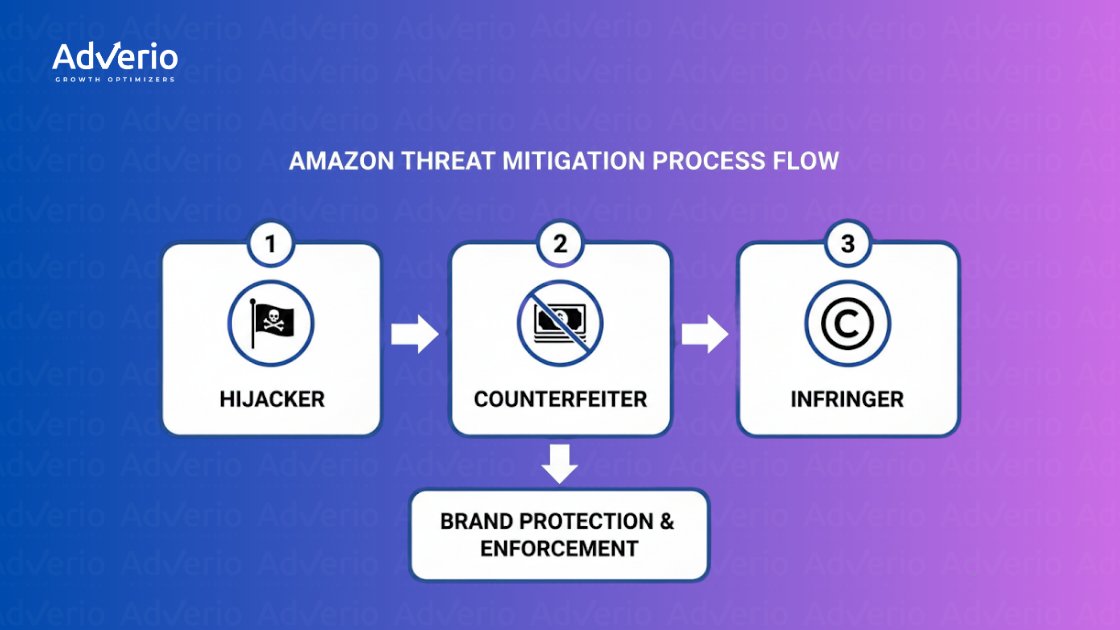
The three threats get used interchangeably and the remedies are completely different.
Counterfeit is a fake product sold under your brand. It infringes your intellectual property, Amazon polices it aggressively, and Report a Violation is the mechanism.
Listing hijacking is a bad actor taking control of your product detail page, altering titles, images or bullets, or fulfilling orders under your ASIN. It is a catalog control problem, and Brand Catalog Lock is the countermeasure.
Unauthorized selling is a third party selling your genuine product through unofficial channels. It infringes nothing. The first sale doctrine protects the seller, and your case rests on quality control standards, customer service failures and MAP rather than on an infringement claim.
Filing a counterfeit claim against an unauthorized seller of genuine product fails, and repeated bad claims damage your standing in Brand Registry.
1. What a Hijack Costs After the Takedown
Here is the part most brand protection advice skips.
The stolen sales are the visible cost and the smaller one.
A hijacker on one ASIN suppresses Buy Box control. That suppresses conversion rate. That raises effective cost per click. That erodes rank. By the time the listing is clean again, you have funded two to three weeks of degraded performance across campaigns that had nothing to do with the hijacked ASIN.
The takedown stops the bleeding. It does not refund the spend.
A hijack usually gets discovered three to four weeks in, when ranking has already slid and refund rates have climbed. The enforcement action resolves the cause. The advertising cost is already sunk, and it sits in a report nobody connects to the incident.
Which makes the detection window the number that matters. Every day between the hijack starting and someone noticing is a day of spend running against a conversion rate you did not agree to.

What to do
- Measure the detection window, not the resolution time. How long the hijack ran is what set the cost.
- Pull the ad data for the affected period. Conversion rate, effective cost per click and TACoS across the whole account, not just the affected ASIN.
- Prioritize monitoring by revenue exposure. Review sabotage at position 10 is survivable. The same attack on an ASIN funding 40% of revenue is an existential event.
What to avoid
- Treating the takedown as the end of the incident. The advertising cost outlives it.
- Monitoring every ASIN at the same cadence. Effort should follow revenue.
|
AFTER THE TAKEDOWN The hijacker is gone and the listing is yours again. The one-star reviews their fake product earned are still sitting on your page.
20 minutes. Bring your worst-rated ASIN. |
2. What Amazon Polices, and What It Does Not
Amazon’s enforcement has improved sharply, which changes where your own effort is worth spending.
What Amazon handles well now. Counterfeits, at scale and increasingly ahead of reports. Fake reviews, with hundreds of millions of suspected reviews blocked in 2025. Fraudulent listings, blocked in the large majority of cases before a brand spots them. Seller verification, now required of all new sellers before they can list.
What Amazon structurally cannot handle. An unauthorized seller offering your genuine product. Nothing about that violates Amazon policy, and the first sale doctrine means it usually does not violate the law either.
|
Knowing who is on your listings starts with knowing what your listings are. Orphaned children, recycled identifiers and variation records nobody has audited in a year are what let a duplicate ASIN sit unnoticed next to the real one, and they are also what makes an unauthorized seller hard to trace back to a source. Amazon catalog management is where that record gets straightened before the enforcement work starts. |
The damage is real regardless. MAP violations trigger price erosion, price erosion crushes margin, and channel conflict makes it hard for you and your authorized partners to compete. Our guide to what brands need to know about MAP violations covers the enforcement mechanics.
So the marginal return has shifted. Effort spent hunting counterfeits duplicates work Amazon is already doing better. Effort spent on distribution control, MAP enforcement and knowing who is on your listings has no substitute, because nobody else is doing it.
What to do
- Audit your distribution before your listings. An unauthorized seller got the product from somewhere, and that somewhere is usually identifiable.
- Build the MAP case on documentation. Quality control failures, customer service records and pricing evidence are what give you standing where infringement claims do not.
- Use Report a Violation for what it is for. Counterfeit and IP claims. Filing against genuine product wastes the claim and your standing.
What to avoid
- Filing counterfeit claims against grey-market sellers. It fails, and a pattern of rejected claims costs you credibility in Brand Registry.
- Assuming a low price means a fake. It usually means diverted inventory.


3. The Programs, and the One Added in 2025
Amazon gives you a set of tools. Enrolment is not a strategy, and the programs work as a layered system rather than a menu.
The foundation
Brand Registry is the control layer that decides whether you own your listings or rent them from Amazon’s catalog system. It requires an active registered trademark, and it unlocks A+ Content, Brand Stores, Sponsored Brands and the Report a Violation tool.
The program table
Brand Catalog Lock, added in 2025
Launched in 2025, it prevents unauthorized changes to titles, images and product descriptions. It is the direct countermeasure to listing hijacking, and brand protection guidance written before 2025 does not mention it.
Report a Violation also gained claim status tracking in 2025, so a submitted claim can be followed rather than resubmitted blind.
The rest, briefly
Transparency applies a unique serialized code to every unit. Amazon scans it before shipping, and an invalid or duplicate code stops the item. Strong for high-value products and convincing fakes.
Project Zero grants self-service takedown to brands with a proven reporting record. Invite-only, and it demands accuracy.
IP Accelerator connects you with vetted IP firms and grants Brand Registry benefits while the trademark is pending, closing a vulnerability window that can otherwise last months. Amazon’s IP Accelerator program covers eligibility.
What to do
- Add Brand Catalog Lock if you have had any listing tampering. It is the cheapest defense on the list.
- Layer rather than choose. Brand Registry for control, Transparency for supply chain, Project Zero for speed, Catalog Lock for the detail page.
What to avoid
- Treating enrolment as protection. Enrolment gives you tools, not outcomes.
- Applying for Project Zero without an accurate reporting history. The accuracy requirement is enforced.
|
+1,119%
Profit Growth
Levtex Home
 |
+586%
Profit Growth
Karat
 |
+833%
Revenue Growth
Crazy Dog
 |
4. Monitoring and Incident Response
The monitoring protocol
Listing audits. Check your revenue-weighted ASINs for unauthorized changes to titles, images, bullets or category. Tampering usually starts small.
Price erosion tracking. A sudden steep drop signals grey-market activity or a Buy Box attempt. Monitor against your MAP policy.
Test buys. When a seller looks suspicious, a test buy is often the only way to prove counterfeiting and produce evidence a claim can use.
Customer service as intelligence. Your support team hears “fake” or “not as described” first. Give them an escalation path.
Cadence follows revenue exposure. Hero ASINs get daily attention and the long tail gets a standardized weekly pass.
When an attack happens
Gather evidence first. Dated screenshots of the offending listing, the seller storefront and any unauthorized changes to your page. If you ran a test buy, keep the order ID, photographs and a written comparison.
Submit through Report a Violation. Include the ASIN, the seller name, your trademark or patent registration number, and a factual description of the infringement. Avoid emotional language.
Escalate when the automated path fails. Open a Seller Central case referencing your original submission ID. Frame the issue as a risk to the customer experience. For severe or repeated cases, a formal letter from an attorney often moves it.
Enforcement failures can escalate into account-level risk, which is why how to handle an Amazon seller account suspension belongs in the same playbook.
What to do
- Document before you report. A clean evidence-backed claim resolves faster than a fast incomplete one.
- Track claim status now that it is available. Resubmitting blind was the old cost of a rejected claim.
What to avoid
- Waiting for customer complaints. By then the reputational damage is already recorded in reviews.
- Resubmitting a rejected claim without adding evidence. It repeats the same outcome.
|
CADENCE FOLLOWS REVENUE You have a monitoring protocol and 400 ASINs to point it at. Nobody has worked out which 12 of them would hurt.
30 minutes. Bring your last 90 days at item level. |
Decision grid
Each threat, whether Amazon polices it, who owns the response, and the actual remedy.
The three rows Amazon does not police are where your own effort earns the most, because nobody else is defending them.
How Adverio Helps
Adverio is an Amazon account management agency that runs Amazon, Walmart and Target for consumer brands, measured on contribution margin against a baseline set before the work starts.
On brand protection that means running enforcement and advertising off the same number. The takedown is the middle of the job, not the end of it. We identify which ASINs carry the revenue exposure, build the monitoring around those first, and read the advertising cost of every incident so the damage gets counted properly.
Then we redeploy. Removing an unauthorized seller frees demand that was being captured by someone else, and that demand goes somewhere. Directing it back into your own campaigns is what turns an enforcement action into a return rather than a cost. For brands weighing whether to run this internally, Amazon account management companies sets out the structural trade-off.

Frequently asked questions
How long does Brand Registry approval take?
Between 24 hours and two weeks. It depends on whether your trademark is already registered with a pre-approved government office, and how quickly your trademark attorney returns the verification code Amazon sends them.
Without a registered trademark, IP Accelerator connects you with vetted firms and grants Brand Registry benefits while the application is pending.
Can you remove an unauthorized seller offering your genuine product?
Not through an infringement claim. The first sale doctrine means reselling genuine product is generally lawful, and Amazon has no policy basis to act.
Your standing is elsewhere. Document quality control failures, customer service problems and MAP violations, and build the case on those. Removal usually comes through the distribution channel rather than through Amazon.
What is the difference between Transparency and a UPC barcode?
A UPC is one-to-many. It identifies what the product is, and every unit of the same product carries the same code.
Transparency is one-to-one. Every unit gets a unique serialized code, scanned at the fulfillment center. An invalid or duplicate code stops the unit before it is checked in, so it never reaches a customer.
Should brand protection sit in-house or with a partner?
It depends on whether enforcement can hold its own priority. In-house it competes with growth work, and enforcement generally loses that competition unless it is systemized.
The question worth asking is who reads the advertising cost of an incident. That number usually sits outside the team doing the enforcement, which is how the real cost goes uncounted.
Closing
Amazon will catch the counterfeiter. It will not catch the reseller quietly resetting your price floor, and that is where your protection budget belongs.
|
The enforcement report says the incident is closed. The ad account funded three weeks of it and nobody added the two together.
30 minutes. Bring your last 90 days. |
References
Platform figures move. All figures were checked on 3 September 2026.
- Amazon, Trustworthy Shopping Experience Report, published April 2026, covering 2025. https://trustworthyshopping.aboutamazon.com/resources
- Amazon Brand Services, IP Accelerator program. https://brandservices.amazon.com/ipaccelerator
- Amazon Brand Registry, Brand Catalog Lock and Report a Violation status tracking, introduced 2025. https://brandservices.amazon.com/