


Hitting a sales plateau on Amazon is frustrating. You’re doing all the right things, but the growth engine has stalled. The knee-jerk reaction? Throw more money at ads. But you and I both know that rarely fixes the underlying problem. If you want to know how to increase sales on Amazon, you need to architect a complete growth system: from your listings and ad funnels to the back-end operations that hold it all together.
Why Amazon Sales Stall Before They Scale
Watching competitors fly past you while you’re seemingly stuck in the mud is a tough pill to swallow for any ambitious founder. It’s a common story: you pour cash into ads, see a flicker of activity, but the return on investment just isn’t there. Your growth stalls, and you’re left wondering what hidden lever you’ve failed to pull.
The issue isn’t a lack of effort—it’s the lack of a cohesive, data-backed plan. You need a clear blueprint that goes beyond generic advice and gets to the root of why sales are leaking from your business.
This guide is that exact framework. We’re going to dive deep into the core pillars of Amazon success and hand you a playbook for generating real, measurable revenue growth.
You’ll walk away knowing exactly how to:
- Turn your product listings into unstoppable conversion machines.
- Build a profitable advertising funnel that acquires customers efficiently.
- Finally get a handle on the operational chaos of pricing, promotions, and inventory.
This entire growth model can be visualized as three core pillars, starting with Listings, moving to Ads, and supported by Operations.
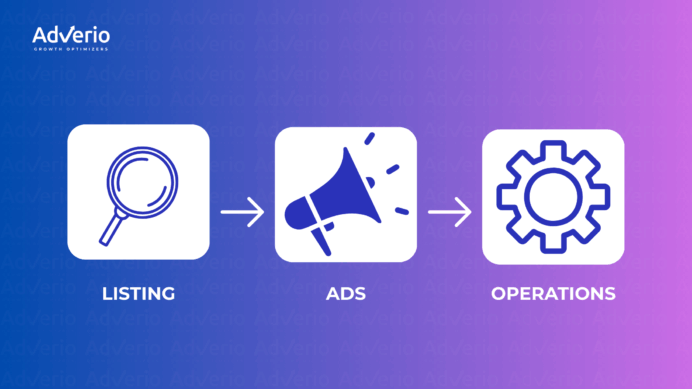
This shows just how critical a rock-solid foundation in listing optimization is before you even think about scaling up your advertising. Get the listing right, and everything else becomes easier and more profitable. Think of it as a sequence where each part amplifies the next.
Success on Amazon isn’t about some secret hack you haven’t found yet. It’s about disciplined execution across multiple fronts. Optimized listings fuel profitable ads, which are supported by flawless operations. That synergy is what creates a powerful, unstoppable growth flywheel.
This is the playbook for leaders who are ready to stop guessing and start implementing a plan that actually delivers. We’ll show you exactly how to increase sales on Amazonby pulling the levers that matter most.
Before we dive in, let’s get a high-level view of the key areas we’ll be tackling. This table breaks down the main growth levers, what we’re trying to achieve with each one, and the metrics you’ll need to watch.
Amazon Growth Levers At a Glance
| Growth Lever | Primary Goal | Key Metrics to Track |
|---|---|---|
| Listing Optimization | Maximize traffic & conversion | CVR, Session %, Keyword Rank |
| Advertising Funnel | Drive profitable, incremental sales | ACoS, TACoS, ROAS, NTB % |
| Back-End Operations | Improve profitability & efficiency | IPI Score, OOS Rate, Margin % |
This gives you a quick snapshot of how all the pieces fit together to drive sustainable growth.
If you’re already looking for more advanced tactics, our guide on Amazon listing optimization offers a deeper framework for turning your product pages into conversion assets.
Alright, let’s get started.
Optimize Product Listings to Increase Amazon Sales
Your product detail page is your digital storefront, your sales pitch, and your closing argument all rolled into one. It’s where the final decision is made. A poorly built listing will absolutely bleed cash by failing to convert the valuable traffic you fought so hard to win.
If you’re serious about growing your sales on Amazon, mastering the art of the high-conversion listing isn’t just a good idea—it’s foundational. This means you have to move past old-school tactics like keyword stuffing and take a much smarter approach. You’re building a page that speaks directly to your ideal customer, answers their questions before they even ask, and builds undeniable trust from the first glance.
Use Keywords and Buyer Intent to Improve Conversion
Every powerful listing starts with deep keyword research, but not just for the sake of traffic. The real goal is to uncover the exact language your customers use when they’re ready to pull out their wallets.
A broad search like “yoga mat” is just browsing. A phrase like “extra thick non-slip yoga mat for bad knees” is a buyer with a specific problem ready to purchase. Your job is to find these long-tail, high-intent keywords and weave them naturally into your listing.
These money-making phrases need to be placed strategically in your:
- Product Title: This is your prime real estate. Lead with your most critical keywords, brand name, and a key benefit.
- Bullet Points: Use each bullet to crush an objection or highlight how your product solves a customer’s specific pain point.
- Product Description: Go deeper here. Tell a story about the product, its journey, and how it fits into your customer’s life.
- Backend Search Terms: This is your hidden arsenal. Pack it with synonyms, common misspellings, and related terms you couldn’t fit elsewhere.
Improve Amazon Product Titles, Bullets, and Product Features
On a crowded search results page, your title has about three seconds to grab a shopper’s attention. That’s it. A winning title formula I’ve seen work time and again is: Brand Name + Main Keyword + Key Feature/Benefit + Size/Quantity.
For example, “EverGrip Pro Non-Slip Yoga Mat, Extra Thick TPE for Joint Support, 72-Inch, Eco-Friendly” is worlds more effective than just “Yoga Mat.” It pre-qualifies the buyer and screams value.
Your bullet points are where you sell the benefits, not just list the features. Don’t just say, “Made from TPE material.” Instead, reframe it as a solution: “Eco-Friendly & Odor-Free: Made from non-toxic TPE material, so you can practice without harsh chemical smells—safe for you and the planet.” See the difference? That subtle shift in language makes a massive impact on conversion.
Your listing copy should read less like a technical spec sheet and more like a conversation with a trusted expert. Anticipate your customer’s questions and answer them proactively in your bullets and description. This builds confidence and dramatically reduces purchase friction.
For a deeper dive into finding the right search terms, our guide on Amazon keyword research walks through the full process from intent mapping to backend optimization.
Use Product Images, Video, and A+ Content to Lift Conversion
Words are only half the battle. We’re visual creatures, and your Amazon product images are often the most persuasive element on the entire page. You absolutely need more than just sterile, white-background product shots.
Think like a magazine editor. Show your product in action with high-quality lifestyle photos. Use infographics to call out key features and specifications visually. A game-changer for many brands is investing in Amazon product videos. A well-produced video can demonstrate value in a way static images simply can’t, often leading to a significant and immediate lift in conversion rates.
A+ Content is where you can truly separate yourself from the competition. For example, Amazon’s own guidelines show how to use comparison charts to cross-sell your other products.

This is a brilliant way to guide customers to other relevant items in your catalog, increasing your average order value right from the product page. A+ Content turns a simple listing into a rich, brand-centric experience that answers questions, builds trust, and ultimately closes the sale.
Build a Profitable Amazon Advertising Funnel
Throwing money at Amazon Ads and PPC without a clear, structured game plan is the fastest way I’ve seen brands burn through their marketing budget. If your ads aren’t pulling their weight, it’s time to stop thinking in terms of isolated campaigns and start building a full-funnel advertising machine. This is how you drive sales now, build brand equity for the long haul, and create a growth engine that actually scales.
This isn’t about chasing a few extra clicks. It’s about architecting a system where every dollar of ad spend has a specific job—from snagging high-intent shoppers ready to buy, to dominating your category and even reaching entirely new audiences off-Amazon. Let’s dig into how you build this flywheel.
Use Amazon Ads and Sponsored Products to Capture High-Intent Shoppers
Sponsored Products are the absolute workhorse of any Amazon ad account. These are the ads popping up right in the search results and on product pages, targeting shoppers who are actively looking for a solution this very second. This is your bottom-of-the-funnel play, designed to convert existing demand as efficiently as possible.
Your main goal here is simple: profitability. To get there, you need a disciplined, almost methodical approach.
- Kick things off with Auto Campaigns: Let Amazon’s algorithm do the initial heavy lifting. It’s surprisingly good at unearthing high-converting search terms and competitor ASINs you might have missed.
- Harvest and Refine: You must regularly pull search term reports from those auto campaigns. Find the winners and move them into precise manual campaigns (Exact, Phrase, Broad) where you have total control over your bids.
- Isolate to Scale: For your absolute top-performing keywords, create single-keyword ad groups (SKAGs). This gives you super granular control over bids and budgets, letting you push your most profitable terms without wasting spend on the duds.
- Get Aggressive with Negatives: This is non-negotiable. Constantly add irrelevant search terms as negative keywords. Every dollar you don’t spend on an unqualified click is a dollar you can reinvest in a click that converts.
This process of harvesting, refining, and isolating is fundamental. It ensures your budget is always flowing toward the search terms that actually make you money. For a much deeper dive, our guide on Amazon PPC management lays out the entire roadmap to maximizing your ad spend profitability.
Dominating Your Category with Sponsored Brands
While Sponsored Products are great for converting existing demand, Sponsored Brands are how you create it. Those top-of-search headline ads and video placements are your tools for brand building and owning your category. They let you show off a collection of products, tell a bit of a brand story, and siphon off traffic from competitors before shoppers even start scrolling.
Think of these ads as your digital billboard on the most valuable real estate on the page. The goal isn’t just one sale; it’s about building brand recall so you become the go-to choice in your niche. Use Sponsored Brands to target broader, category-level keywords. A coffee brand, for example, might target “organic whole bean coffee” to capture that top-of-funnel interest and drive people to a custom landing page or their Amazon Store.
Reaching New Audiences with Amazon DSP
Amazon DSP is a powerful tool, but it is not an always-on channel. Smart brands deploy DSP for specific objectives: retargeting shoppers who viewed but did not purchase, defending branded search during competitive tentpole events, and driving incrementality once Sponsored Products and Sponsored Brands have been fully optimized.
The real value of DSP shows up when it is layered intentionally. A shopper sees a retargeting ad after browsing your listing, later searches for your brand and clicks a Sponsored Brands ad, and finally converts through a Sponsored Products campaign. That sequence works because DSP is doing a specific job, not running open-ended at the top of funnel.
The Rise of AI in Amazon Advertising
Amazon is weaving AI deeper into its platform, and smart sellers are paying close attention. For instance, Amazon’s AI-powered shopping assistant, Rufus, is becoming a serious tool for boosting conversions. We’re seeing that consumers who use Rufus are 60% more likely to complete a purchase than those who don’t.
With the tool projected to drive over $10 billion in incremental sales, getting your products recommended is a massive opportunity. This just underscores how critical it is to have fully optimized listings with rich, accurate data, because that’s the information the AI feeds on to make its suggestions.
Mastering Pricing, Promotions, and Inventory
You can architect the world’s best listing and build a flawless ad funnel, but it all falls apart if your pricing is off or you run out of stock. These aren’t just back-end tasks; they’re the operational backbone of your entire Amazon business. Honestly, mastering them is non-negotiable if you want to see sustainable growth.
This is where the rubber really meets the road. We’re moving from attracting customers to actually fulfilling their orders profitably. Get this right, and you create a resilient, cash-flow-positive operation. Get it wrong, and you’ll find yourself constantly putting out fires, losing momentum, and leaving a ton of money on the table.
Winning the Buy Box Without a Race to the Bottom
Every Amazon seller is obsessed with the Buy Box, and for good reason—it’s where the overwhelming majority of sales happen. The rookie mistake is thinking the only way to win it is by having the absolute lowest price. That’s a dangerous game that quickly tanks your margins and devalues your brand.
Instead, think of pricing as a dynamic lever. Your goal isn’t just to be the cheapest; it’s to be the most compelling offer. Amazon’s algorithm considers more than just price. It heavily weighs your fulfillment method (FBA is king), shipping speed, and seller feedback score.
This means you can often win the Buy Box at a slightly higher price if your operational metrics are superior to your competitors’. Use a repricing tool to set intelligent rules—not just “beat the lowest price,” but something smarter, like “price $0.05 below the next FBA offer” or “hold price against non-FBA sellers.” This is how you protect your margins while staying competitive.
Your price is a signal of value. Slashing it to win a short-term sale can do long-term damage to your brand perception. The smarter play is to build a superior offer through better fulfillment and service, allowing you to command a healthier price point.
Executing Promotions That Drive Real Momentum
Promotions are your go-to tool for spiking sales velocity, which in turn juices your organic keyword rankings. But not all promotions are created equal. A poorly planned deal can attract one-time bargain hunters and decimate your profits. A strategic one, however, can launch a product or revive a stalled listing.
Prime Day has become a beast of an event for sellers. During this massive sales blitz, U.S. eCommerce sales can reach billions, with independent sellers achieving record sales globally as over 300 million items are sold. The event’s success just goes to show how crucial it is to capitalize on Amazon’s big promotional events to maximize visibility and sales velocity.
To make the most of these opportunities, you need to choose the right tool for the job.
I’ve put together a quick table breaking down the main promotional tools and when to use each for the biggest impact on your sales.
Promotional Tool Comparison for Amazon Sellers
| Promotion Type | Best For | Potential Impact on Sales Velocity | Strategic Consideration |
|---|---|---|---|
| Coupons | Driving a steady, everyday conversion rate lift. Great for making your listing stand out in crowded search results. | Moderate | The orange badge is a powerful visual cue that grabs attention. Use it to gain an edge over similarly priced competitors. |
| Prime Exclusive Discounts | Targeting loyal Prime members, especially leading up to and during events like Prime Day or the holiday season. | Moderate to High | An effective way to clear out aging inventory or give a mature, well-reviewed product a solid sales bump. |
| Lightning Deals & 7-Day Deals | Generating a massive, short-term burst of visibility and sales velocity. Ideal for product launches. | Very High | These are your shock-and-awe tactics. The goal isn’t just the immediate profit but the “after-effect” of improved organic ranking. |
The takeaway here is that promotions are a means to an end. The real goal isn’t just the immediate sale; it’s the lasting benefit of a higher organic rank that comes from that concentrated sales velocity.
Strengthen Inventory Management and FBA Execution
The single most destructive operational failure you can have is a stockout. It’s a killer. When you run out of inventory on a best-selling product, you don’t just lose sales for a few days. Your sales velocity drops to zero, your keyword rankings plummet, and competitors swoop in to steal your hard-earned spot. Recovering can be a painful, expensive process.
This is why accurate demand forecasting is so critical. You need a clear view of your sales velocity, seasonality, and any planned promotional spikes. I always recommend maintaining a buffer of safety stock, especially during Q4 or ahead of Prime Day.
Your Inventory Performance Index (IPI) score is another key metric to obsess over. A low IPI score can lead to storage limits and higher fees, which hits your bottom line directly. To keep it high, focus on maintaining a healthy sell-through rate, avoiding excess inventory, and promptly addressing any stranded inventory issues.
Weaving Reviews and Analytics into Your Growth Flywheel
Your Amazon business runs on two things: hard data and social proof. If you aren’t obsessively managing both, you’re flying blind and leaving a massive amount of growth on the table. This is all about creating a powerful feedback loop—one where customer sentiment and cold, hard numbers constantly inform your next move.
Let’s break down how to systematically generate the social proof that drives conversions, and then use analytics to make smarter, profit-focused decisions. This is the engine for sustainable, predictable growth.
Turning Customer Feedback into a Conversion Machine
Amazon reviews are the lifeblood of your product listing. Nothing sends a stronger signal to Amazon’s A9 algorithm, or to a hesitant shopper, than a steady stream of positive, authentic feedback. Think about it: a product with even one review is exponentially more likely to be purchased than a product with none.
The secret is building a repeatable, compliant system for getting them. Amazon’s own “Request a Review” button is your best friend here. It’s a simple, one-click way to send an official, policy-compliant review request. Automating this with an approved third-party tool is a tiny investment that pays for itself almost immediately.
But what happens when you get the inevitable negative review? Don’t panic. View it as free market research.
- Is it a product flaw? If multiple people complain about the same defect, that’s a direct signal to your product development team. Time for a V2.
- Is it a logistics problem? Feedback about items arriving damaged might mean it’s time to upgrade your packaging.
- Is it a listing issue? When customers say, “it was smaller than I expected,” that’s your cue to make your images or bullet points crystal clear.
When you publicly and professionally respond to negative feedback (where Amazon allows), you show other shoppers that you stand behind your product. That move alone can often salvage a sale.
How to Actually Use Your Amazon Analytics
Amazon gives you a mountain of data, but honestly, most of it is just noise. Your job as a growth-minded leader is to zero in on the handful of metrics that truly reflect the health and trajectory of your business. You need to know what’s working, what’s bleeding cash, and where your next big opportunity lies.
Your Seller Central dashboard gives you the 30,000-foot view.
This snapshot is great for spotting immediate anomalies in sales, order volume, or account health, letting you react quickly. But to really drive growth, you need to master a few key reports.
Don’t get lost in vanity metrics. The goal isn’t just to see numbers go up; it’s to understand the story the data is telling you about your customers and your profitability. Analytics is your compass for navigating how to increase sales on Amazon intelligently.
To start, get laser-focused on these critical data points:
- Unit Session Percentage: This is your listing’s conversion rate, plain and simple. If this number is low or dropping, it’s a huge red flag that something on your product page—copy, images, price—is turning shoppers away. It’s the very first place to look for conversion leaks.
- Total Advertising Cost of Sale (TACoS): While ACoS tells you about ad efficiency, TACoS (Total Ad Spend ÷ Total Sales) tells you about your business’s overall health. A declining TACoS means your organic sales are growing faster than your ad spend—a fantastic sign of a healthy brand building real momentum.
- Search Query Performance Report: For Brand Registered sellers, this report is pure gold. It shows you the exact search terms driving impressions, clicks, and sales for your products. Use this to double down on what’s working in your PPC campaigns and find a treasure trove of new keywords for your listing’s SEO.
By regularly checking in on these metrics, you shift from being reactive to proactive. You can spot trends before they become problems and make data-backed decisions that consistently move the needle.
For a deeper analysis of your brand’s unique data, consider booking a free Amazon growth audit with our team. We’ll help you find the story in your numbers.
How Adverio Helps You Increase Sales on Amazon
Most brands stall not because they lack effort but because their listings, ads, and operations are running as disconnected pieces instead of one system. Adverio builds that system. We diagnose where profit is leaking, whether it is conversion friction on your listings, wasted ad spend in your campaigns, or margin erosion from pricing and inventory gaps. Then we fix it with a governance-first approach that prioritizes sustainable profit over vanity metrics. Every engagement starts with a custom ROI forecast so you see the math before you commit.
Frequently Asked Questions About How to Increase Sales on Amazon
Let’s cut right to it. You’ve got questions about the nitty-gritty of how to increase sales on Amazon, and you need clear, direct answers. We’ve pulled together the most common strategic questions we hear from founders and brand leaders to give you the actionable insights you need to move forward.
FAQ 1: What Is the Fastest Way to Increase Sales on Amazon?
The absolute fastest way to spike sales is by combining aggressive, well-targeted PPC campaigns with a compelling, limited-time promotion like a coupon or a Lightning Deal. The ads drive immediate, high-intent traffic while the deal provides a strong nudge for shoppers to convert right now. This combo boosts sales velocity, which Amazon’s algorithm rewards with improved organic ranking. But this tactic only works if it is built on a fully optimized listing with strong Amazon reviews. Without that foundation, you are paying to send traffic to a page that will not convert.
Should I Lower My Price to Get More Sales?
Lowering your price can feel like a quick fix to win the Buy Box, but it is rarely a sustainable strategy. This approach often triggers a race to the bottom that shreds your profit margins. A smarter approach is to increase your product’s perceived value through superior branding, compelling A+ Content, a steady stream of positive Amazon reviews, and excellent customer service. Use strategic, short-term promotions to drive sales instead of permanent price drops that devalue your brand.
How Important Is A Plus Content for Sales Growth?
A+ Content is critical for conversion. While it is not indexed for keywords the same way as your title or bullet points, its impact on sales is undeniable. It is your best tool for using rich media and brand storytelling to get ahead of purchase objections. Brands that use A+ Content effectively often see a 5 to 10 percent increase in conversion rates, which translates directly to more sales from the same amount of traffic.
How Often Should I Analyze My Amazon Sales Data?
For advertising, you need to review campaigns daily or every few days to manage bids, budgets, and negative keywords before they burn cash. For broader business analytics and sales trends, a weekly review helps you spot emerging trends and check inventory levels without overreacting to daily noise. A deep-dive monthly business review is essential for long-term strategic planning and making sure you are on track to hit your goals.
Final Thoughts: Increase Amazon Sales With a Complete Growth System
There is no single hack that fixes stalling Amazon revenue. Sustainable growth comes from optimized listings that convert, a disciplined advertising funnel that drives profitable traffic, a steady engine of Amazon reviews that builds trust, smart pricing and inventory management that protects margin, and consistent execution across all of them at the same time. Brands that treat these as one connected system, not five separate tasks, are the ones that break through plateaus and scale profitably.
Ready to stop guessing and start scaling with a system that actually works? Adverio builds custom growth roadmaps for 7- and 8-figure brands ready to scale profitably on Amazon and beyond. We find the leaks, fix the structure, and deliver measurable profit growth.