



Table of Contents
Most Amazon brands with large catalogs sit on more search-term data than any human can read. A single account can generate hundreds of thousands of unique customer searches in a month, and the standard move is to scroll a spreadsheet row by row looking for waste. That does not scale, and it misses the pattern that matters.
If you run a 250-plus SKU catalog and your PPC waste is buried across thousands of fragmented queries, N-gram analysis is how you read the whole picture at once. It breaks long search terms into their component word stems, aggregates performance by those stems, and shows you which word clusters convert and which ones quietly drain budget. This piece covers what N-gram analysis is, how to use it to lower TACoS, and where it fits inside a real conversion-first system rather than a bag of PPC tricks.
Before you touch a single bid, know this: N-gram analysis tells you where spend is leaking. It does not fix a broken listing underneath the click.
At a Glance
- N-gram analysis breaks search terms into word stems (unigrams, bigrams, trigrams) and aggregates performance by stem, so you read a whole account’s search behavior in minutes instead of scrolling rows.
- Its highest-value use is negation. Finding the losing word clusters and cutting them is the fastest way to lower TACoS without touching your winners.
- The winning stems belong in your listing copy and titles, not just your campaigns. Search-term language should feed conversion, not only bids.
- N-grams surface regional and vocabulary gaps (“crock pot” vs “slow cooker”, “toboggan” vs “beanie”) that row-by-row review will never reveal.
- Data tells you where to spend. It does not tell you whether the listing can convert the click. Sequence conversion before traffic.
Quick Answer: What Is N-Gram Analysis in Amazon PPC?
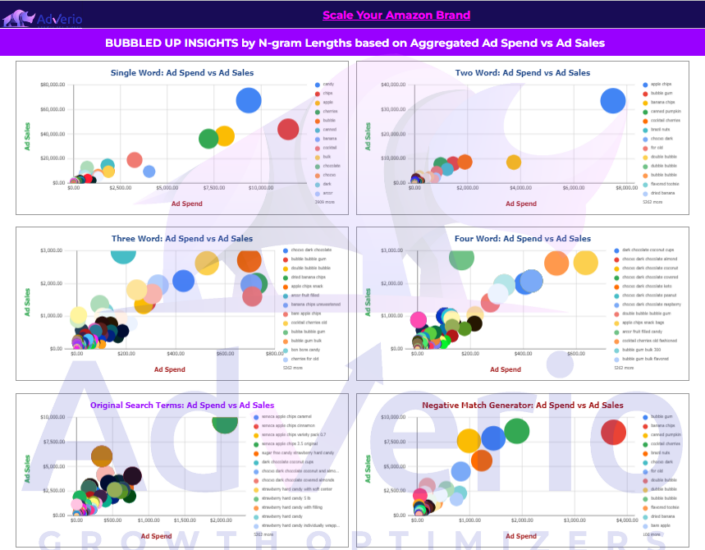
N-gram analysis is a method for breaking Amazon search-term reports into smaller word sequences (single words, pairs, triplets) and aggregating ad performance by those sequences. Instead of judging thousands of individual long-tail queries one at a time, you judge the underlying word stems that repeat across them. That lets you see which clusters of language are profitable and which are burning spend, then act in bulk with negatives and bid changes.
Why N-Gram Analysis Matters for Large Catalogs
Fragmentation is the problem. A brand with hundreds of children generates search terms so varied that no single query has enough spend to flag on its own. The waste is real, but it is spread across a thousand near-identical phrases. Row-by-row review can’t see it. Aggregation can.
N-gram analysis rolls that fragmentation back up. Ten thousand unique searches collapse into a few hundred meaningful word stems, ranked by spend, sales, and efficiency. Now the pattern is obvious: the trigram that looks harmless in any one row is bleeding four figures a month once you total it.
This is a reporting lever, not a strategy on its own. It shows you the truth about your search terms fast. What you do with that truth is where the strategy lives.
Use N-Grams to Kill Wasted Spend First
The cleanest win in most accounts is negation, and it’s the first thing to run.
What to do
- Pull your search-term report across Sponsored Products and Sponsored Brands.
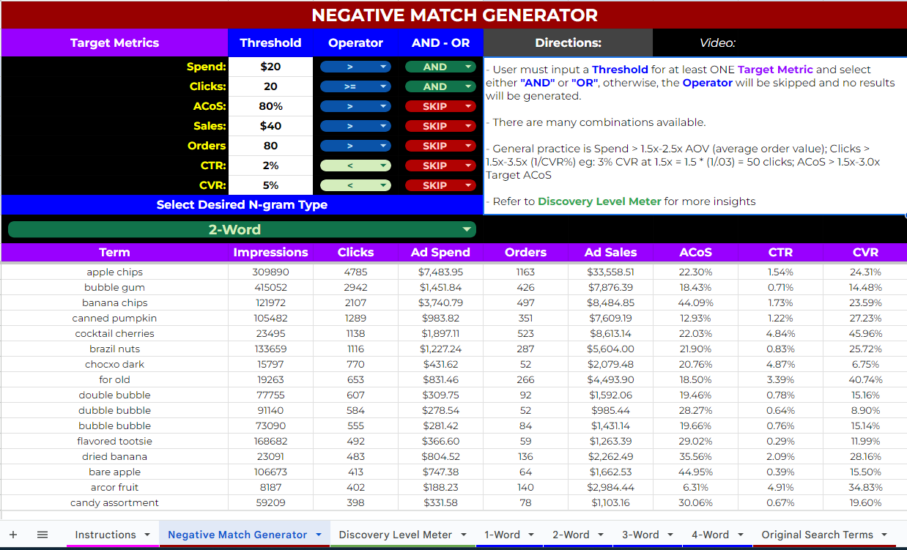
- Break it into unigrams, bigrams, and trigrams and aggregate spend, sales, and TACoS by stem.
- Rank the stems that carry spend with little or no attributed sales.
- Negate the losing clusters at phrase or exact level so you suppress the whole family of queries, not one at a time.
For example, if the trigram “fashion tank top” shows heavy spend and no conversions, a single phrase negation suppresses “blue fashion tank top,” “fashion tank top for men,” and every sibling in one move. That’s the leverage: one decision, hundreds of wasteful impressions gone.
What to avoid
- Negating a stem before checking whether the loss is a listing problem, not a targeting problem. A high-spend, zero-sale cluster on a broken PDP is a conversion failure wearing a PPC costume.
- Cutting a stem that carries branded or defensive intent you actually want to hold.
- Treating one week of data as a verdict. Let the cluster accumulate enough spend to be real.
Adverio insight
A losing n-gram is a symptom, not a diagnosis. Before you negate, ask whether the click was wasted or whether the listing wasted the click. Same data, two very different owners.
This is where most cost-cutting stops too early. Pruning wasted clusters lowers spend, but if the underlying listing can’t convert, you’re optimizing a leak instead of closing it. The order matters: confirm the offer and PDP can convert, then run the Amazon PPC management strategy that trims spend around it.
Use the Winning Stems to Fix Conversion, Not Just Bids
Here’s the move most accounts miss. The profitable n-grams you find aren’t only a bid signal. They’re a conversion signal.
If your customers convert on “toboggan” and your listing says “beanie,” your ads are paying to bridge a gap your copy should have closed for free. The high-performing stems belong in your titles, bullets, and backend, so the listing earns organic relevance instead of renting it through PPC.
What to do
- Take your top-converting stems by region and category.
- Map them against your current title and bullet language.
- Rewrite listing copy so the winning vocabulary lives in the PDP, not just the campaign.
- Feed regional and dialect variants (“crock pot” for “slow cooker”) into copy and targeting where volume justifies it.
What to avoid
- Stuffing every winning stem into a title. Relevance beats keyword density, and Amazon’s semantic matching rewards clean, buyer-language copy over a wall of terms.
- Ignoring the organic side. If a stem converts in ads, it will usually convert organically once the listing carries it.
Adverio insight
Search-term data is a conversion asset, not just a bidding one. The words your buyers use should live in the listing first and the campaign second. That’s listing optimization for conversion doing what ads can’t.
Where N-Gram Analysis Fits in the Bigger System
N-gram analysis lives inside the traffic layer, and the traffic layer is downstream. Sequencing runs inventory, then conversion, then traffic, in that order. Reading your search terms brilliantly does nothing if the ASIN is stocking out or losing the Buy Box, and it does nothing if the PDP can’t convert the visitor once the ad delivers them.
That’s the difference between a tactic and a system. A tactic says “negate the losing trigrams.” A system asks whether the loss is a targeting problem, a conversion problem, or a supply problem before it spends a dollar deciding. Incrementality is the benchmark, not raw ROAS: cutting a cannibalistic branded stem might barely move sales while it lifts real profit, because those orders were coming anyway.
How Adverio Helps
Reading search-term data is easy. Knowing whether a losing cluster is a targeting waste, a broken listing, or a supply constraint is the hard part, and it’s where most accounts guess.
Adverio runs N-gram analysis as one input inside a conversion-first system, not a standalone hack. We check the constraint layer first, confirm the listing can convert the click, then prune and reallocate spend against incrementality and TACoS rather than vanity ROAS. The winning language flows back into the listing so you stop renting relevance you should own.
Want your search-term waste diagnosed as part of the full account, not in isolation? Explore our full Amazon account management system.
FAQs
What is the difference between a unigram, bigram, and trigram?
They’re all n-grams, just different lengths. A unigram is a single word (“beanie”), a bigram is a two-word sequence (“wool beanie”), and a trigram is three words (“black wool beanie”). Aggregating your Amazon search terms by each length shows patterns that individual queries hide, which is what makes negation and copy decisions faster.
Does N-gram analysis lower ACoS or TACoS?
Both, but TACoS is the number that matters. Negating losing clusters cuts wasted ad spend, which lowers ACoS directly. Feeding winning stems into your listing lifts organic conversion, which lowers total ad cost as a share of total revenue over time. Chasing ACoS alone can hide the fact that your spend isn’t incremental.
How often should I run N-gram analysis on my account?
For a large catalog, a monthly aggregate pass catches most waste, with a lighter weekly check on high-spend campaigns. Running it daily on every campaign is usually over-segmentation. Let clusters accumulate enough spend to be a real signal before you act on them.
Should winning keywords go in my listing or just my campaigns?
Your listing first. If a word stem converts in ads, it will usually convert organically once your title and bullets carry it. Leaving winning buyer language out of the PDP means you’re paying through PPC for relevance you could own for free.
Can N-gram analysis fix a poorly converting listing?
No. It tells you where spend is being wasted, but a high-spend, zero-sale cluster on a broken listing is a conversion failure, not a targeting one. Fix the PDP and offer first, then use N-gram data to prune and reallocate the traffic around it.
Ready to See What Your Search-Term Data Is Really Telling You?
Most accounts are leaking profit inside search terms nobody has aggregated correctly. A forecast shows you the number.
Request Your Profit ROI Forecast
Read Next: Amazon PPC Management: Built for Incrementality, Not Just ACoS