


Table of Contents
The worst advice on Amazon IP complaints is “appeal immediately.”
That’s how brands turn a bad day into a long suppression. Amazon acts first. Your listing disappears, your spend gets distorted, and your team starts guessing. If you respond before you diagnose the complaint, you can hand Amazon the wrong documents, hand the complainant a better record, and hand your competitor free market share.
An Amazon IP complaint is not just a legal issue. It’s a commercial triage problem. The first 24 hours decide how fast you recover revenue.
15-minute diagnostic call. No pitch deck.
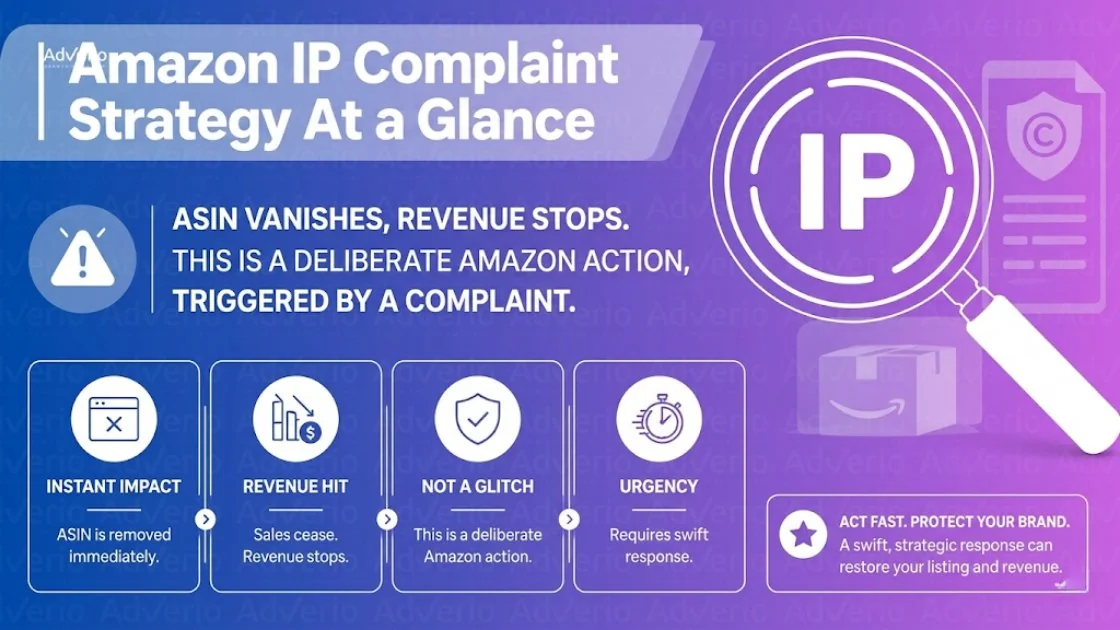
Amazon IP Complaint Strategy At a Glance
An Amazon IP complaint can suppress an ASIN before anyone seriously checks whether the claim is right. That’s the reality.
Your job in the first day is simple. Identify the complaint type, choose the right resolution path, and avoid a rushed response that creates more damage. Weak appeals waste time. Focused evidence wins faster.
-
Amazon acts first: Your ASIN can disappear before the dispute is sorted.
-
Not every complaint deserves an instant appeal: If the claim has merit, a rushed denial can backfire.
-
There are three core complaint types: Trademark, copyright, and patent.
-
There are three practical resolution paths: Counter-notice, complaint retraction, or license submission.
-
This is an account-health issue and an operations issue: Legal, catalog, and media teams need one workflow.
-

Amazon ip complaint strategy: protect your listings 25
If your team treats this like a support ticket, you’ll move too slowly. If your listing content is sloppy, your risk goes up. That’s one reason brands that need to fix their Amazon listings should also tighten compliance controls before the next complaint arrives.
| What matters first | Why it matters |
|---|---|
| Complaint type | It determines the evidence Amazon will care about |
| Rights owner details | You may need direct retraction or verification |
| ASINs and marketplaces | Scope tells you how big the revenue hit is |
| Response discipline | Emotional appeals create bad records |
A good Amazon IP complaint strategy is boring on purpose. Calm tone. Exact evidence. No extra story.
How Amazon Handles IP Complaints in 2026
Amazon’s system is built to reduce Amazon’s risk, not yours. Rights owners can file complaints through Amazon tools, and the platform can suppress listings before the seller gets a meaningful review window. That’s why brands experience the process as guilty first, explanation later.
Scale matters here. Amazon identified, seized, and appropriately disposed of more than 15 million counterfeit products worldwide in 2024, according to Amazon’s 2024 Brand Protection Report.
That’s the operating environment you’re in. Preventive controls and fast response are revenue protection, not admin work, according to Amazon’s 2024 Brand Protection Report.
This also explains why weak documentation hurts. Amazon’s own seller guidance emphasizes buying only from authorized sources and keeping invoices and written authorization. Informal receipts won’t save you when an ASIN is down.
A lot of brands understand storefront design but ignore compliance. That’s a mistake. Your creative, copy, brand field usage, and content ownership all need rules. If that area is loose, start with a guide to Amazon Storefront compliance.
What Amazon is really optimizing for
Amazon wants fewer risky listings live on the marketplace. That means speed favors the complainant at the beginning.
So stop expecting a fairness-first process. Build a response-first process inside your own team.
-
Capture the notice immediately: Save the performance notification, ASIN, complaint category, and rights owner.
-
Limit the evidence to what matters: Trademark proof, license proof, or invoices showing authorized sourcing.
-
Protect account health: Repeat IP complaints can trigger broader enforcement. Solve the issue, then build out an Amazon brand protection strategy to reduce future risk.
The Three Types of IP Complaints and What Each Requires
Using the wrong response on the wrong complaint type is amateur hour. Amazon doesn’t care that your team worked hard. It cares whether the documents match the allegation.
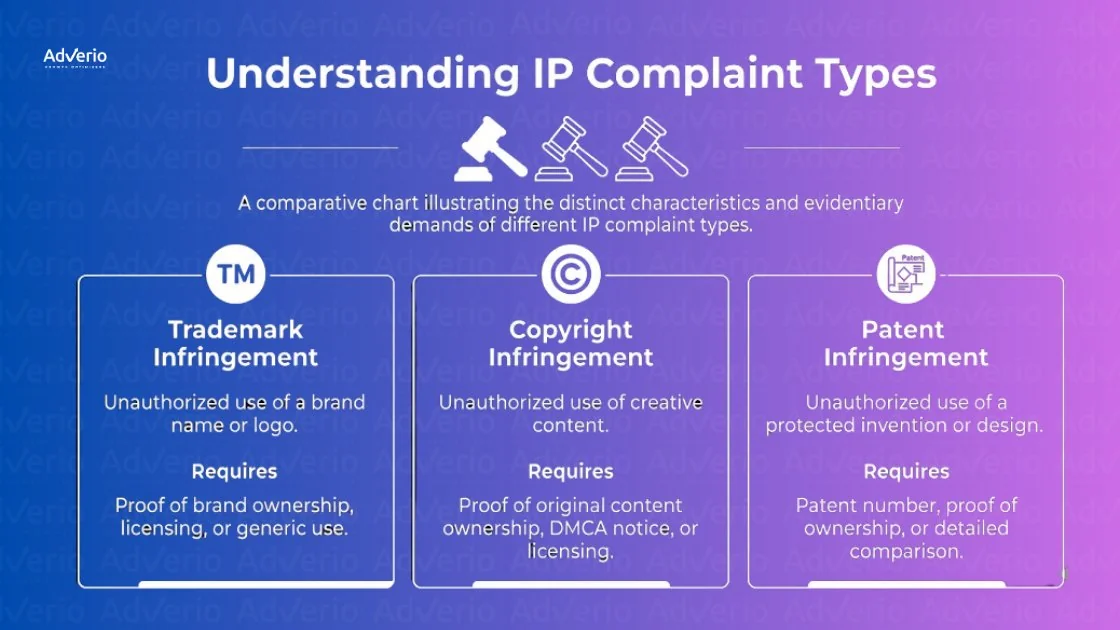
Type 1 Trademark infringement
This usually shows up when a complainant says you used their registered mark where you shouldn’t have. Common flashpoints are the title, bullets, images, packaging references, or the brand name field.
Your response is straightforward. Either prove you have the right to use the mark, remove the offending use, or get the complainant to retract. For seller responses, the practical evidence is usually trademark ownership proof, licensing proof, or invoices that support authorized sourcing when that’s relevant to the listing setup.
| Trigger | What Amazon will want | Immediate move |
|---|---|---|
| Brand name or logo use | Ownership or license proof | Remove risky content and assess retraction or submission path |
If your team stuffed a competitor trademark into copy or imagery, don’t pretend this is a documentation problem. It’s a content problem first.
Type 2 Copyright infringement
This is about creative assets. Product images, A+ content, bullet copy, comparison charts, packaging art, and sometimes product design elements presented as expressive works can all trigger it.
If you copied images from a manufacturer, scraped text from another listing, or reused a creative your vendor doesn’t own, fix that now. Copyright complaints are often resolved by proving original authorship, showing permission, or replacing the disputed content entirely.
For teams using generated assets, ownership gets murkier fast. If your internal process relies on AI-assisted creative, you should understand the current debate around intellectual property for AI content before a complaint forces that conversation.
Practical rule: If you can’t prove who created the asset, when it was created, and who had rights to use it, don’t build your defense around that asset.
Type 3 Patent complaint
This is the one brands mishandle most. Patent disputes are not a copy swap. You can’t fix a patent claim by changing bullets and hoping Amazon forgets.
A patent complaint alleges that the product itself infringes. That can involve utility or design issues. Your options are narrower here. You may need a license, a technical non-infringement position, a stronger invalidity argument handled by counsel, or removal of the product from sale while risk is assessed.
| Complaint type | Best evidence | Bad response |
|---|---|---|
| Trademark | Mark ownership, license, authorized sourcing records | Sending generic supplier emails |
| Copyright | Original files, permissions, proof of authorship | Arguing without replacing copied content |
| Patent | License or counsel-backed product analysis | Treating it like a listing edit issue |
Patent complaints are where operators lose time by trying to “Amazon support” their way through a product-level dispute. Don’t.
The Three Resolution Paths
Once you know the complaint type, pick the path. Don’t mix all three at once unless the facts support that. Scattershot responses look weak.
Amazon complaint strategy starts with immediate evidence collection. Capture the performance notification, ASIN, complaint category, and rights owner details, then respond in Seller Central with only the critical documentation that matters, such as trademark proof, licensing agreements, or invoices showing authorized sourcing, as outlined in Traverse Legal’s guidance on Amazon IP complaints.
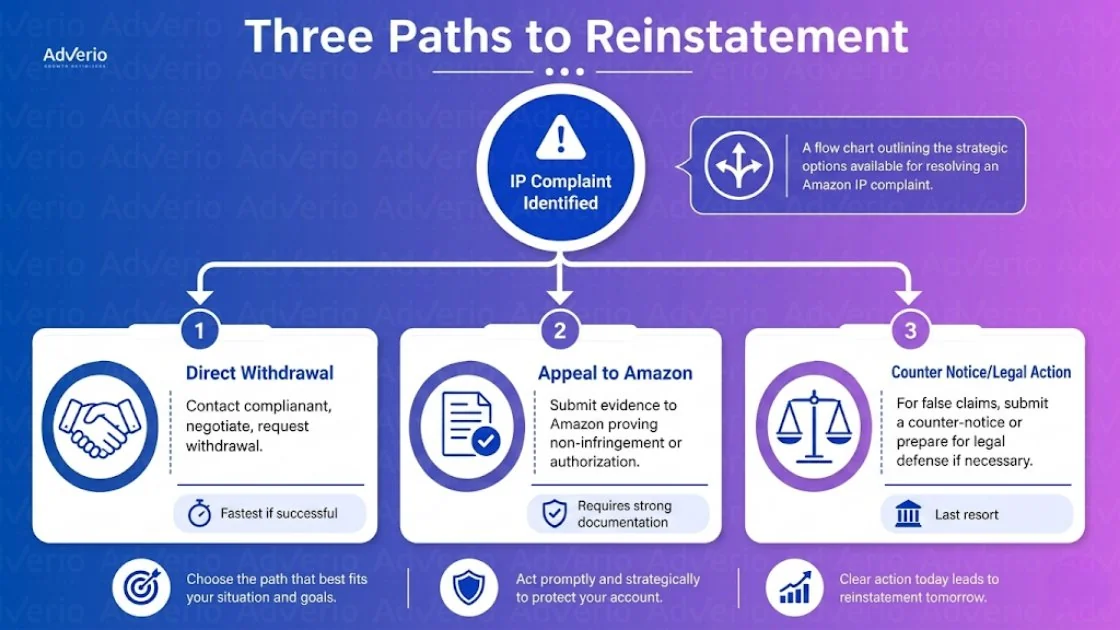
Path 1 Counter-notice when the complaint is unjustified
Use this when the complaint is wrong and you can prove it cleanly. Not emotionally. Not with a manifesto. With documents.
Your counter-notice should match the allegation exactly. If the complaint says trademark misuse, submit rights or authorization evidence. If it says copyright misuse, submit authorship or permission evidence. If it says patent, be careful. That often needs counsel before you file anything aggressive.
Path 2 Complaint retraction when direct resolution is faster
Sometimes the fastest path is not fighting Amazon. It’s getting the complainant to withdraw.
This works best when the complaint was filed in error, filed too broadly, or filed as pressure. Contact the complainant with a tight factual summary and the exact proof that resolves the issue. Ask for retraction, not a debate.
Path 3 License submission if you have rights
If you hold a valid license, submit it. Don’t bury Amazon in extra background. Give them the operative agreement or authorization that answers the complaint.
If your account is already under stress, pair this with process cleanup. Adverio’s Amazon suspension advice is relevant when a single complaint starts looking like a broader account-health problem.
How to Identify Abusive IP Complaints
Not every complaint is legitimate. Some are just competitive sabotage dressed up as compliance.
The tell is usually the pattern, not one dramatic detail. A complaint appears at a high-value sales moment. The complainant is suspiciously close to your product category. The claim doesn’t line up with your actual listing content. Then the complaint gets pulled back fast when you push back with real evidence.
Red flags worth documenting
-
Timing looks strategic: peak events, major promos, and high-traffic weekends are frequently cited as pressure points for abusive complaints, according to Traverse Legal’s guidance on Amazon IP complaint patterns.
-
The complainant is a direct competitor: Especially when the complaint seems disconnected from your actual content.
-
The claim is mismatched: The rights asserted don’t fit what’s on the listing or product page.
-
Retraction comes quickly after resistance: That often signals the goal was disruption, not a real IP dispute.
Save the complainant’s contact information from every IP complaint you receive, even if you resolve it fast. Repeat filers tend to repeat the playbook.
When you see a pattern, document every notice, ASIN, date, marketplace, and communication trail. That record helps with abuse reporting and gives your legal team something useful if the behavior continues.
The First 24 Hours Exactly What to Do
The smartest move is often to pause before you appeal. One legal source warns sellers to assess whether the complaint has merit and avoid a rushed response that can lock in an admission or create worse evidence for repeat complaints. It also frames this as an operational discipline, not just a legal one, in Appellate Law Group’s discussion of Amazon IP complaint response.
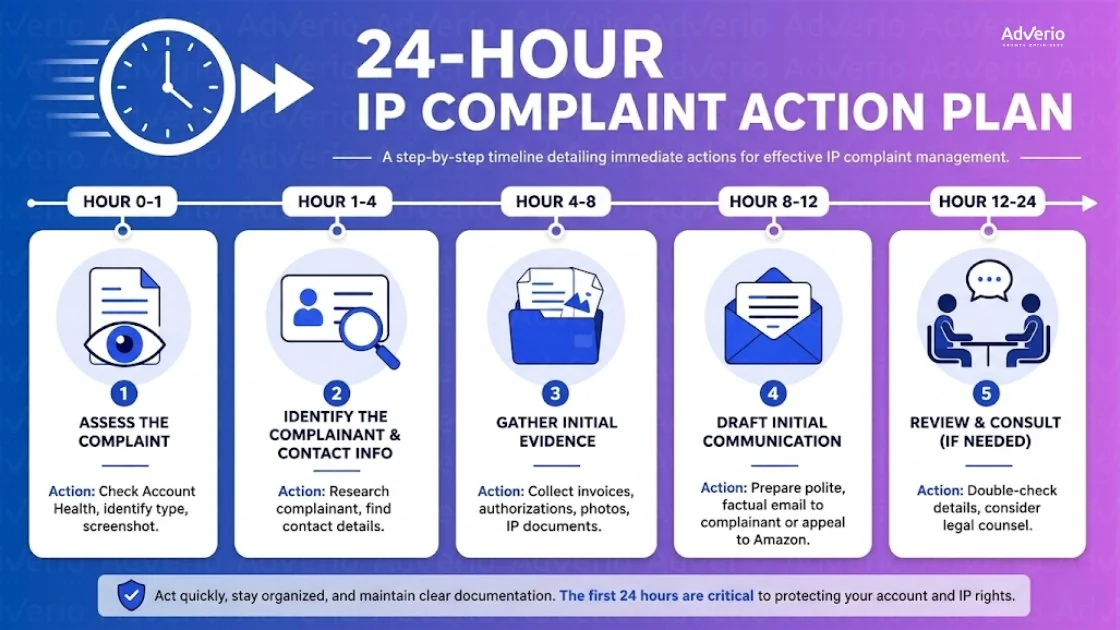
Hour 1 to 2
Open Account Health. Pull the exact complaint. Save screenshots. Identify the ASIN, rights owner, marketplace, complaint category, and any deadline language.
Hour 2 to 4
Decide whether the complaint has merit. Then choose the path. Counter-notice, retraction, or license submission.
Hour 4 to 8
Execute one path hard.
-
Retraction path: Contact the complainant with a short factual request and proof.
-
Counter-notice path: Draft a precise submission with matching evidence.
-
License path: Compile the authorization documents and submit through Seller Central.
| Time window | Action | Outcome you want |
|---|---|---|
| Hour 1 to 2 | Capture notice details | Clean case file |
| Hour 2 to 4 | Assess merit and choose path | No wasted motion |
| Hour 4 to 8 | Submit or contact complainant | Active resolution |
| Hour 8 to 24 | Follow up and prepare escalation | Faster recovery or clean legal handoff |
Hour 8 to 24
Follow up. If the complainant doesn’t retract and your evidence is strong, push the formal route. If this is patent-related, escalate to counsel sooner, not later.
If your listing is also suppressed from the complaint fallout, review Adverio’s suppressed listing fix and tighten your response package before sending another weak appeal.
15-minute diagnostic call. No pitch deck.
How Adverio Manages IP Complaint Response
For brands that can’t afford chaos, IP complaints need a system. The right workflow ties catalog, operations, and account health together, then pulls in counsel only when the facts demand it. That’s the difference between random firefighting and structured recovery.
If reputation spillover becomes part of the problem, brands handle external cleanup alongside the marketplace response. When you need a team to manage your Amazon account, protect margin, and keep platform risk from draining sales, that’s the system we run.
Book your ROI Forecast. 15-minute diagnostic call. No pitch deck.
Frequently Asked Questions
Should I always appeal an Amazon IP complaint right away?
No. First assess whether the complaint has merit. If the claim is valid, a rushed denial can make the record worse. Choose the right path before you submit anything.
What documents matter most in an Amazon IP complaint response?
Only the documents that match the allegation. That usually means trademark proof, licensing proof, permission records, proof of authorship, or invoices showing authorized sourcing. Extra paperwork slows review.
When should I contact the complainant directly?
When retraction is the fastest realistic path. This is common when the complaint appears mistaken, overbroad, or abusive. Keep the message factual and short.
When should legal counsel get involved?
Bring counsel in faster for patent complaints, repeat complaint patterns, or any situation where your response could create broader risk outside Amazon. Patent issues especially can move beyond listing operations quickly.
Can repeated IP complaints damage account health even if I resolve them?
Yes. Guidance cited earlier stresses that repeat IP hits can trigger broader enforcement, so the goal isn’t just fixing one complaint. It’s reducing the chance of the next one.
Read Next
An IP complaint is a revenue event, not a paperwork event. If your team needs a tighter response system, cleaner catalog controls, and stronger account operations on Amazon,
Book your ROI Forecast below. 15-minute diagnostic call. No pitch deck.