


Table of Contents
Every unresolved piece of amazon negative seller feedback is a silent margin leak—and Amazon is using it to decide whether you deserve the Buy Box. It sits there, affects how Amazon reads your account, and keeps doing damage long after your team has mentally moved on.
Most brands treat seller feedback like a support ticket. Amazon treats it like a performance signal. That’s a mistake. It’s an account health issue, a Buy Box issue, and a margin issue. If your team disputes everything—or ignores it—you’re either wasting time or bleeding profit. Usually both.
You need a triage system. Fast. Remove what Amazon allows. Respond to what stays. Fix the operational and listing failures that keep generating the same complaints.
At a glance
| Topic | What it means | Why it matters |
|---|---|---|
| Seller feedback | Buyer feedback about the transaction experience | Can affect account health, Buy Box eligibility, and seller metrics |
| Product reviews | Buyer feedback about the item itself | Affects ASIN conversion and shopper confidence |
| What Amazon may remove | Feedback that violates policy, including some product-review content or abusive content | Removal can stop avoidable damage |
| What Amazon usually won’t remove | Legitimate complaints tied to your service or order experience | You have to respond and then fix the root cause |
| What you control | Listing clarity, fulfillment reliability, customer communication, issue detection | Profit protection happens here |
Your Seller Feedback Score Is a Ticking Time Bomb
Every seller says the same thing when feedback starts slipping. “It’s only a few bad ratings.” That’s exactly how brands sleepwalk into suppressed Buy Box share and ugly account health conversations.

The backdrop is getting worse, not better. In the U.S., customer satisfaction with Amazon marketplace sellers fell to 84.7% positive experiences in early 2025 from 92.1% in 2020, and Amazon then made the problem harder to manage by introducing star-only seller feedback ratings on August 4, 2025, which can’t be appealed through the standard Feedback Manager, according to Marketplace Pulse’s reporting on Amazon’s seller feedback changes.
That means two things.
First, more brands are dealing with feedback pressure at the exact moment Amazon has reduced the context sellers used to rely on. Second, unresolved negatives don’t just annoy your customer service team. They distort how Amazon interprets your reliability.
The expensive mistake brands keep making
Most operators lump seller feedback and product reviews into the same bucket. They aren’t the same, and treating them that way creates slow, expensive decisions.
A product review problem belongs to listing quality, merchandising, and product truth. A seller feedback problem touches fulfillment, customer expectations, and account health. Different signal. Different consequence. Different response path.
Practical rule: If your team doesn’t know whether a low-star comment belongs to the ASIN or the seller account, you’re already late.
This is why smart brands stop treating feedback as a fire to put out and start treating it as an operating signal to manage. That’s the difference between reactive cleanup and disciplined marketplace control.
If your internal team is stretched thin, this is usually where specialist Amazon account management companies earn their keep. Somebody needs to own the signal before it starts owning your margins.
Seller Feedback vs Product Reviews: Why Confusing Them Costs You Money
Confusing seller feedback with product reviews is one of the dumbest avoidable mistakes on Amazon. It causes bad escalation, wasted appeal attempts, and missed root causes.
This is seller feedback
Seller feedback is about the transaction.
Think shipping speed, packaging, order handling, communication, and the overall buying experience. Amazon reads this as a seller-performance signal.
If the complaint says the order arrived late, the box was damaged, or support was unhelpful, you’re in seller feedback territory.
This is product review territory
Product reviews are about the item itself.
Think fit, durability, taste, sizing, material quality, compatibility, performance, or whether the product matches the promise. Amazon reads this as an ASIN-level conversion signal.
If the complaint says the fabric feels cheap or the part doesn’t fit, that belongs with the product, not the seller.
Where the mess starts
Buyers routinely put product complaints into seller feedback. Sellers have complained that negative product-related feedback appears almost exclusively under seller feedback while positive comments land under product reviews, and that confusion can push down metrics like Order Defect Rate and hurt Buy Box eligibility, as reflected in this Amazon Seller Central forum discussion about feedback routing confusion.
Here’s how operators separate it:
| If the buyer is complaining about… | It should be treated as… | The business impact lands on… |
|---|---|---|
| Delivery, packaging, support, fulfillment | Seller feedback | Account health and seller performance |
| Quality, fit, function, features, defects | Product review | Listing conversion and ASIN performance |
Why this distinction matters financially
When your team disputes a legitimate product review as if it’s seller feedback, nothing happens. When your team ignores a transaction issue because they think it’s “just a review problem,” the account absorbs the hit.
That confusion also slows root-cause fixes. A product mismatch should trigger listing revisions. A shipping complaint should trigger ops review. A packaging complaint should trigger packaging changes. If you send all of it to one generic “reputation” bucket, nobody fixes the actual problem.
The wrong diagnosis is often more expensive than the negative feedback itself.
This is also why brands need a removal process tied to policy, not emotion. If your team needs help sorting removable comments from noise, a focused how to remove Amazon seller feedback the right way workflow can keep everyone from chasing the wrong targets.
The Removal Rules What Amazon Will and Won’t Delete
Amazon’s feedback removal system is binary. Your opinion doesn’t matter. Policy fit does.
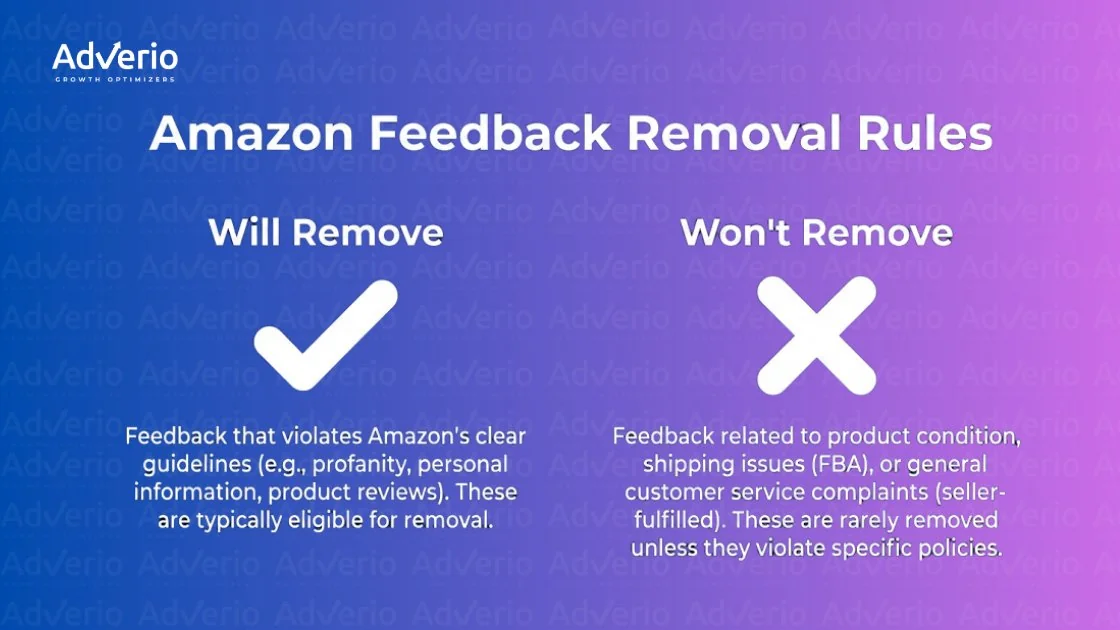
The 2025 change made this worse. Amazon’s shift to star-only ratings on August 4, 2025 removed the standard Feedback Manager appeal path for certain negative entries and pushed sellers into a narrower “Report a violation” process, which makes unfair ratings harder to challenge when no written context exists, as explained in Seller Labs’ overview of seller feedback vs product reviews in 2025.
The fast decision filter
Ask three questions the moment feedback lands:
-
Does it clearly violate policy?
-
Is it a product review posted in the wrong place?
-
Is there enough written context to challenge it through the available process?
If the answer to all three is no, don’t waste hours trying to force a removal that isn’t coming.
Amazon Seller Feedback Removal Eligibility
| Feedback Content | Eligible for Removal? | Reason |
|---|---|---|
| Profanity, abusive language, or personal information | Usually yes | Violates Amazon content standards |
| A comment that is clearly about the product, not the seller | Often yes | Misplaced product review content |
| Written feedback that violates policy and fits Amazon’s stated criteria | Potentially | Can be reviewed through Amazon’s processes |
| Star-only negative rating with no written context | Rarely | Standard Feedback Manager appeal path is unavailable |
| Legitimate complaint about your seller-fulfilled shipping or service | Usually no | Amazon generally treats it as valid seller feedback |
| Complaint that the item wasn’t as expected | Usually no | Amazon may treat this as a buyer experience issue unless it clearly belongs elsewhere |
| General dissatisfaction without policy violation | No | Not a removal case |
What brands should stop doing immediately
Stop arguing fairness. Amazon doesn’t remove feedback because you think it’s unfair. It removes feedback when it violates policy.
Stop escalating everything manually. If your team sends support requests on every negative, they create busywork and still leave the root causes untouched.
Stop waiting for a pattern. If something is removable, act right away. Delay doesn’t improve your odds.
What brands should do instead
Use a triage workflow.
-
Flag obvious policy violations first because they have the clearest removal path.
-
Separate written negatives from star-only ratings because the response options differ.
-
Log the reason category internally so operations, catalog, and CX can see what keeps repeating.
-
Escalate only when the content fits Amazon’s rules.
If the feedback doesn’t fit Amazon’s deletion criteria, your job shifts from removal to damage control and prevention.
That distinction matters. Teams that don’t understand it burn time on low-probability appeals while late shipments, bad packaging, and misleading listings continue to generate fresh negatives.
If you want a cleaner operational workflow for valid removals, this guide on how to remove negative feedback on Amazon is the right place to standardize the process.
The Proactive Playbook: Respond, Dispute, Prevent
You don’t solve amazon negative seller feedback by obsessing over the comment itself. You solve it by controlling the next move. Then the next system. Then the root cause.

The stakes are real. One feedback spike caused a 2-point CVR drop, 55% revenue loss, and 2.5 ROAS deterioration. That’s not reputation—that’s profit destruction. The same source says mismatched listing details cause 30% of negatives and recommends keeping on-time shipping above 99%, according to SellerApp’s breakdown of feedback impact and mitigation steps.
Respond first
Public responses won’t erase the rating, but they can reduce the damage. They show future buyers that you aren’t hiding and that your operation has standards.
Keep responses short. Don’t fight the customer in public. Don’t write a legal defense. Don’t sound robotic.
Use a structure like this:
-
Acknowledge the issue in plain language.
-
State the corrective action you took or are taking.
-
Offer a clean resolution path if the buyer wants to continue the conversation through approved channels.
Example:
We’re sorry this order didn’t meet expectations. We’ve reviewed the issue and are addressing the process behind it. If you’d like further help, please contact us through Amazon buyer-seller messaging so we can assist within Amazon’s guidelines.
That response does three jobs. It signals professionalism. It lowers perceived risk for the next buyer. It gives your team a record of response discipline.
If your customer service staff needs sharper language and de-escalation patterns, these tactics to handle an upset customer are useful because they focus on calming the interaction before it turns into a wider reputation problem.
Dispute what qualifies
This is the part most brands bungle. They either don’t dispute eligible feedback, or they dispute everything.
Use a simple workflow:
Check the content type
Look for policy triggers. Is it abusive. Does it expose personal information. Is it obviously a product review in the wrong place. If yes, move fast.
Use the correct path
Written feedback and star-only ratings aren’t handled the same way anymore. If the comment is star-only, your options are narrower. That means your internal logging becomes more important because Amazon has removed some of the context you used to rely on.
Document internally
Take a screenshot. Save the order details. Tag the issue type. Note whether it appears tied to listing mismatch, fulfillment delay, packaging, or post-purchase service.
Your dispute process should produce usable ops intelligence, not just a support ticket.
Prevent the next one
This is where most of the money sits.
Most brands overinvest in reactive cleanup and underinvest in expectation control. That’s backwards. Negative feedback usually starts before the order ships.
Listing accuracy
If your images, titles, bullets, or variation setup create the wrong expectation, buyers punish the seller account when the experience disappoints them. Tighten claims. Remove ambiguity. Fix variation confusion. Use customer complaint language to identify mismatch points. This is where Amazon listing optimization services directly reduce negative feedback at the source.
Fulfillment discipline
Late delivery and weak packaging create feedback that your ads can’t outrun. If seller-fulfilled orders are sloppy, the account pays for it. Audit carrier performance, handling time settings, packaging integrity, and weekend processing gaps.
Customer communication
Silence creates anger. Buyers are more forgiving when they know what’s happening. Use approved communication carefully and only where it adds clarity, not clutter.
Root-cause categorization
Don’t just count negatives. Sort them. Transaction delay, damaged delivery, wrong item, confusing listing, unclear sizing, missing parts, service complaint. Once you categorize the complaint stream, you can fix the right system.
Monitoring cadence
Review feedback frequently enough that your team can act while the issue is still local, not after it becomes a trend. A feedback problem that sits untouched often shows up elsewhere, including returns, CX tickets, and conversion softness.
Treat every negative as a symptom first and a reputation issue second.
Most teams duct-tape this together with tools, spreadsheets, and Slack alerts—and still miss the pattern. A centralized system like an Amazon review checker helps you actually see what’s driving negative feedback before it compounds.
The True Cost Impact on Account Health and Buy Box Share
A weak seller feedback profile doesn’t just look bad—it directly limits revenue. It changes how Amazon allocates opportunity.

Amazon’s target Negative Feedback Rate is under 5%, and Order Defect Rate must stay below 1% to avoid penalties. Sellers who maintain those levels win the Buy Box 80% to 90% more often in competitive listings, according to this Seller Central forum analysis of feedback rate, ODR, and Buy Box outcomes.
That should end the debate right there. Seller feedback is not cosmetic.
Account health is the primary battlefield
Amazon uses seller-performance signals to decide who looks safe to shoppers. If your feedback issues feed into a weak ODR profile, Amazon has no incentive to reward you with visibility or Buy Box consistency.
And when Buy Box share slips, the damage spreads fast:
-
Your ads work harder for worse outcomes
-
Your conversion rate gets pressured
-
Your sales velocity softens
-
Your catalog loses momentum on listings that should be scaling
This is why brands often misdiagnose the problem. They look at rising ad inefficiency and start tweaking bids, campaigns, and placements. Meanwhile the primary drag sits at the seller-account layer.
Negative feedback leaks into paid media efficiency
PPC can’t compensate for broken trust signals. This is where Amazon PPC management services must align with listing quality and seller performance—not operate in isolation. If your listing is eligible to serve but your seller profile is weaker than the competing offer, you won’t capture the same value from your traffic.
That means the feedback issue becomes a profit issue even if media execution is solid.
A seller account with weak trust signals turns good traffic into expensive traffic.
Low-volume sellers get hit harder
Established brands launching new categories or accounts face a more brutal version of this problem. A small number of negatives can distort performance perception quickly because the account doesn’t have enough positive volume to absorb the hit.
That makes early monitoring and response discipline essential. One bad patch in the wrong period can drag down visibility just when the account needs momentum most.
If your team is losing placement due to trust and seller-metric pressure, this analysis of why you’re losing the Amazon Buy Box is worth reviewing before you blame pricing or ad structure alone.
The Adverio Engine From Damage Control to Dominance
Fixing feedback one case at a time is maintenance. It isn’t strategy.
The stronger move is to rebuild the systems that create negative feedback in the first place. That means tightening listing truth, identifying expectation gaps, reducing avoidable returns, and feeding complaint data back into catalog, operations, and paid media decisions.
Many agencies falter here. They treat reputation, catalog, and ads as separate workstreams. Amazon doesn’t. A poor listing promise creates the wrong sale. The wrong sale creates returns or complaints. Complaints weaken trust. Weak trust reduces conversion efficiency and marketplace visibility. It’s one chain.
Adverio approaches this through a connected operating model rather than isolated cleanup. Its Review Resilience Framework focuses on root cause keyword and content audits, post-purchase reseeding triggers, NCX improvement, and return reduction. The same framework ties 20% to 40% higher Listing Quality Score to lower negative feedback rates because fewer purchases are driven by mismatched expectations, and it cites Shinesty’s refund rate down 13% as a direct prevention proxy. Those are the right levers because they address expectation control, not just damage response.
What that looks like in practice
Listing quality as prevention
If a detail page oversells, confuses variant selection, or hides a limitation, the customer often punishes the seller experience even when the product itself is fine. Stronger content quality reduces bad-fit purchases.
Operational signal loops
Returns, NCX themes, and complaint keywords should feed back into packaging, fulfillment rules, and assortment decisions. If the same issue keeps appearing, the fix belongs upstream.
Paid media alignment
Driving more traffic to a weak listing or to an offer with fragile seller trust just scales waste. Media should support profitable velocity, not hide structural problems for a few weeks.
Done-for-you or done-with-you
Some brands need full execution. Others have capable internal teams but need a sharper operating system, cleaner diagnostics, and a more disciplined escalation path. Both models can work if the ownership is clear and the data is connected.
What doesn’t work is the common middle ground. Nobody owns seller feedback. Nobody classifies the root causes. Everyone assumes someone else is handling it.
That’s how brands lose margin in silence.
How Adverio Fixes Seller Feedback at the System Level
Most teams treat feedback as a support issue. We treat it as a system failure across listings, operations, and media.
Adverio identifies where feedback originates—listing mismatch, fulfillment breakdown, or expectation gaps—and fixes the upstream constraint so it doesn’t repeat.
Explore Amazon Account Management Services
Frequently Asked Questions
Can Amazon remove negative seller feedback automatically
Sometimes. If the feedback clearly violates policy or fits a known removal category, Amazon may remove or strike it through. But plenty of negatives stay live, especially when they involve legitimate transaction complaints or star-only ratings with limited context.
Should you respond to feedback you can’t remove
Yes. A good public response won’t erase the rating, but it can reduce buyer hesitation and show operational maturity. Keep it brief, factual, and professional. Don’t argue in public.
Is seller feedback more important than product reviews
They matter in different ways. Product reviews influence ASIN-level conversion. Seller feedback hits the seller account itself and can affect account health and Buy Box competitiveness. If you’re thinking like an operator, seller feedback often carries broader operational risk.
What causes the most avoidable negative feedback
Listing mismatch and fulfillment problems are the biggest repeat offenders in most accounts. When the promise is unclear or the delivery experience breaks down, buyers don’t care which internal team caused it. They leave a negative signal.
Can FBA sellers still get hurt by negative seller feedback
Yes. Sellers have long complained that customers blame them for fulfillment problems that sit outside their direct control. That issue becomes even harder to untangle when ratings arrive without written context.
How often should your team check seller feedback
Frequently enough to catch issues before they become patterns. If you only review feedback occasionally, you lose the chance to connect it to recent shipment delays, listing changes, return spikes, or CX breakdowns.
What’s the right internal owner for seller feedback
Not just customer service. Seller feedback sits at the intersection of account health, operations, catalog, and conversion. One person can manage the queue, but the fixes usually require cross-functional ownership.
When should you get outside help
When feedback issues are affecting Buy Box share, account health, ad efficiency, or launch momentum. At that point, you don’t need another support ticket process. You need a tighter operating model.
If seller feedback isn’t actively managed in your account, you’re leaking margin every day. Adverio connects feedback, listings, operations, and media into one profit system.
Book your ROI Forecast to see exactly where feedback is costing you revenue.