


Table of Contents
A profit-first framework to align pricing and PPC so every click drives real margin—not wasted spend.
If your Amazon PPC and pricing aren’t aligned, you’re not scaling—you’re leaking profit.
Most 7- and 8-figure brands don’t have a traffic problem. They have a profit coordination problem between ads, pricing, and margins.
This guide breaks down how to connect those levers—so every click, bid, and price change actually drives incremental profit, not just revenue.
Book Your ROI Forecast and see where your margin is actually being lost.
The Profit Blind Spot Most Amazon Sellers Overlook

Too many brands get stuck in what we call Optimization Myopia. They obsess over one metric at a time—chasing a lower ACoS, pushing for more sales, or winning a price war—while their actual profits flatline or disappear.
This fractured approach is the number one reason brands doing millions in revenue still can’t turn a healthy profit.
They treat their ad campaigns and pricing as totally separate jobs, often managed by different people with competing goals. The PPC team bids hard to drive traffic, while the pricing team slashes prices to win the Buy Box. The result? A race to the bottom where your margins are the first casualty.
Breaking the Silos for Strategic Growth
Dominant brands on Amazon operate differently. They know that every pricing decision directly impacts how much they can afford to spend on ads, and every ad click has to be measured against real profit.
The core idea is simple but powerful: your product’s price sets the absolute ceiling for how much you can profitably spend on ads. A higher price with a good margin gives you more fuel to bid aggressively and grab market share without bleeding cash.
When you align these two functions, you turn competing cost centers into a single growth engine. This is a common profit blind spot because many sellers haven’t dug into the real mechanics of their ad spend. Getting clear on this starts with understanding performance marketing principles and applying them to every dollar.
Instead of asking, “How do we lower our ACoS?” the real question is, “How can we price our products to fund a PPC strategy that drives the most profitable growth?”
This guide gives you a clear, actionable way to connect these two critical levers. We’ll show you how to stop guessing and build a data-driven system where every decision serves one ultimate goal: maximizing your net profit.
The Core Formula Syncing Your Price to Your PPC Bid

Let’s cut through the noise. Syncing your pricing and PPC strategy isn’t about guesswork; it’s about cold, hard math. The relationship is direct and unforgiving: your product’s retail price dictates the absolute maximum you can profitably bid for a click.
Understanding this link is the first step toward building a profitable growth engine.
The Math Behind a Profitable Bid
At its heart, your starting PPC bid comes down to a simple calculation based on three key variables. This formula strips away the complexity and reveals exactly how your price empowers your ad spend.
Starting Bid = (Product Price x Target ACoS x Conversion Rate)
This is your baseline. Ignore it, and you’re guessing. It forces you to connect your desired advertising efficiency (Target ACoS) and your listing’s performance (Conversion Rate)—which is directly impacted by Amazon listing optimization—back to your pricing decision.
Here’s what this actually looks like in practice.
Example 1: The Standard Approach
Imagine you’re selling a product for $40. You’ve determined a healthy, profitable Target ACoS is 25%, and your historical data shows your listing converts at a solid 10%.
- Calculation: ($40 Price x 0.25 Target ACoS x 0.10 CVR) = $1.00 Max CPC
This tells you that you can bid up to $1.00 per click and, on average, stay within your profit target. It takes 10 clicks to land one $40 sale, costing you $10 in ad spend—exactly 25% of the revenue. That’s a solid, sustainable position.
But what if you need to get more aggressive to capture market share?
How a Price Change Unlocks Aggressive Growth
Now, let’s see what happens when you strategically adjust your price. After analyzing the market and your margins, you decide you can raise the price to $50 without a significant hit to your conversion rate.
Example 2: The Growth-Focused Approach
The variables have changed, giving you more firepower.
- Calculation: ($50 Price x 0.25 Target ACoS x 0.10 CVR) = $1.25 Max CPC
That extra $10 in your retail price just handed you a 25% increase in your maximum profitable bid. This isn’t a small tweak; it’s a strategic game-changer. That extra $0.25 per click allows you to outbid competitors for top-of-search placements, fund more aggressive campaigns, and accelerate growth without sacrificing an ounce of your target margin.
This is how profitable Amazon PPC bidding actually works in practice. In competitive categories where average CPC has hit $1.04—a 15-30% rise in some niches—that extra bidding power is crucial. If your target ACoS was 50% on that $40 item, your bid would be $2.00. At $50, it jumps to $2.50, giving you the fuel to compete.
This is the point where you stop reacting to the market and start shaping it. But remember, this calculation is only as strong as your understanding of each product’s unique financial profile. To truly master this, you have to start by break down SKU-level profitability on Amazon to get a crystal-clear picture of your true margins and profitability levers.
Strategic Pricing Models for Every PPC Objective
A one-size-fits-all approach to pricing and PPC is a fast track to burning cash. Once you nail down the core formula, you have to move from theory to action by tailoring your strategy to specific business goals. You simply can’t use the same pricing logic for a new product launch that you use for a mature, high-margin cash cow.
Smart brands deploy different pricing models based on what they’re trying to accomplish. Each objective demands a unique mix of price, ad spend, and desired outcome. This is how you stop chasing ACoS and start driving goal-oriented growth.
The Launch and Rank Model
When you’re launching a new product, immediate profit isn’t the goal—sales velocity and keyword ranking are. The ‘Launch & Rank’ model is built for exactly that. It leverages a lower, more aggressive initial price point to fuel sky-high conversion rates.
This high conversion rate sends a massive signal to Amazon’s A9 algorithm that shoppers love your product for its target keywords.
Here’s how price and PPC work together here:
- Lower Price: You set a competitive launch price, sometimes near your break-even point, to get those first critical sales.
- Aggressive PPC: This lower price makes an aggressive PPC campaign affordable. With a high conversion rate, your ACoS will naturally be lower, letting you bid heavily on top-of-search placements to drive a flood of traffic.
- The Flywheel Effect: The PPC traffic hits a high-converting, competitively priced listing, and sales pour in. This sales velocity helps your product climb the organic rankings faster than it ever could with a premium price.
Once you’ve locked in a strong organic rank, you can start inching your price up to a healthier, more profitable level.
The Profit Maximizer Model
For established products with strong brand recognition and a solid sales history, the game changes. You’re no longer fighting for rank; you’re focused on maximizing net profit. This is where the ‘Profit Maximizer’ model shines.
This strategy involves setting a premium price, which protects your margins and gives you more cash to pour back into your advertising.
A higher price doesn’t just increase your profit per sale; it gives you a larger war chest for your PPC campaigns. It’s the fuel that allows you to fund aggressive top-of-funnel Amazon DSP campaigns or defend your position against new competitors without wrecking your bottom line.
This model is perfect for best-sellers where you already own significant organic real estate. Your higher price point can support a higher ACoS, enabling you to invest in broader awareness campaigns that feed your entire sales funnel. To dial this in, you need a clear profit-first Amazon pricing strategy framework by balancing your market position with your profit goals.
The Competitor Knockout Model
Sometimes, the mission is pure market share. The ‘Competitor Knockout’ model is a tactical strike that uses competitive price data to justify aggressive bids directly on competitor ASINs and branded keywords.
This isn’t a broad campaign; it’s a surgical strike. You pinpoint a key competitor’s product, strategically price yours just a bit better (or add a coupon for better perceived value), and then dump a significant chunk of your PPC budget into Sponsored Products ads that target their listing.
The logic is simple: you’re using your price as the hook and your PPC ad as the delivery system to steal sales right from under your rival’s nose. This works even better when paired with a structured Amazon promotions strategy without killing margin that increases perceived value without eroding profitability. This is especially potent during high-traffic events like Prime Day or Black Friday, when shoppers are actively comparing prices using coupons vs lightning deals vs best deals on Amazon to determine the best offer. It’s a bold move that, when done right, can permanently shift market share in your favor.
This only works if your pricing is governed—not reactive. That’s where a dynamic pricing strategy that adapts to market conditions stops being optional—and becomes a competitive advantage.
Using the 2.5 Percent Rule to Guide Profitability
You can drown in formulas trying to manage Amazon bids, but in the real world, you need a quick gut check—a simple guardrail to stop you from bleeding profit on bad bids before the data even catches up.
That’s where the 2.5 Percent Rule comes in. It’s a dead-simple benchmark we use to keep Cost-Per-Click (CPC) bids tethered to a product’s actual price, forcing every campaign to start on a profitable footing. It cuts through the noise and gives you an instant sanity check on your bidding strategy.
The rule is simple: your target CPC should be about 2.5% of your product’s retail price. This isn’t a number pulled out of thin air; it’s a calculated starting point based on real-world Amazon averages.
The Math Behind This Strategic Guardrail
So, why 2.5%? It’s all about reverse-engineering profitability from typical Amazon conversion rates. If you can maintain a healthy Advertising Cost of Sales (ACoS) around 25% and hit an average conversion rate, this rule keeps your spend in the black.
Let’s walk through a quick example:
- Product Price: $30.00
- Applying the Rule: $30.00 x 0.025 = $0.75
- Resulting Target CPC: $0.75
For a $30 product, this tells you that bidding around $0.75 per click is a sustainable starting point. It’s the kind of discipline that prevents you from getting sucked into a bidding war where you’re suddenly paying $1.50 for a click on a product that can’t possibly support it.
How the Rule Protects Your Margins
The core idea is tying your ad spend directly to your pricing strategy. The 2.5% Rule acts as this bridge. It’s built on the back of empirical data showing that average Amazon conversion rates (CVR) hover around 9-10%, and a sustainable ACoS is roughly 25%.
Do the math: if it takes 10 clicks to get one sale (a 10% CVR), and you’re paying $0.75 per click for your $30 product, your total ad cost for that one sale is $7.50. What’s $7.50 of a $30 sale? Exactly 25% ACoS. Your margins are protected from the very first bid. If you want to go deeper on the numbers, you can discover more insights about Amazon advertising costs.
But this isn’t about setting your bids on autopilot. It’s about establishing a disciplined, data-driven starting line for every single product in your catalog.
Think of the 2.5% Rule as the governor on an engine. It doesn’t stop you from accelerating, but it prevents you from redlining your budget and blowing up your profitability. It forces you to ask the right question: “Based on this product’s price, what is a sensible amount to pay for a customer’s attention?”
Of course, this is a benchmark, not an unbreakable law. Have a product with an unusually high conversion rate or fantastic margins? You can absolutely justify pushing that CPC higher. On the flip side, for a low-margin SKU, you might need a more conservative 1.5% or 2% rule to stay profitable.
The key is to use this as your strategic baseline. Start here, then tweak and optimize based on the unique performance of each product. It’s the first step in moving from just managing bids to building a truly profit-driven advertising strategy.
Putting Your Integrated PPC and Pricing Flywheel Into Action
Theory is useless without action. Shifting from siloed tactics to a unified strategy means building a dynamic pricing system that protects margin while scaling your PPC. It’s about building a repeatable system that turns your PPC and pricing into a powerful, self-reinforcing growth engine.
This is exactly how our Growth Cultivator framework operates. It’s a structured way to move from guesswork to a data-driven system where every decision is intentional and every result is measurable. Stop reacting to the market—this is how you start to command it.
Step 1: Strategic SKU Segmentation
First: stop treating your entire catalog as one monolithic entity. Your high-margin hero product and a low-margin clearance item need completely different playbooks. The initial step is to break down your SKUs based on their specific role and financial profile.
Group your products into logical cohorts:
- By Lifecycle Stage: New launches, established best-sellers, and end-of-life products.
- By Business Goal: SKUs you’re trying to rank, maximize profit on, or use to steal market share.
- By Margin Profile: High-margin workhorses vs. low-margin volume drivers.
This segmentation creates the clarity you need for the next step. You can’t set effective rules if you’re applying a one-size-fits-all strategy to products with wildly different goals.
Step 2: Data-Driven Rule Setting
With your SKUs properly segmented, you can start building smart, automated rules that sync your pricing and PPC bids. This is where the magic happens, turning two separate levers into one coordinated machine. The goal is to create simple “if-this-then-that” scenarios that automatically adjust based on what’s happening in real-time.
For a seamless system that executes your integrated PPC and pricing adjustments, it’s helpful to think in terms of Straight Through Processing (STP), a concept focused on automating financial tasks from start to finish without manual intervention.
Here are a few examples of powerful rules you could set:
- Aggressive Growth Rule: If Buy Box win rate is >90% and ACoS is below target, then increase the PPC bid by 10% and the price by 2% to capture more profit.
- Defensive Ranking Rule: If organic rank for a top keyword drops by more than three spots, then increase the bid by 15% and lower the price by 3% to get sales velocity back on track.
- Profit Capture Rule: If a competitor on a key ASIN goes out of stock, then immediately raise your price by 5% and hold your current bid to capitalize on the gap.
This is how you turn a high-level plan into tangible, automated actions that drive results 24/7.
The flowchart below shows how the 2.5% rule can help you set a profitable target CPC right from your product’s price, which is a core piece of your data-driven rule-setting.
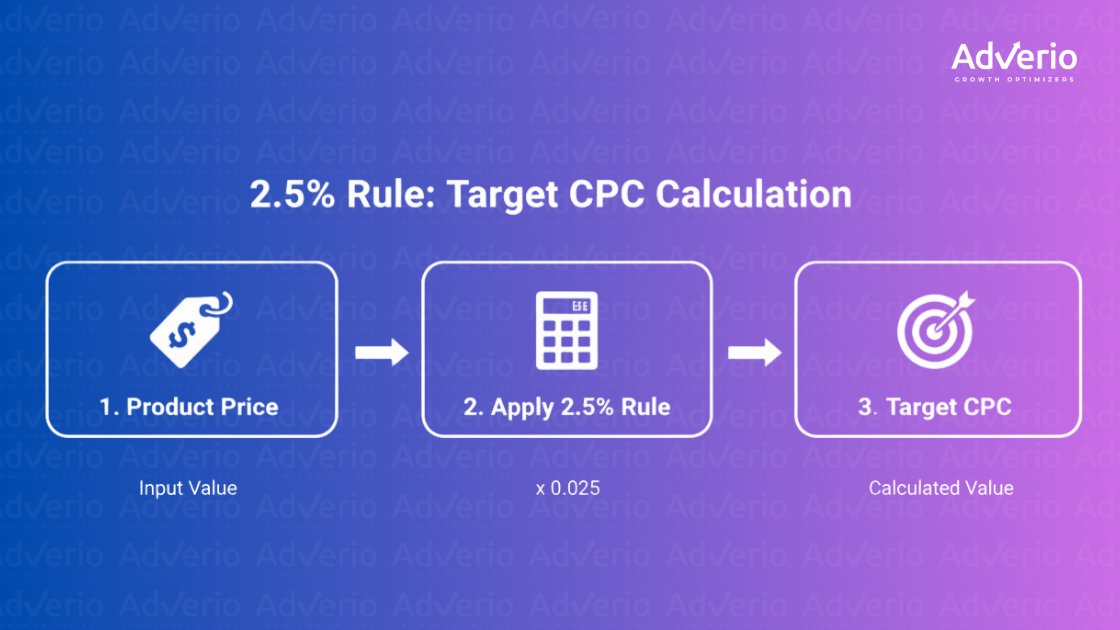
This visual makes it crystal clear: there’s a direct mathematical link between your price and a sustainable ad spend. Get this right, and you stop overbidding before it ever touches your margins.
Step 3: Technology and Workflow Integration
You cannot scale this system manually. Spreadsheets break the moment speed and coordination matter. You need technology that connects the dots between your pricing software, your ad management platform, and your core profitability data.
This is precisely why we built proprietary systems like our Profit Pulse System. It’s designed to eliminate the data lag and manual fumbling that kill profitability, creating a single source of truth for your entire commercial operation.
The right tech stack automates the rules you’ve set, ensuring your bids and prices adjust almost instantly. This gets rid of human error and frees up your team to focus on big-picture strategy instead of getting bogged down in tedious daily tweaks. For a closer look at the mechanics of running campaigns, check out these essential Amazon PPC optimization tips and best practices.
Step 4: Monitoring and Iteration
Finally, an integrated strategy is never “set it and forget it.” It requires constant monitoring and fine-tuning. The trick is to track the right metrics. It’s time to ditch the obsession with ACoS and focus on what actually moves the needle on your P&L.
That means focusing on incrementality—whether your ads are driving new demand or just capturing existing traffic.
Here are the key metrics to watch:
- Total Advertising Cost of Sales (TACoS): This gives you the full picture of your ad spend relative to total revenue, not just the sales your ads touched.
- Net Profit per SKU: The ultimate bottom line. Are your combined pricing and PPC efforts actually making you more money on each unit you sell?
- Share of Voice (SOV): Are your strategies helping you own more of the digital shelf compared to your key competitors?
Review these metrics weekly and monthly. This rhythm lets you see what’s working, cut what isn’t, and continuously refine your rules to make the entire flywheel spin faster and more profitably.
Stop Guessing and Start Growing with a Unified Strategy
Let’s cut right to it. Managing Amazon PPC and your pricing in separate silos is a losing game. It’s the number one reason brands hitting massive revenue numbers are still suffocated by wafer-thin margins. You’re either torching cash on ads for a product that’s priced out of the market, or you’re slashing prices so low that every ad click actually costs you money.
The smartest brands on Amazon don’t work this way. They run a single, unified commercial strategy where every price change informs ad spend, and every ad click is measured against true profitability. This is how you win—not by outspending the competition, but by out-thinking them at every single turn.
This is what separates the sellers who hit a plateau from the ones who become market leaders. It’s about building a flywheel where your pricing funds your advertising, and your advertising drives profitable sales velocity.
It’s time to ditch the fragmented tactics and mediocre results. This isn’t about lowering ACoS or winning the Buy Box for a few hours. It’s about engineering a sustainable growth engine that actually prints cash. You have to understand how Amazon PPC and pricing strategy work together to maximize profit, turning your ad budget from a necessary evil into your most powerful growth asset.
Stop leaving money on the table. The guesswork and siloed thinking have to end if you want to unlock your brand’s real potential on Amazon.
If your ads are driving sales but not profit, your system is broken. You need to know exactly where margin is leaking—and how to fix it.
Or read next: How to Reduce Amazon PPC Spend Without Killing Growth
How Adverio Aligns Pricing + PPC for Profit Growth
Most brands optimize ads and pricing separately. That’s why growth stalls.
At Adverio, we unify both through our Growth Cultivator framework—connecting SKU economics, pricing logic, and PPC execution into a single system.
That means:
- Bids tied to real margins
- Pricing driven by demand + competition
- Spend optimized for incrementality—not just efficiency
→ Explore our Amazon PPC Management Services
Frequently Asked Questions
Getting your PPC and pricing to play nice can feel like solving a puzzle in the dark. Below are straight answers to the questions we hear most often from brands trying to connect these two growth engines. The goal isn’t just to sync them—it’s to make them work as one profit-hungry machine.
How Often Should I Adjust Prices and PPC Bids Together?
There’s no magic number here, but think of a weekly review as your absolute baseline. This lets you respond to what the market’s doing without getting whiplash from every tiny change. But for your fast-moving SKUs or during the chaos of Q4, a daily check-in is non-negotiable.
The real key, though, is automation. Instead of you manually tweaking things every day, set up rules that trigger changes automatically. A competitor goes out of stock? Your price adjusts. ACoS spikes? Bids come down. This shifts you from constantly reacting to staying one step ahead.
Can I Use This Strategy for New Product Launches?
Absolutely. But for a launch, your goal isn’t profit—it’s sales velocity and ranking. You’ll want to start with a lower price to get that conversion rate humming. A high conversion rate makes your PPC spend far more effective, naturally pushing your ACoS down and justifying a more aggressive ad budget.
Think of it as a strategic investment. You’re sacrificing some margin today for a powerful organic rank tomorrow. Once your product grabs a solid footing for its main keywords, you can slowly nudge the price up to your target profit level. Your strategy then shifts from “Launch & Rank” to “Profit Maximizer.”
What Is More Important: A Low ACoS or a High Profit Margin?
This is the classic trap we call Optimization Myopia. Chasing a low ACoS while your bottom line is bleeding is a fast track to profitless revenue. A great ACoS is worthless if your prices are so low you’re losing money on every single sale after all is said and done.
The answer couldn’t be clearer: a high profit margin is always more important.
Stop looking at ACoS by itself. Your true north should be Total Advertising Cost of Sales (TACoS) and, ultimately, the net profit you make on each SKU. Those are the numbers that tell you the real story of whether your ad spend and pricing are actually working together to build a sustainable business.
Stop letting siloed tactics cannibalize your profits. Adverio builds a unified commercial strategy where every ad dollar and pricing decision is engineered to grow your bottom line.
Want to see exactly where your profit is leaking—and how to fix it? Book Your ROI Forecast