


Table of Contents
Amazon COSMO and RUFUS just rewrote the rules of product discovery—and most brands are still playing the old game.
If your strategy still relies on keywords and ACoS, you’re already behind.
This guide breaks down how Amazon’s AI actually works—and what mid-to-enterprise brands must do to win visibility, conversion, and market share in this new environment.
At a Glance
• COSMO = Amazon’s intent engine (understands product context)
• RUFUS = AI shopping assistant (drives recommendations)
• Keywords alone no longer drive ranking
• Conversion, content depth, and operations now control visibility
• Winning brands align catalog, ads, and CRO into one system
Your Old Amazon Playbook Is a Liability
If your Amazon strategy still revolves around keyword stuffing and obsessing over ACoS, you’re playing a game that no longer exists. Amazon’s introduction of its COSMO and RUFUS AI isn’t just another minor algorithm tweak; it’s a complete rewrite of the rules. That old playbook is now a liability, actively costing you market share and profit.
This new ecosystem prioritizes a genuine understanding of customer intent over simple word matching. It breaks down like this:
-
COSMO acts as the brain. It builds a deep, “common sense” understanding of your product’s purpose, its benefits, and who it’s for.
-
RUFUS is the conversational guide. It uses COSMO’s knowledge to offer shoppers personalized, context-aware recommendations, much like a helpful store associate.
Brands clinging to outdated tactics will watch their visibility and profits disappear. Many are already wondering why their Amazon sales are down, and this fundamental shift is a primary reason. Success now demands a sophisticated, full-funnel Amazon growth strategy where your listing quality, conversion signals, and operational excellence are the new ranking factors.
Stop guessing. Start operating with a profit system.
Book Your ROI Forecast and see exactly where your growth is leaking—and how to fix it.
The diagram below shows just how big this change is, moving from the old keyword-centric model to the new intent-driven strategy.
This isn’t theory. It’s already happening: the focus has moved from mechanical SEO to building a rich, semantic profile for each and every product you sell.
We’re already seeing the impact. During its early rollout, the COSMO and RUFUS system increased targeted traffic to relevant product detail pages by roughly 8–12%. This shows just how effective the AI is at connecting high-intent shoppers with the right products. This isn’t a future trend—it’s the new reality of the marketplace.
Old Strategy vs New COSMO and RUFUS Strategy
The table below breaks down the strategic shift required to win in this new AI-driven era. It’s a high-level look at how the old rules compare to the new mandates from Amazon’s AI.
| Strategic Element | Old Approach (Pre-COSMO/RUFUS) | New Mandate (Post-COSMO/RUFUS) |
|---|---|---|
| Listing Optimization | Keyword stuffing and density. Jamming terms into titles, bullets, and backend fields. | Semantic richness. Using natural language to describe features, benefits, and use cases. |
| PPC Targeting | Heavy reliance on exact and phrase match keywords to capture specific searches. | Broad and contextual targeting. Focusing on customer intent and product associations. |
| Content Focus | Feature-based. Listing product specs and technical details. | Benefit-driven. Explaining how the product solves a customer’s problem or fits their lifestyle. |
| Success Metric | ACoS (Advertising Cost of Sale). A pure efficiency metric that leads to Optimization Myopia. | Full-funnel growth. Measuring New-to-Brand customers, market share, and total profitability. |
| Operational Priority | Maintain in-stock status. Basic inventory management. | Flawless execution. High in-stock rates, fast shipping, and excellent customer reviews are ranking signals. |
As you can see, the new mandate requires a much more holistic and customer-centric approach. Simply being “good” at Amazon PPC is no longer enough; your entire operational and content strategy must align with demonstrating value and solving customer problems.
Bottom line: If your listing doesn’t explain who it’s for, what it solves, and why it wins, you’re invisible.
How COSMO and RUFUS Actually Work
Let’s be clear: COSMO and RUFUS aren’t just minor updates; they represent a fundamental rewiring of how Amazon’s entire product discovery engine thinks. Imagine them as two distinct but deeply connected AI layers, each with a very specific job.
COSMO is the silent architect, the brain behind the whole operation. It acts as Amazon’s gigantic “commonsense” knowledge graph. It’s not just scanning for keywords anymore; it’s ingesting and actually understanding every single piece of data tied to your product.
This includes things like:
-
Product Content: Your A+ content, bullet points, and descriptions.
-
Visual Data: The metadata from your images and even the text inside your infographics.
-
Customer Sentiment: The subtle language and intent found in your reviews and Q&As.
-
Operational Metrics: Your in-stock rate, shipping speed, and overall seller performance.
COSMO’s entire goal is to build a rich, contextual profile of your product. It wants to answer questions like: Who is this for? What problem does it solve? When and where would someone use this? In short, it connects your product to a huge web of real-world needs and behaviors.
The Role of RUFUS
Then you have RUFUS, the conversational guide that stands directly on COSMO’s shoulders. RUFUS is the customer-facing AI assistant that uses COSMO’s deep knowledge to give shoppers personalized, conversational advice.
So when a customer asks, “What’s a good waterproof jacket for hiking in the Pacific Northwest?” RUFUS doesn’t just search for “waterproof jacket.”
Instead, it taps into COSMO’s knowledge graph to understand the unique demands of that very specific situation—things like needing breathability for humid weather or extra durability for rugged trails. If your listing has successfully “taught” COSMO that your jacket delivers on these specific benefits, RUFUS will recommend your product with confidence.
The most profound takeaway is this: your product listings are no longer static sales pages for humans. They are now dynamic data assets that must continuously educate an AI about your product’s utility and value.
This shift makes operational excellence and high-quality content more important than ever. In fact, multiple reports show that under this new system, signals like listing quality and behavioral data have gained significant weight. This is forcing sellers to prioritize explicit, use-case-oriented copy just to maintain their rank. To see how to structure your campaigns in this new environment, check out our guide on building an Amazon advertising strategy that drives incremental profit.
If your content fails to clearly spell out the who, what, why, and when for your product, COSMO won’t get it, and RUFUS will never recommend it. This is exactly why “Optimization Myopia”—obsessing over a single metric like ACoS—is a fatal flaw in this new ecosystem. If you’re still optimizing for ACoS alone, you’re sacrificing margin without realizing it—this is where a structured Amazon pricing strategy that protects margin becomes critical. You can’t advertise your way out of a poor data foundation.
Pillar 1: Building Your Profit-Driven Catalog Foundation
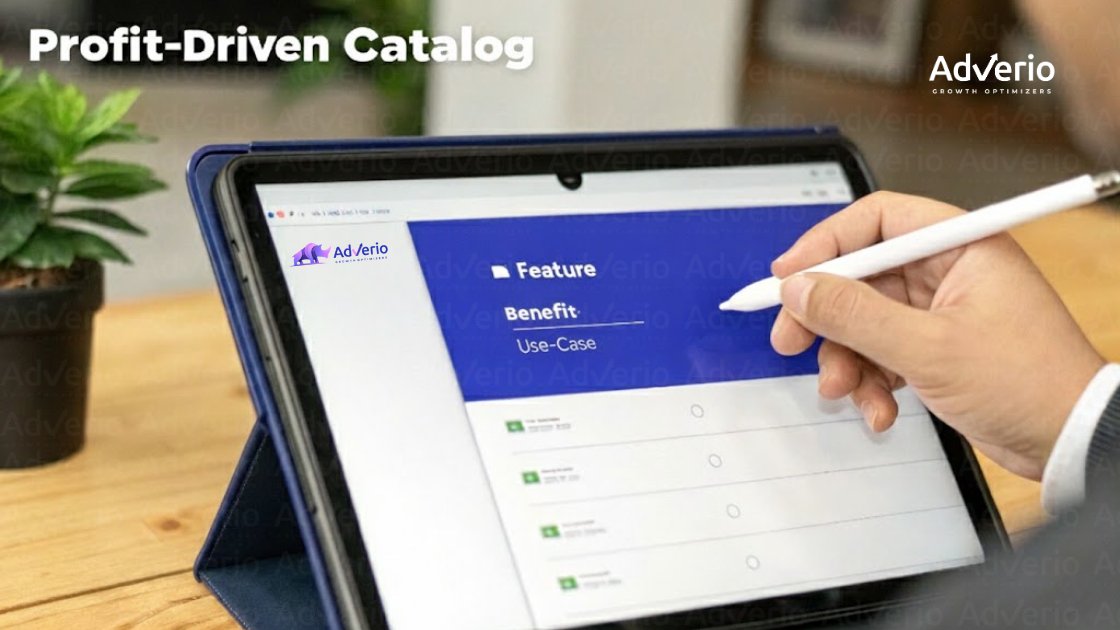
In the age of COSMO and RUFUS, your catalog is no longer just a list of products. Think of it as the foundational data layer that determines whether you even get seen. A weak, poorly structured catalog will simply crumble under the AI’s scrutiny.
This is where Adverio’s first strategic pillar, Profit-Driven Catalog Optimization, becomes absolutely non-negotiable. We’re not talking about minor tweaks here. This is about systematically re-engineering your listings to speak the language of both AI and human shoppers fluently. The goal is to evolve beyond simple, feature-based descriptions and build a semantic structure that COSMO can instantly parse and understand.
From Features to Use-Cases
The old way of writing listings was to just list out features. The new mandate is to connect those features to clear benefits and specific use-cases. This is how you literally “teach” the AI what your product actually does for a person.
-
Old Method: “Moisture-wicking fabric.”
-
New Mandate: “Features moisture-wicking fabric to keep you dry and comfortable during intense workouts.“
That small change provides critical context. It tells COSMO your product isn’t just a piece of clothing; it’s a solution for a specific activity (intense workouts) that solves a specific problem (staying dry). This semantic richness is exactly what the algorithm is designed to reward. Without it, you’re invisible to high-intent shoppers.
Building a Rich Data Profile for Every SKU
A truly optimized catalog goes way deeper than just the title and bullet points. Every single data field contributes to a comprehensive profile for each SKU, creating a robust foundation for the AI to build upon.
This requires a granular, almost obsessive approach:
-
Backend Keywords: Forget keyword stuffing. Use this space for synonyms, colloquialisms, and specific long-tail phrases that don’t fit naturally into your main copy. Think of it as providing the AI with a thesaurus for your product.
-
Image Alt-Text: While its direct ranking power has shifted, alt-text still provides contextual clues for accessibility and external search crawlers. Describe the image accurately, focusing on the product’s use-case.
-
A+ Content: This is your chance to build a rich narrative. Use A+ modules to visually demonstrate benefits, answer common questions before they’re asked, and tell a story that reinforces your product’s real value.
Your catalog is the single source of truth for Amazon’s AI. If the information is thin, inconsistent, or lacks context, COSMO cannot build a confident understanding of your product, and RUFUS will never recommend it.
Here’s the reality: your listings are no longer content—they’re training data for Amazon’s AI. Mastering this foundation is the first critical step toward real profitability on the platform.
For brands ready to go even deeper, understanding the financial impact of each product is key. We break down exactly how to approach this in our guide on utilizing SKU economics on Amazon. This level of detail is what separates brands that merely survive from those that truly thrive.
Pillar 2: Executing Intelligent Growth Marketing Campaigns
With a profit-driven catalog foundation locked in, your ad spend suddenly becomes exponentially more effective. This is where Adverio’s Amazon PPC Management comes in—built to turn ad spend into incremental profit, not wasted traffic. comes in. It’s all about transforming your campaigns from a simple cost center into a powerful profit engine. The old model of just bidding higher for visibility is completely broken.
In the era of COSMO and RUFUS, Amazon’s ad-ranking algorithm doesn’t just reward the highest bidder; it heavily favors listings with high conversion rates. A single dollar spent promoting a perfectly optimized product page generates a far higher return than ten dollars thrown at a weak, unconvincing one. The goal is to create a powerful feedback loop: better listings improve conversion, which in turn boosts your ad performance and drives higher organic rank.
Aligning PPC and DSP with AI Realities
Your advertising strategy now needs to mirror the semantic, intent-driven logic of the AI itself. This calls for a two-pronged approach that smartly separates top-of-funnel awareness from bottom-funnel conversion, using both PPC and DSP to their full potential.
-
Sponsored Products (PPC): These campaigns should be laser-focused on long-tail, high-intent keywords. Think of these as the specific phrases that perfectly match the use-cases you’ve already built into your listings. Forget broad terms like “running shoes.” Instead, target phrases like “lightweight trail running shoes for rocky terrain.” This precision captures shoppers at the exact moment of decision. For more granular advice, explore our Amazon PPC optimization framework for scaling profit, not just ACoS.
-
Demand-Side Platform (DSP): Your DSP campaigns should move way beyond simple keyword targeting. Use them to build and retarget audiences that have already shown strong intent through Amazon DSP Management—capturing demand your competitors miss.
This includes shoppers who visited your product pages, browsed your competitors’ products, or have lifestyle interests that align with your brand. DSP becomes your tool for nurturing consideration and bringing qualified traffic back to your perfectly optimized listings.
This strategic split is absolutely essential for escaping the “ACoS trap” and driving genuine profit growth. The new advertising economics on Amazon reward this holistic approach. To execute truly intelligent campaigns that protect your margins, staying on top of your competitors’ pricing and promotions is non-negotiable. Using competitor price monitoring software gives you the data you need for a sharp, responsive strategy.
The adoption of COSMO and RUFUS fundamentally changed the financial dynamics of Amazon advertising. Reports from agencies tracking performance in 2024 and 2025 confirmed that Amazon’s ad-ranking system shifted to favor listings with higher conversion rates. As a result, many sellers achieved a lower effective Cost-Per-Conversion even as their Cost-Per-Click (CPC) rose, reinforcing the need to invest in content optimization over purely aggressive bidding. You can learn more about these findings on Amazon’s 2025 algorithm changes on mrprime.com.
Pillar 3: Driving Holistic Marketplace Conversion
Traffic is a vanity metric; profit is sanity.
This simple truth is the core of Adverio’s third strategic pillar: Holistic Marketplace Conversion Rate Optimization (CRO). After you’ve built a profit-driven catalog and launched smart ad campaigns, this is the final piece that ties it all together. It ensures every single click has the highest possible chance of becoming a profitable sale.
The COSMO algorithm isn’t just looking for relevant products anymore. It relentlessly prioritizes listings with a proven history of turning visitors into customers. This means your conversion rate is now one of the most powerful ranking signals you have. A low conversion rate tells the AI your product isn’t meeting customer expectations, leading to suppressed visibility no matter how much you spend on ads.
Beyond the Listing Copy
Effective CRO goes far beyond just tweaking titles and bullet points. While compelling copy is foundational to our approach to Amazon listing optimization services built for conversion and AI visibility, a truly holistic strategy looks at every single touchpoint that influences a buyer’s decision.
-
Review Quality and Sentiment: COSMO’s AI doesn’t just count your stars; it performs sentiment analysis on your reviews to gauge true customer satisfaction. A pattern of negative comments about a specific flaw can tank your ranking even with a 4-star average. We implement strategies to generate high-quality, verified reviews that build trust and send the right signals to the algorithm.
-
Brand Store and A+ Premium Content: Your Brand Store and A+ Premium content are no longer optional add-ons; they are powerful conversion assets. A well-designed storefront acts as a curated brand experience. Meanwhile, interactive A+ content like video modules and comparison charts increases dwell time and educates shoppers, directly boosting conversion rates.
To truly drive holistic marketplace conversion, you need to understand and implement a full range of tactics. Exploring different powerful conversion rate optimization techniques can give you a much broader perspective on improving your storefront’s performance.
The ultimate goal is to create an undeniable value proposition for both the customer and the algorithm. Every element, from your main image to your customer Q&A, must work in concert to answer questions, build confidence, and drive the purchase.
This integrated approach also pulls in data from tools like Amazon’s Market Basket Analysis. When used correctly, this insight feeds directly into a stronger Amazon brand tailored promotions strategy that increases AOV without eroding margin. By understanding what customers frequently buy together, you can create strategic product bundles that also send strong conversion signals to the algorithm—solidifying your product’s relevance and authority in the marketplace.
Putting It All Together: Your Roadmap to Winning on Amazon
Theory is one thing, but execution is everything. Knowing how COSMO and RUFUS work is only half the battle. Now comes the hard part: turning that knowledge into a decisive, actionable plan that drives real growth. This is where we stop talking about the ‘what’ and start mastering the ‘how.’
This roadmap pulls together Adverio’s three strategic pillars—Profit-Driven Catalog Optimization, Intelligent Growth Marketing, and Holistic Marketplace Conversion—into a clear sequence of actions. We aren’t talking about small, incremental tweaks. This is about a fundamental restructuring of your Amazon operations to align with the new AI-driven reality. The era of guesswork is officially over.
The Blueprint for Decisive Growth
The path forward requires a systematic approach, starting with your foundational assets and building up to your growth levers.
-
Audit and Rebuild Your Catalog Foundation: Start with a brutal, honest audit of your entire catalog using Adverio’s proprietary LQS (Listing Quality Score) framework. This isn’t just about keywords; it identifies deep semantic gaps and conversion weaknesses, giving you a clear punch list to re-engineer every listing for both AI readability and human persuasion.
-
Restructure Advertising Around Profitability: Overhaul your ad campaigns to mirror your newly optimized catalog. It’s time to shift your focus from chasing a low ACoS to relentlessly targeting high-intent, long-tail keywords that perfectly match the specific use-cases detailed in your product content. This creates a powerful feedback loop where better listings fuel far more efficient ad spend.
-
Establish a Conversion Monitoring System: Implement a process to constantly monitor and improve your conversion signals. This means actively managing review sentiment, optimizing A+ content and Brand Stores, and digging into Market Basket Analysis to spot opportunities for strategic bundles that competitors miss.
For brands feeling overwhelmed by this shift, Adverio offers two distinct partnership models to ensure you have a clear path forward, no matter your team’s size or structure.
Whether you need a team to take the reins completely or a strategic partner to guide your internal experts, the goal remains the same: treat your financial success as our own.
Our Done-for-You service provides a dedicated pod of Growth Evangelists to manage every aspect of your marketplace presence from top to bottom. For brands with capable internal teams, our Done-with-You model offers the strategic oversight, proprietary tools, and expert guidance needed to execute flawlessly.
How Adverio Turns COSMO Into a Growth Engine
Most brands treat COSMO like an algorithm update.
We treat it like a system constraint.
Adverio aligns three critical levers:
• Profit-Driven Catalog Optimization → builds AI-readable product depth
• Intelligent Growth Marketing → drives incremental, not cannibalized demand
• Conversion Systems → turns traffic into profit
This isn’t about “better ads” or “better listings.”
It’s about building a marketplace system where every lever compounds.
If you need a team that connects strategy to profit—not just activity—
explore our Amazon growth services or Book Your ROI Forecast.
Frequently Asked Questions
Let’s cut through the noise. Here are some straight answers to the most common questions we’re hearing from brands about COSMO and RUFUS.
How Quickly Do I Need to Adapt My Listings for COSMO and RUFUS?
Yesterday. The rollout is live, and every day you operate with an outdated keyword-stuffing strategy, you’re bleeding visibility and sales to competitors who’ve already made the shift.
The algorithm is prioritizing intent-rich content right now. This isn’t something to plan for next quarter; it’s an urgent, foundational change you need to make to stay in the game.
Can I Still Succeed with Just a High Ad Budget?
Not anymore. Throwing a huge ad budget at a poorly optimized listing is like trying to fill a leaky bucket—it’s incredibly inefficient. COSMO is designed to reward high-converting products, which means your ad spend will deliver a much lower return if your content isn’t doing its job.
The new reality demands a balanced approach: world-class content that converts, paired with smart advertising. A big budget can’t fix a weak foundation.
What Is the Biggest Mistake Brands Make with This New Algorithm?
The single biggest mistake we see is “Optimization Myopia.” Brands get completely obsessed with one metric—usually ACoS—while totally ignoring the overall health of their listings and, most importantly, their conversion rates.
Success in this new ecosystem requires a full-funnel mindset where your catalog, advertising, and conversion strategy are all working together. If you’re only focused on one piece of the puzzle, you’re setting yourself up to fail.
If your catalog, ads, and conversion systems aren’t aligned, COSMO will bury you—no matter your budget.
Book Your ROI Forecast and get a clear, data-backed growth plan built around profit, not vanity metrics.