


Table of Contents
Most Amazon brands treat seasonal spikes like a lottery ticket. They increase ad budgets, launch blanket discounts, and hope volume covers inefficiencies.
For multi-SKU brands managing 250+ products, that mindset is expensive.
Seasonality doesn’t create growth. It exposes operational weakness — pricing misalignment, fragile inventory planning, weak PDP conversion, and non-incremental ad spend.
This guide breaks down how serious operators capture seasonal demand without eroding margin, using a governed approach across pricing, inventory, and advertising.
At-a-Glance — Boosting Seasonal Sales the Right Way
-
Seasonality magnifies weak systems: It doesn’t fix broken listings, pricing, or inventory.
-
Demand capture beats demand creation: The goal is capturing existing demand efficiently, not forcing volume.
-
Inventory and pricing matter before ads: Scaling traffic without a solid foundation is a recipe for waste.
-
Margin discipline matters most during peaks: Profitability is the ultimate measure of seasonal success.
Why Most Seasonal Sales Strategies Fail
Seasonal sales don’t fail because demand is low. They fail because governance is weak. Most brands get stuck in a reactive loop, creating three critical failure points that turn promising revenue spikes into painful financial losses. The result: vanity revenue, compressed margin, and a January cash flow hangover.

Discounting Into Demand That Already Exists
The most common trap is paying Amazon to sell what would’ve sold anyway. During peak seasons, customer intent is already sky-high. Slashing prices might drive impressive-looking sales numbers, but it often just cannibalizes full-price sales from shoppers who were ready to buy. You’re not creating new demand; you’re just giving away profit.
Scaling Ads on Broken PDPs
Cranking up PPC and DSP spend is tempting. But driving a flood of traffic to an under-optimized Product Detail Page (PDP) is like pouring water into a leaky bucket. Your click-through rates (CTR) might improve, but your conversion rates (CVR) will collapse. You end up paying more to show shoppers a page that isn’t built to close the deal.
Increasing traffic to a PDP converting at 8% instead of 14% during peak demand can destroy thousands in incremental profit over a 30-day window.
Inventory Blind Spots
Botched inventory management is the most devastating mistake. The seasonal crunch will expose every flaw, leading to two equally expensive disasters:
-
Stockouts: Running out of your best-seller mid-peak doesn’t just cost sales; it forfeits organic ranking momentum that can take months to recover.
-
Over-ordering: Ending the season with a warehouse full of unsold goods means massive write-downs, storage fees, and cash tied up that you need elsewhere.
What Actually Drives Seasonal Sales Lift
True seasonal lift isn’t about brute-force spending. It’s about operational readiness. You don’t need to manufacture demand. You need to capture it without cannibalizing full-price sales. A profitable season is built long before the first ad runs.

Conversion Readiness Before Traffic
Before you spend a dollar on ads, your listings, images, and offers have to be flawless. Your Amazon listing optimization must already support a stable, predictable conversion rate. Your PDPs should already perform at a stable, predictable conversion rate. The small friction points you tolerate in July become massive profit leaks under holiday volume. Fix your conversion elements before you scale spend.
If your traffic spikes but CVR stays flat, the issue isn’t budget — it’s merchandising and PDP conversion discipline.
Pricing That Matches Seasonal Elasticity
Most brands default to discounting. This is a mistake. A sophisticated Amazon dynamic pricing strategy recognizes that customer price sensitivity shifts during seasonal demand spikes. The key is knowing when to hold your price, when to test an increase, and when a strategic discount makes sense. Blindly slapping a 20% off coupon on everything isn’t a strategy; it’s lazy execution.
If you default to coupons and Lightning Deals without modeling incrementality, read our breakdown of Coupons vs Best Deals vs Lightning Deals on Amazon before committing margin.
Inventory Coverage & Velocity Control
Nothing kills momentum faster than a stockout. Mastering inventory is the final, critical piece. This requires sharp forecasting based on historical data, market trends, and your promotional calendar. Effective velocity control means actively managing your sell-through rate to line up with inventory levels, preventing the dual disasters of stocking out mid-December or facing huge storage fees in January.
This is where most brands fail — they separate advertising from inventory governance, instead of aligning both under a unified seasonal pricing strategy on Amazon.
Seasonal Sales vs Year-Round Growth
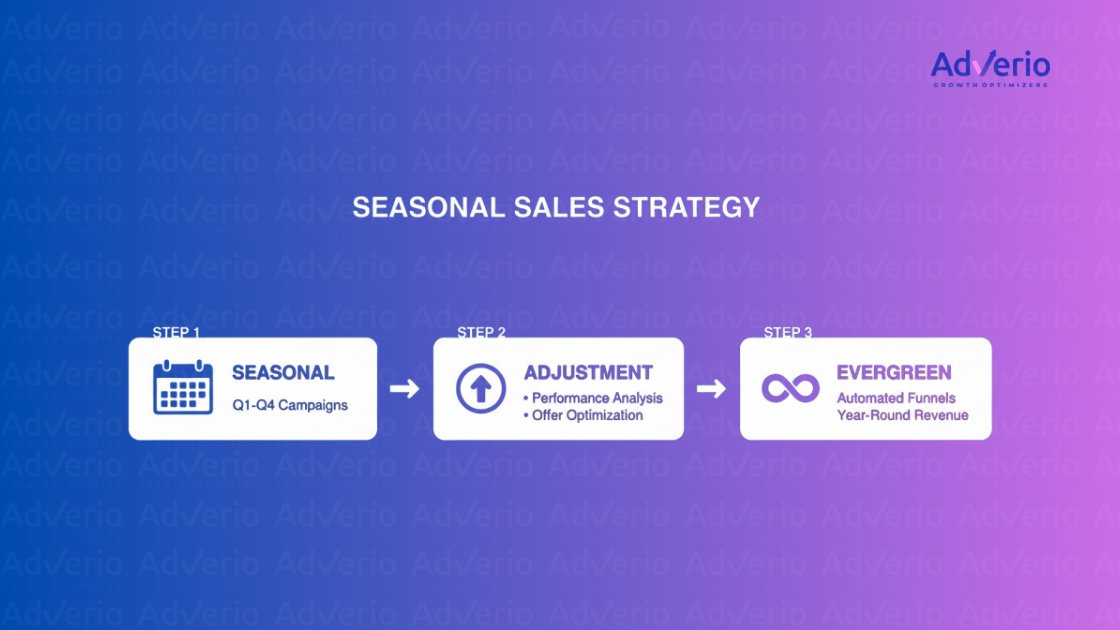
Chasing seasonal spikes and building year-round growth are two different games. A seasonal strategy is reactive and defensive, laser-focused on capturing a temporary surge. An evergreen strategy is proactive and offensive, built for creating long-term market share.
| Factor | Seasonal Spikes | Evergreen Growth |
|---|---|---|
| Risk Profile | High. Heavily dependent on short windows, promotions, and consumer spending habits. | Low. Diversified risk over a full calendar year, focused on consistent demand. |
| Margin Volatility | High. Prone to deep discounting, higher ad costs, and promotional fees. Profitability is erratic. | Low. Emphasizes stable pricing, controlled ad spend, and predictable profit margins. |
| Inventory Exposure | Very High. Requires aggressive front-loading of stock, creating major risk of overstock or stockouts. | Moderate. Inventory levels are managed against predictable, consistent sales velocity. |
| Operational Complexity | High. Requires compressed planning, reactive decision-making, and strained logistics. | Moderate. Allows for strategic, long-term planning and system optimization. |
If your brand depends on seasonal spikes to hit targets, your growth model is fragile. Building an evergreen foundation creates resilience. It lets you use seasonal events as accelerators, not lifelines.
How to Prepare Before the Season Starts
The operators who consistently win build their advantage months in advance with a disciplined, data-driven operational audit. The core principle is simple: diagnose before you scale. Instead of asking, “How can we sell more?” ask, “Which of our products are truly ready for a traffic surge?”
Governance Before Growth
Before scaling spend, validate three constraints in order:
-
Inventory reality
-
Conversion system health
-
Traffic scalability
If inventory or PDP conversion is unstable, ads will only amplify the weakness. Ads are traffic — not the product.
Diagnose Before You Scale
Before dialing up ad spend, stress-test your catalog. A product might be a bestseller, but if it has underlying issues, peak season volume will magnify the damage.
Your pre-season audit should focus on:
-
CVR stability: Pull data for the last 60-90 days. A product with a volatile CVR is a terrible candidate for aggressive ad scaling.
-
Return risk: High-return products become exponentially more costly during peak season. Pinpoint SKUs with above-average return rates and fix the root cause, or pull them from the primary push.
-
Pricing floors: Know your numbers cold. What is the absolute lowest price you can offer while maintaining an acceptable margin? This prevents emotional, in-the-moment discounts that kill your bottom line.
Decide What Not to Push
One of the most strategic decisions you can make is choosing which products not to promote. Pushing every product is a sign of a weak strategy.
Exclude these SKUs from your main promotional calendar:
-
Low-margin SKUs: Pushing these with discounts and high ad spend is a guaranteed way to lose money.
-
Fragile supply chains: If inventory is unreliable, promoting it heavily risks a stockout that will decimate its organic rank.
How Adverio Approaches Seasonal Growth Differently
Most agencies treat seasonal demand with a generic “holiday playbook.” This isn’t a strategy; it’s a gamble with your profit margin. At Adverio, seasonality isn’t a frantic event. It’s a governed process baked into our core systems year-round.
This proactive governance covers:
-
Pricing strategy: We model seasonal price elasticity to know exactly when to hold firm and when a surgical promotion will drive real lift.
-
Inventory governance: Our systems connect demand forecasts with supply chain realities to prevent stockouts and overstocks.
-
Listing optimization: Product pages are optimized for seasonal intent long before the traffic surge to ensure every paid click has the highest possible chance of converting.
-
Ads used to capture, not force, demand: We use ads surgically to capture existing, high-intent demand—not to force volume at any cost.
-
Post-season analysis to prevent repeat mistakes: We conduct a rigorous audit to dissect what worked, what didn’t, and why, creating a feedback loop for continuous improvement.
Seasonal growth is governed—not improvised.
How Adverio Helps Brands Win Seasonal Peaks
We don’t sell “holiday playbooks.” Seasonal growth is handled inside our core Amazon account management systems. Our focus is on profit retention, not just headline sales, turning every season into a stepping stone for long-term market leadership.
👉 Book Your Seasonal Profit ROI Forecast
Or explore how we reduce wasted spend with a governed Amazon PPC management strategy.
FAQs
How do you boost seasonal sales without discounting?
You boost sales without deep discounts by obsessing over conversion rate optimization (CRO) before the traffic hits. Instead of giving away margin, invest in upgrading creatives, optimizing copy with seasonal keywords, and managing social proof to make your product pages ruthlessly effective at turning visitors into buyers at full price.
When should you start preparing for seasonal demand?
You should start preparing for a major seasonal push 90-120 days out. For Q4, that means planning should kick off in late summer. This gives you the runway to perform a catalog audit, lock down inventory, and methodically optimize listings long before the traffic actually spikes.
Should you increase ad spend during peak seasons?
Yes, but only when it’s backed by solid data. Strategically increase ad spend on products that have a proven, stable conversion rate, bulletproof profit margins, and enough inventory to handle the increased sales velocity. Blindly throwing budget across your entire catalog is one of the fastest ways to burn cash.
Why do seasonal sales hurt profit?
Seasonal sales hurt profit because they act as a massive amplifier for every existing weakness in your operations. The main culprits are pointless discounting on products that would have sold anyway, wasteful ad spend on under-optimized listings, and inventory disasters like stockouts or overstocks.
Is seasonality bad for Amazon brands?
Seasonality isn’t inherently bad; it’s a test of operational discipline. For unprepared brands, it’s a high-risk period that can destroy margins. For well-prepared brands, it’s a predictable opportunity to capture market share and accelerate profitable growth. The outcome depends entirely on preparation, not aggression.
What is the seasonal price elasticity on Amazon?
Seasonal price elasticity measures how sensitive demand is to price changes during high-intent periods. In peak events, many products become less price sensitive — meaning unnecessary discounts directly erode margin without increasing unit volume.
How do you know if seasonal ads are incremental?
Evaluate branded vs non-branded lift, new-to-brand metrics, and share-of-voice changes. If most seasonal revenue comes from branded keyword capture, you’re not creating incremental growth.