



An amazon agency roi calculator that starts with revenue is measuring the wrong thing. Profit is the only number that matters to finance. A sales increase means nothing if ad spend, discounting, fee leakage, and internal workload erase the gain. CFOs should treat agency ROI as one question: did this relationship produce more attributable profit than it consumed in total cost?
Too many brands approve agencies on ROAS screenshots, blended revenue growth, and polished monthly decks. None of those answers the finance question. An agency can raise revenue and still reduce contribution margin. It can improve ad metrics while forcing your team to spend more hours fixing catalog issues, inventory problems, and reporting gaps. That is not a return. That is the cost of a better presentation.
Use this article to pressure-test your assumptions. The model that follows is built for finance, not agency reporting. It measures profit improvement attributable to agency work against every cost tied to the relationship, including fees, media, software, and the hours your internal team spends managing the agency.
If you need a reality check before building your model, compare your current reporting against real amazon agency performance standards. Many brands already track activity. Very few track true return.
At a Glance
-
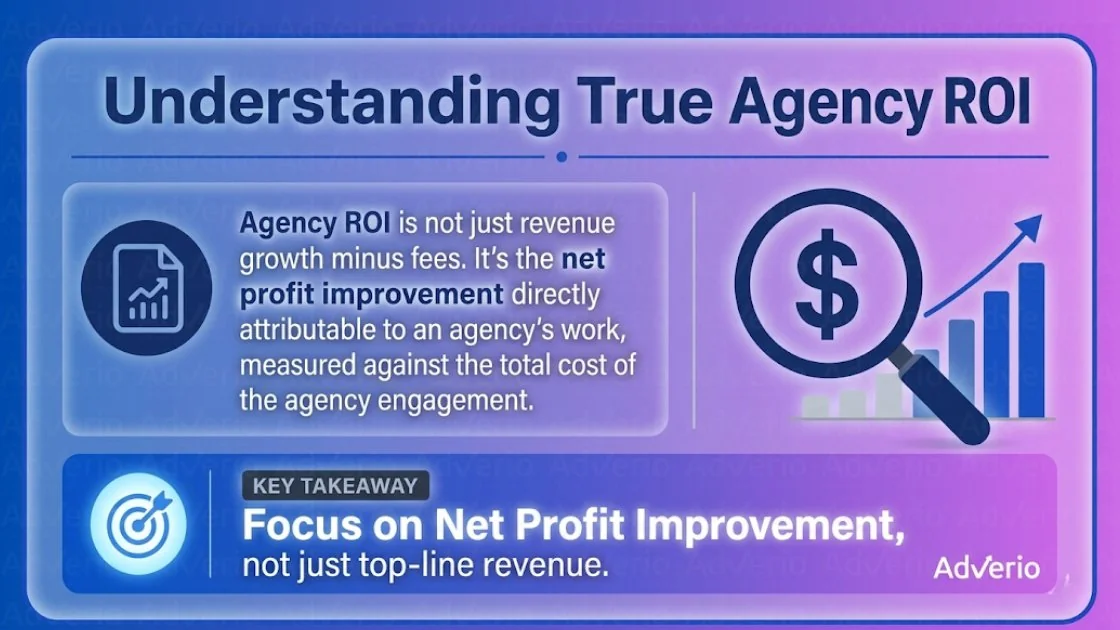
Agency ROI is not revenue growth minus fees. It is profit improvement directly attributable to agency work, measured against the full cost of the relationship.
-
Your calculator needs a baseline. No pre-agency baseline means no credible attribution.
-
ROAS is not enough. Margin, TACoS, conversion efficiency, and organic lift matter because Amazon profitability depends on far more than ad spend alone.
-
Total cost is always higher than the retainer. Agency fees are only one line item in the investment.
-
A CFO should care about one outcome. Did the agency create more net profit than it consumed?
Why Most Agency ROI Calculations Are Wrong
Most brands make three mistakes. All three inflate perceived agency value.
First, they attribute all sales growth to the agency. That’s lazy math. A technically sound Amazon agency ROI calculator starts with a pre-agency baseline and a fixed evaluation window. Treating gross sales lift as ROI is a known pitfall because PPC can increase revenue while margin still deteriorates when product fees and FBA costs are ignored. A campaign can raise revenue while contribution margin drops when FBA fees and promo costs are ignored.
Second, they celebrate ROAS improvement without asking what happened to TACoS.
A campaign can look more efficient at the ad level while the business gets less profitable. This is exactly where Amazon PPC management needs to go beyond bid optimization and answer the margin question.
If ad-attributed efficiency improves but total sales rely on heavier spend or weaker margin, you haven’t improved ROI. You’ve moved numbers around.
Third, they ignore the total relationship cost. The retainer is obvious. The internal drag isn’t. Your team spends time onboarding the agency, validating strategy, fixing catalog issues, joining weekly calls, checking forecasts, and cleaning up reporting gaps. That time has a real cost even if it never hits the agency invoice.
Agencies love isolated wins because isolated wins hide system-wide losses.
If your current partner reports visibility, clicks, and ad sales but can’t tie them back to net profit, that’s not transparency. That’s reporting design. You can compare those warning signs against Adverio’s take on Amazon agency red flags.
The True Cost of an Amazon Agency Relationship
Your retainer is the entry price. It is not the total investment.
An honest amazon agency roi calculator includes every recurring and one-time cost tied to the relationship. That means retainer, any performance fee, onboarding, software pass-throughs, and internal team time. If the agency uses outside platforms for reporting, keyword tools, or workflow management, those costs still belong in the model. Those costs still belong in the model.
True monthly cost of an Amazon agency
| Cost Component | Typical Range | Notes |
|---|---|---|
| Monthly retainer | $5K to $20K | Base management fee |
| Performance fee | $0 to $5K | Variable fee tied to spend or performance |
| Internal time | $1.5K to $4K | Senior operator time spent managing the relationship |
| Onboarding fee | $2K to $5K | One-time setup and transition cost |
| Tool pass-throughs | $500 to $2K | Reporting, workflow, or software costs |
| Total true monthly cost | $7K to $31K | Fully loaded relationship cost |
That table changes the conversation. A so-called $10K agency is often not a $10K decision. It’s a broader capital allocation decision with management overhead attached.
The Right Metrics to Measure Agency ROI Against
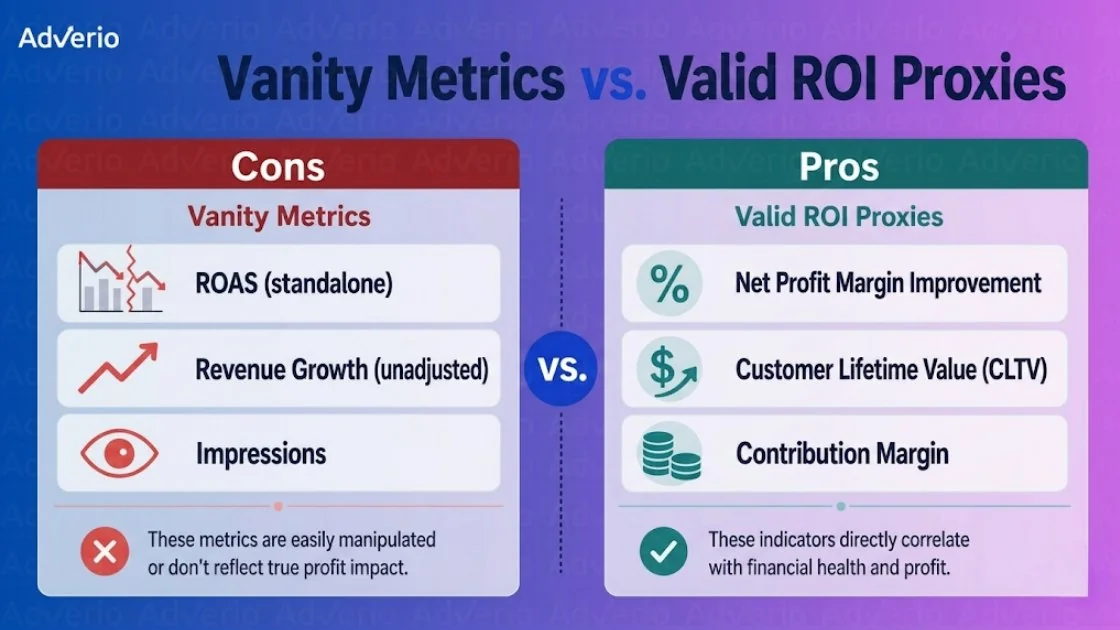
Agencies protect themselves with activity metrics because activity is easy to report and hard to challenge. CFOs should reject that frame. If a metric does not show how the agency changed profit, margin retention, or cash generation on Amazon, it does not belong in the ROI discussion.
The test is simple. Can you connect the metric to incremental profit after ad spend, fees, promos, and operational drag? If the answer is no, you are reviewing theater.
Valid versus invalid ROI metrics
| Metric | Valid ROI Proxy | Why |
|---|---|---|
| TACoS reduction | Yes | Shows whether ad spend is consuming less of total sales while the business holds or improves margin |
| Contribution margin improvement | Yes | Connects agency actions to actual dollars kept after variable costs |
| Organic share growth | Yes | Matters when it lowers paid dependence or increases profitable sell-through |
| Conversion rate improvement | Yes | Better traffic quality or optimized Amazon listings produce more gross profit from the same visits |
| Buy Box improvement | Yes | Fixes a revenue and margin constraint that directly affects sales capture |
| ROAS improvement without TACoS context | No | A campaign can look efficient while total ad dependence and total cost worsen |
| Revenue growth without margin context | No | More sales can produce less profit |
| Impressions and clicks | No | Exposure does not pay the agency bill |
TACoS belongs on the list because it forces a whole-account view. Contribution margin belongs there because revenue without retained profit is useless. Conversion rate matters only when it improves profitable unit economics, not when it is propped up by discounting that destroys margin.
If your team still needs help with understanding ROAS and TACoS, fix that first. An agency can show a prettier ROAS while the account gets less efficient at the business level.
Visibility has no value until it produces profitable commercial movement.
Use one operating rule in every agency review. If the metric cannot explain a change in profit, challenge why it is in the deck at all.
The Amazon Agency ROI Framework
Agencies like to report movement. Finance needs profit.
Use a simple standard. Measure the agency on attributable profit improvement divided by the full cost of the relationship. That means profit the agency helped create, after you strip out gains that would have happened anyway, compared against every dollar you spent to get that result.
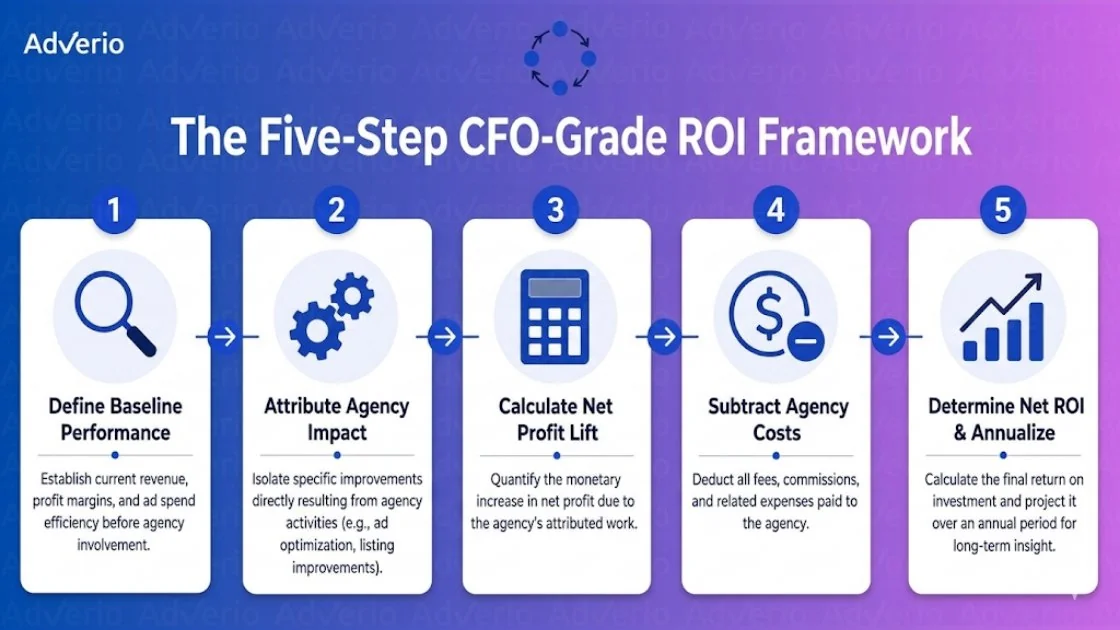
Step 1 Establish the pre-agency baseline
Set the baseline before the agency changes bids, content, pricing, or inventory priorities. Use average monthly contribution profit, TACoS, conversion rate, contribution margin, and any operational constraint that limits profitable growth.
Keep the comparison window clean. If the business is seasonal, compare like-for-like periods. If Prime Day, a price cut, or a stock recovery sits inside the test window, isolate that effect or remove the period from the analysis.
One rule matters here. No baseline, no ROI claim.
Step 2 Calculate the total cost of the agency relationship
Start with the retainer, then add everything finance usually leaves in separate buckets. Include onboarding fees, creative costs, software pass-through charges, internal team review time, reporting overhead, catalog cleanup support, and the cost of executive attention.
Weak agency economics often remain hidden. The invoice may look acceptable while your team burns hours feeding the agency data, fixing errors, and approving work that should have been right the first time.
If you want a cleaner attribution model, review Adverio’s approach to Amazon ROI.
Step 3 Isolate the agency-attributable profit improvement
Give the agency credit only for profit improvement it likely caused. That requires discipline.
Separate agency impact from category growth, seasonality, promotions, inventory recovery, review count changes, price increases, and distribution expansion. If organic sales rose because a product came back in stock after months of suppression, that is not agency ROI. If margin improved because finance raised prices, that is not agency ROI either.
Use ranges if precision is not possible. A conservative estimate is better than a polished fiction.
Step 4 Calculate net ROI and payback period
Use the formula finance will trust:
Net ROI = ((Agency-attributable profit improvement – Total agency cost) / Total agency cost) × 100
Then calculate speed to recovery:
Payback period = Total agency cost / Monthly attributable profit improvement
Those two numbers answer the core question. Is this relationship producing enough incremental profit, fast enough, to justify keeping it?
Step 5 Adjust for opportunity cost
A positive ROI is not enough. The agency still has to beat the alternatives.
Compare the expected return against the return from hiring one strong in-house operator, fixing pricing architecture, funding inventory to prevent stockouts, improving creative, or expanding into another channel. Capital is limited. If the agency cannot outperform those options, the right decision is obvious.
That is the framework. Strip out noise, count all costs, and force every reported win back to profit. If the agency resists that level of scrutiny, you already have your answer.
Worked Example What the Calculation Looks Like in Practice
Use this as a model, not as a shortcut. The point is the logic.
A brand starts at $800K monthly revenue, 18% TACoS, and 28% contribution margin. After a defined six-month window, the brand is at $920K monthly revenue, 14% TACoS, and 33% contribution margin. The true monthly agency cost is $19.5K.
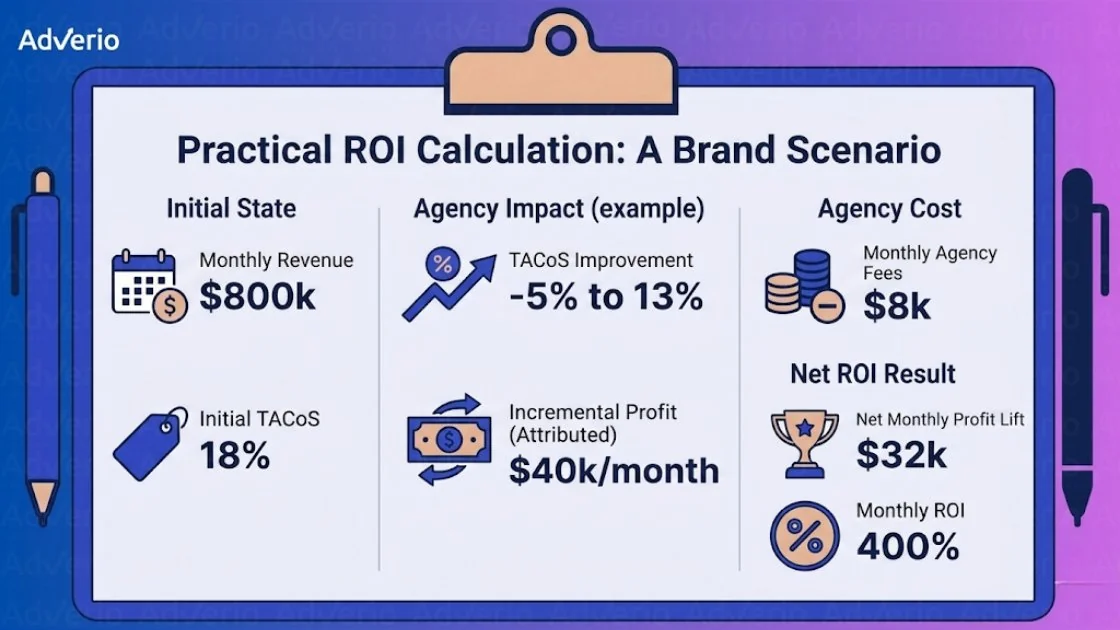
Here’s the CFO version of the analysis:
-
Start with profit, not revenue: Monthly contribution profit at baseline is lower than it is after the six-month window because both sales and margin improved.
-
Test attribution discipline: Don’t give the agency credit for all of the increase. Separate what came from cleaner ad efficiency, conversion gains, and organic lift from what came from market demand or promotion effects.
-
Subtract total cost: Only after you isolate attributable profit improvement do you compare that figure against the $19.5K monthly relationship cost.
-
Judge against sensible return thresholds: Nova’s 2026 calculator says a healthy Amazon FBA ROI runs 100–300% annually, with established top sellers targeting 20–30% monthly ROI.
If your modeled monthly net ROI doesn’t clear that bar, the agency isn’t scaling profit. It’s an inflating activity. If you need a cleaner method for separating lift from noise, review Adverio’s approach to Amazon ROI.
Practical rule: Run this calculation at day 90, day 180, and day 365 of any agency relationship. If net ROI declines over time, the agency may have captured easy wins and shifted into maintenance while still charging for growth.
When Agency ROI Is Negative and What to Do About It
Negative ROI isn’t always failure. Sometimes it’s a diagnosis.
If ROI is negative in the first stretch of the relationship, that can be normal. A serious agency often has to clean up structure, shut off waste, rebuild listings, or correct catalog issues before profit improves. Don’t panic too early. Do demand a timeline tied to profit recovery.
If revenue is up while margin ROI is still negative, the agency is optimizing the wrong metric. Stop discussing scale and start discussing economics.
If ROI declines for three straight months, treat that as maintenance mode. At that point, you have three choices:
-
Reset the scope: Reduce fees to match a maintenance mandate
-
Raise the accountability bar: Require profit-linked milestones
-
Replace the partner: If they can’t explain the decline, they can’t reverse it
How to Use This Framework Before You Sign
Use the model before procurement turns agency fees into a sunk cost.
Force the agency to price its own accountability. If it wants your business, it should show the profit it expects to improve, the cost required to get there, and the timeline for proving it. CFOs do not approve agencies on pitch quality. They approve them on expected profit lift after fees, internal labor, software spend, and operational drag.
Ask for a pre-sign ROI case built on your account, not a recycled success story. The model should define:
-
The profit baseline they inherit
-
The specific levers they expect to change
-
The review period for judging performance
-
The full relationship cost, including internal team time
-
The attribution method used to isolate agency-driven improvement
Then pressure-test the proposal with simple questions. What has to be true for this engagement to pay back? Which assumptions are under the agency’s control, and which depend on your pricing, inventory, or conversion rate staying stable? How fast does profit need to improve to cover the overall cost of the relationship?
If they cannot answer those questions in plain numbers, you are not evaluating an operator. You are evaluating a sales team.
Before you sign, make the agency tell you exactly why hiring them will improve your bottom line. If they can’t show it in numbers, walk. Brands that need a full-system approach to profitability, not just ad reporting, look for full Amazon account management that ties execution to margin outcomes.
If the answer centers on traffic, impressions, or top-line growth without a clear path to incremental profit, pass.
How Adverio Approaches ROI Accountability
Adverio starts with a pre-engagement Profit ROI Forecast. Before any contract begins, it defines the profit baseline, the improvement case, and the cost required to produce that lift. That gives finance teams something far more useful than a pitch deck. It gives them a model they can test against actual results.
The bar is clear. Agency work has to earn back its full cost fees, internal oversight, operational load, and the slower decision cycles that come with any external partner. Adverio builds the profit model before the contract starts, not after the first quarterly review. If the math does not clear at the forecast stage, the engagement does not move forward.
Adverio uses that forecast as the operating benchmark for review. The team measures whether changes in advertising, catalog structure, pricing support, review generation, and inventory coordination are improving attributable profit, not just top-line sales or blended ROAS. That matters because Amazon accounts rarely fail from one bad ad metric. They fail when margin leaks across multiple functions and nobody ties those leaks back to profit.
If you are evaluating whether an agency can actually move your margins, ask to see how it sets the baseline, what costs it includes, and how it plans to prove incremental profit after fees. That is the standard Adverio applies. It should be the standard you apply to every agency.
FAQs
How long should you wait before judging agency ROI?
Use a fixed evaluation window and compare like-for-like business periods. A rushed verdict is just as misleading as a vanity report. Review early for direction, but judge decisively only after enough time has passed to isolate real profit impact.
Should Prime Day or major event months be included in the calculation?
Yes, but only if your baseline and comparison periods treat event timing consistently. Big promotional months distort attribution. If the event changes traffic, pricing, and conversion behavior, isolate it instead of blending it into a normal monthly average.
Is ROAS ever enough to evaluate an Amazon agency?
No. ROAS is an efficiency signal, not a profit verdict. Amazon’s own guidance says ROAS and ROI-style metrics should be interpreted with margin, conversions, and customer lifetime value because high ROAS can still lose money when margins are thin, High ROAS can still lose money when margins are thin.
How does this model handle seasonality?
Use matched periods, fixed windows, and consistent cost allocation. Don’t compare a seasonal high against an off-season low and assign the variance to the agency. If your business is volatile, your attribution model needs to be tighter, not looser.
Can this framework compare agency performance across Amazon, Walmart, and DTC?
Yes, but only if you normalize for channel economics and use the same profit logic across each one. The point is not ad efficiency by channel. The point is which channel and which partner created the most net profit after all costs.
Read Next
If you’re building a CFO-grade scorecard for marketplace growth, keep going with these resources:
-
what the first 90 days with an Amazon agency should look like
If your current agency reporting can’t answer one question, “what net profit did this relationship create after total cost,” you don’t have an ROI model. You have a presentation. Adverio helps brands build profit-first marketplace plans across Amazon, Walmart, and Target. If you want the numbers before you commit.
Start with a Profit ROI Forecast