


Table of Contents
Most brands ask the wrong question about amazon display ads.
They ask whether DSP is better than Sponsored Display. That’s lazy thinking, and it’s expensive. These are not the same tool at different price points. They solve different problems, use different buying models, and break your budget in different ways when used badly.
Amazon’s ad machine is massive. In 2025, Amazon Advertising’s daily spend across all campaigns exceeds $47 billion, with over 300,000 global sellers earning more than $100,000 annually according to Luzern’s 2025 Amazon advertising statistics. In a market that crowded, bad channel selection isn’t a minor mistake. It’s a profit leak.
If your agency keeps pushing DSP as the automatic next step, slow down. You may need it. You may not. The right answer depends on your catalog, your margin structure, your conversion engine, and whether you’re trying to capture demand or manufacture it.
Your Agency Says DSP Is Better Is It True
No. DSP is not “better.” It’s broader, more complex, and easier to misuse.
That sales pitch survives because it sounds advanced. Programmatic buying. Audience layering. Off-Amazon reach. Premium inventory. All true. None of that means it’s the right move for your brand right now.
Sponsored Display and DSP sit under the same broad display umbrella, but they behave differently in practice. Sponsored Display is usually the practical choice when you need straightforward retargeting, competitor conquesting, and defensible CPC economics. DSP is what you use when you need larger audience access, impression buying, and real off-Amazon scale.
The real problem is bad financial framing
Agencies love turning this into a maturity badge. Serious brands use DSP. Smaller brands use Sponsored Display. That’s nonsense.
The right framing is this:
-
If you need efficient lower-funnel recovery, Sponsored Display often gets you there faster.
-
If you need broader audience orchestration, DSP gives you capabilities Sponsored Display doesn’t.
-
If your listing conversion is weak, both can become expensive ways to amplify a broken retail experience.
Hard truth: A more advanced media tool does not fix an unconvincing PDP, weak reviews, poor pricing, or chaotic catalog structure.
If you want the financial lens agencies usually avoid, the answer is almost always ROAS. ROAS alone is how brands get talked into expensive media that looks smart in a dashboard and weak in a P&L.
Book Your ROI Forecast if you want the answer based on margin and incrementality, not platform theater.
How Sponsored Display Actually Works and Its Ceiling
Sponsored Display is the workhorse. Not glamorous. Not weak. Just frequently misunderstood.
It’s built for brands that want Amazon-native display functionality without stepping into full programmatic media buying. That matters because most operators don’t need more complexity. They need cleaner targeting, better sequencing, and tighter profit control.
What Sponsored Display does well
Sponsored Display works best when you’re trying to stay close to the transaction. Think product detail page disruption, competitor ASIN targeting, and retargeting shoppers who already signaled intent.
At a practical level, most brands use it for a few core jobs:
-
Retargeting warm shoppers who viewed a product but didn’t buy
-
Defending your own detail pages from competitor pressure
-
Showing up on relevant product pages where comparison shopping is already happening
-
Extending visibility beyond search without moving into full DSP execution
This is why brands need to master Sponsored Display before chasing anything more complex. It often handles the most profitable middle of the funnel if your listings and offer structure are solid.
Why sequencing matters more than most teams admit
A lot of brands still manage ad types in silos. Sponsored Products over here. Sponsored Brands over there. Sponsored Display as an afterthought. That’s a structural problem — and it starts at the
Amazon PPC management layer.
That’s amateur hour.
The strategic sequencing of ads is critical. A shopper might see a Sponsored Brands ad, then be reminded by a Sponsored Display ad on a third-party site later. Amazon’s expansion of Sponsored Products off-site in late 2023 made this even messier for teams that still think in one-channel buckets.
Sponsored Display works best when it follows intent. It gets weaker when brands expect it to create intent from nothing.
For a more tactical view of this specific channel, Adverio’s Amazon Sponsored Display ads page covers the mechanics.
Where Sponsored Display hits its ceiling
Agencies become slippery. They present Sponsored Display as if it can cover the entire display strategy. It can’t.
Its ceiling shows up in three places:
Audience depth
You get useful audience and product targeting, but not the same programmatic audience sophistication DSP offers. If your goal is broader household penetration, richer audience segmentation, or full-funnel pathing, Sponsored Display runs out of road.
Inventory control
Sponsored Display gives you access to valuable placements, but not the same level of control across broader web inventory and owned-and-operated environments that DSP can access.
Measurement nuance
You can track core ad metrics, but you won’t get the same strategic flexibility when you’re trying to understand assisted paths, impression-led influence, and audience-specific sequencing across a wider media footprint.
So yes, Sponsored Display is powerful. But don’t turn it into something it isn’t. It is not your full brand-equity machine. It is your efficient display operator inside a narrower tactical lane.
How Amazon DSP Unlocks Off-Amazon Scale
DSP is not Sponsored Display with a higher invoice. It’s a different buying system.
The first shift is economic. Sponsored Display usually keeps you focused on clicks. DSP makes you think in impressions, audience saturation, frequency, and media quality. That changes how you judge success, and it exposes weak operators fast.
What DSP actually gives you
DSP matters when you need reach beyond Amazon’s retail environment and more control over who sees your ads.
That typically includes:
-
On-Amazon and off-Amazon placements across sites, apps, and Amazon-owned environments
-
Programmatic audience buying using richer shopper and behavioral signals
-
More advanced retargeting structures than most brands can build with Sponsored Display alone
-
Video and broader creative deployment for upper-funnel influence and re-engagement
This is why DSP belongs in the conversation for brands trying to build memory, not just harvest existing demand.
Why the off-Amazon piece matters
A lot of shoppers don’t buy the first time they touch your brand. They compare. They delay. They disappear into other apps and sites.
DSP gives you a way to stay in front of those shoppers after they leave the immediate Amazon environment. That’s valuable if your product needs repetition, education, or visual reinforcement before conversion.
It also matters in event-based periods. According to Amazon Advertising’s Prime Day advanced strategies guide, advertisers who integrated display ads with video into their campaigns achieved a +24% uplift in ad-attributed sales during Prime Day 2025. That’s the strongest clean argument for DSP-style media I’ve seen lately. Display, especially when paired with video, can drive performance. Not just awareness.
Practical rule: Use DSP when you can clearly explain how broader reach will create profitable future demand, not because your agency wants a bigger media line item.
Where brands get DSP wrong
Most brands misuse DSP in one of two ways.
First, they launch it too early. Their PDPs are weak, their review profile is soft, and their hero SKUs still leak conversion. That’s an Amazon listing optimization problem — not a media problem.
They pay for reach before they’ve earned the right to scale.
Second, they run it as always-on vanity media. Lots of impressions. Lots of “brand presence.” Not enough proof that the spend improved the business.
If you need the platform-level details, Amazon DSP ads are worth reviewing. But the strategic point is simple. DSP should be deployed with intent, specific audience logic, and clear profit thresholds. Otherwise it becomes expensive wallpaper.
Sponsored Display vs DSP The Technical Breakdown
You don’t need another fuzzy explanation. You need a practical comparison.
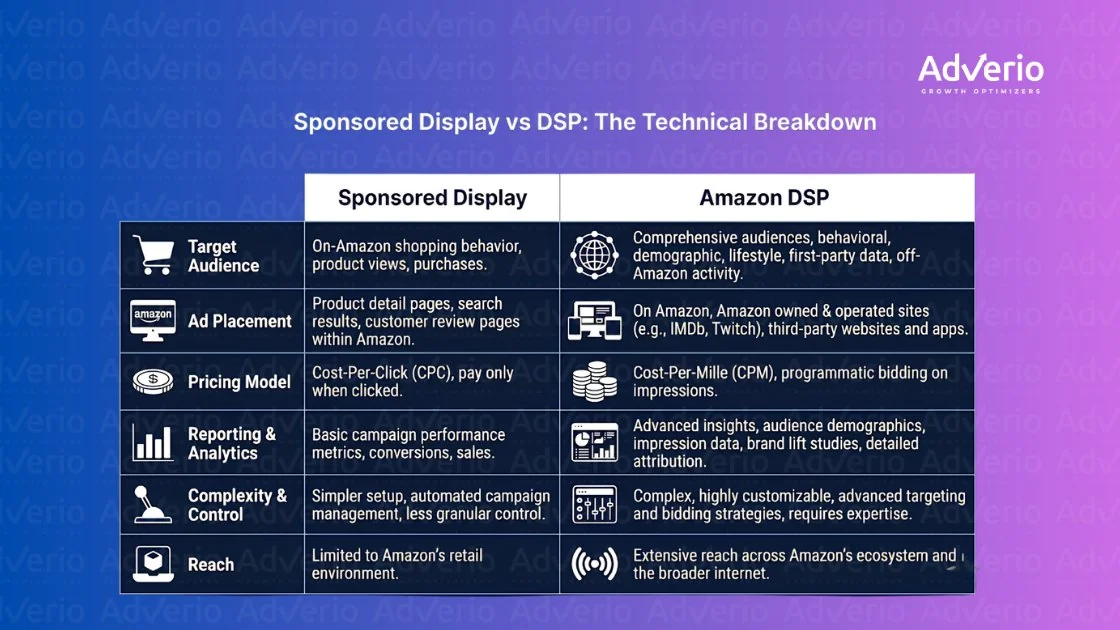
Sponsored Display vs Amazon DSP Key Differences
| Attribute | Sponsored Display | Amazon DSP |
|---|---|---|
| Placement | Amazon retail environment and select off-Amazon display extensions tied to Amazon ad products | On Amazon, Amazon-owned properties, and broader third-party websites and apps |
| Targeting | Product targeting and simpler audience targeting tied to Amazon shopper behavior | Richer audience construction with broader programmatic controls and deeper segmentation |
| Pricing | Primarily CPC-based | CPM-based impression buying |
| Best for | Retargeting, product-page defense, competitor conquesting, lower-funnel efficiency | Off-Amazon reach, advanced audience strategy, video-led awareness, larger-scale retargeting |
| Minimum spend | Lower barrier to entry and easier for most brands to test | Higher operational and budget commitment in practice |
That table should settle the fake debate. They are not interchangeable.
The strategic read on that table
A CPC model usually gives Sponsored Display a cleaner entry point for operators who need accountability fast. You’re still vulnerable to bad setup, but the economics are easier to understand.
A CPM model in DSP can be powerful, but only if your team knows how to judge impression quality, frequency pressure, audience fatigue, and assisted conversion behavior. That’s why weak agencies hide behind complexity. They know most brands won’t challenge the assumptions.
Here’s the blunt recommendation:
-
Use Sponsored Display first when your job is to recover demand and protect profitable traffic.
-
Use DSP when your audience plan requires media beyond Amazon’s immediate retail context.
-
Use both only when you can explain what each channel owns in the path to purchase.
If your team needs outside support managing that complexity, Amazon DSP management is one route to evaluate. But keep the standard high. You want channel ownership logic, not just media activation.
Display Creatives That Win Clicks and Stop Scrolls
Most display campaigns don’t fail because of targeting. They fail because the creative is lazy.
Brands spend weeks debating audience strategy, then run a bland product shot with no reason to care. That’s not advertising. That’s inventory documentation.
Bad creative makes every media decision worse
If your ad looks generic, the platform has to work harder to earn a click or view-through. If your message is vague, your strongest audience still won’t care. Creative is not decoration. It is the conversion bridge between the placement and the product.
For video-based amazon display ads, Amazon’s moderation requirements are strict. Display video creatives require a maximum file size of 500MB, 16:9 aspect ratio, minimum duration of 6 seconds and maximum of 45 seconds, dimensions of 1920×1080 or higher, minimum video bit rate of 4mbps, supported frame rates including 23.976, 24, 25, or 29.97 fps, and minimum audio bit rate of 192kbps with 44.1kHz or 48kHz sample rate. Ignore the specs and you create moderation problems before performance problems.
The 300×250 unit matters more than brands think
For DSP, the 300×250 Medium Rectangle is the workhorse. It accounts for the majority of total impression share, often delivers lower CPMs, and outperforms larger formats in high-intent placements.
That matters because many brands overdesign for flashy formats and underinvest in the unit that bears the load.
A few essential requirements:
-
Lead with the product benefit, not a vague lifestyle promise
-
Design for mobile readability, because clutter dies fast on smaller screens
-
Use clean branding, but don’t let the logo consume the ad
-
Build creative by audience stage, because retargeting creative should not look like prospecting creative
The best display creative doesn’t try to say everything. It gives one clear reason to care and one clear reason to act.
If your product visuals are weak, fix that before you touch media. Adverio’s guide on Amazon product photography that converts is the right starting point.
The Growth Operator’s Framework for Choosing Your Ad Type
Stop asking which platform sounds more advanced. Ask which platform matches your business problem.
That single change saves brands from a lot of expensive stupidity.
Start with the business objective
If your main goal is direct-response recovery, competitor interception, or detail-page defense, Sponsored Display usually deserves the first budget.
If your goal is broader audience creation, repeated exposure, and off-Amazon reinforcement, DSP enters the conversation.
Those are different jobs. Treating them as the same is how budgets drift.
Then audit conversion reality
Here’s the under-discussed issue most agencies skip. Display ads often sit outside the cleanest purchase path, so conversion tends to suffer. Display ads tend to have lower conversion rates because they don’t appear in Amazon’s search results the same way sponsored search does. If you don’t quantify that penalty inside your own account, your ROAS targets can lie to you.
Operator rule: Don’t judge display with search expectations. Judge it by incremental profit after accounting for weaker conversion behavior.
Use this decision filter
Choose Sponsored Display when
-
Your retail fundamentals still need work
You need a channel that can support efficient retargeting without introducing full DSP complexity.
-
You need lower-funnel pressure
You’re trying to recover shoppers who already touched the brand or disrupt competitors at the PDP level.
-
You want faster testing cycles
Sponsored Display is usually easier to stand up, interpret, and iterate.
Choose DSP when
-
You’ve already proven Amazon conversion strength
Your hero products convert well enough that wider reach won’t just magnify leakage.
-
You need broader audience access
You’re trying to influence shoppers beyond Amazon’s immediate retail environment.
-
You can measure beyond last-click
If your team only trusts the shortest attribution path, DSP will create confusion and internal fighting.
Use both when
Sponsored Display handles the warmer retargeting and defensive jobs. DSP handles broader audience reach, richer sequencing, and upper-funnel reinforcement. That split is rational. “Run both because more touchpoints are better” is not.
Watch for Optimization Myopia
A lot of brands obsess over ACoS and ignore everything else. That’s what we call Optimization Myopia. It sounds disciplined. It usually leads to underinvestment in growth channels or overinvestment in channels that look efficient while capping scale.
The right decision is the one that improves contribution after ad spend, protects ranking where it matters, and supports the catalog you want to grow.
If you’re trying to decide whether now is the right time to expand, this is the exact strategic question behind when to use Amazon DSP.
Why Adverio’s Approach to Display Is Different
Most agencies treat DSP like a status symbol. Turn it on, spend more, call it strategic. That’s how brands end up paying for media they haven’t earned.
The better doctrine is controlled deployment.
DSP should not be always-on by default. It should be deployed when your retail conversion engine is already stable, your catalog priorities are clear, and your team knows what the campaign is supposed to own. That kind of cross-channel discipline is what Amazon account management is supposed to deliver.
That’s also why Sponsored Display remains the right retargeting tool for most brands until they’ve proven they need DSP’s broader audience access and off-Amazon reach. The wrong sequence burns money. The right sequence compounds.
At Adverio, DSP is controlled deployment — not a default upsell. Every channel decision ties back to profit visibility across ads, listings, inventory, and reviews.
If you’re evaluating any partner, ask three questions:
-
What specific business problem does DSP solve for us right now
-
What retail metrics must be healthy before we scale display
-
How will you separate direct response from assisted influence
If they can’t answer clearly, don’t hand them your budget.
Burning Questions on Amazon Display vs DSP Strategy
The last layer is where experienced operators usually get stuck. Not on definitions. On ownership, budget logic, and measurement.
Frequently Asked Questions
| Question | Answer |
|---|---|
| Do Sponsored Display and DSP do the same thing | No. They overlap in some display use cases, but they operate on different buying models and are built for different levels of audience access and media control. |
| Is DSP worth the higher cost | Sometimes. It’s justified when off-Amazon reach, impression buying, richer audiences, or video sequencing solve a real growth problem. It’s wasteful when used to mask weak retail fundamentals. |
| Should I replace Sponsored Display with DSP | Usually no. Sponsored Display often remains the better tool for practical retargeting and PDP-level pressure. DSP should add capability, not automatically replace what already works. |
| How should I split budget between them | Start from channel role, not arbitrary percentages. Fund Sponsored Display for lower-funnel recovery and defense. Fund DSP only when you can define the audience and expected incremental job clearly. |
| How do I judge success if display converts worse than search | Use a different lens. Look at contribution, audience quality, assisted paths, and whether the channel improves total business outcomes. Don’t force display into a pure search-style scorecard. |
| What if my agency says DSP is necessary for brand equity | Ask them to define brand equity in operational terms. If they can’t connect spend to audience strategy, retail readiness, and downstream profit, they’re selling a narrative, not a plan. |
The cleanest strategy is rarely the loudest one. It’s the one that matches media type to business stage, protects profit, and doesn’t confuse channel complexity with sophistication.
If you want a blunt answer on whether your brand should stay in Sponsored Display, add DSP, or avoid both until your retail fundamentals improve,
Book your ROI Forecast with Adverio.