



Table of Contents
Most advice on DTC Amazon integration tells $5M–$50M brands to “protect the brand” on Shopify and “test Amazon carefully”—like those are separate decisions with separate consequences.
They aren’t. If you run Shopify and Amazon as separate P&Ls, separate teams, and separate data sets, you’re already creating margin leaks. Amazon isn’t killing your DTC business. Your lack of channel architecture is.
The brands that win treat DTC as the relationship engine and Amazon as the demand-capture engine. Different jobs. Shared economics. Shared inventory logic. Shared pricing rules. Shared creative discipline. Shared reporting. That’s the difference between expansion and self-cannibalization.
That same cross-channel pressure is showing up beyond Shopify and Amazon. If you want a fast example of how marketplaces now influence each other, this breakdown of how TikTok Shop impacts your Amazon ranking is worth your time. The lesson is simple. Channels don’t stay isolated just because your org chart says they do.
If your Amazon presence is underbuilt, unmanaged, or being “handled internally when there’s time,” you need tighter Amazon account management for established brands.
And if your current model already feels messy, Book Your ROI Forecast before those leaks get more expensive.
Amazon Isn’t the Problem. An Unmanaged Presence Is.
DTC operators usually fear three things when Amazon enters the mix. Margin compression. Customer data loss. Brand dilution.
Those fears are valid. They’re also incomplete.
The real problem isn’t channel conflict
Amazon becomes a problem when you let it operate without rules. No pricing guardrails. No inventory buffers. No audience strategy. No understanding of what belongs on DTC versus what belongs on Amazon.
That’s when a marketplace turns into a parasite instead of a growth channel.
Unmanaged Amazon doesn’t just create extra sales. It also creates extra confusion, duplicated spend, and bad attribution.
A lot of brands still act like avoiding Amazon protects DTC. It doesn’t. It usually hands branded demand to competitors, gray-market sellers, or a sloppy listing that someone else controls.
Separate channels create fake clarity
Founders like clean separation because it feels like control. DTC owns retention. Amazon owns volume. Separate dashboards. Separate goals. Separate accountability.
That setup looks organized. Financially, it’s a mess.
You start seeing the same customer move between touchpoints with no shared measurement. Promotions conflict. Inventory gets tight in one channel while the other keeps spending. Your PPC team optimizes one metric while your retention team protects another.
What you need is not channel independence. You need synchronized profit logic.
Why Your Fear of Amazon Is Costing You Millions
Fear creates fake discipline.
Brands call it “protecting DTC” when they avoid Amazon, limit the catalog, or treat the marketplace like a side project. In practice, they are leaving revenue, pricing control, and audience intelligence on the table. The cost is not just missed sales. The cost is giving Amazon demand to competitors while your own team keeps paying to generate it.

Your channels already share demand
Customers do not respect your org chart. They move between paid social, Google, Amazon search, reviews, your PDPs, and creator content before they buy. Buyers discover in one channel and convert in another—constantly. Branded DTC activity drives Amazon consideration. Amazon reviews push customers back to Shopify. The funnel is circular, not linear.
That should change how you plan the business.
If your team measures DTC in one dashboard, Amazon in another, and paid media in a third, you are not protecting profit. You are hiding cannibalization, duplicated spend, and pricing mistakes from yourself. The fix is a profit-centric integration architecture that connects four control points: inventory, advertising, audience, and pricing. Anything less gives you channel reports instead of channel strategy.
Buy with Prime made the separation story weaker
Buy with Prime puts Prime delivery and checkout directly on Shopify storefronts. No minimum volume requirement. The “DTC versus Amazon” framing is already obsolete at the infrastructure level. Your operating model needs to catch up.
Use that overlap with intent.
| Concern | Expensive assumption | Profitable interpretation |
|---|---|---|
| Margin pressure | “Amazon sales are lower quality revenue” | “Different channel economics require different SKU, fee, ad, and fulfillment rules” |
| Customer ownership | “Amazon blocks customer value” | “Amazon captures high-intent conversion. DTC captures retention, bundles, and first-party audience growth” |
| Brand dilution | “Marketplace presence weakens the brand” | “Weak catalog control, bad content, and unmanaged resellers weaken the brand” |
Avoiding Amazon does not protect growth
It reroutes growth to whoever is easier to buy from.
A shopper who cannot find your offer on Amazon does not suddenly become loyal to your Shopify store. They compare alternatives, buy a substitute, or purchase from an unauthorized seller. Meanwhile your paid media team keeps funding category education and branded demand that someone else monetizes.
That is why the decision is not whether Amazon belongs in your channel mix. The decision is whether you will run it with centralized profit rules or let the market run it for you.
If you’re weighing broader marketplace tradeoffs, this comparison of Amazon vs Walmart vs Target marketplace strategy helps frame where each channel fits.
The Three Profit Leaks That Sink Unmanaged Integrations
Most failed dtc amazon integration efforts don’t fail because the tech is impossible. They fail because the operating rules are weak. The damage usually shows up in three places first.
Pricing inconsistency wrecks trust and marketplace stability
Run a promo on Shopify without thinking through Amazon and you can trigger downstream problems fast. Your DTC customer sees one price. Amazon sees another. Your marketplace listing loses momentum, your offer becomes unstable, and your team starts “fixing” a problem that was created upstream.
This gets worse when promotions are owned by different teams.
One side wants list growth. The other wants Buy Box stability. Finance wants margin protection. Nobody owns cross-channel pricing logic, so everyone steps on everyone else.
Practical rule: Set pricing policy centrally. Promotional freedom without channel governance is just a slower way to lose profit.
Customer data silos waste the value of demand you paid for
Amazon won’t hand you the same customer relationship data your DTC stack gives you. That’s obvious. What too many brands miss is the strategic implication.
If your DTC and marketplace teams never align on acquisition and retention roles, you keep treating every buyer like a net-new event. That inflates CAC thinking, blurs lifetime value decisions, and leads to sloppy retention planning.
A clean operating model looks more like this:
-
DTC owns retention mechanics such as email, subscription, bundles, loyalty, and post-purchase experience.
-
Amazon owns frictionless trial and discovery for shoppers who prefer marketplace behavior.
-
Leadership owns migration logic so each channel supports the other instead of competing for the same buyer without context.
Ad spend competes when budgets are set in silos
This is the leak that astute brands still miss. Google is buying demand. Meta is creating demand. Amazon PPC is harvesting demand. DSP can shape consideration and retarget marketplace behavior. If these budgets sit in separate systems, you don’t have a media strategy. You have a bidding war with yourself.
Brands that fix this typically start by consolidating under a unified Amazon PPC management framework that maps spend to contribution margin, not siloed ROAS targets.
A common pattern looks like this:
-
DTC pays to generate branded search interest.
-
The customer checks Amazon before purchasing.
-
Amazon campaigns pay again to close the same demand.
-
Reporting celebrates both teams while blended profit gets worse.
That’s not growth. That’s duplicate acquisition cost.
For brands trying to stop this cycle, tighter Amazon inventory management across channels usually needs to sit inside a broader operating model, not a one-off fix.
What unmanaged integrations usually look like
-
Inventory updates lag behind promotions
-
Creative messages conflict across PDPs and ads
-
Brand search gets overfunded in multiple channels
-
Operations teams react to oversells after the damage is done
-
Finance sees revenue growth but can’t explain margin compression
What disciplined integrations look like
-
Shared calendar
-
Shared pricing rules
-
Shared inventory thresholds
-
Shared budget model
-
Shared view of contribution profit by channel
If you don’t have those, your channels are cannibalizing each other whether the dashboards admit it or not.
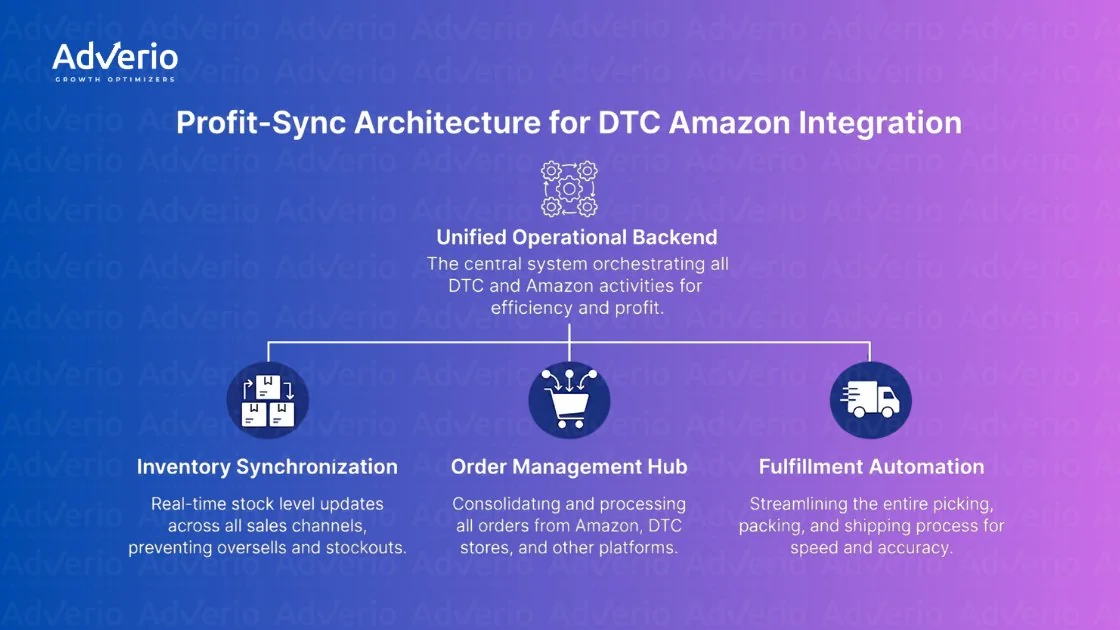
The Profit-Sync Architecture for Inventory, Orders, and Fulfillment
Brands that treat Amazon integration like a feed connection usually end up with a margin problem, not a growth engine. The winners build an operating architecture that controls inventory, orders, fulfillment, pricing, and demand signals together. That is how you stop Amazon from stealing profit from your DTC channel while still using its scale.
Build the connection correctly
Shopify-to-Amazon integration usually runs through connectors such as Byteout or Codisto. The setup includes an Amazon Professional selling plan, API authorization, product mapping, and fulfillment rules across FBA, FBM, or MCF, as outlined in Byteout’s Shopify to Amazon integration guide.
The mechanics are simple. The sequence is not.
A disciplined rollout follows this order:
-
Clean the catalog first. Fix titles, variants, images, GTIN problems, and parent-child relationships before anything syncs.
-
Authorize the connector after the catalog is stable. Bad source data only spreads faster once the connection is live.
-
Map products SKU by SKU. Bulk pushing a messy assortment into Amazon creates listing conflicts, suppressed offers, and pricing exceptions.
-
Set channel-specific fulfillment rules. Decide which products belong in FBA, which should stay FBM, and which can use MCF without crushing contribution margin.
-
Test a narrow batch first. Byteout recommends starting with 5 to 10 SKUs in the same guide, then checking order flow, inventory decrements, tracking updates, and refund handling before expanding.
Inventory sync is required, but it is only one layer
Inventory accuracy matters because every bad sync creates a downstream cost. Oversells trigger cancellations. Stockouts waste ad spend. Delayed decrements push one channel to borrow profit from the other.
That is why your integration architecture needs explicit controls:
-
Safety stock thresholds by channel and SKU
-
Category approval checks before launch
-
Daily exception monitoring for suppressed listings, stranded inventory, and price conflicts
-
A single product source of truth for catalog updates
-
Shared pricing logic so Amazon promotions do not undercut DTC profitability
If you want a clean primer on the concept itself, Streamkap’s explanation of data synchronization is useful context. The operating principle is straightforward. When systems disagree, margin disappears.
Choose fulfillment by profit role
Too many brands choose fulfillment based on convenience. That is amateur planning. Fulfillment should be assigned by profit role, customer expectation, and channel economics.
| Fulfillment path | When it fits | Tradeoff |
|---|---|---|
| FBA | Fast-moving Amazon SKUs where Prime speed materially improves conversion | Higher fees and less control over parts of the customer experience |
| FBM | Margin-sensitive SKUs, oversized items, bundles, or products that need tighter handling rules | More operational complexity on your side |
| MCF | Selected DTC orders where Amazon’s network improves service levels without eroding brand economics | Fees and brand experience need close review before scaling |
Use Buy with Prime the same way. It is a tactical conversion tool for specific products and customer segments. It is not a blanket DTC strategy, and it should never be layered in without checking fee impact, repeat-purchase behavior, and channel mix.
Reporting has to sit above the connector
The connector moves data. It does not make decisions. You still need a reporting layer that combines inventory status, order flow, pricing, returns, ad spend, and channel-level contribution margin in one operating view.
That matters because profit leaks rarely show up inside one platform. They show up between platforms.
A serious setup gives operators one place to see whether a pricing change on Amazon hurt Shopify conversion, whether an FBA stockout shifted demand into a lower-margin path, and whether ad spend is supporting profitable sell-through or just accelerating stock problems. That is the point of a unified business intelligence layer for marketplace and eCommerce operations.
Get this architecture right and Amazon becomes part of a coordinated profit system. Get it wrong and you will keep calling channel conflict a growth strategy.
Unifying Your Customer View with Cross-Channel Data
Inventory sync keeps operations running. Profit comes from connecting customer, advertising, pricing, and order data well enough to see whether Amazon is creating incremental demand or just stealing demand you already paid to generate elsewhere.
That is the line too many brands miss.

AMC gives you a usable overlap view
Amazon Marketing Cloud gives brands a privacy-safe way to analyze how first-party DTC audiences relate to Amazon ad exposure and purchase behavior. Adverio explains the workflow in this breakdown of linking DTC and Amazon shoppers through AMC.
That matters because channel reporting is usually fragmented by design. Shopify shows owned customer behavior. Amazon limits direct access to shopper identity. Ad platforms report media performance inside their own walls. If you do not connect those environments, your team will misread overlap, overspend on duplicated targeting, and make pricing decisions without seeing the downstream effect on contribution margin.
This is where Amazon DSP management becomes a cross-channel tool—not just a retargeting add-on, but a mechanism for protecting audience segments you already paid to acquire on DTC.
The setup is technical. The objective is commercial.
The mechanics are straightforward if your data model is disciplined:
-
Export first-party DTC data from Shopify or your commerce stack.
-
Route that data into AWS through tools such as Amazon AppFlow or AWS Lambda.
-
Store it in Amazon S3.
-
Map it to AMC-compatible schemas.
-
Run overlap and pathing analysis inside AMC against Amazon media and conversion events.
The important part is not the pipe. The important part is what you combine around it. Audience overlap alone is not enough. You need to line it up with ad spend, price changes, promo calendars, repeat-purchase behavior, and channel-level margin so the business can see whether a customer shift helped total profit or just moved revenue from one dashboard to another.
Questions worth answering
A connected customer view should answer decisions that affect spend and margin:
-
Where demand starts. Did the customer discover you on Amazon, through paid social, through search, or through an existing retention loop?
-
Where demand finishes. Are shoppers buying where the economics are strongest, or where convenience and price pulled them?
-
Who is being hit twice. Which audiences are getting paid media on both Amazon and DTC with no incremental lift to justify it?
-
What pricing is doing to behavior. Did an Amazon promotion pull forward profitable new demand, or did it train existing DTC buyers to defect?
-
Which segments deserve protection. Subscription buyers, high-LTV cohorts, and bundle buyers should not be treated like one-time marketplace shoppers.
That is how you stop channel politics and start running portfolio strategy.
Use the right split of control
Teams make better decisions when they are clear about what they own and what they measure.
| Area | Your role |
|---|---|
| DTC first-party data | Own it, enrich it, and use it for retention, segmentation, and lifetime value planning |
| Amazon interaction data | Analyze it inside Amazon’s privacy-safe environment and use it for acquisition and demand capture decisions |
| Cross-channel overlap | Measure it to reduce duplicated targeting, protect margin, and spot migration patterns |
| Pricing and promo response | Compare channel behavior and contribution margin before scaling any offer |
If your stack can support this level of analysis, pair AMC with broader Amazon analytics tools for profit-focused measurement. Visibility alone does not fix cannibalization. A profit-centric integration architecture does.
Governing Your Brand and Catalog Across Channels
A messy catalog can sabotage good media, good ops, and good data. That’s why brand governance matters just as much as integration mechanics.
You need one source of truth for pricing, product data, content hierarchy, and promotional rules. Not a Google Sheet someone updates when they remember. A real operating standard.

Brand consistency doesn’t mean copy-paste content
Your Amazon PDP should not be a duplicate of your Shopify product page. Different platforms reward different structures and buyer behavior. But the core brand promise, product claims, imagery standards, and offer logic still need to stay aligned.
That requires governance at three levels:
-
Pricing rules that prevent channel conflict and random discounting
-
Catalog rules that keep variants, parent-child relationships, and product naming clean
-
Content rules that adapt to each platform without splitting the brand story in half
Catalog health is a profit issue
If your listings are inconsistent, you’ll create operational mistakes and conversion drag at the same time. Internal teams usually treat this as a merchandising clean-up project. It’s not. It’s a margin issue.
A disciplined review process should cover.
Weak listings don’t just hurt Amazon conversion—they undermine the brand equity your DTC channel is building. Amazon listing optimization is the structural fix, not a cosmetic one.
-
Title and variation consistency across DTC and Amazon
-
Image and copy compliance for platform requirements
-
Promotion logic by SKU, not by channel whim
-
Review use and syndication strategy where your stack supports it
-
Listing quality scoring so weak PDPs get fixed before more ad dollars hit them
Structured catalog QA matters. Some brands use internal frameworks. Others use a listing quality process or LQS-style review standard to catch content, compliance, and merchandising issues before they spread.
If your brand voice changes every time a shopper changes platform, you don’t have a multi-channel strategy. You have channel drift.
Protect the brand by tightening operations
A lot of founders think brand protection means avoiding Amazon-native tactics. Usually it means the opposite. The channel needs tighter rules, not softer participation.
If your pricing is disciplined, your listings are well-governed, your reseller exposure is controlled, and your promotional calendar is centralized, Amazon can reinforce brand equity instead of stripping it down.
The Adverio Blueprint for Omnichannel Dominance
Omnichannel growth does not come from listing the same products in more places. It comes from running one profit system across every revenue channel.
That is the line DTC brands keep missing on Amazon. They sync inventory, maybe orders, then call it integration. That is incomplete and expensive. Real integration has to unify pricing, advertising, audience signals, and contribution reporting so one channel does not steal margin from the other.
That’s the foundation of a working Amazon growth strategy for multi-channel brands—one that treats DTC and Amazon as coordinated levers, not competing P&Ls.
Adverio’s operating model is built around that standard. One profit framework. One set of channel roles. One decision system that tells your team when Amazon should acquire demand, when DTC should retain it, and when pricing or media changes in one channel will create damage in the other.
What execution actually requires
There are two workable models.
-
Done-for-you for brands whose internal team is already stretched and cannot keep fixing marketplace mistakes after they hit margin
-
Done-with-you for leadership teams that want control over strategy but need stronger marketplace execution, tighter reporting discipline, and channel-specific operator support
Both models fail without the right control layer. You need shared budget logic, SKU-level profitability review, catalog governance, ad reporting tied to contribution margin, and audience intelligence that carries across platforms. If those systems live in separate tools and separate teams, your integration is cosmetic.
Some brands only need tighter marketplace execution. Others need a wider operating model that connects Amazon with DTC, Walmart, and retail media under the same margin rules. The right answer depends on where profit leakage is happening now, not on which channel looks promising in a board deck.
What to do next
Stop increasing spend if any of this is true:
-
DTC promotions keep disrupting Amazon conversion or buy box performance
-
Inventory planning happens without ad spend, demand pacing, or margin context
-
Amazon reporting and DTC reporting still live in separate team views
-
Marketplace revenue is up while blended contribution margin is getting worse
-
Your retention team and marketplace team target customers with no shared audience logic
Fix the architecture first.
If your brand wants Amazon growth without cannibalizing DTC economics, start by mapping the profit system, not the channel tactics. If that work is overdue, Book Your ROI Forecast.
Frequently Asked Questions about DTC Amazon Integration
Should promotions run at the same time on DTC and Amazon
Not automatically. Run them under a shared pricing policy. Some promotions should mirror across channels. Others should be channel-specific based on inventory position, margin structure, and customer objective. Randomly matching every offer is sloppy.
How do you handle resellers that disrupt pricing parity
First, tighten distribution. Then monitor listing ownership and offer volatility aggressively. If resellers can undercut your intended pricing architecture, your integration model will stay unstable no matter how good your ads are.
Is Buy with Prime right for every DTC brand
No. It’s a tool, not a strategy. Use it where faster checkout and fulfillment support the economics and customer experience you want. Don’t roll it out just because it exists.
Should the full catalog go to Amazon
No. Some SKUs belong on Amazon because they convert well in marketplace environments. Others work better as DTC exclusives, bundles, subscriptions, or retention drivers. Channel role should dictate assortment.
How should international expansion work
Don’t copy your domestic setup blindly. Rebuild the operating rules for each market, especially around approvals, fulfillment, pricing, and catalog structure. Expansion without local channel discipline just exports your mistakes.
For brands that need a broader cross-channel operating model, this is usually where an omnichannel Amazon marketing agency and a tighter ecommerce growth strategy for multi-channel brands start making sense.
If your Shopify store and Amazon channel are still managed like separate businesses, you’re funding the leak and calling it strategy. Adverio builds profit-centric integration systems for established brands—connecting inventory, advertising, pricing, and customer data around one margin framework. If you want to know exactly where cannibalization is happening and what to fix first, Book Your ROI Forecast.