Amazon PPC Branded Campaign Strategy [The PPC Den Podcast]
The world's first and longest running show all about Amazon PPC.
Episode Overview
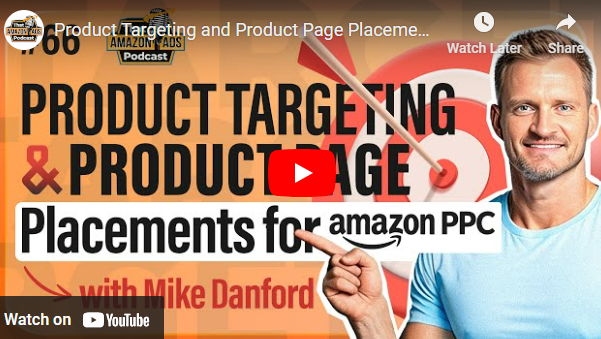
In this episode of The PPC Den Podcast, Mike Danford from Adverio joins the discussion to explore one of the most debated topics in Amazon advertising: branded PPC spend. While branded campaigns often deliver strong return on ad spend, many brands unknowingly allocate a large portion of their advertising budget toward branded keywords without fully understanding their impact on overall performance.
Mike explains how Amazon advertisers can use Search Query Performance data to analyze branded campaign performance and uncover hidden inefficiencies. By breaking advertising data into clear performance buckets, brands can evaluate the difference between branded keywords, competitor targeting, and generic search campaigns.
Core insight: This approach helps advertisers understand where incremental revenue is actually being generated and where advertising spend may simply be capturing demand that would have converted organically.
The conversation also explores how brands can gradually reduce excessive branded ad spend while monitoring performance metrics like purchase share and impression share. Through careful testing and structured campaign management, advertisers can rebalance budgets toward more incremental opportunities such as competitor targeting and broader keyword campaigns.
These types of campaign audits and data-driven decisions are often part of structured Amazon PPC management, where brands continuously analyze performance data and refine campaign structure. When combined with broader Amazon account management, advertisers can align their advertising strategy with long-term growth and marketplace performance.
This episode provides practical insights for Amazon brands looking to control branded advertising spend while improving overall campaign efficiency.
What You'll Learn in This Episode
- Why many Amazon brands overspend on branded PPC campaigns
- How to analyze branded spend using Amazon Search Query Performance data
- How bucket analysis helps separate branded, competitor, and generic traffic
- Strategies for targeting competitor product pages at lower CPCs
- How auto and broad campaigns can capture competitor placements
- How negative keyword sculpting improves Amazon PPC campaign efficiency
- How to gradually reduce branded ad spend without losing purchase share
Highlights
- 00:00 Intro
- 02:16 Amazon PPC: branded spend cycles
- 07:22 Bucket analysis, BI dashboards, and incrementality scores
- 11:00 Targeting strategies: competitor pages, broad and auto campaigns, and negatives
- 17:55 Controlling branded spend and tapering strategies
- 24:15 Measuring results with cannibalization and Search Query Performance
- 30:12 Final tips and actionable advice for brands
Episode Transcript
Host: What is going on, Badger Nation? Welcome to the PPC podcast, the world's first and longest running show all about how to make your Amazon advertising life a little bit easier and a little bit more profitable. Branded spend on Amazon is an interesting topic that has been discussed many times on this show. What has not been discussed is really what to do about it and how to think about it in a way that you can actually act on. We are going to get into that in this episode, talking about buckets of data analysis, negative keyword sculpting, and broad and auto type campaigns to pick up competitor impressions for really cheap. It is going to be great. Let us jump in.
Host: Mike, thanks so much for coming back on the show. Great to have you. Tell me about your setup, you moved office locations. Are you still working from home? What is your home office strategy like?
Mike: Yes, that is from home. It is actually in the same room, but I am able to use multiple parts of it instead of being shoved into a corner. Now I have three or four different zones where I can sit, stand, be in the chair, different cameras, mics, everything. It feels like my office is 10 times the size it used to be. Fresh coat of paint, the color I wanted. It has been great.
Host: I recently did something that might inspire some people. Four-bedroom house, the primary bedroom is gigantic, and we had all these little tiny rooms I was using as an office. I swapped it. My office is now the primary bedroom, so I have oodles of space now. That was my change over the last year and it has been cool.
Mike: That is nice. We live in a 127-year-old home, so these rooms are not large, all the same size. We shoved a bathroom into my daughter's closet, so she now has her own suite. That was a good change.
Host: Anyway, as we shift from home office optimization into the world of Amazon PPC, I love that you brought this topic up in our pre-show, the cyclical nature of it. People are either paying hyper attention to it or they completely forgot about it, and really where you want to be is the balanced middle where you have it under control and tracked, which is of course branded spend in Amazon PPC. So why was this up for you? Did you recently have an experience where a client's branded spend was a little out of whack? Talk us through how this came up.
Mike: Absolutely. There is some percentage of every brand that comes to us that will work to reallocate that brand spend, but we have had clusters in the last three to six months where somebody is all absorbing the same ideology and they are pushing 30, 40, even up to 70 percent of their spend on brand keyword protection. Now with Search Query Performance, where you can more objectively understand your search coverage and where you are in the funnel, it is so much easier to objectively show and test inside Amazon that when you pull back spend on branded, you either do or do not lose your purchase share. Putting those two together has been remarkable. It is definitely a hot take, a controversial topic. On the flip side, we will have brands that are aware they are spending too much on branding and they are scared to pull back because they did not know they could measure it in Search Query Performance, or they do not know how to measure whether they lose the purchase share. And others are so used to that great looking ROAS that when you go to competitors or more generic search terms, they are like, what, this ROAS is a third or a tenth of what we are used to, and it is a bit of a shock if they are not used to it.
Host: It is so fascinating. Branded spend, both on branded search terms and branded as defense, is a really interesting intersection. I am picturing a lighthouse with different waves crashing from lots of directions, because you have brands that are relatively unknown who would kill for branded traffic, since that is a sign of a really healthy brand. If you have 70 percent branded spend, the bummer is maybe you could have gotten those sales without that spend, but at the same time you have people clamoring for who you are, which a new brand would kill for. So you have the life cycle of the brand. Then you also have brands that wake up one day and go, oh, branded spend, and start asking the question. What is really interesting is if a brand has been analyzing things at a high level, they know their current ACoS is 35 percent, and then you do this branded study, and all of a sudden it shatters their world, because it has possibly been years of 30 to 35 percent ACoS and now you tell them their branded spend converts at a 2 to 3 percent ACoS and everything else converts at like a 60 percent ACoS. So if you turned off all your branded spend today, your account-level ACoS would skyrocket and your revenue would be much lower than you thought. So the question is, how does one manage this? Let us take some of those scenarios. The extreme one: somebody comes to you with 70 percent brand spend, incredible ACoS because the majority is branded. How do you untangle that?
Mike: Absolutely. First we dive one layer. We try to understand what share of that 70 percent is branded keywords or search result pages, and the other part is your PDP, your detail page, product defense, and the advertising carousels. We want to understand that breakdown. From there you get into the nitty-gritty of the actual target versus the search terms, because you can target an ASIN and it shows up for a keyword, or you can target a keyword and it shows up for an ASIN. So you have to be really intentional. A lot of that is now placements: how we force a keyword to show up on just search and not the ASINs, and vice versa. We need a product placement high enough so it does not show up in search. You declutter all of that. We have a program, and we offer it to a brand, here is your DIY option, and they go do it, and the first thing they say is, hey, we did all this but our search terms are still showing up. Negate, block, and make sure your placements are set up. That is the next thing. It is all over the place, so that is how we approach it, see where it is at and go from there.
Host: Let me put a pin on that first point. This kind of analysis is always helpful. I call it bucket analysis, meaning what bucket of spend do I have and how does it behave. Branded search terms is one bucket. Branded ASIN search terms is another. Placement information you can cross these dimensions, so branded search terms and top of search placement, and so on. You tease out each bucket, and it is difficult because it takes time to do this. Going back to that company humming along at 35 percent, maybe only analyzing total ad spend versus total ad revenue, splitting these into smaller buckets can reveal exactly what is going on. You mentioned different considerations for branded defense versus search term based defense. How do you think about those two buckets?
Mike: Our reporting dashboard is fully built onto this. It is pre-wired to say this is what you are spending for branded ASIN, branded keywords, competitor keywords, generic keywords, competitor ASIN, all built in, and we can see it when you connect the past 90 days at the search term level. If we go longer we can see year over year. Then we tie that into an incrementality score. A brand keyword is the lowest incrementality, someone is already searching for it and you likely have a strong organic placement, so you may not need to spend on that. Your highest incrementality is when you steal from someone else's competitor or branded search, and everything else is in between. We track that over time, put weight on it. We work with very large catalogs, lots of parent ASINs and child variations, so we can fully cover all the carousels on your own product detail pages, which is fun, and report on the ROAS and performance. It is a defense and also an upsell and cross-sell. We have case studies showing, hey, this product we have never seen before, why is it now showing up in the carousel, and it is your own brand product, so you get a much better return than going on a different detail page. Based on your CPC and historic data, we have an idea what your conversion rate will be and what percentage of budget should go there, and we can push aggressively or pull back. We can see it month over month and how it impacts your incrementality.
Host: So that takes bucket analysis one step further. Not every dollar of spend is equal. The highest value order, what you called the incrementality score, is where you are going after a competitor's brand or product page, because you basically plucked a sale from them, so that is worth more than just the revenue. That analysis can be tricky for any brand. What is the conversation like when you explain these levels, like a branded keyword has the lowest value because they would have converted anyway, up to a competitor term that has different value because they might not have converted at all? How does goal setting work at that level? Do you set an account-level goal?
Mike: The best scenario is they have done a little of all of this: branded keyword, branded PDP defense, some competitor conquesting, maybe some competitor keywords. So we have a bit of data to say, here is your relative ROAS and conversion rate, and use that as a starting point to scale. It is about getting a barometer and preparing them: competitor keyword is going to be expensive, let us do a little, that is the last thing we want to get into, let us maximize all the other placements and incremental targeting first and then go there. How much can you take? Is a certain product or brand better? Brands come to us with vanity: I want to conquest this brand. Okay, we will do it and show you. But on Amazon there are millions of sellers and brands, so why not pepper a lot of those little brands you can absolutely dominate based on review rating and pricing? Last time I was on, we talked about targeting through autos and broads and more generic targeting instead of exact or an ASIN product attribute target. We have consistently done this and can get on a competitor's detail page for about a third of the cost through an automatic or category target than an exact product attribute target. So we instantly reduce cost and keep scale. We just went through a tent pole for one of our brands, Mother's Day, Father's Day, and the search was really expensive this year, less traffic, but we picked up and moved a lot of that spend. About 30 percent of that search spend we put on competitor pages, and it filled the entire gap we lost on search. All the search traffic was 30 or 40 percent down and we made it up on top pages of competitors. That was an amazing win.
Host: To tease out what you mentioned, using broader or looser targeting to show up instead of the exact ASIN target. My rationale has always been that this is probably just the way the Amazon PPC algorithm was designed, where exact matches, whether exact ASIN targeting or exact match keywords, enter a different style of auction than a broad match keyword or an auto does. A low-bid auto can generate clicks cheaper for the same search term than if you bid on that search term exactly.
Mike: Exactly. Amazon has some mechanism to play with different auction levels based on different targeting. We have replicated campaigns: an ASIN target, a keyword target, a category target, dedicated campaigns that are product-placement specific, high placement, and very low. And the inverse, higher top of search or medium rest of search with no multiplier for product placement. We know this campaign is going to show up here for this search term or ASIN, so that is one way we can be very granular. Once you cling that together, Amazon makes it messy, so we keep data hygiene on the back end. A category target will hit a product detail page for about a third the cost of an exact product attribute or ASIN target, and somewhere in between is an ASIN expanded target. We want to make sure we only go for that product detail page versus the search. And because you still have bleed and crossover even as siloed as these campaigns are, our reporting builds it in and says, okay, this was a competitor ASIN target but it converted for a competitor keyword, or this was a branded target and converted for a competitor target. We clean that in the back end so we can still see it, because you will have bleed regardless.
Host: I have done a lot of research where the type of targeting is assisted through negatives: target something loose like a category and use a lot of negative keyword sculpting to sculpt it toward a competitor. That works quite well. Have you found the same? How often are you using negatives to accomplish that?
Mike: Our catalogs have campaign sets in the hundreds and thousands because of the number of products and replication. We have accounts with hundreds of thousands and millions of negatives across the entire campaign set. Let me tease it up: for a relevant search term, what is your comfort level of how many clicks or how much spend before you would perceive it as relevant?
Host: Relevance, I would say you only need one click, it is either relevant or not. But when it is underperforming to the point where I would want to negate it, probably two to three times the average cost per conversion of the account.
Mike: We have some campaigns set up with that logic, give us some room in the greens. But in the autos and categories, if it is a highly relevant campaign or search term, we will negate at two clicks, even if it takes 30 plus clicks on average to convert. There is a negation reset and a sweep where we pull everything out for a few days and see what sticks. When you do aggressive category, automatic, or broad targeting, you get a lot of low-relevance search terms and cheap clicks, so you have to be vigilant because you will catch them in other campaigns too. That took us a lot of getting comfortable, hey, two clicks and we are negating, we cannot do one click.
Host: That makes sense, and you mentioned they would be duplicated elsewhere, so you are not losing complete visibility. You are balancing the broadness of an auto with the specificity of what you are trying to accomplish. And I love the negative keyword reset, where you periodically reset negatives, which happens a lot with seasonality and because conversion rates change over time, ideally getting better, so something that did not convert in the past you can clear out. We have so many great things here: studying branded spend using Search Query Performance, watching yourself reduce branded spend and measuring against purchase share, dividing product-based branded defense versus search term based, building dashboards, understanding buckets with different incrementality. Anything else on branded traffic and visibility? One question I have is about negatives. How aggressively are you trimming branded spend? I have worked with people who said, I do not want to appear for any branded search ever, so every campaign needs a negative phrase of my brand. What are your thoughts on that?
Mike: That is a challenging negation, because you can over-negate and block a relevant term. If you block a keyword Amazon thinks is relevant, you get a spidering effect. When you negate, you are training it that something is not relevant, and Amazon makes assumptions. They have negated this term and this term and there is a massive overlap over here, so they start phrase-negating for you. If you negative-phrase your own brand, which we do, be careful, do not overdo it, do not do it in a campaign where you are not getting brand traffic. Wait until you see brand traffic on a campaign and then start. Try negative exact first, because negative phrase is a massive negation beyond the actual phrase match, and it starts looking at relevancy and what else is relevant to your brand. We have seen that over and over.
Host: Let me ask a more specific question. Say a client comes to you with 70 percent of all their traffic branded. What is your approach, would you say let us get this under 50 percent?
Mike: It is going to be a taper. It is a shock for the brand, especially that high. We have to wait one to three weeks, sometimes a month, before the Search Query Performance data catches up, and there is latency, so it is really a 30-day reduction. What we are trying to do is cut it in half every month. If you are at 70, the goal is around 35 to 40 the first month, and see what happens, measure it against Search Query Performance. No loss in your funnel share on your branded search term, okay, now cut that 35 to 40 down to 15, 20, 25, and keep going until you get down. We have brands that come in at 50 to 60 percent of their spend, and within three to six months we are down to 5 percent, and the branded sales are either the same or convert cheaper. In our case, we have a lot of campaigns and products, so you end up inflating your own bids inside campaign manager before it goes to the auction. So we want granular campaigns where nobody else is bidding on that, so we do not inflate our bids. It is really just reducing it and going back to Search Query Performance with all the QueryIQ intelligence we built in house, and it shows the impact over time: are you still getting impression share, click-through, add to carts. So far we have not seen issues.
Host: To follow up, you mentioned bringing it down over time, checking it against Search Query Performance to be sure your conversion share for branded terms is the same. How are you actually engineering that? And I was inferring a good percentage, single digit, less than 10 percent of ad spend should go to branded keywords.
Mike: ASIN and product detail page defense is a totally different strategy depending on the size of your catalog. First, look at the campaigns you have, how much co-mingling you have. We start by blocking keywords specifically in the campaign that we do not want branded. We try not to relaunch campaigns, especially with significant history, we want to keep that, so we clean it up and block the keyword or ASIN in the campaign. That spend is likely going to shift somewhere else if you have not fully done the negation on the other campaigns, so you are constantly fighting where it pops up. A lot of our products compete for similar search terms whether branded or not, so it goes from one campaign to another. When we start seeing that, instead of playing whack-a-mole, we do a large full-campaign negation or full-campaign pausing. All of it is easy to revert at a campaign or wide level. We try to do as much at once so you can see the impact quickly. If you piecemeal it, it is really hard to see the performance and impact. So we do it abruptly, see what the next couple days look like, and go from there.
Host: So we ran the gamut of branded spend and touched a lot of topics that have not been brought up in years past. I appreciate you bringing the modern and fresh stuff to light. Anything else you wanted to share about branded spend and how to think about it, mitigate it, and control it, which is really the ultimate goal?
Mike: You want to be able to control your branded spend. Be intentional, be aggressive, see what happens, do not be afraid. If you do what you have always done, you will get what you have always got. Have a plan in place, figure out how to use your Search Query Performance, and figure out how to measure what you are doing. The second part is we built a cannibalization score in house as well. It does the opposite of the incrementality score. Hey, what happens when we pull our branded spend and branded ad sales down, how does that impact total sales, organic sales, and ad sales? That lets us know if cannibalization is decreasing or increasing as we push and pull on branded search terms. It is another layer of testing and confirming for a brand. The worst scenario, a nightmare for us: brand comes in at 50 percent brand spend, we cut it to 25 percent in the first month, sales drop. They automatically assume the reason sales dropped is because they cut the spend in half. Two options, turn it right back on and see if sales recover, which it does not, I can just tell you, but sometimes we have to do that. The other is the cannibalization score helps us show that everything is down, it is not tied to this, and we can show the Search Query Performance, the branded traffic is the same or down. So it is not because your branded ad sales are down, your brand traffic is down, which has nothing to do with the ads. There are lots of ways we check and balance it because we do this every day. Brands have never done this, they have been thinking about it for years, so we cover all the bases.
Host: I like that you have different lenses to analyze data, because doing PPC is all about understanding what is going on and then asking what is the next best option, why did it change, and what do we do about it. If you can figure out those two questions, you are ahead of 90 percent of PPC. You have to be able to measure it.
Mike: Both where you are deploying it and its impact. If you cannot measure the impact, spend more time figuring out how to measure it, or ask someone else to, because that is important. Otherwise you are doing it blind. Like I said, sales down, I cut branded spend, that is the culprit, no it is not, but we want to be able to show that.
Host: Well said. Mike, where can people find you if they have more questions?
Mike: Sure, mike@adverio.io. I answer every email.
Host: Awesome. Mike, thank you so much for coming back on The PPC Den and sharing your experience. I very much appreciate it, and I am sure everyone in Badger Nation did as well. I hope to have you back in a couple months. Everyone else, I will see you next week.
See how AI shopping reads your catalog
A shopper asked AI for the best in your category and it did not name you. Run the three-layer AI Shopping Readiness check and see where you are losing the sale, ranked by impact.
Get My Products Named by AITakes 2 minutes. No call required.
Prefer to talk it through? Map your profit leaks with a strategist