How to Grow an Amazon Business [Smartest Amazon Seller Podcast]
Work smarter, not harder.
Episode Overview
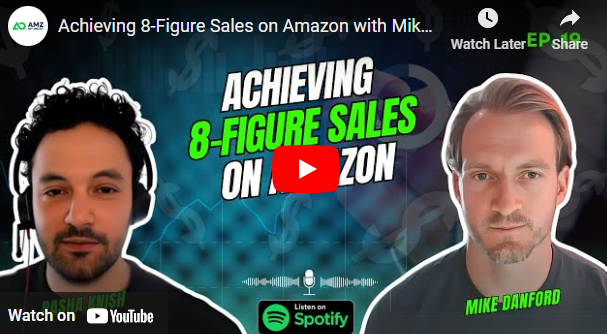
In this episode of the Smartest Amazon Seller Podcast, host Scott Needham speaks with Mike Danford, Chief Strategy Officer at Adverio, about practical strategies brands can use to grow their Amazon businesses in today's increasingly competitive marketplace.
Mike shares insights from his journey as an Amazon seller and agency strategist, explaining how many brands reach a plateau after years of selling on Amazon. Often, growth stalls because sellers focus on only one aspect of optimization, such as advertising, while overlooking other critical areas like catalog strategy, pricing optimization, and listing performance.
Reviving stagnant SKUs. The discussion highlights how brands with large product catalogs can unlock hidden growth opportunities by revisiting underperforming SKUs and optimizing listings that may have been neglected for years, to revive products that previously generated little traction.
Mike also explains how Amazon data, such as search query performance and conversion metrics, can be used to identify opportunities for growth. Combined with structured Amazon listing optimization and strategic Amazon account management, these insights help brands scale their presence more efficiently.
For sellers looking to overcome stagnation and build a scalable Amazon business, this episode provides practical strategies for catalog management, data-driven decision making, and long-term marketplace growth.
What You'll Learn in This Episode
- Why many Amazon brands experience stagnant growth after several years
- How sellers can identify hidden opportunities within large product catalogs
- Why optimizing underperforming SKUs can unlock new revenue streams
- How Amazon data and search query performance insights guide strategic decisions
- How pricing adjustments can influence product visibility and profitability
- Why strong Amazon listing optimization improves conversion rates
- How effective Amazon account management helps brands scale their operations and maintain marketplace performance
Highlights
- 00:03 Strategies to grow a stagnant Amazon business
- 02:32 Starting with a health supplement for his dad's arthritis
- 06:30 Optimizing sales for brands with large catalogs
- 08:41 Leveraging machine learning and predictive analytics
- 12:50 Private label brands focusing on pricing and automation
- 15:10 How dynamic pricing strategies impact profitability
- 19:01 Using search query performance for business growth
- 20:40 Understanding data points for pricing and positioning
- 24:16 Using Amazon data for business growth
- 26:04 Closing thoughts
Episode Transcript
Mike Danford: Most brands will come to us and they have been selling on Amazon for five, 10, 15 years, and they are either flat, stagnant, or maybe not growing at the rate that they want to, or maybe even losing some market share. They are trying to figure out new ways, to know which products to push and pull, or which new products to go after. A lot of brands just have not done the basics, or they are still pre-COVID, they have not tried the new things that are different since COVID hit and changed a lot of stuff.
Scott Needham: Welcome to the Smartest Amazon Seller podcast. I am your host, Scott Needham, and the goal of this show, I have been doing this for five years, is that we just want you to be a little bit smarter about the opportunity of selling on Amazon. There are a lot of different ways to succeed, but it is a huge marketplace, and I find that if you keep your mind open there is always something you can do. I have a guest who has seen the variety of ways to sell and work around Amazon, Mike Danford of Adverio. One of the things I love most is he has transitioned, he has seen the multiple different ways of operating on Amazon. Mike, welcome.
Mike Danford: Thanks for having me, Scott. Looking forward to it.
Scott Needham: Let us hear your story. You started out as just an Amazon seller in a variety of ways and learned some things the hard way, I presume. Give us your background.
Mike Danford: Absolutely. Back in 2014 I found what was ASM, Amazon Selling Machine, got into it, and started building my own supplement, a health supplement for my dad's arthritis and joints. That was great, a little slower than I wanted in the beginning, and then it was all about doing retail arbitrage or online arbitrage. At the time I was living in Charlotte and had access to a bunch.
Scott Needham: So you started a supplement and you are arbitraging, which happened first?
Mike Danford: Started with the supplement, and then to bridge the gap I started doing retail because I already had the account.
Scott Needham: Was that to bridge the gap to being a full-time Amazon seller?
Mike Danford: Yeah, it was more about trying everything. I gave myself six to eight months to see what would work and learn how to do it. Then a buddy of mine came up from Florida, he was traveling all over Florida buying thousands of Nikes every weekend, and he showed me how he did it and I started doing it.
Scott Needham: Were you mainly in shoes?
Mike Danford: Shoes are easier, the packaging is quicker, the software we were using was much easier. You could get into apparel, but shoes were much easier to move, you could really understand the demand and what would sell.
Scott Needham: Once you jump into apparel it is a bigger beast, larger catalogs, who knows what customers actually want, but I can always tell you they are going to want the latest version of Nike's running shoes, that is always in demand. So take us, I always like to find where people started. What were the next stages, did the supplement brand evolve?
Mike Danford: It worked out really well. My dad was able to use it when we were doing our trials and it actually worked well for him. What I learned there is we were using a pretty common formulation, and it was all about who could out-market whoever had the similar formulation. I realized it is really hard to go against the Costcos of the world, the Kirkland, on Amazon. It plateaued in our revenue, and to go to the next level you had to bring out a bunch more products or invest a lot of capital, it was going to be expensive as they take more market share. Meanwhile, slinging the Nikes was so much easier, selling black and white tennis shoes was faster and quicker, and it was a manual process, which kept me engaged. Then someone said, I want to add a joint supplement to my catalog, would you be willing to let us pick it up, and I said yes, because I did not want to make that next big investment at 23 or 24. I kept doing the Nikes, and I still did the advertising for the supplement after I got rid of the brand, and started posting some of those results in Facebook groups. The feedback was, this looks awesome, especially in the supplement space, would you mind doing it for us and we pay. And the history from there is just growing, adding staff, and now doing creatives and full-service management of the agency.
Scott Needham: What year did you get into PPC?
Mike Danford: 2014, 2015 is where all this took off.
Scott Needham: That is 10 years ago, a lot has evolved and changed. You have had success with some of your clients on something I have seen as a unique challenge, large catalogs. You think of apparel, maybe auto repair, lots of little parts, lots of SKUs, and that starts to make your spreadsheets look bigger. Tell me some of your experience with large catalogs.
Mike Danford: Most brands will come to us having sold on Amazon for five, 10, 15 years, either flat, stagnant, or losing some market share, trying to figure out which products to push and pull or which new products to go after. A lot of brands have not done the basics, or are still pre-COVID and have not tried the new things. We commonly have, after the first three months of working with a new brand, hey, we have not sold this product in years and now it is our top 10, how do you do that? How we do that is different, there are ways of looking at the SEO side, conversion rate optimization, and advertising. And one of our more recent levers, the last year or so, is dynamic pricing to help with that. I have upped our technical and development side, and we are pretty good at seeing from a sell side when a product is moving and has potential, and pouring more gas on that through our Profit Pulse System. What I am working on now is understanding the lift or changes in click-through rate and conversion rate before the traffic catches up, so we can be more proactive to those losers and winners. That is fun for me now, getting into more machine learning and predictive analytics.
Scott Needham: What do you see with a catalog of a dozen SKUs versus a catalog of a thousand SKUs, from the brand management perspective, what is the different initial approach? If it is 12 it is not that hard, whereas a thousand, if you are rolling out advertising across all of them and they have small differences, maybe different variations, one piece of clothing can have 500 variants with size and color.
Mike Danford: For a smaller catalog you are really able to focus on the incrementality and minutia within a product, a lot more split testing, image, copy, and just going all in. And you are faster to find external traffic to these products, you are living and breathing them. From there it is how can I bring other products in, looking at market basket analysis, what is commonly purchased with my products, is it a different variation, a different size, or a totally different product altogether, we find that all the time. With a larger catalog, the faster way to increase revenue and profit is generally going after the B and C tiers, the ones that have been forgotten, the ones with dust on the shelf, or where COGS has changed and it has not been pushed and is better now.
Scott Needham: I have heard sometimes on Amazon it is easier to turn a good product into a great product than a bad product into a good product. Tell me about these C tier products where you give them just a little bit of love and things change.
Mike Danford: We have a C1 and C2 tier, and it is usually the quickest lever, there are two we pull. One is advertising, low cost, they probably never advertised or have not in years, so they do not have good data. With the pay-to-play space, if it has been three, four, five years since they really pushed, it has lost a lot of visibility, and sometimes just getting it going with a little traffic. There is a process we graduate through with a budget, really conservative cheap clicks just to see what happens. 15 to 20 percent of that will surface up, and then they can move from C2 to C1 to B, and A is a long-term strategy. The other lever is pricing, let us not spend money, let us see if you can get additional conversion or click-through just by being more competitive on pricing. To your point, it is easier for us to get a B into an A than a C into a B. It is a lot of work if a product is not getting any traffic, as opposed to something getting a little traffic that is a good product and just needs to be reframed or put a little more effort behind it.
Scott Needham: You also mentioned dynamic pricing, that is a newer conversation. There are a few players, Prophecy and Trellis, tools that are talking about repricing. You are seeing private label brands really think more about pricing and using automation more than ever. What is your experience with this and how has it affected the brands you work with?
Mike Danford: Absolutely. Working with larger catalogs, one of those platforms handles larger catalogs and a lot more products more easily than the other, so that is great. It is a spray-and-pray approach where we can put some min-maxes in and see what happens pretty quickly. And then the others, going into the A group where it is already a pretty well-optimized listing, pretty efficient and maxed out on your sponsored ads, maybe getting DSP as well, and within that group you have top sellers in their category where there is not much more real estate or market share available for that SKU. Now you are trying to squeeze out more profit.
Scott Needham: I had one experience where we had a product go viral on TikTok and had a lot of inventory, but it was also Christmas. We were making 15 percent gross margin, not a ton, but I started playing around, increasing a dollar or two, and it did not really impact sales. I tested five or 10 dollars, I tried it all, and it is amazing how with A tier products there is actually more profit you can make. Do you risk competition? Sure. But that is the magic of something more dynamic, you can optimize for a specific goal and change that goal within a week or two, okay let us make profit, and then later, no, let us sell the units, let us be the winner. Even changing the price by a dollar for 24 hours made an impact on that day's gross margin. The B tier guys can do some stuff with pricing and the A tier guys can do different stuff, and both matter, both are meaningful.
Mike Danford: Absolutely, tons of different strategies around tentpole events, trying to squeeze out more juice or preserve inventory if you are going low or have a late shipment coming in. And there is charm pricing, if they have charm pricing, hey, let us add those few cents back to it.
Scott Needham: I have never heard the term charm pricing.
Mike Danford: Charm pricing is where you want to end at a 9.96 as opposed to a .99, they have these special things. So getting those few pennies back, we sell a lot of apparel sets, millions of units a year, millions of pennies adds up over time. And playing around with small incremental changes, and anchor pricing where you play with individual variants and colors to get them to convert better or anchor your price better. There are so many ways of doing it, and that is where I love the machine learning helping us look at demand elasticity versus profit elasticity.
Scott Needham: Mike, I was looking through our email history preparing for this, and I came across one where I gave a shout out on my newsletter for a new little Chrome extension called Seller Central Utilities. It seems you got wind of it and started an email conversation with Uri, the founder. I have heard great things about it, and you glow up when you talk about it, so tell us more about Seller Central Utilities, how you use it, and where its biggest benefits are.
Mike Danford: Sure. Uri is great. At first it was talking about search query performance and how do we automate, through robotic process automation, RPA, pulling the data at a product level or account level. So they built that, and then released, when you are inside campaign manager, a separate chart that gets pushed above your campaign manager chart, and it shows your TACoS, PPC conversion, ad conversion, and percent of ad sales. This is not inclusive of any DSP advertising dollars, but it makes it so when you are inside campaign manager you can quickly see your profitability based on TACoS and see how the ads are converting.
Scott Needham: It is interesting that he has built two free solutions that are very different. One is the search query performance, being able to get that into Excel over time, and the other is creating these charts that are a little better than Amazon, with a few more data points. One question, on the search query performance, what is the main value his tool provides that you do not get otherwise?
Mike Danford: Admittedly, we do not use it, we built our own RPA process that goes directly into our dashboard, but it is a very similar concept. You could do it at the ASIN level and we do that sometimes when going back on a few products. For us we built a role on top of it, so it was cool.
Scott Needham: Tell us about the history, what kind of insights do you get from a history of that search query report?
Mike Danford: For us right now we have a lot of brands with more than the normal tentpoles, a lot around the US holidays, Father's Day, Mother's Day. It is going back and looking at the data, what was your share over time, what were some terms you may have missed or did not catch at that time. You will also see some things bubble up as we get near those tentpole events that may not be on your radar, and the semantics are a little different, that is exciting. And going back to a smaller brand, we can get a good idea of what your TAM is, at least your search TAM. We can say the ownership of your search across all your products, because if you do the comprehensive report it is 2,500 or 3,500 rows, and that shows how you are doing when searching and what Amazon thinks you are doing well over time. You can get into things like your CTR versus the competition, your conversion rate, and an idea of your pricing at the product level, but really at the search term level, if there is a lot of traffic and the top sellers have a lower or higher price than you, it gives you an idea of what to push and how to position yourself.
Scott Needham: You guys have also built your own set of tools, spreadsheets and visualizations. Tell us more about that development and how people can use them.
Mike Danford: Absolutely. We have two different teams, a data science team that works in the Google Suite and makes light, nimble reports, anytime a new brand comes in we are trying to find something unique for them, a sandbox is easier for us. And another team that does more of our full BI and reporting intelligence. We take these concepts, build them, play around with them, and give them to the other team, and once they are useful for us we let other folks have them. A lot of it is how to manipulate and visualize the data Amazon gives us, it is a lot of data, how do you put it together and what is the best way to visualize it. Now we are bolting in some machine learning, helping you set it up and data mine it through GPT. We have a full-time data scientist who works with me every week, what is new, what can we do, what is Amazon releasing, we see a report and think, can we reverse engineer that, improve it, do it for the rest of our brands.
Scott Needham: And you are giving some of those out, right? That is on your homepage if people want more tools, free ones. I really like spreadsheets because they are easy to configure and understand. That is on your website, Adverio, how do you spell that?
Mike Danford: A D V E R I O dot I O.
Scott Needham: How did you get that name?
Mike Danford: I honestly do not know, I was not part of that process. I was involved with the V, up and to the right, and there is a rhino over here, we have a rhino mascot. We have personified a rhino for our social content and other things, so it is fun.
Scott Needham: How do you feel about this post-COVID period, what are some predictions or comments on where Amazon is going?
Mike Danford: That is an interesting question. I take a page out of Bezos's book where he talks about focusing on what is not going to change for the next 10 years and building around that, as opposed to having shiny object syndrome, while keeping a pulse on it. It is figuring out how to pull more levers. Amazon is starting to give us more data than ever, which is awesome, but there are limitations, and how valuable is it, do we need to focus on it, and how can we do it at scale and enrich it for ourselves and our brands. Right now we are pretty big on the AI side in terms of mining textual data, and now getting more into images and videos, playing around with Amazon Rekognition, Cosmo, Rufus. I think that is where it is going, way more conversational, a lot more NLP involved, and what am I going to use this product for, so your lifestyle images need to be more than just the search terms. When you go in with Rufus you are asking questions, I need this dress or shirt for an event, what is the best one, and it asks a few questions and then gives you a result.
Scott Needham: I did not know that, Rufus will ask you follow-up questions?
Mike Danford: Yeah, depending on how you communicate with it, you can literally ask it pretty much anything, it is interesting to play around with. You want to get it more toward use cases and it will guide you as well, it is pretty fun.
Scott Needham: That is cool. Mike, thank you for giving us some of your time. Love hearing the transitions you made, it gives people a lot of perspective. Thanks for coming on the podcast.
Mike Danford: Yeah, Scott, thanks for having me.
See how AI shopping reads your catalog
A shopper asked AI for the best in your category and it did not name you. Run the three-layer AI Shopping Readiness check and see where you are losing the sale, ranked by impact.
Get My Products Named by AITakes 2 minutes. No call required.
Prefer to talk it through? Map your profit leaks with a strategist