



Table of Contents
“Be everywhere” is bad advice. Profitable brands are not winning because they opened more channels. They are winning because pricing, media, inventory, and creative all answer to one profit model.
If Amazon, Walmart, and Target are managed in separate silos, you are not scaling. You are paying multiple teams to suppress buy boxes, misread attribution, and waste ad spend against the same inventory pool. The result is predictable. Margin slips, budgets drift to the loudest dashboard, and channel managers protect their own numbers instead of your P&L.
An omni-channel marketing agency specializing in Amazon should fix that financial mess. It should not add more meetings, more disconnected reports, or another layer of channel politics. Its core function is to build one operating system for marketplace growth, with unified decisions on pricing, content, retail readiness, and media efficiency.
That shift is overdue. the evolving landscape of marketing agencies has made one thing clear. The old specialist-per-channel model breaks down fast when every marketplace decision affects margin somewhere else.
If you want the blunt version, start with the hidden costs of split marketplace management. Or skip straight to an Amazon account management system built to run all three channels without the silo tax. Either way, fix the structure before your competitors do.
Your Marketplace Strategy Is Broken (Here Is Why)
Running three marketplaces isn’t three times the work. It’s three times the mistakes if nobody is synchronizing pricing, creative, budgets, and reporting.
That’s the story many brands tell themselves. They hire one Amazon agency, one Walmart freelancer, maybe an internal eCommerce manager for Target, then wonder why growth stalls. The answer is simple. Each team optimizes its own scoreboard. Nobody owns the full picture.

Strong omni-channel execution is not a branding exercise. It shows up in retention and revenue. Companies with strong omnichannel engagement strategies retain an average of 89% of customers, compared with 33% for weaker approaches, according to Uniform Market’s omnichannel shopping statistics.
That gap is brutal. It means fragmented execution doesn’t just create inconvenience. It destroys lifetime value.
What most brands get wrong
Multi-channel is easy to launch. You list products in more places. You run ads in more dashboards. You add more vendors.
Omni-channel is harder because it forces control.
-
One pricing logic across marketplaces and DTC
-
One creative system that keeps your message intact
-
One reporting view tied to profit, not channel vanity metrics
-
One operator mindset that decides where the next dollar should go
Practical rule: If each channel manager can claim success while your total margin stays flat, your operating model is broken.
That’s why the evolving landscape of marketing agencies matters here. The old agency model was built around channel silos. Marketplace brands need something different. They need integrated control.
If that sounds uncomfortably familiar, start with the hidden costs of split marketplace management. Most brands are losing more than they think.
Multi-Channel vs Omni-Channel and Why the Distinction Costs Real Money
Multi-channel means you sell in multiple places. Omni-channel means those places work together. Big difference. One builds scale. The other builds confusion.
A brand can be on Amazon, Walmart, and Target and still operate like three disconnected companies. Separate briefs. Separate agencies. Separate promo calendars. Separate reporting. Same logo. Same products. Same headache.

That’s not semantics. Integrated campaigns perform materially differently. SuperAGI’s roundup of omnichannel marketing trends cites omnichannel campaigns with a 494% higher order rate than single-channel efforts, with 0.83% versus 0.14% order rate. If your channels aren’t connected, you’re paying the price for that gap.
For a sharper breakdown of what real synchronization should look like, review this omni-channel Amazon marketing agency guide. Brands looking to get ads and listings operating under one system often start with Amazon PPC management as the first lever to unify.
Pricing inconsistency wrecks trust and can trigger platform friction
If your product is priced one way on Amazon, another on Walmart, and another on your own site, you create two problems at once.
First, the customer loses confidence. Second, marketplace performance can suffer when platforms detect inconsistent value signals. Amazon operators know this pain. If a shopper can find the same item cheaper elsewhere, your listing strength can weaken at the worst possible moment.
This isn’t a minor merchandising issue. It’s revenue governance — and it’s often compounded by inconsistent Amazon listing optimization across channels that compounds the pricing signal problem.
Duplicate creative spend is lazy and expensive
Most siloed setups pay for the same strategic work multiple times.
One team writes Amazon copy. Another rewrites Walmart content. A third agency builds paid social creative from scratch. Nobody starts from a shared playbook, so the brand pays repeatedly for translation work that shouldn’t exist in the first place.
The waste isn’t only money. Inconsistent headlines, imagery, and value props fracture your brand signal — and once attribution gets noisy, nobody can explain where the sale actually came from.
Consistency isn’t a design preference. It’s a profit protection system.
Budget misallocation follows the loudest team
When channels run independently, budgets don’t move toward contribution margin. They move toward whoever argues hardest in the meeting.
Amazon wants more ad spend because branded search is rising. Walmart wants support for a seasonal push. Target wants premium creative. DTC wants paid social top-of-funnel. Without a shared financial view, leadership is forced to make judgment calls off partial data.
That’s how brands overspend on the lowest-quality opportunity while starving the channel that improves blended economics.
A smarter model asks one question: where should the next dollar go based on total business impact?
Attribution confusion inflates CAC and hides the real path to sale
A shopper sees your product on Amazon. Later they research on Walmart. Then they convert after a branded search or email touch. Which channel gets credit?
In siloed organizations, all of them try to claim it. That creates fantasy reporting. Each team reports “wins,” but nobody can explain why blended acquisition cost keeps climbing.
The fix is shared attribution logic and one source of truth. Without that, your customer journey is just a tug-of-war between dashboards.
One of the clearest examples of cross-channel lift is when a brand improves its Walmart presence with synchronized content and promotions, then sees Amazon organic performance strengthen without changing the Amazon playbook. A siloed team misses that signal. A synchronized team catches it and scales it.
What a Synchronized Omni-Channel Operation Actually Looks Like
A synchronized operation doesn’t depend on everyone “communicating better.” That’s corporate fantasy. It depends on systems that force alignment.
The structure is simple. One shared creative playbook. One budget model tied to contribution margin. One reporting layer that leadership can trust.
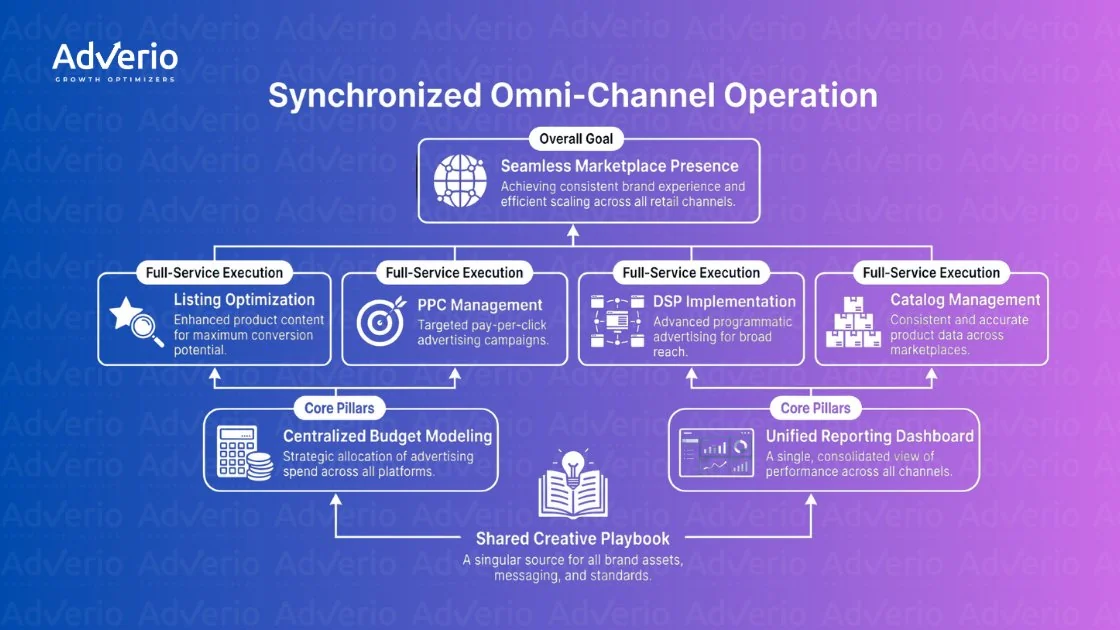
Shared creative playbook
Your Amazon main image, A+ content, Walmart listing copy, Target content brief, Shopify landing page, and ad creative should all pull from the same source.
That source should define:
-
Core value proposition your product must communicate
-
Messaging hierarchy for primary, secondary, and proof-point claims
-
Asset library for approved visuals, video, comparison charts, and brand language
-
Channel adaptations that respect platform requirements without changing the signal
When teams improvise per channel, performance becomes harder to read. You can’t tell whether one marketplace is underperforming because of traffic quality, content mismatch, pricing, or a bad creative interpretation. That’s exactly the kind of ambiguity that Amazon listing optimization removes — clean creative systems make attribution readable.
Centralized budget and profit modeling
Most brands fail because they let each channel optimize its favorite metric.
Amazon reports ACoS. Walmart talks sales lift. DTC focuses on CAC. None of those metrics are wrong. They’re just incomplete. They don’t belong in charge.
Operator standard: contribution margin should be the shared KPI. Everything else is diagnostic.
That means channel performance gets judged after fees, ad spend, returns, storage, promotions, and operational drag. Not before.
A unified reporting layer matters here. Adverio’s business intelligence system brings ads, listings, pricing, inventory, and review signals into one profit view — the same one that drives decisions across Amazon PPC management and DSP execution.
Unified reporting and customer data flow
Reporting should answer one question fast. Where should the next dollar go?
That only works when your data architecture can sync customer status and campaign logic across touchpoints. A Customer Data Platform as described by Piwik Pro’s omnichannel analytics overview acts as the technical backbone by unifying first-party data into a single customer profile, updating status across channels after purchase, suppressing wasteful retargeting, and lowering blended CAC.
Here’s what good reporting usually includes:
| View | What leadership needs to see |
|---|---|
| Channel contribution | Which marketplace adds profit after real costs |
| Creative performance | Which messaging angles convert across platforms |
| Catalog health | Which listings need content, compliance, or structure fixes |
| Promotional impact | Whether discounts create profitable lift or fake volume |
| Cross-channel movement | How actions on one marketplace influence another |
One strategy and multiple distribution points
This is a fundamental shift. You stop asking, “How is Amazon doing?” and start asking, “How is Amazon contributing to the whole business?”
That changes behavior fast. Walmart is no longer a side project. Target is no longer a vanity expansion. DTC is no longer a separate kingdom. Each channel becomes a distribution point inside one profit engine.
The Marketplace Hierarchy How to Sequence Your Channel Expansion
Brands love to say they want to be everywhere. That instinct is expensive.
If your foundation is weak, adding Walmart and Target doesn’t diversify risk. It multiplies confusion. Different content rules, different ad mechanics, different catalog standards, different operational demands. You end up spreading the same team thinner while pretending expansion equals progress.

Start with Amazon
Amazon should usually come first because it gives you the deepest feedback loop. Search demand, conversion behavior, listing performance, keyword movement, ad response, review signal, competitive pressure. You can learn fast there.
That matters because Amazon forces discipline. Your title, images, bullets, A+ content, pricing, review profile, and PPC structure all get stress-tested daily. If your offer is weak, Amazon exposes it quickly.
Once the Amazon foundation is stable, you have something useful to export:
-
Refined positioning from real shopper behavior
-
Creative assets already tested under pressure
-
Catalog logic that can inform structure elsewhere
-
Demand signals that help prioritize what to launch next
For a direct comparison of channel fit and expansion timing, this Amazon vs Walmart vs Target marketplace guide is a useful reference.
Expand to Walmart second
Walmart is the logical next move for many brands because it can benefit from the discipline already built on Amazon, while forcing you to adapt to a different marketplace environment.
Many operators exhibit a tendency to get sloppy. They assume Walmart is just Amazon with fewer competitors. Wrong. Walmart has its own catalog expectations, advertising behavior, and listing quality requirements. If you port over assets without adapting them, performance stalls.
Still, Walmart often rewards brands that arrive with a clean foundation. Better creative consistency, tighter pricing control, and stronger merchandising logic make the launch cleaner and the reporting more trustworthy.
A stable Amazon operation often creates momentum you can use to de-risk Walmart, instead of treating Walmart like a cold start.
Add Target third
Target deserves respect. It’s not the place to figure out your operating model. It’s the place to extend one that already works.
Target.com tends to demand more brand discipline, stronger content presentation, and tighter promotional coordination. If your Amazon and Walmart programs are still fighting over assets and budget, Target won’t fix that. It will expose it.
The sequence matters because each marketplace should fund and inform the next one. Amazon gives you signal. Walmart gives you broader marketplace reach with a distinct retail environment. Target becomes a strategic extension once your content, pricing, and governance systems are already under control.
That’s how serious brands expand. Not by opening three tabs and hoping for the best.
Choosing Your Omni-Channel Partner A 5-Point Checklist
Most agencies calling themselves omni-channel are just channel specialists standing under the same logo. That’s not enough.
The capability gap is real. A 2025 report summarized by Percepture noted that marketplaces captured 45% of US eCommerce spend, while only 12% of omni-channel agencies claimed marketplace-specific expertise. If your brand sells heavily through Amazon, Walmart, or Target, that gap should make you suspicious immediately.
Use this checklist before you sign anything.
Check for marketplace-native depth
Ask whether the team has in-house operators for Amazon, Walmart, and Target. Not “we can support those channels.” Actual specialists.
If the Walmart work gets outsourced, or the Target strategy is really a retail media generalist improvising, you’re buying coordination problems.
Demand a profit-based dashboard
If they show you a stack of platform screenshots, walk away.
You need one reporting layer that ties channel activity back to contribution margin. ACoS, ROAS, and sales lift are useful diagnostics. They are not the business.
Ask how they synchronize execution
Weak agencies often fall apart at this stage. Ask direct questions:
-
How does Amazon search data influence Walmart PPC decisions
-
How do you keep creative messaging consistent across marketplaces and DTC
-
How do you handle pricing governance across channels
-
What changes after a purchase to prevent wasted spend
If the answer is “we align in weekly meetings,” that’s not a system. That’s hope.
For teams evaluating operational tooling, cross-platform mcp for ads is the kind of resource worth reviewing because it reflects the market’s shift toward connected ad execution instead of isolated platform management.
Look for proof of cross-channel thinking
You want examples of one channel lifting another. Not just a pretty Amazon result and a separate Walmart result.
A real omni-channel partner should be able to explain how catalog fixes, promotional timing, brand search demand, and creative consistency moved performance across platforms.
If an agency can only talk about channels one at a time, it probably manages them one at a time.
Put guarantees and accountability on the table
Ask what happens if targets are missed. Ask who owns the final number. Ask whether they’re willing to be measured against profit, not activity.
Vendors hand you a report. Partners hand you a number they’re willing to defend.
How Adverio Helps: One System, Every Marketplace
The practical answer to channel fragmentation is structural control.
Adverio runs marketplace growth through one operating model instead of splitting listing work, PPC, DSP, catalog management, and creative across disconnected vendors. That matters because marketplace performance is interdependent. Pricing affects ads. Listings affect conversion. Inventory affects rank. Reviews affect everything.
The operating model also needs one owner. Not three account managers defending their own dashboards. One strategist should be responsible for the full picture, with channel specialists executing against the same plan and the same P&L view.
That’s the logic behind systems like the COSMO Framework. The point isn’t a catchy label. The point is coordinated decision-making across Amazon, Walmart, Target, and DTC so leadership can stop reconciling contradictions at the end of the quarter.
A serious omni-channel marketing agency should be able to do all of this under one roof — including Amazon DSP management, catalog management, and full Amazon account management without fragmenting ownership:
-
Listing optimization aligned to channel rules and conversion goals
-
PPC management that reflects cross-channel budget logic
-
DSP execution tied to broader demand creation
-
Catalog operations that keep content, compliance, and structure clean
-
Unified reporting built around business outcomes, not platform theater
If your current setup requires three vendors and a spreadsheet to explain what happened, it’s not built for scale.
Omni-Channel Marketing FAQs
| Question | Answer |
|---|---|
| Do I need to be on all three marketplaces | No. You need the right channel sequence, not maximum channel count. For many brands, that means fixing Amazon first, then expanding to Walmart, then deciding whether Target adds real profit or just more operational drag. |
| How does an agency handle the differences between Amazon, Walmart, and Target | By treating each marketplace as a distinct selling environment with its own ad structure, content rules, catalog logic, and merchandising standards. Strategy stays centralized. Execution adjusts by platform. That is how you protect margin without creating channel chaos. |
| What should unified reporting actually include | It should show contribution margin by channel, catalog health, creative performance, promotional impact, and cross-channel influence. Leadership should see where profit comes from, where margin leaks, and where the next dollar should go without piecing together five disconnected reports. |
| Can I start with Amazon and add channels later | Yes. That is often the smart move. Amazon usually gives the clearest read on offer quality, listing strength, and ad efficiency. Once those economics work, expansion gets cleaner and far less expensive. |
| How does pricing stay consistent across marketplaces | Through centralized pricing control. One team needs to own rules, promo timing, and exceptions across Amazon, Walmart, Target, and DTC. If each channel sets pricing in isolation, buy boxes get suppressed, ad efficiency drops, and margin disappears fast. |
Here’s the issue.
The hardest part of omni-channel execution is not software. It is getting every channel to answer to the same P&L.
A siloed structure lets each team chase local wins while the business loses money overall. Amazon can hit ROAS targets while Walmart drains margin through bad pricing. DTC can push promos that weaken marketplace conversion. Everyone reports progress. Finance sees bleed.
Fix that with one shared KPI. Contribution margin works best because it forces media, pricing, content, inventory, and promotion decisions into the same financial frame.
Brand consistency matters for the same reason. If Amazon says one thing, Target says another, and Shopify tells a third story, conversion gets weaker and attribution gets muddy. You need one message architecture, one asset system, and channel-specific adaptations that support the same commercial goal.
The tool stack matters less than decision quality. A pile of dashboards will not save a bad operating model. You need one view that combines spend, content quality, pricing, inventory, and reviews so leadership can reallocate budget before waste turns into a quarter-end surprise.
Cross-channel lift is real, but siloed teams rarely catch it. A better retail presence on Walmart can strengthen branded search, improve conversion signals, and change how efficiently media works elsewhere. If nobody owns the full system, nobody acts on that signal.
If your brand is still running Amazon, Walmart, and Target like separate businesses, competitors with tighter control are already taking your margin. Adverio runs marketplaces as one profit engine — shared strategy, coordinated execution, one P&L owner. Book your ROI Forecast to see where margin is leaking and what synchronized growth should actually cost you.