


Table of Contents
The largest and most successful sellers always seem to make it look easy to find new products to add to their catalog, while the rest of the crowd pays for third-party tools such as Helium10, JungleScout, Sellerise, and similar.
Secret #1: These tools don’t just help you find demand. They help you identify where profit actually exists inside the marketplace.
Secret #2: Those same Top Sellers also leverage two extremely powerful and underutilized Amazon tools that are 100% FREE(!) Amazon Product Opportunity Explorer and Amazon Market Basket Analysis.
Join me below as we dive deep into these free tools that are constant game-changers for savvy sellers like you. They can enable you to expand your catalog, uncover new opportunities, and make informed decisions to boost your business consistently.
By effectively using these Top Amazon Product Research Tools and staying updated on market trends, you can gain a competitive edge and achieve steady growth in 2024 and beyond.
Why Most Amazon Product Research Tools Point You in the Wrong Direction
Most sellers rely on tools like Helium10, Jungle Scout, or Data Dive.
They all answer the same question:
“Is there demand?”
And they measure that using search volume (SV).
On the surface, that makes sense.
But here’s the problem:
Search volume is not opportunity.
It’s just visibility.
Here’s where it breaks:
- High search volume often means saturated competition and compressed margins
- Low search volume niches can have higher conversion rates and stronger profitability
If search volume goes up → more sellers enter → CPC rises → margins compress.
Meanwhile, conversion stagnates and profit declines.
This isn’t an ads problem.
It’s a product selection problem—and one most brands only uncover after working with an Amazon account management agency.
Understanding the Product Opportunity Explorer
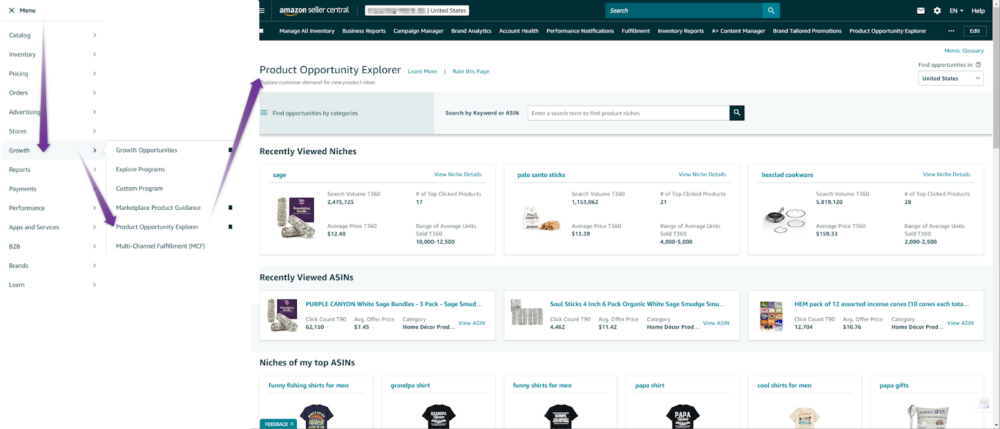
Launched in 2021, the Product Opportunity Explorer (POE) should be a go-to tool for Amazon sellers seeking to identify profitable niches and understand evolving customer demands. It’s mind-boggling(!) how many sellers I see daily that have never used Amazon’s POE.
The Product Opportunity Explorer harnesses the power of Amazon’s vast data repository to offer a comprehensive view of customer behavior and market dynamics. It takes into account a range of factors, including product seasonality, historical prices, and performance over time, enabling sellers to make informed decisions about their product selection and go-to-market strategies. These Real-time insights into customer search patterns, product demand, and emerging trends are analyzed and compiled via weekly refreshed data.
As of May 2024, there are two primary views that you can drill down:
Niche Details View
This view allows sellers to explore various product niches by search terms, keywords, and sub-categories, helping them identify untapped market segments with growth potential. There are 6 primary sections within Amazon’s Product Opportunity Explorer’s Niche Details Page view. The amount of information can be a bit overwhelming at first glance. However, I aim to break those down into more digestible segments below.
ASIN Product Details Pages View
You can perform a more granular assessment of the niche details at a single product level. This includes many of the same metrics from the Niche Details but for the single user selected ASIN. Below are snapshots of each view, along with key takeaways for each of the Niche Details and ASIN (Product) Sections found here: Product Opportunity Explorer
Products: Product Opportunity Explorer Amazon Niche Details
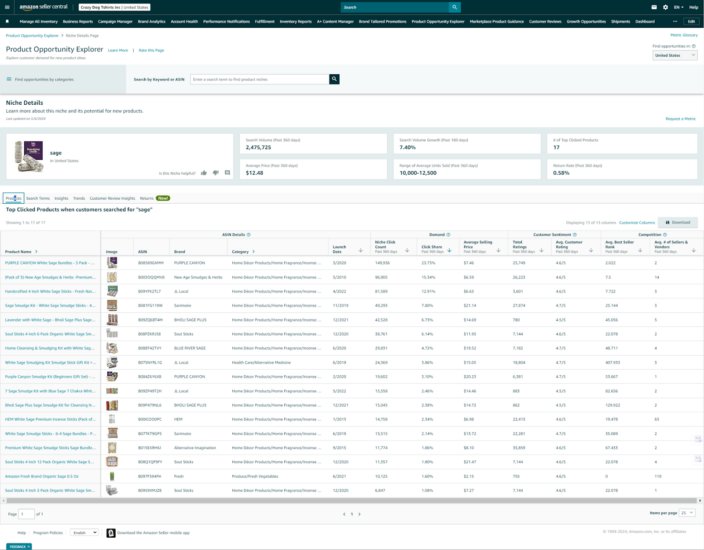
Niche Exploration:
Within the product view, there are 13 columns available, including launch dates, niche click counts and click shares, average selling prices (ASP), customer sentiment across total ratings, and review quality, among others
You’ll be able to quickly ascertain the depth and breadth of various niches along with varying levels of competition. Be prepared, as there will be a few head-scratchers where newly released products are among the top results, even though they lag in customer sentiment.
Search Terms: Product Opportunity Explorer Amazon Niche Detail
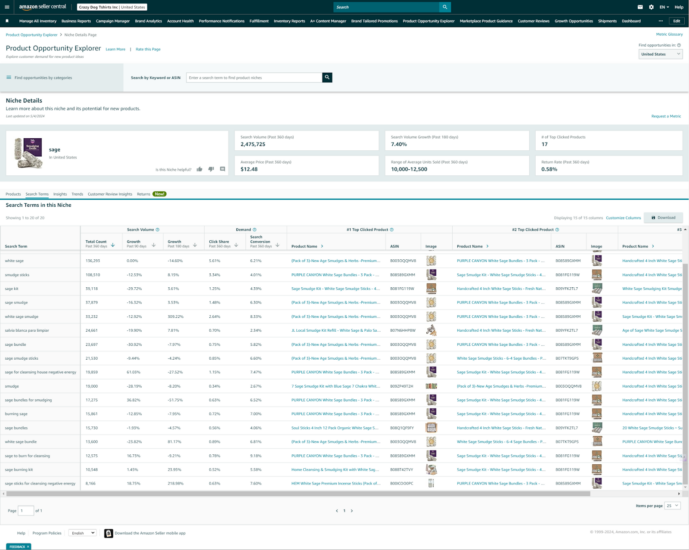
Keyword Insights:
The Product Opportunity Explorer provides valuable insights into top customer search terms for each niche. By understanding the semantics customers use when searching for products, sellers can improve performance through Amazon listing optimization services, improve discoverability, and drive more traffic to their offerings.
Additionally, you can determine customer search volume deltas and demand patterns via click share and search conversions over the past 90, 180, and 360 days. Sellers can uncover emerging trends and be among the first to capitalize on new opportunities.
This is another way to better understand any shifts in search trends in your current niche, which may be improving or declining over time.
Search Volume Is Only Step One (And Usually Misused)
The Product Opportunity Explorer shows search volume—but that’s not the insight.
The real signal comes from how search volume interacts with:
- Click share concentration
- Conversion rates
- Price trends
- Customer sentiment
For example:
- If search volume is rising but conversion is falling → demand is becoming less efficient
- If search volume is flat but conversion is rising → the niche is becoming more valuable
This is where most third-party tools fall short.
They show demand.
They don’t show demand quality.
Insights: Product Opportunity Explorer Amazon Niche Details
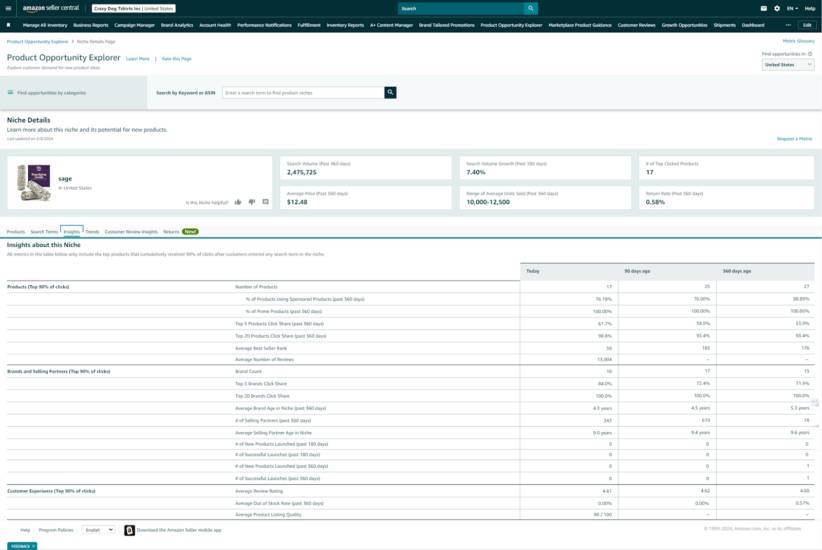
Competitive Analysis:
Sellers can use the view to further evaluate the competitive landscape within specific niches. By analyzing factors such as average selling price, number of reviews, and top-performing products, sellers can benchmark their offerings against competitors and make strategic decisions to differentiate themselves.
One of our favorites is seeing Top 5 Products Click Share (past 360 days) decreasing from 360 days ago to 90 days ago and today. If the opposite is true, then it’ll be more challenging to capture market share.
Trends: Product Opportunity Explorer Amazon Niche Details
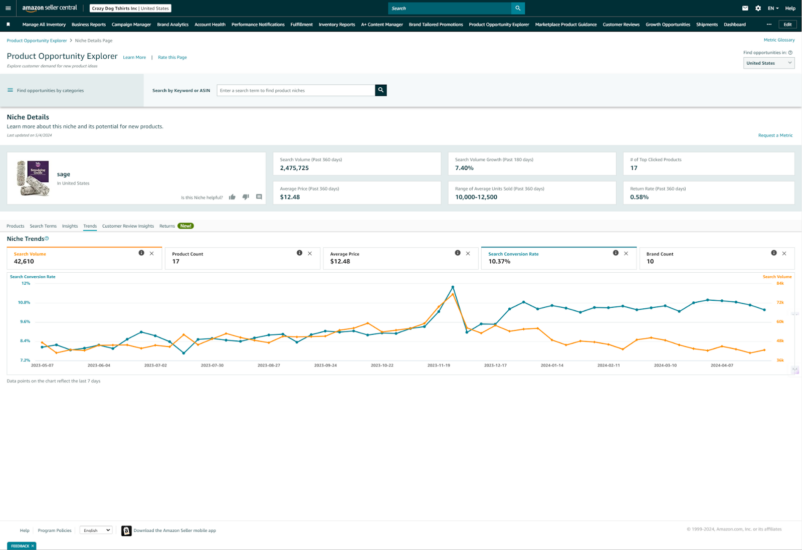
Directionality:
This is another visual way to better understand a niche’s trends, which may be improving or declining over time. We like to refer to Search Volume, Search Conversion Rate, and Average Price over time. If you notice a decline in all three, then it’s likely time to look at another niche. Furthermore, it can be rather insightful as to whether there is any seasonality and price elasticity over the last 12 months.
Another view includes Product Count and Brand Count. This helps us understand the ebbs and flows of new entrants into the market at both the product and brand level. You’ll likely be surprised as the volatility over 12 months.
Customer Review Insights: Product Opportunity Explorer Amazon Niche Details
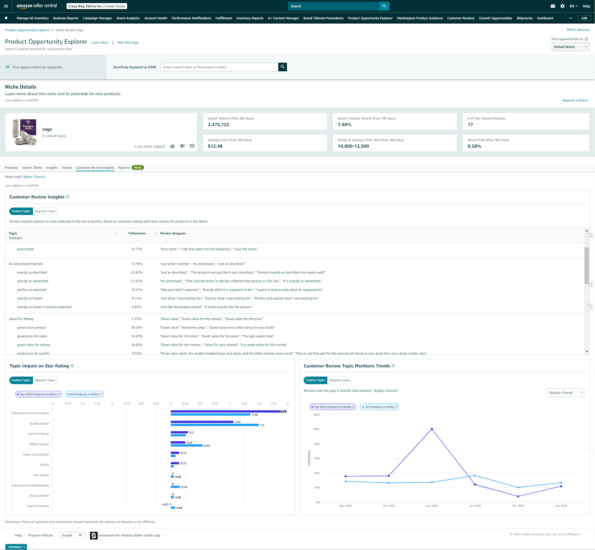
Product Development Guidance:
The Product Opportunity Explorer offers data-driven product development and optimization recommendations. By identifying unmet customer needs and analyzing successful product attributes, sellers can refine their product offerings to better align with customer preferences and market demands.
One of the key advantages of the Product Opportunity Explorer is its ability to surface customer review insights. By analyzing customer feedback, sellers can gain valuable information about product strengths, weaknesses, and areas for improvement.
This data-driven approach allows sellers to refine their offerings continuously and address common pain points, ultimately leading to higher customer satisfaction and increased sales.
Returns: Product Opportunity Explorer Amazon Niche Details
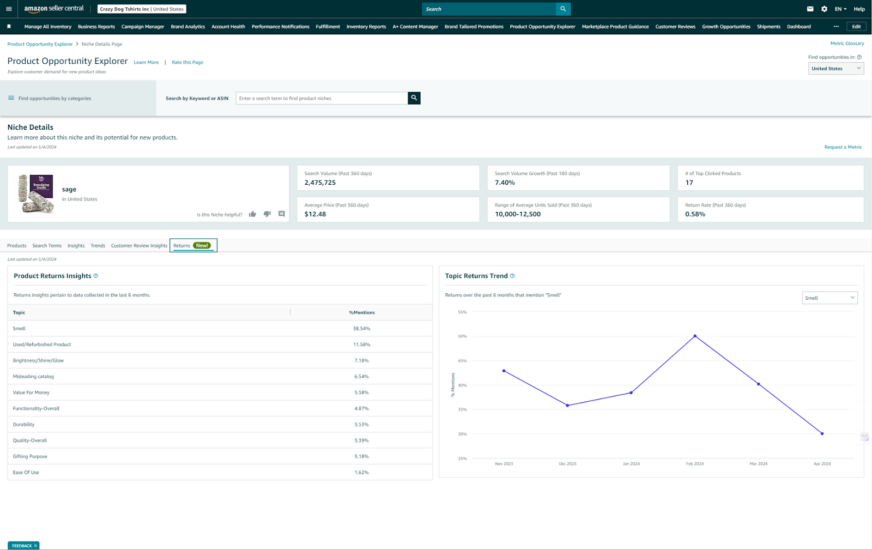
To Keep or Not to Keep:
Another critical feature of the Product Opportunity Explorer is its returns analysis capability.
By identifying products with high return rates and understanding the underlying reasons, sellers can optimize their product offerings and reduce the costs and hassles associated with returns. This proactive approach improves the customer experience and helps sellers maintain a healthy bottom line.
Product Metrics: Product Opportunity Explorer, Amazon Product Details Page
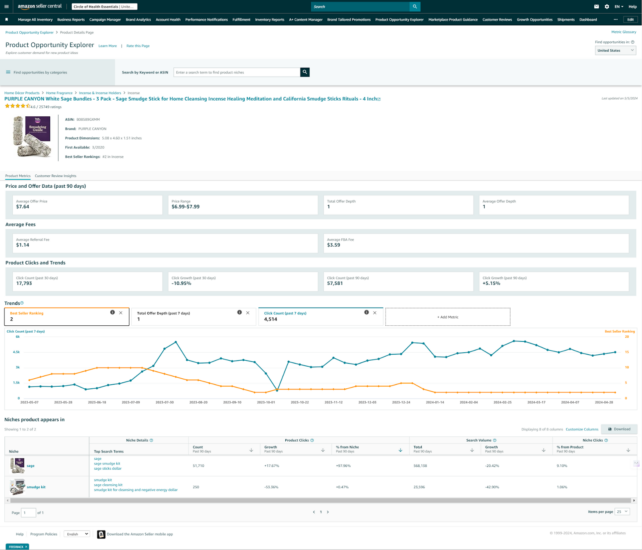
- Product Exploration: Similar to the Niche Product overview, you’ll also see product-specific insights into click growth or decline, over the past 30 and 90 days, Referral and FBA Fees, as well as offer depth.
Customer Review Insights: Product Opportunity Explorer Amazon Product Details Page
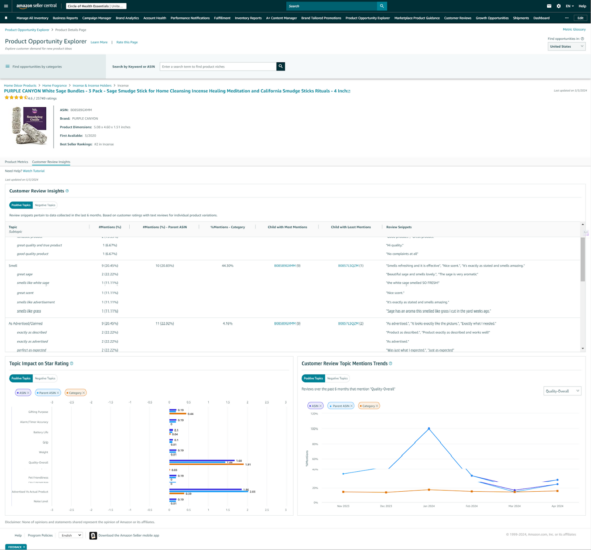
- Product-Specific Sentiments: The Product Opportunity Explorer offers data-driven product development and optimization recommendations.
By identifying unmet customer needs and analyzing successful product attributes, sellers can refine their product offerings to better align with customer preferences and market demands.
One of the key advantages of the Product Opportunity Explorer is its ability to surface customer review insights at the product level. By analyzing customer feedback, sellers can gain valuable information about product strengths, weaknesses, and areas for improvement.
This data-driven approach allows sellers to refine their offerings continuously and address common pain points, ultimately leading to higher customer satisfaction and increased sales.
Utilizing the Strength of Market Basket Analysis
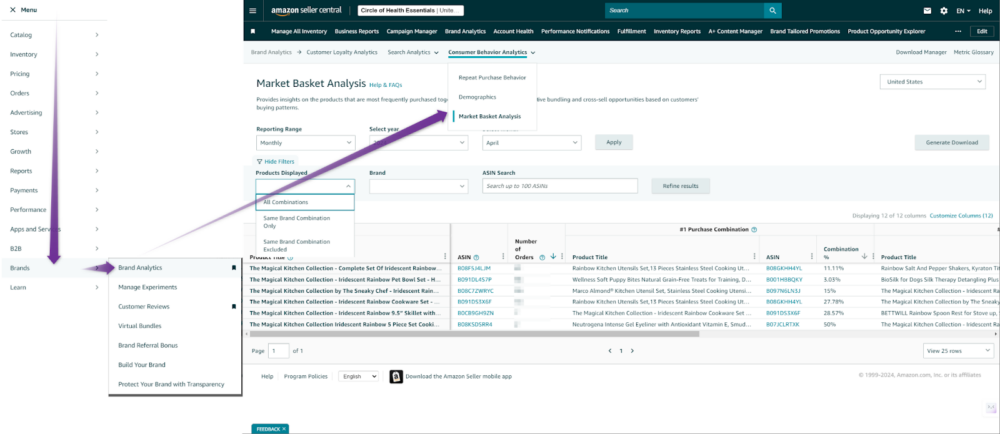
While the Product Opportunity Explorer helps sellers identify new product opportunities, Market Basket Analysis enables them to optimize their existing offerings and drive cross-selling opportunities. This powerful tool, available through Amazon Brand Analytics, provides insights into which products customers frequently purchase together
Amazon Market Basket Analysis dashboard identifies the products that your customers purchased together to help find cross-selling and bundling opportunities.
This Is What Most Product Research Tools Miss. Third-party tools focus on what people search. Market Basket Analysis shows what people actually buy together. That difference matters.
- Search = intent
- Purchase behavior = revenue
This is where real growth comes from.
Here are a few general definitions from Amazon Seller Central for clarification of the underlying data:
Purchase Combination %: Percentage of orders that contain both the selected ASIN and the #1, #2, or #3 Purchase Combination ASIN, in comparison to the total number of orders that contained at least two different items, including the selected ASIN.
Product Title: The title of the product as displayed in the search results page.
The title length can vary but we limit it to 50 characters initially. Click the arrow in the column heading to expand and get full details.
ASIN: ASIN stands for Amazon Standard Identification Number. ASIN ID is guaranteed to be unique within a marketplace.
By analyzing customer purchase patterns, sellers can identify complementary products and create targeted bundles or promotions to encourage multi-item purchases. This not only increases the average order value but also enhances the customer experience by providing convenient and relevant product combinations
Market Basket Analysis also helps sellers optimize their inventory management and pricing strategies. By understanding which products are commonly bought together, sellers can ensure they have sufficient stock of complementary items and adjust their pricing to maximize profitability.
How to Interpret Your Commingled Data
As your product catalog size increases, it becomes increasingly difficult to digest the data, even after downloading the report from Amazon. That’s largely because there will be more rows to analyze AND cross-overs across multiple of your products.
Fortunately, Amazon does some of the initial lifting for us by offering 3 uniquely segmented tabular views:
1) Same Brand Combination Only – This filters the purchase combinations to only include Combination Percentages when more than one of your products was purchased within the same shopping cart.
2) Same Brand Combination Excluded – On the flip side, this display selection explicitly excludes purchase combinations when more than one of your products was purchased within the same shopping cart. This is our current favorite, although #1 is a very close second.
3) All Combinations – Amazon doesn’t exclude purchase combinations based on brands purchased and simply displays the top purchase combinations for each of your catalog ASINs.
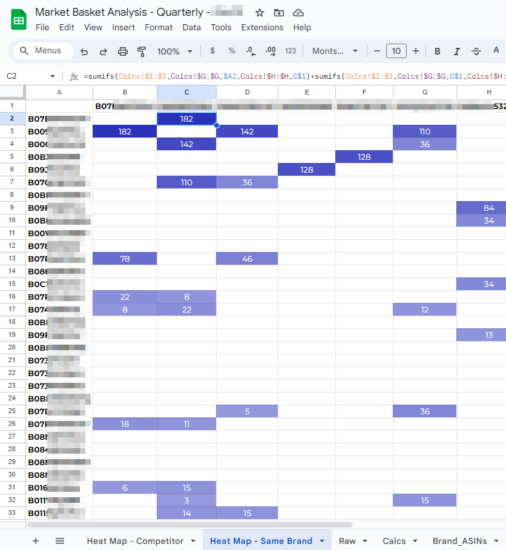
This is the exact tool that we built and leveraged for all of our brands.
For example, while auditing one of our prospective brands, we found a complementary product with an even higher price tag than their core product.
Using our tool, we noticed that 100s of shoppers were also adding another popular ASIN to their shopping cart. So we dug deeper and found that over 1,000 shoppers were adding a nearly identical product to their cart, the same one that 100s of shoppers were adding.
With information like this, you can quickly identify which products to launch next. Instead of 1,000s of shoppers having to buy from another brand, you can offer that same product, which will increase your Average Order Value (AOV), increase Return on Ad Spend (RoAS), and raise your Customer Lifetime Value (LTV) by retargeting and cross-selling them along their buying journey.
| Third-Party Tools (Helium10, Jungle Scout) | Product Opportunity Explorer (POE) | Market Basket Analysis | |
|---|---|---|---|
| Core Question | Is there demand? | How is demand behaving? | What do customers buy together? |
| Primary Metric | Search Volume | SV + Conversion + Click Share | Purchase combinations |
| What It Misses | Profitability & competition saturation | Cross-product relationships | Early demand discovery |
| Risk If Used Alone | Launching into crowded niches | Misreading demand trends | Missing new opportunities |
| Best Use Case | Initial filtering | Demand validation | AOV & catalog expansion |
Other Strategies for Leveraging Product Opportunity Explorer and Market Basket Analysis
To fully capitalize on the insights provided by these powerful tools, Amazon sellers should consider the following strategies:
Regularly Monitor Market Trends:
Stay up-to-date with the latest insights from the Product Opportunity Explorer to identify emerging trends and adapt your product offerings accordingly. By being proactive and responsive to market changes, you can stay ahead of the competition and meet evolving customer demands
Optimize Product Listings:
Use the keyword insights from the Product Opportunity Explorer to optimize your product titles, descriptions, and bullet points. Incorporate relevant and high-volume search terms to improve your product’s discoverability and attract more qualified traffic
Experiment with Product Bundles:
Leverage Market Basket Analysis to create compelling product bundles that encourage multi-item purchases. Test different bundle combinations and pricing strategies to find the most effective approach for your target audience.
Invest in Complementary Products:
Identify products that are frequently bought together and consider adding them to your catalog. By offering a wider range of complementary items, you can capture a larger share of customer spend and improve overall profitability
Continuously Refine Your Strategy:
Regularly review the insights from both tools and use them to inform your ongoing product development, marketing, and pricing strategies. Continuously test and refine your approach based on data-driven insights to optimize your performance over time.
Leverage Customer Reviews:
Pay close attention to customer reviews and feedback gathered through the Product Opportunity Explorer. Use this valuable information to identify areas for improvement, address common customer pain points, and enhance your product offerings. By demonstrating responsiveness to customer needs, you can build trust, loyalty, and a positive brand reputation.
Collaborate with Complementary Brands:
Consider partnering with other brands that offer complementary products to yours. By leveraging Market Basket Analysis insights, you can identify potential collaboration opportunities and create joint promotions or cross-selling initiatives. Collaborating with complementary brands can help you reach new audiences, expand your market share, and drive mutual growth.
Personalize Your Marketing Efforts:
Use the insights from Market Basket Analysis to create personalized product recommendations and targeted marketing campaigns. By understanding the products customers frequently purchase together, you can tailor your email marketing, retargeting ads, and on-site recommendations to individual customer preferences. Personalization can significantly improve customer engagement, conversion rates, and overall sales.
Optimize Inventory Management:
Leverage Market Basket Analysis to streamline your inventory management processes. By anticipating which products are likely to be purchased together, you can ensure you have sufficient stock levels to meet customer demand. This proactive approach can help you avoid stockouts, reduce overselling, and improve customer satisfaction.
Monitor Competitor Activity:
Keep a close eye on your competitors’ activities using the Product Opportunity Explorer. Regularly analyze their product offerings, pricing strategies, and customer reviews to identify potential gaps or areas where you can differentiate yourself. By staying informed about your competitors, you can make data-driven decisions to maintain your competitive edge.
The Product Opportunity Explorer and Market Basket Analysis are invaluable tools for Amazon sellers looking to grow their businesses in 2024 and beyond. By leveraging the insights provided by these tools, sellers can identify untapped opportunities, optimize their product offerings, and make data-driven decisions to drive sales and profitability.
However, success on Amazon requires more than just access to powerful tools. It demands a willingness to continuously learn, adapt, and innovate. By staying attuned to market trends, customer preferences, and competitor activities, sellers can position themselves for long-term success in the dynamic world of e-commerce.
As you embark on your journey to unlock growth opportunities on Amazon, remember to approach these tools with a strategic mindset. Use the insights they provide to inform your decision-making, but also rely on your own business acumen and customer understanding. By combining data-driven insights with your unique value proposition and customer-centric approach, you can build a thriving and sustainable Amazon business.
If you’re looking for expert guidance in managing your Amazon business and leveraging the power of Product Opportunity Explorer and Market Basket Analysis, look no further. Adverio is here to support you every step of the way, starting with one of the free tools that we’ve built and have been using for all over brands since 2014
This is the exact tool that we built and leveraged for all of our brands.
Most Brands Chase Demand. The Best Ones Build for Profit.
If you’re making product decisions based on search volume alone, you’re competing in the same pool as everyone else.
More demand doesn’t mean more profit.
It usually means more competition, higher costs, and thinner margins.
The brands that scale don’t just look at what people search.
They look at:
- Where conversion is improving
- Where the margin is still protected
- Where customers are already buying multiple products together
That’s where real growth happens.
See Where Your Next Profitable Opportunity Actually Is
We’ll break down:
- Which niches are worth entering (and which to avoid)
- Where your current catalog is leaking profit
- What products you should launch next based on real purchase behavior—not guesswork
Get a Profit Opportunity Analysis