


Table of Contents
Most Amazon brands don’t have an ads problem—they have a profit leakage problem. If you’re scaling revenue while margins shrink, your ad strategy is broken. This guide shows how to automate margin protection using profit-first bidding systems that actually scale. Stop optimizing for ACoS in isolation—it’s the fastest way to scale unprofitable growth. It’s time to build an automated system around what actually matters: contribution margin and true profitability. This is the strategic shift that ensures your ad spend is always tied to your bottom line, preventing you from chasing revenue right off a cliff.
If your ads are driving revenue but not profit, it’s time to fix the system. Book Your ROI Forecast and see exactly where your margins are leaking—and how to recover them.
At a Glance
• ACoS is not a profitability metric
• Contribution margin = your real bidding limit
• Automation must follow margin guardrails—not rules alone
• Profit-first systems outperform ACoS optimization at scale
The Profit-First Playbook for Amazon Ads
Most brands are stuck in “Optimization Myopia,” obsessively tweaking ACoS while their profits bleed out. They celebrate a low ACoS on a campaign, completely blind to the fact that after Amazon’s fees, COGS, and other costs, they’re losing money on every sale.
Most agencies optimize ads. We optimize profit systems. That’s the difference.
This is how brands unknowingly scale into negative cash flow. ACoS is a vanity metric; profit is sanity.
Fixing this requires a shift in how you define performance. Instead of asking, “How can we lower our ACoS?” the right question is, “How much can we afford to spend to acquire a customer and still remain profitable?” This question is the foundation of a real margin protection strategy.
Ditching Vanity Metrics for Profit-Driven KPIs
The first step is to adopt metrics that reflect true business health. Chasing a low ACoS without context is like driving a car by only looking at the speedometer—you might be going fast, but you have no idea if you’re headed toward a cliff.
We anchor our strategy to North Star metrics that give you a real picture of profitability.
Key Metrics for Automated Margin Protection
This table breaks down the essential KPIs that move beyond ACoS to give a true picture of profitability in your Amazon ad campaigns.
| Metric | What It Measures | Why It’s Critical for Margin Protection |
|---|---|---|
| Contribution Margin | The true profit per unit after subtracting all variable costs, including COGS, Amazon fees, and ad spend. | This is the most accurate measure of a product’s profitability. It tells you exactly how much cash each sale adds to your business. |
| Total Advertising Cost of Sales (TACoS) | Your total ad spend measured against your total sales (both organic and ad-driven). | This is where most brands fail—because they don’t connect ads to total business performance. A proper Amazon advertising strategy ties spend directly to profit, not just efficiency. |
| True Return on Ad Spend (ROAS) | The actual profit generated for every dollar spent on advertising, based on profit, not revenue. | This metric answers the ultimate question: “Is my ad spend generating real, take-home profit?” It cuts through revenue-based vanity. |
By focusing on these KPIs, you move from just managing ad campaigns to strategically investing in profitable growth. This is a core component of a sophisticated Amazon advertising strategy that maximizes your real ROI.
“The idea that you must choose between scaling ad spend and protecting margins is the biggest fallacy in retail. With the right framework, you can—and must—do both. The alternative is a race to the bottom.”
Pillars of an Automated Margin Protection System
Transitioning to a profit-first model isn’t just about looking at different reports; it’s about building a system that acts on this data automatically. The goal is to create an engine that self-corrects based on real-time profitability, not outdated assumptions. This requires a new operational mindset and the right technology.
To truly embrace a profit-first playbook, businesses often look to broader AI and ecommerce strategies to enhance their competitive edge.
The challenge is real, especially as costs rise. With the average ACoS hovering around 30.20%, rising ad costs pose a severe threat to seller margins. In response, sellers who deployed AI-powered automation saw an 18% uplift in sell-through rates within six weeks. This helped them recover their Inventory Performance Index (IPI) scores and slashed their long-term storage fees by 22%.
Defining Your Profitability Guardrails
Automation without a strategy is just a faster way to fail. Before you can let any system touch your bids, you have to define what “profitable” actually means for every single product in your catalog.
Slapping a universal 30% ACoS target across the board is lazy, ineffective, and guaranteed to bleed you dry on low-margin SKUs while leaving money on the table for your high-margin heroes.
True automation requires building intelligent profitability guardrails. Think of these as the non-negotiable boundaries that ensure your bidding engine is always protecting your bottom line, not just chasing clicks. This all starts with getting brutally honest about your numbers, one ASIN at a time.
Calculating Your True Product Margins
You can’t protect what you don’t measure. The first step is to get way beyond surface-level metrics and calculate the contribution margin for each product. This number is the actual cash profit you bank on a sale after every single variable cost is subtracted.
Your math has to include every cost that eats into your revenue:
-
Cost of Goods Sold (COGS): What you paid to source or manufacture the product.
-
Amazon Referral Fees: The commission Amazon takes on every sale, which varies by category.
-
FBA Fulfillment Fees: All the costs for picking, packing, and shipping.
-
Shipping & Inbound Costs: The expense of getting your inventory to Amazon’s fulfillment centers.
-
Other Variable Costs: Don’t forget things like returns, packaging, or other per-unit expenses.
Once you have this number, you know exactly how much room you have for advertising before a sale becomes unprofitable. This granular, product-level data is the bedrock of any successful automation strategy. For brands with big catalogs, understanding and utilizing SKU economics on Amazon is the difference between guessing and knowing.
Setting Dynamic Targets for Every Product Lifecycle Stage
Your profitability guardrails shouldn’t be set in stone. A product you’re launching needs a completely different advertising posture than a mature, category-leading ASIN. Setting dynamic ACoS and ROAS targets based on a product’s lifecycle stage lets your automation be aggressive when it needs to be and defensive when it counts.
-
Launch Phase: During a product launch, the goal is velocity and data, not immediate profit. Here, you might set a “breakeven” ACoS where ad spend equals your contribution margin. You’re acquiring customers and market data at cost to build sales history and climb the organic ranks.
-
Growth Phase: For products gaining traction, the target can be more aggressive. You might aim for a specific ROAS that delivers a small but consistent profit. The focus is on scaling impressions and stealing market share without setting cash on fire.
-
Maturity Phase: For your established best-sellers with strong organic rank, the goal flips to maximizing profit. This is where you set a highly conservative ACoS target that ensures every ad-driven sale is significantly profitable. The system’s job is simply to defend your market position as efficiently as possible.
Automation isn’t about removing human strategy; it’s about empowering it. By setting dynamic targets, you’re telling your system how to think, allowing it to execute your strategic vision with speed and precision 24/7.
Structuring Portfolios by Margin Profile
Finally, to make this all work, you need to organize your campaigns logically. One of the most powerful ways to do this is by structuring your campaign portfolios around margin profiles. It’s simple: group ASINs with similar contribution margins together.
This structure allows you to apply different bidding strategies with surgical precision.
-
High-Margin Portfolios (e.g., >40% margin): These products can handle aggressive bidding. You can set higher budgets and more lenient ACoS targets to push for maximum visibility, knowing you have the profit cushion to back it up.
-
Mid-Margin Portfolios (e.g., 20-40% margin): These demand a balanced approach. Bidding strategies here should focus on steady, profitable growth, with rules designed to maintain a healthy ROAS.
-
Low-Margin Portfolios (e.g., <20% margin): These are your “protect-at-all-costs” products. Automation rules for this group must be extremely conservative, with tight ACoS ceilings and aggressive negative keyword strategies to eliminate any wasted spend.
By segmenting your catalog this way, you create a system where your automation isn’t making blind, one-size-fits-all decisions. Instead, it’s making nuanced, margin-aware optimizations across your entire product line, ensuring your ad spend is always aligned with your ultimate goal: profitable growth.
Building Your Automated Rule-Based Engine
You’ve defined your profitability guardrails. Now it’s time to turn that strategy into a tireless, 24/7 optimization machine. This is where you build the automated, rule-based engine that executes your margin-protection plan with relentless precision.
Forget being chained to spreadsheets for manual bid adjustments. A well-built engine uses simple ‘if-then’ logic to make thousands of micro-decisions every day, ensuring your ad spend always protects the bottom line. This isn’t about making things complicated; it’s about codifying your strategic goals so a system can execute them at scale.
This flowchart lays out the foundational process. Successful automation doesn’t start with writing rules; it starts with a rock-solid understanding of your unit economics.
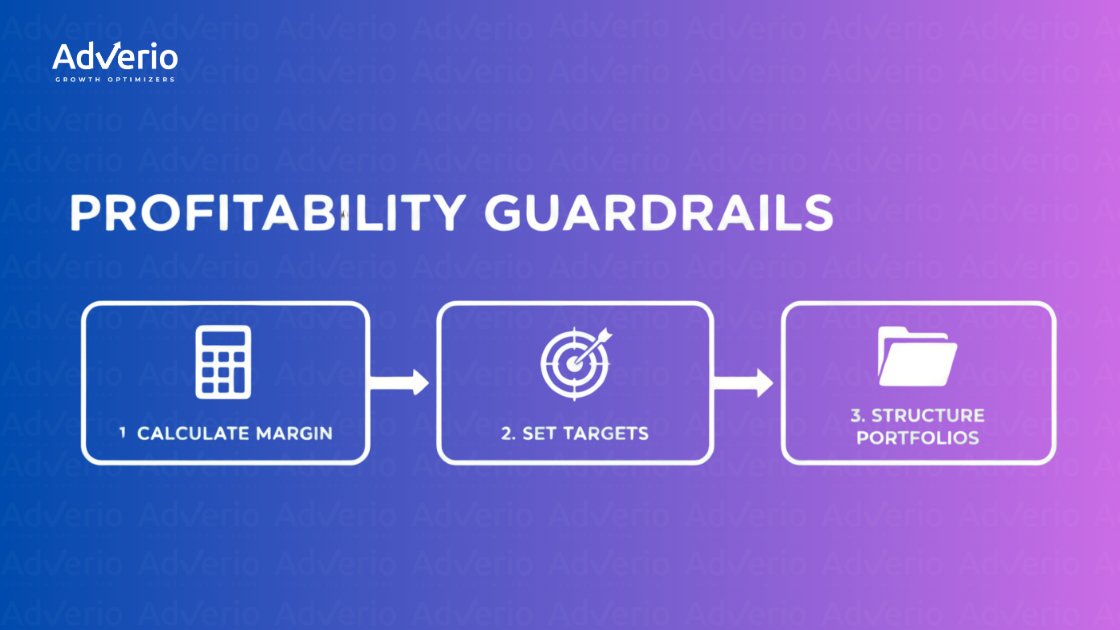
As you can see, the rules are the final step. They’re the output of a clear strategy, not the starting point.
Sample Rules for Immediate Margin Protection
Your automation engine is only as good as the instructions you feed it. Here are a couple of practical, no-fluff examples you can set up right now to start plugging profit leaks and capitalizing on what’s working.
If you don’t have this structure in place, automation just accelerates bad decisions. That’s why most brands need a structured Amazon PPC management system before scaling rules.
Scenario 1: The Money Pit Keyword
-
The Problem: You have a keyword that’s getting plenty of clicks but has driven zero sales in the last month. It’s just burning cash.
-
The Rule: IF a keyword has > 20 clicks and 0 orders in the last 30 days, THEN pause it.
-
Why It Works: This is your most basic safety net. It automatically cuts spending on search terms that are clearly not converting, stopping the bleeding before it gets out of hand.
Scenario 2: The High-Performer
-
The Problem: A specific search term is converting like crazy with a ROAS way above your target, but its ad position is still low. You’re leaving profitable sales on the table.
-
The Rule: IF a search term has > 3 orders and a ROAS > 8 in the last 14 days, THEN increase its bid by 15%.
-
Why It Works: This rule gives your system permission to be aggressive where it counts. It automatically doubles down on proven winners to capture more sales from your most profitable traffic.
These are just the starting blocks. The real magic happens when you start layering and refining these rules over time. For a deeper tactical playbook, check out our complete guide on Amazon PPC optimization tips and best practices.
A common mistake is trying to build a dozen complex rules right from the get-go. Start simple. Master the fundamentals of cutting waste and scaling winners first, then add more layers.
Advanced Automation Tactics
Once your foundational rules are running smoothly, you can add more nuance to your engine for even greater precision. At this stage, keyword-based optimization alone isn’t enough. To unlock incremental growth, brands need to move beyond search and into audience targeting. This is where Amazon DSP management becomes a critical extension—capturing high-intent shoppers outside traditional PPC and driving incremental revenue.
-
Dayparting: Your conversion rates aren’t the same at 3 AM as they are at 8 PM. Dayparting automatically adjusts bids based on these peak conversion windows. For example, set a rule to increase bids by 20% from 6 PM to 10 PM on weekdays if your data shows that’s your prime buying time.
-
Negative Keyword Automation: Stop paying for irrelevant traffic. Set up rules to automatically add dead-end search terms to your negative keyword lists. A great one is: IF a search term has > 15 clicks, 0 add-to-carts, and 0 orders in the last 30 days, THEN add it as a negative exact match. This keeps your campaigns laser-focused on shoppers who are actually looking to buy.
By building a robust, rule-based engine, you transform ad management from a reactive, manual chore into a proactive, strategic asset that consistently protects and grows your profit margins.
Choosing Your Automation Tech Stack
An automation strategy without the right tech is like a race car without an engine. It might look impressive, but it’s going nowhere. The tool you choose will either accelerate your margin protection or become another expensive casualty of “Shiny Object Syndrome.”
Let’s cut through the noise.
Your choice here isn’t just about features; it’s a strategic decision that hinges on your scale, expertise, and how much complexity you can stomach. A brand with 50 SKUs has vastly different needs than a seller managing a catalog of over 1,000 ASINs across multiple marketplaces.
Native Amazon Tools: The Starting Point
Amazon’s own advertising console offers basic, rule-based automation. You can set simple “if-then” rules to adjust bids or pause keywords based on metrics like ACoS or clicks.
-
Best For: Brands with small catalogs or those just dipping their toes into automation. It’s a low-risk way to learn the fundamentals without spending a dime.
-
Key Strengths: It’s free and built right into Seller Central. The learning curve is gentle.
-
Potential Limitations: Think of this as automation with training wheels. The rules are rigid, lack sophistication, and operate in a total vacuum. They are completely blind to your actual product margins, inventory levels, or broader business goals. Relying solely on these tools is a recipe for leaving profit on the table.
Third-Party Platforms: The Power Players
This is where things get serious. An ecosystem of third-party software has emerged to fill the gaps Amazon left behind. These platforms connect to the Ads API, offering far more powerful and flexible rule-building capabilities.
They can pull in data from multiple sources, allowing you to build rules based on TACoS, inventory forecasts, and even competitor pricing. This is a massive step up, enabling a much more holistic approach.
But this is also where many brands fall into the “black-box” trap. They invest in powerful tech like Quartile that offers little transparency, giving you outputs without any real visibility into the why behind the automated decisions. Without that insight, you’re just a passenger.
Your tech stack should be a glass box, not a black box. If you can’t see the logic driving your automation, you’ve lost control of your strategy.
Agency-Managed Systems: The Strategic Engine
For brands focused on outcomes, not just tools, a full-service agency system is the final evolution. This approach integrates proprietary technology with expert human oversight—a model we’ve perfected with our Growth Cultivator framework.
-
Best For: Established brands with large, complex catalogs ($3M+ revenue) who view advertising as a core driver of their P&L and are frustrated with black-box platforms.
-
Key Strengths: You get the best of both worlds. The system executes thousands of data-driven decisions at machine speed, while human strategists focus on high-level opportunities. It’s not just about ad metrics; it’s about tying every single action back to total business health with full transparency.
-
Potential Limitations: This is a strategic partnership, not just a SaaS subscription. It requires a commitment to collaboration and is built for brands that are serious about scaling profitability.
Choosing your stack is really about aligning technology with ambition. Here’s a quick breakdown of how these solutions stack up.
Comparing Amazon Ads Automation Solutions
| Solution | Best For | Key Strengths | Potential Limitations |
|---|---|---|---|
| Native Amazon Tools | New sellers, small catalogs, or those testing automation for the first time. | Free, integrated directly into Seller Central, easy to learn. | Rigid rules, lacks sophistication, blind to business metrics like margin or inventory. |
| Third-Party Platforms | Brands with growing complexity that need more powerful rule-building and data integration. | Connects to Ads API for flexible rules, can incorporate TACoS, inventory, and competitor data. | Risk of becoming a “black box” with little transparency into the decision-making logic. |
| Agency-Managed Systems | Established, scaled brands with complex catalogs looking for a profit-driven, managed solution. | Combines proprietary tech with expert human oversight, ties ad performance to overall business P&L. | A strategic partnership that requires a deeper commitment than a simple software subscription. |
Ultimately, the right tech doesn’t just run rules; it executes a profit-driven strategy with relentless efficiency. For a deeper understanding of how integrated data transforms decision-making, explore our insights on building a powerful business intelligence dashboard.
Monitoring and Scaling Your Automated System
Let’s get one thing straight: automation isn’t a magic button you press and walk away from. It’s a living system that demands governance. Letting your automated ad engine run wild is just as reckless as making manual bid changes based on a gut feeling.
The goal here is to build a system that evolves with your business, getting smarter and more profitable as you scale. This is the crucial step that separates brands that dabble in automation from those who master it.

Building Your Profitability Dashboard
You can’t manage what you don’t measure. The default Amazon Ads dashboard is built to track ad metrics, not business health. To get a true read on your automation, you need a simple dashboard that tracks the KPIs that actually matter to your bottom line. This is exactly where most internal teams break—because reporting isn’t tied to decisions. A centralized Amazon business intelligence system fixes that.
This isn’t about building some monstrously complex report. It’s about focusing on a handful of key profit metrics.
-
Contribution Margin per ASIN: This is your north star. Track this weekly. It’s the ultimate proof that your automated bidding is protecting—and ideally improving—your per-unit profitability.
-
TACoS (Total Advertising Cost of Sales): Keep an eye on the trend. A healthy, declining TACoS means your automation is successfully driving organic rank and creating that flywheel effect.
-
Ad Spend vs. Budget: Are your portfolios staying within their defined budgets? This is a basic health check. If they aren’t, your guardrails have failed.
Forget drowning in data. Your dashboard should answer one question at a glance: Is my advertising investment making the business more profitable? If it can’t do that in 30 seconds, it’s a vanity project.
Establishing a Testing Cadence
A static ruleset is a dead ruleset. The market changes, competitors get aggressive, and customer behavior shifts. Your automation engine has to adapt. This requires a disciplined testing cadence where you experiment with new rules and bid strategies in a controlled way.
Start with a simple monthly testing cycle.
-
Form a Hypothesis: “I believe that increasing bids by 25% on Fridays for my high-margin portfolio will capture more weekend shoppers and increase overall profit.”
-
Isolate and Test: Apply this new rule to just one campaign or portfolio. Let it run for a full 30-day cycle, leaving your other campaigns as the control group.
-
Measure and Decide: Compare the results. Did the test group deliver a higher contribution margin? If yes, roll that rule out to the rest of the relevant portfolios. If not, kill the experiment and move on.
This iterative process of testing and learning is what transforms a good automation system into an unbeatable one. Exploring various AI monitoring tools can give you an extra layer of oversight, helping you track the performance and health of your automated systems more effectively.
Governance for Scaling Across Your Catalog
As you scale, governance becomes absolutely critical. What works for 50 SKUs can quickly break down when you’re managing 500. You need a clear framework to keep things from devolving into chaos.
This means defining who owns the automation strategy, who is responsible for monitoring the dashboards, and who has the authority to approve new rule tests. Without this structure, you risk creating a system where multiple teams are pulling levers without a unified strategy. That’s a recipe for disaster, and it’s how brands end up constantly firefighting and reactively focusing on reducing Amazon PPC ad spend instead of proactively managing profit.
A strong governance model ensures your automated margin protection strategy stays aligned with your overarching business goals. It’s the framework that allows your engine to run smoothly and evolve intelligently as you expand, protecting your profits at any scale.
How Adverio Builds Profit-First Ad Systems
Most brands don’t need more campaigns—they need a system that ties ads to profit, inventory, and conversion.
Adverio’s Growth Cultivator framework connects your Amazon PPC, catalog, and pricing into a single profit engine. That means every bid decision is tied to contribution margin—not guesswork.
If you want a system that scales profit—not just spend—explore our
→ Amazon PPC Management Services
Frequently Asked Questions
Most brands hesitate with automation because they think they’ll lose control. In reality, they already don’t have it. It’s smart to have questions about control, cost, and whether it actually works. Let’s get straight to it.
What Is the Difference Between ACoS and Margin-Based Bidding?
ACoS (Advertising Cost of Sales) is just ad spend divided by ad revenue. It’s a simple efficiency metric, but it’s dangerously incomplete because it tells you nothing about your actual profit.
Margin-based bidding, on the other hand, is built on the real profit left over after you subtract all your costs—COGS, Amazon fees, shipping, the works. A 30% ACoS might look great on a report, but it could easily be a money-loser on a low-margin product. When you automate for margin, you’re telling the system to make every sale profitable, shifting the goal from just hitting a revenue target to generating real cash.
How Often Should I Review My Automation Rules?
While the system is running 24/7, automation is not a “set-it-and-forget-it” magic button. Think of it like a high-performance engine; it needs regular tune-ups.
We’ve found that a two-tiered review cadence works best:
-
Weekly Check-in: A quick, top-level look at performance. You’re scanning KPIs, checking budget pacing, and spotting any anomalies.
-
Monthly Strategy Review: This is the deep dive. You’re assessing if your rules are still effective, analyzing test results, and building new hypotheses to test in the next cycle.
During crunch time like Q4 or Prime Day, you need to bump this up to daily monitoring. The whole point of automation is to free up your sharpest minds to refine the strategy, not to replace them.
Automation handles the tedious, tactical execution. Your job is to elevate your focus to the high-level strategy that drives the machine. It’s about working on the system, not just in it.
Can I Automate Margin Protection Without Expensive Third-Party Tools?
You can get started with Amazon’s native advertising tools, but you’ll hit a wall fast. The “Rules” feature in the ad console allows for some basic automation, like pausing a keyword if its ACoS gets too high.
But those native tools are fundamentally limited. They can’t factor in true product margin, dayparting, or inventory levels. They’re operating in a data silo, completely blind to the real-world business metrics that define profitability.
For any brand with a decent-sized catalog or a serious commitment to profit, a more advanced solution is non-negotiable. Whether that’s a dedicated third-party platform or a strategic agency partner like Adverio, you need a system that can execute a true margin-protection strategy at scale.
Will Automation Limit My Ability to React to Market Changes?
This is a common fear, but the reality is the opposite. A well-configured automation system radically improves your ability to react to market shifts with speed and precision no human team could match.
Manual management is slow, reactive, and full of human error. An automated system can adjust thousands of bids in real-time based on what a competitor just did, a sudden dip in conversion rates, or a change in your inventory levels.
For instance, it can automatically pull back spend on an ASIN that’s about to stock out, or get aggressive with bids the second a key competitor goes dark. This lets your team focus on the big picture while the system executes flawless tactical responses, instantly.
If your ads are generating revenue but killing your margins, the system is broken. Adverio’s Growth Cultivator framework builds and manages automated systems that protect your margins while you scale. We’re not another vendor; we’re a strategic financial partner with an ROI-backed delivery model.