


Table of Contents
Most 7–8 figure Amazon brands don’t have a data problem; they have a governance problem. They’re drowning in dashboards, yet still guessing on pricing, spend, and inventory. That’s not intelligence; it’s just history. If your dashboard doesn’t tell you what to do next, it isn’t intelligence—it’s noise.
Real Amazon BI doesn’t report performance. It governs decisions — pricing, spend, inventory, catalog structure, and profit allocation. It surfaces clear, profit-driven actions, cuts down on decision fatigue, and ensures every move you make is designed to grow your bottom line—not just chase vanity metrics. Amazon BI should reduce decisions, not create more. This guide explains what real Amazon BI looks like and how to move from passive reporting to an active intelligence system that governs growth.
At-a-Glance — Amazon Business Intelligence for Operators

You’re drowning in data. Seller Central reports, ad platform exports, financial spreadsheets—metrics are everywhere, yet clear, confident decisions feel miles away. This is the fundamental gap most brands face: they have plenty of numbers but no reliable system to translate them into profit.
A proper BI framework is the ultimate filter for operational chaos. It should:
-
Show what happened, but explain why. Reporting shows the numbers; intelligence explains the cause.
-
Surface actions, not just charts. BI should point to the next required move.
-
Make contribution margin and incrementality, not ROAS, your north star. Every decision must be tied back to the bottom line.
This isn’t about finding a better dashboard; it’s about building a better decision-making engine. It’s the control layer that allows you to scale aggressively without losing profitability. For a deeper dive into how this fits into a broader strategy, you can explore the principles of our holistic growth framework.
Reporting vs Business Intelligence on Amazon
Let’s draw a clear line in the sand. Too many brands treat Amazon reporting and business intelligence as the same thing, but they serve completely different purposes. One looks in the rearview mirror; the other tells you how to drive the car.
What Reporting Tells You
Reporting is the simple act of gathering and presenting historical data. It’s a necessary chore, but it’s only half the story. It answers the basic question, “What happened?” by showing you metrics like:
-
Sales over the last 30 days
-
ROAS for your latest campaign
-
Spend for the quarter
-
Units sold for a specific SKU
This information gives you a high-level summary but offers zero context. Seeing sales go up is great, but reporting alone won’t tell you if you torched your profit margin to get there.
What Business Intelligence Tells You
True Amazon business intelligence, on the other hand, is your forward-facing GPS. It doesn’t just show you the past; it explains why things happened and maps out the smartest route forward. It answers the only question that matters: “What should we do next?“
Reporting looks backward. Intelligence governs forward.
A proper BI system digs deeper to reveal the real dynamics of your business. It tells you things like:
-
Where profit leaks at the SKU level, even when total revenue looks healthy.
-
Which SKUs to scale or cut based on their true contribution margin?
-
What breaks if you add spend, from inventory to fulfillment capacity?
-
What needs to change next is from pricing tweaks to listing optimizations.
For example, a report might flag a high ACoS. Business intelligence would diagnose that the high ACoS is driven by a single keyword generating low-margin sales, and recommend reallocating that budget to a target with a higher Amazon customer lifetime value is a competitive advantage.
Why Most Amazon BI Fails
Ever feel like you’re drowning in data but starved for actual insights? You’re not alone. Many brands are data-rich but profit-poor, armed with countless dashboards that just create more questions. This is the predictable outcome when you have numbers without a decision framework.
The U.S. Business Intelligence market is projected to grow to over $21.64 billion, largely driven by data from platforms like Amazon. This highlights a critical need: a BI system that stitches scattered data into a single, actionable picture. You can see how these market trends impact brands on vocal. media. Failure isn’t random; it stems from a few common mistakes.
Siloed Data Sources
The first point of failure is a fragmented data landscape. Critical information is trapped in disconnected systems:
-
Ads: PPC and DSP dashboards track clicks, spend, and ROAS.
-
Seller Central: Your command center for sales, returns, and inventory.
-
Finance: Accounting tools hold the real numbers—margins and profitability.
-
Inventory: Warehouse or 3PL data that dictates fulfillment capacity.
When these sources aren’t integrated, you make critical decisions with blind spots.
Vanity Metrics Over Profit Signals
The second major failure is chasing the wrong numbers. Too many brands fall into the trap of “Optimization Myopia,” obsessing over metrics that look great on a slide deck but do nothing for the bottom line. A high ROAS means nothing if the product’s contribution margin is low. This is how brands scale ad spend on unprofitable products—effectively paying Amazon to lose money.
No Decision Framework
Finally, the most critical failure is the absence of a decision framework. Data without rules for action is just trivia. What happens if a top-selling SKU’s conversion rate drops by 10%? Who gets the alert, and what’s the immediate action plan? Without predefined triggers and responses, your team is left with analysis paralysis. A comprehensive Amazon selling strategy must include these operational triggers.
No Governance in the First 14 Days
Most agencies try to “improve performance” immediately. That’s how you destroy baselines. The first 14 days should be a Clean Test: remove waste, protect branded efficiency, and establish true performance signals before making structural changes.
What Effective Amazon Business Intelligence Includes
Let’s move beyond abstract ideas into the non-negotiable components that track the real signals of profitable growth. This isn’t about adding charts; it’s about engineering a system that forces the right decisions. A truly effective Amazon BI setup hinges on a smart process for building robust data pipelines to create a blueprint that both protects and expands your bottom line.
SKU-Level Profitability
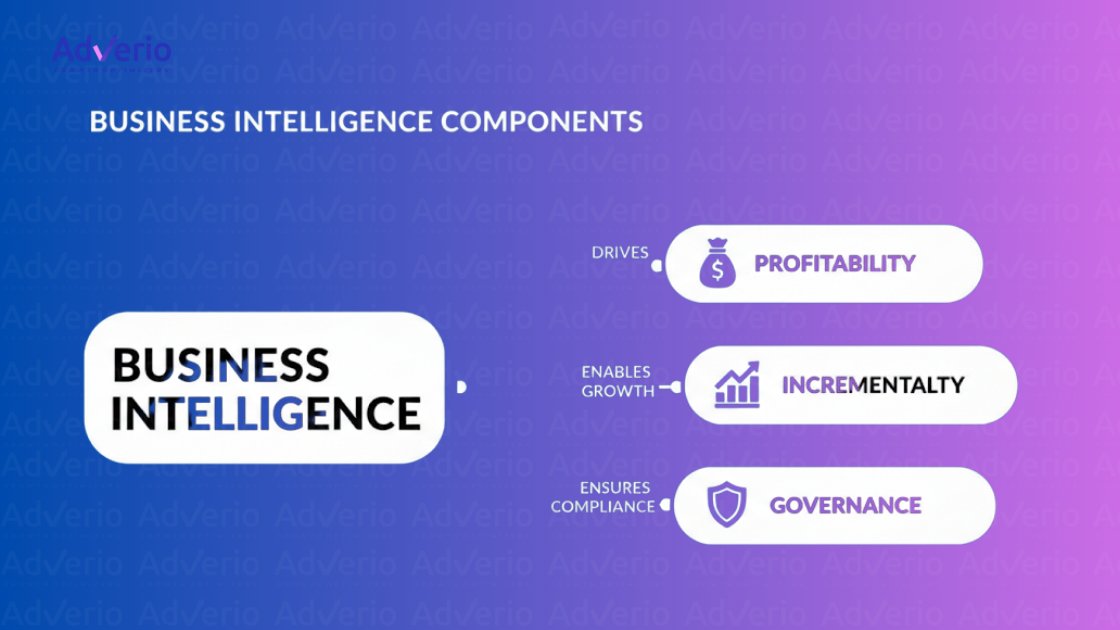
The foundation of any intelligent Amazon strategy is ruthless SKU-level profitability — and that starts with a governed Amazon dynamic pricing strategy. Aggregate data hides the truth. A smart BI system must track:
-
Contribution Margin: Your true profit per unit after all variable costs. It’s the ultimate litmus test for whether a product is helping or hurting you.
-
CVR Floors: A minimum acceptable conversion rate for each SKU. If a product’s CVR dips below that floor, it triggers an immediate review before you burn more capital.
-
Velocity Bands: Categorizing products by sales velocity helps create tailored strategies for inventory governance and advertising.
With this granular view, you can confidently decide which products to scale and which to cut. For a deeper dive, check out our guide on utilizing SKU economics on Amazon.
Incrementality & Market Share Governance
Efficiency is not incrementality. A SKU can show a 4.0 ROAS and still be cannibalizing branded demand. True BI measures impression share, click share, add-to-cart share, and purchase share to identify where growth is actually constrained.
-
Shift spend from branded capture to competitor and generic incrementality
-
Monitor market share funnel deltas
-
Separate demand capture from demand creation
Incrementality Measurement
One of the toughest questions is: “Did my ad spend generate new sales, or did I just pay for sales that were going to happen anyway?” This is the question of incrementality. A sophisticated BI system must provide the answer by separating the true lift from your advertising from the baseline organic sales you would have captured regardless.
Risk & Governance Signals
Finally, a powerful Amazon BI framework acts as a governance layer, constantly monitoring the operational risks that can silently kill your growth. Your system must track and flag these critical signals 24/7:
-
Buy Box: Losing the Buy Box on key products is a direct hit to revenue. An instant alert should fire when ownership drops below a set threshold.
-
Returns: A sudden spike in returns for a specific SKU often points to a quality control issue or a misleading listing.
-
Compliance Flags: Monitoring for potential compliance issues—from incorrect categorization to IP complaints—is essential for avoiding listing suspensions.
Event-driven spikes without governance destroy margin faster than they create revenue. This is especially true during high-traffic moments like Amazon Prime Day strategy.
Amazon BI vs Common “Tools”
Not all data solutions are created equal. Many brands mistakenly think a third-party tool is the same as a true business intelligence system. The difference isn’t in the charts; it’s in the decisions they enable.
Let’s break down how common tools stack up against a truly governed BI system. Amazon’s own ad services have become a powerhouse by using its BI on unparalleled first-party data. But while their dashboards show campaign performance, they intentionally lack the context of your overall profitability—which is exactly what a governed system provides. You can discover more insights into Amazon’s own data transformation on chroniclejournal.com.
Comparison of Amazon Data Tools
| Tool Type | Data Depth | Decision Support | Profit Visibility | Risk Awareness |
|---|---|---|---|---|
| Seller Central Reports | Surface-level | Non-existent | Minimal | Low |
| Ad Dashboards | Siloed to ads | Limited to campaigns | None | Low |
| Third-party Tools | Varies widely | Often generic | Indirect at best | Moderate |
| Governed BI Systems | Fully integrated | Action-oriented | Central focus | High |
The table says it all. Most tools are designed for isolated tasks, not for managing a complex, holistic business. A governed BI system integrates all critical data streams—ads, listings, inventory, and finance—to provide clear, actionable intelligence rooted in SKU-level profitability.
How Adverio Uses Business Intelligence Differently
For us, Amazon business intelligence isn’t a dashboard you buy; it’s the control layer for your entire growth strategy. We see BI as the central nervous system that allows brands to scale aggressively without creating chaos. It’s about embedding a decision-making framework directly into your operations.

Our BI provides both executive and operator views, with alerts, thresholds, and clear action paths.
BI without controlled traffic deployment is noise. That’s why our intelligence layer directly governs our Amazon PPC Management Services spend, which is deployed based on contribution margin and incrementality, not just ROAS.
BI informs every critical decision:
-
Pricing: We identify price points that maximize sales velocity and profit margin. Our approach to a winning Amazon pricing strategy is data-driven, not a race to the bottom.
-
Ads: Our intelligence layer tells us which SKUs can scale and which have hit their profitability ceiling. We deploy spend through Amazon PPC Management Services, and we use audience layering inside Amazon DSP strategy and management to measure incrementality, not just campaign ROAS.
-
Listings: When conversion drops, it’s rarely an ad problem — it’s a merchandising problem. Our intelligence layer flags underperforming SKUs and deploys improvements through Amazon listing optimization services to restore conversion velocity.
-
Inventory: Our system provides forward-looking projections to prevent costly stockouts and avoid tying up cash in slow-moving products.
BI is the control layer that allows scale without chaos.
This turns data from a passive report into an active governance tool. While it’s useful to explore the broader landscape of Top Business Intelligence Tools, our approach is different. We don’t sell BI as standalone software because its value is in the decisions it forces.
How Adverio Helps Brands See What Others Miss
Adverio builds the profit-focused BI frameworks that allow brands to scale with confidence. Our BI is not sold standalone; it’s embedded inside our complete Amazon account management and growth systems. The focus is always on what to do next, ensuring every move is calculated, controlled, and relentlessly profit-focused.
If your dashboards aren’t translating into controlled profit growth, you don’t need more data — you need governance.
Book Your ROI Forecast and see exactly where profit leaks, incrementality gaps, and market share losses are hiding.
FAQs
What is Amazon business intelligence?
Amazon business intelligence is a decision-making framework that translates raw data from ads, sales, inventory, and finance into specific, profit-driven actions. Its only job is to tell you what to do next. If your “BI tool” just shows you what happened, it’s a history book, not intelligence.
How is BI different from Seller Central reports?
Seller Central reports are a rearview mirror; they show historical data like sales and units sold. They answer, “What happened?” Business intelligence is a forward-facing GPS that integrates data with profit margins and inventory to answer, “What should we do next?” Reporting gives you a number; intelligence gives you a directive.
Do 7-figure Amazon sellers actually need BI tools or just better governance?
No, sellers don’t need more “BI tools”—they need a governed intelligence system. The market is flooded with software that promises insights but only delivers more data points. Instead of another dashboard, sellers need a unified system that connects all puzzle pieces and applies a decision framework to them. The goal is fewer, better decisions.
What metrics actually matter for profit?
Most brands drown in vanity metrics like ROAS and top-line revenue. The single most important metric is SKU-level contribution margin—the real profit you bank after all variable costs are stripped out. Other critical signals include customer lifetime value (CLTV), inventory turn, and Buy Box ownership percentage.
Can BI help prevent scaling mistakes?
Yes, this is one of its most valuable functions. Scaling on Amazon without a governance layer is like driving a race car without brakes. A proper BI system acts as that framework, preventing costly mistakes like inventory stockouts, unprofitable ad spend, and negative unit economics by setting up alerts for critical operational risks.
How does Amazon BI impact TACoS and contribution margin?
Amazon BI reduces TACoS by separating demand capture from true incrementality. Instead of scaling branded campaigns that would convert organically, a governed BI system reallocates spend toward higher-incremental segments. At the same time, it protects contribution margin by aligning pricing, inventory, and ad spend decisions at the SKU level. The result isn’t just lower TACoS, it’s controlled, profitable growth.