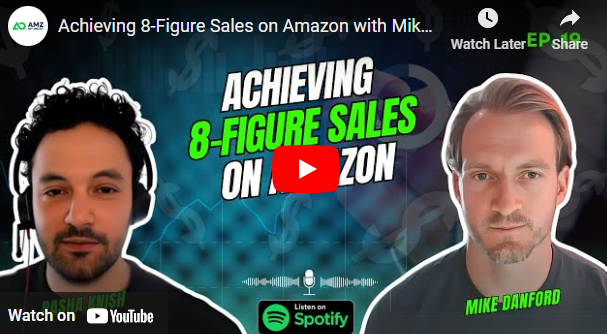
Scaling to 8-Figure Amazon Sales [Agency Operators Podcast]
Uncovering the paths to success from agency owners.
Episode Overview
In this episode of the Agency Operators Podcast, Pasha Knish sits down with Mike Danford from Adverio to discuss the strategies ecommerce brands use to scale from seven-figure to eight-figure revenue on Amazon.
Mike shares his journey from building his own Amazon business to helping large ecommerce brands unlock growth through data-driven marketing strategies. As Amazon has evolved over the past decade, scaling a brand has become significantly more complex, requiring advanced catalog management and cross-channel expertise.
The scaling lever. The conversation explores how successful brands combine several growth levers, including Amazon PPC management and external traffic, to drive visibility. By analyzing large catalogs to identify underperforming products, brands can allocate budgets more effectively.
The episode also dives into the growing importance of advanced tools such as Amazon Marketing Cloud (AMC) and Amazon DSP management. When paired with strong Amazon account management and Amazon listing optimization, these strategies build scalable systems for long-term growth.
For Amazon sellers aiming to move beyond incremental improvements and scale their sales, this episode highlights the importance of focusing on the fundamentals while strategically leveraging new marketing opportunities.
What You'll Learn in This Episode
- How ecommerce brands scale from seven-figure to eight-figure Amazon sales
- Why strong Amazon PPC management is essential for driving consistent traffic and revenue
- How brands analyze large product catalogs to identify growth opportunities
- Why optimizing product content through Amazon listing optimization improves conversions
- How advanced data tools like Amazon Marketing Cloud (AMC) help analyze customer behavior
- How Amazon DSP advertising helps brands reach new audiences and expand market share
- How influencer marketing and external traffic campaigns contribute to Amazon growth
- Why focusing on core ecommerce fundamentals often delivers better results than chasing new tactics
Highlights
- 00:43 Mike's journey to Adverio
- 02:27 The evolution of advertising and marketing
- 07:04 Team building and scaling challenges
- 12:07 Navigating marketplaces and expansion
- 20:15 Strategies for driving traffic and sales
- 22:59 Challenges with Amazon attribution
- 24:32 Understanding and utilizing AMC data
- 25:21 Leveraging DSP and AMC for insights
- 27:12 Moving from seven to eight figures
- 30:03 The importance of market basket analysis
- 33:28 Influencer and affiliate marketing strategies
- 40:49 Final thoughts and resources
Episode Transcript
Pasha Knish: Hey everybody, Agency Operators, Pasha here with Mike Danford, good old friend of mine from Adverio. How you doing, Mike?
Mike Danford: Great. Thanks for having me today.
Pasha Knish: You and I have known each other for a number of years, we have had many calls talking about what is working and how things are changing. Before we dive in, could you share a little about your story and how you ended up with Adverio, and your position has changed quite a bit too, which has been cool to watch.
Mike Danford: Absolutely. I have been in the space for about 12 years. I studied undergrad for risk management and insurance, spent several years in insurance, and then I contracted MRSA and was like, this is not what I want to do for the rest of my life. I got into real estate, and around that time is when getting on Amazon FBA was a big thing. I went through the Amazing Selling Machine, which was the way to get into it at that time for a lot of us. We started our own FBA store and realized there was a lot of opportunity. I was having someone run my advertising and marketing, which was a lot less sophisticated at that time, and I was like, this is just numbers, I can figure this out. So I started doing that, and thanks to Facebook groups I posted and shared success and tactics, and a few people said, I would love for you to do that for me, and the rest is history. To your point about my role, I was on my own for a few years, then started doing some white labeling for other agencies, but I did not want to get into the marketing side, I just wanted to do the PPC and the algorithms before all the SaaS platforms came out. Then I bumped into Alden, my partner at Adverio, and we had two businesses in similar lines, not really competing, and figured we could do more if we came together, so the rest is history. As far as the role change, it is still changing almost every day, there is a new opportunity, let's figure this out. Where we found our stride is working with mid-seven figure to mid-eight figure brands that are stagnant or having some decline in revenue or inability to launch new products. What used to work 10 years ago does not work now. A large pain point for them is prioritization, we work with very large catalogs, some brands have tens of thousands of products, so we built systems to leverage for those brands. I love the challenge and the tech that has developed over the last 12 to 15 years.
Pasha Knish: You guys were really working on some cutting-edge technology back in those days, and I am curious how that has changed with all the new upgrades, and with the addition of other marketplaces and services. How has the tech part caught up?
Mike Danford: We were one of the first in our group to dig into having our own GPT API access on the back end before it became mainstream, understanding what large language models are and how to impact everything from SEO to advertising. We have 80,000 products for a brand, we cannot go manually into each title and bullet point, so how do we create these recipes. You can see some of that with other AI platforms doing SEO and titles, and it really is not good, I saw one SmartScout posted where a big-name brand is clearly using AI. So the big part is being able to do more, but the moderation is the most challenging part now. The more access and data we have, the better it becomes, and I can see trends, hey, this is not working anymore, why, oh, Amazon changed this. We are digging into Walmart, which has a really good guide, brand name, product name, use attribute, one keyword, and we bring those formulas back into Amazon. One of our new exciting projects is Amazon's Rekognition software, their AI that scans all your images and videos and scrapes the text, so we are looking at another way of hidden indexing for listings, making sure Amazon knows from our images the most relevant searches, how many keywords we can place, whether we are getting duplication of the same word in the image. That is directly from Amazon, so it is cool to see under the hood what they are reading in these images.
Pasha Knish: Pretty amazing how there are all these little nuances for optimization, putting keywords into the metadata of an image can have a big impact on your ranking. And back in the day you were more focused on PPC specifically for Amazon, and now it is content, catalog optimization, and other platforms. So you must have built a pretty robust team. How was that scaling process, managing all the people and mid-level management?
Mike Danford: That is where part of the role changes. I listened to Stephen's appearance last week, and I liked how he mentioned eight people under one person is kind of a capacity, and that is trying to figure that formula out. It is more of an HR role I am not used to, so we have an operator who helps us understand capacity and how roles change. Similar to how tech has changed, you are still in the same space but pulling different levers, and it is the same with human capital, you are still creating images and copy, but now you have these other tools, so what can you do the most with your time. We try to promote within before bringing someone new in, and it is nice to have someone with a background that built exactly what we are looking for. We give them the freedom and autonomy to create within their domain, and if something is boring or you do not like clicking this button, come over to the data scientists and see if they can fix it, because we want you to enjoy your job and focus on things that are more impactful. If I could do it over, I would bring in an operator much sooner. Wearing that hat in the beginning was okay, but systematizing is not my strongest suit, I am definitely an implementer. When you bring someone in who has built multiple agencies, it is eye-opening what they bring, all the questions, very similar to what we do for advertising where we see hundreds of brands and are not pigeonholed. The learning curve is so much shorter. Sometimes I am stuck in web 1.0, we were talking on our marketing team, this is how we used to do blog articles in the early 2000s and it is totally different now.
Pasha Knish: In my agency, having a strategist with that experience and building a workforce around them has worked well because they know what moving parts to put together and the learning curve is shorter. There is a lot of fractionalized opportunity now, agencies are at different stages so you cannot always offer a full-time position at a high salary, and people are more open to remote and contract work as long as the job gets done.
Mike Danford: Absolutely. How it has changed the last 10 to 15 years, one, where to find talent, and this whole gig economy that COVID spread. LinkedIn has been phenomenal for us to find talent that is already engaged and kind of knows us, we can see their past interactions and how they create content, as a way to cut down the noise as opposed to a ZipRecruiter, which others have success with but is not for us.
Pasha Knish: With the other marketplaces you are expanding into, you mentioned Walmart. From the data you are collecting, what are you seeing compared to Amazon? Is Amazon still going to be number one forever, or do you see that shifting? How much opportunity is there outside of my website and my Amazon channel?
Mike Danford: I will share something and then answer directly. I was reading a couple weeks ago, I might misquote the brand, I want to say it was a seasonal summer product that blew up with virality, a cool product. He is going against the grain, they started DTC and are in retail but do not sell directly on Amazon right now. The gist of his post was that having all the channels and managing everything that comes with DTC when you do it yourself, it is still enticing for even a large brand to come back to Amazon and simplify things, ship everything just to Amazon, the fees may be more and you are beholden to them, but life and operations are simpler. So I think you will have a lot of transition both ways, DTC coming over to the marketplace, and people saying I do not want to pay the 30, 40, even 50 percent, so I am going to go DTC and see if the grass is greener. For us specifically, it is taking a brand most commonly already on Amazon, getting them onto Walmart or Target if they have an invitation, then helping with their DTC traffic. When you go across platforms, does a rising tide raise all shelves, that is a challenge and very category specific. Target is very limited in what they will take right now, because a year and a half ago right before Christmas they had to liquidate a lot of inventory that did not move in Q4, so now they are just looking at pet and baby brands. For Walmart, a brand that does extremely well on Amazon may not do well on Walmart because of the target audience and locations. We used to say five to 20 percent of your Amazon revenue you could get on Walmart, but now we are seeing brands with 40, 50, 60 percent on Walmart versus Amazon, and it is so random we are still trying to figure out how to anticipate that. Each platform performs totally differently, what works on one does not work on the other. Brands come to us with their top 200 or 300 Google keywords that did well on DTC, and I appreciate that, just be prepared, that is probably not how the search traffic is inside Amazon. And the new release Google pushed out where Performance Max can go directly to your Amazon listing as opposed to going through your website is cool, the two giants figuring out how to create less friction.
Pasha Knish: If you had a choice between expanding to other US marketplaces, Target and Walmart, or going to the EU with all the VAT compliance and shipping, knowing what you know, what would be your option?
Mike Danford: It is going to be other marketplaces in the geographic region you are already in, where you already have the infrastructure. It is much easier to ship an extra shipment to a warehouse than to go across the pond, or even across the northern border. We have an eight-figure brand asking how do we figure out Canada, the VAT and fees and shipping and delays, do we have to buy a property in Canada. They rely on tentpole events with a six to eight week build-up, and in the US the demand dies a couple days before because of shipping delays, but in Canada if you are not shipping through their systems, a seven-day shipping does not work and you miss the meat of the sales event. So wherever you have your operations set up already working, figure out how to get more of that to other places first. It is nice when you do your ASIN match and can get reviews to follow around on each platform, which used to not be the case, but it is still a totally different market and a lot more headache.
Pasha Knish: The reason I ask is when I think about why a brand does well in one US marketplace and not another, what comes to mind is Amazon is saturated with competition and Walmart is not. The same is true with EU marketplaces, but the audience might be bigger, so if there is no competition there and tons in the US, maybe it makes sense to go over. And with external traffic, Performance Max going straight to Amazon, does it make more sense to send to a Shopify store to capture that sale, or to Amazon where you have the authentic reviews? What are you seeing?
Mike Danford: For right now we have two primary buckets. Most brands running Google traffic have a reasonable DTC presence already. We break it up and want to drive as much traffic that is not necessarily in the Amazon funnel to their DTC, but with search semantics specifically, if someone searches this product on Amazon, that traffic I am going to drive straight to Amazon because they are already thinking about Amazon, with my attribution tag on it. If we do not have Walmart or Target, we push you to our platform. For some brands, when someone falls out of the funnel, you give them an incentive to go over to Amazon, a coupon, or hey we have Prime Day coming up. It is really hard to track a lot of that, and there is a latency, you do not want it too cold where it has been three months, it is a recency bias. So lots of new campaigns being tested.
Pasha Knish: I answer that question a lot and my answer is always like yours, it is case by case, depends on the brand, and the only way to know is to test it. The only difficulty is attribution is not that accurate, I am finding Amazon attribution has holes, delays or double booking. Do you have any tricks to help get accurate results from your attribution data?
Mike Danford: When possible, we like to concentrate budgets around an objective, go a little heavy and aggressive where we anticipate a low-traffic time, and reduce the noise in the platform so you can see what happens, do not run extra promos, pull that out and see. Then going to DSP and AMC is a whole other situation. So we pull back on other things, get some stability, and push more aggressive than we would want to sustain to see if you get new external traffic. Even if you get the clicks, you may not always get the conversion because of attribution windows, but at least see if the traffic is more interested, and then look at your conversion rate comparison, try to be a high enough percentage that you can make some assumptions, but it is still an assumption at the end of the day.
Pasha Knish: You mentioned AMC, that is something we are also trying to get our head around. It is a lot of good information straight from Amazon, but formatting that raw data into something actionable has been a challenge. How are you utilizing AMC data, and is it paired with anything on the DSP side?
Mike Danford: It is the juice-squeeze ratio again, you can get so lost in AMC. To reduce as much noise as possible is hard because if your audience is not big enough and you trim it down, AMC will say no, we cannot, because we think you might reverse engineer who these shoppers are. So it is difficult to remove those layers of the onion to get to the core of what is and is not working. You do have to have a really high volume of DPVs and traffic and multiple types of ads across where you can control the journey, getting into the upper funnel. If you are not doing that, it is really hard to glean valuable information from AMC, the quantity and quality of data is not reliable. We have brands with tens of thousands of products spending millions a year, and when you look at the back end there are still not a ton of insights, you might get a little, should I push more here, but it is very minute, a lot of effort, and can be expensive. They built a little editor that is helpful, and some platforms have preformed templates. It is still something we are tackling and learning, and I think it is most impactful for a brand with a significant amount of traffic.
Pasha Knish: That comes back to moving from seven to eight figures, with smaller brands it is just overkill, and same with DSP, you have to be at a certain level. So bringing it back, if I was a prospective client with a seven-figure account wanting to make eight by next year, what would be the plan, the lines of attack you would implement?
Mike Danford: You have to do a little bit of everything. It is dollars in clicks on Amazon now, so every time they offer a new feature, whether it is Creator Connections, sponsored display video, STV, or any of those levers, you have to pull them. They may not work, it may take a while, but that is how you answer the questions for your own brand, and not focus on shiny objects. Let's look at your sponsored products, sponsored brands, brand tailored promotions, Creator Connections, UGC, are you pulling those. Well, we pulled them, okay, how much did you spend, 100 bucks, okay, you are a multimillion dollar brand, you have to spend a little more than 100 to consider something works or not. That is where an agency with experience across multiple categories can say, it takes 10,000 before it works, you will have this many detailed page views before you get a large enough sample. All that to say, we go down to the basics, so many brands do not do the basics, and the basics are so basic it is hard to have that conversation, guess what we are going to do in the first six weeks, everything you were supposed to do that you stopped a couple years ago because of COVID, it is time to turn it back on, it has improved. Look at your market basket analysis, what else is commonly purchased. I get this all the time, hey Mike, what should we look at, we are aggressive, we want to push, and I say have you looked at what else is purchased with your products, and they say where do we find that, and I am like, Amazon is telling you what people purchase with your products, both at an ASIN level, and we pull Ngrams in on the titles, it is not the same product but 200 brands are purchasing a very similar product, so you should offer your own or bundle it, put a virtual bundle. Are you doing virtual bundles, how do you test packaging, they do not do anything, it is spray and pray and put it up, and what worked on one platform does not work on another, are you split testing. Amazon has that built in and they do not want to split test long enough. It is really being a root cause analysis, and the big thing is not just what are you doing and not doing, but understanding why they have not done it, that fear, oh we got burned, we built a beautiful video and it just did not work, okay that is one video, let's try another or clip it up, it is a two-minute video, that is probably a problem, let's do a 20-second video and get right to the punch. The bigger brands have the resources and are getting all these notifications and tools, they just need to know what to do, that is our goal, this is what generally works, and let's not go straight into AMC, let's get you stabilized first.
Pasha Knish: To me as this imaginary prospective client, it is a relief to hear something grounded and reasonable, let's focus on the most important things, get the listing right from the graphic and textual side to the back end keyword stuff, then are you spending your ads correctly, are you utilizing all the Amazon programs, are you on other marketplaces, external traffic, influencer marketing. It is very step by step. When you do creator content and influencer campaigns, are you only using Creator Connections, Amazon's native system, or other influencer campaigns, and targeting Amazon or the website?
Mike Danford: It kind of depends. Most brands we work with are larger and established, and they already have a flow of UGC content. We help them not put a square peg in a round hole, go from your social platform and do the same thing on Amazon, see if it works. I was just on the PPC Den about a month ago with Mike Facchin and that was the theme, do not reinvent the wheel, put the wheel out there first. To answer more directly, yes, we use and recommend third parties for affiliate and influencer marketing, it depends on the budget and how aggressive they want to be. What I have seen, whether Creator Connections or a third party, is it is quantity over quality, getting a lot of signals, you can look at an influencer's resume and think we are going to crush it and it is crickets, and someone else with a small audience posts on the right day or on TikTok and it takes off. So it is taking all the arrows out of your quiver, one at a time, until you find what works and try to figure out why so you can replicate it. That is where seeing it across so many brands helps, we have done this across 10 brands and it has not worked, so we are less likely to do it. If you have a really good creative team, or a fun brand people are already engaging with, you can be more human and less commercial in the marketing.
Pasha Knish: With influencer marketing, is there a way to easily track what happens?
Mike Danford: Some platforms have that, you can see a post or engagement or backlink and go back and look at the traffic. The attribution still works reasonably well, if you are on Amazon affiliates they have theirs, or your own attribution, it is a little fuzzy coming from TikTok but other platforms are better. We try to do a case study to see if this type of influencer works for us, and warm up the audience, a smaller offer or bigger offer, which product to go with first, get them into the brand, then a bigger bundle. It is building those funnels, because a higher AOV product might not convert as well as something 15 or 20 bucks that gets them into your funnel and the brand following. Where do you drive your traffic, and our recommendation is always, if possible, drive into your brand storefront on Amazon as opposed to your detail page, because it is more of a web page, DTC feel, there are no advertisements for other products, and the attribution is usually a little better. As soon as you drive to a PDP, who knows where they click.
Pasha Knish: Very cool. It sounds like you need a lot of different levers, you need to know how and when to pull them, and as long as you are consistent and persistent it is going to grow. Any last things you wanted to say?
Mike Danford: I will say we used to pull a lot of levers all at once, because when you come in with a 90-day expectation everybody wants to get as much done, but now it is understanding which levers to pull and keeping them as stable as possible. It used to be volatile in the beginning to show them measurably what is going on, and now it is narrowing and pinpointing so they can see, let's focus on this while we work on so many other products, and 1 percent across 100 is 100 percent. We are also working on our hidden agenda where we know this is really where the potential is, it is not on their radar, and we communicate, we will do your priority, and also take a small set that based on our experience is where we would put our mind first. If this were my business, if I had just acquired it, this is day one, that is how we approach it. We have a growing number of levers, content, external traffic, other marketplaces, it is an evolving process, and I love that we have experts in each platform to collaborate and share the knowledge.
Pasha Knish: I love what you guys are doing. I appreciate you coming on, Mike, and sharing all your experience. Thank you everybody for watching and we will see you on the next one.
Mike Danford: Thanks so much.
See how AI shopping reads your catalog
A shopper asked AI for the best in your category and it did not name you. Run the three-layer AI Shopping Readiness check and see where you are losing the sale, ranked by impact.
Get My Products Named by AITakes 2 minutes. No call required.
Prefer to talk it through? Map your profit leaks with a strategist