



Table of Contents
Your ROAS report looks healthy. Your margin keeps getting squeezed.
That’s the moment brand operators start asking why is my tacos increasing. And they’re usually asking the right question before their agency does. Stable ROAS with rising TACoS means paid media is carrying more of the business than it should. That is not a reporting quirk. It is a structural warning.
When TACoS climbs, ad spend is consuming more of total revenue. In plain English, you are spending more to produce the same commercial outcome, or to protect sales that used to come through organic rank, stronger conversion, or true incremental lift. Agencies love to keep the conversation on ROAS because ROAS flatters ad accounts.
TACoS exposes the retail engine underneath, and connecting that signal to your full marketplace business intelligence picture is how the structural problem gets diagnosed correctly.
Here’s the hard truth. If ROAS holds steady while TACoS rises, your ads are not getting more efficient. Your business is getting weaker somewhere outside the ad console.
The right move is to test whether paid spend is creating net new demand or just taxing existing demand. Start with Amazon incrementality measurement. That is how Adverio separates a bidding issue from the underlying problem and stops brands from paying more just to stand still.
If your TACoS is climbing while margin contracts, book a Profit ROI Forecast before you make another media change.
The ROAS Trap: Why Your Gut Feeling About Rising TACoS Is Right
Rising TACoS is often misread as a bidding problem. It often isn’t.
Sometimes you built organic rank with paid velocity, then trimmed spend, then competitors took the shelf space back. That’s the nuance most surface-level TACoS advice misses. The Amazon flywheel can work in reverse. Paid sales help organic rank, but if you stop supporting that rank while competition gets sharper, your brand slips and paid media has to do more of the work again (AMZ Monitor).
That’s why your gut feels off. You’re seeing a business that looks efficient inside the ad console but weaker in the marketplace.
Good ROAS can hide a bad retail engine.
This is the dangerous version of TACoS inflation because it doesn’t show up as an obvious campaign failure. CTR may look acceptable. ACoS may look stable. ROAS may still keep the agency comfortable. Meanwhile, your organic share erodes, branded defense gets more expensive, and every month requires more paid support.
You don’t solve that by asking for another search term report and a few bid tweaks.
You solve it by diagnosing what broke first:
-
Organic visibility
-
Incrementality
-
Conversion rate
-
SKU economics
If your agency isn’t answering those questions, they’re not managing your profit. They’re protecting their dashboard.
TACoS vs ROAS: The Dangerous Disconnect
You can hold ROAS steady for months while TACoS keeps climbing. That’s not a reporting quirk. It’s a structural warning — and your agency should have flagged it before you did.
ROAS measures ad-attributed revenue against ad spend. TACoS measures ad spend against total revenue. One tells you whether media is producing tracked sales efficiently. The other tells you whether the business is becoming more dependent on paid support.
If you need a quick refresher on ROAS itself, What Is Return On Ad Spend covers the basics.
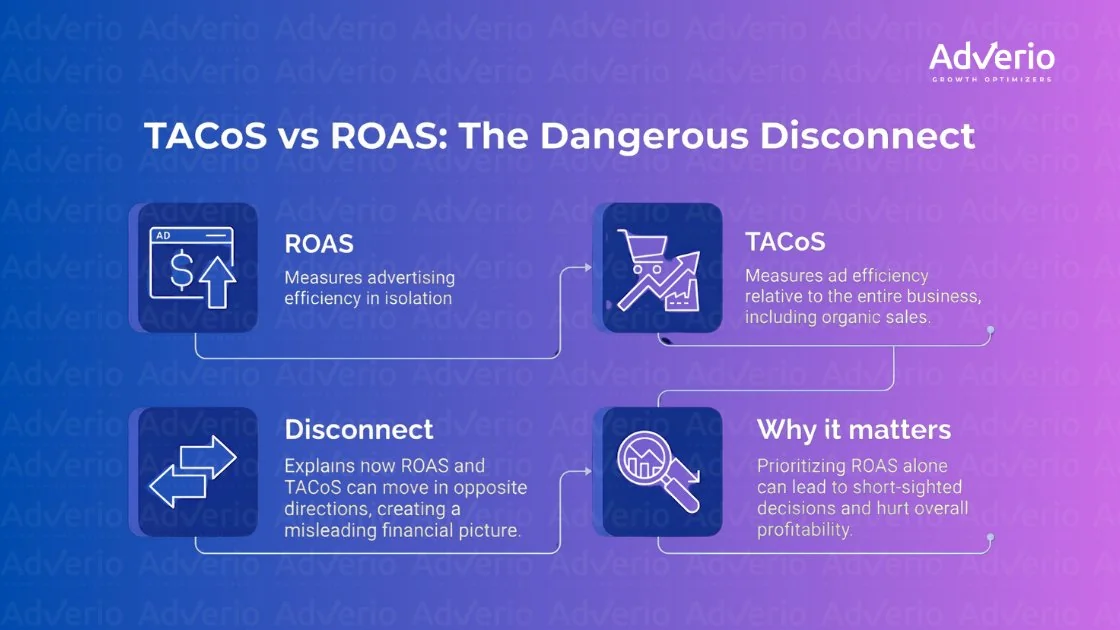
What each metric actually tells you
| Metric | What it measures | What it hides |
|---|---|---|
| ROAS | How efficiently ads generate attributed revenue | Whether organic sales, conversion rate, and incrementality are weakening |
| TACoS | How much total revenue advertising is consuming | Which campaign or keyword caused the problem |
TACoS = (Ad Spend / Total Sales) x 100
If you want the formula and examples, use this guide on how to calculate TACoS.
The mistake is treating ROAS as the final answer. It is a channel metric. TACoS is a business metric. Agencies that report ROAS first are usually protecting the ad account, not diagnosing the retail system.
Here is the disconnect in plain terms. You can keep ad efficiency stable while total sales quality gets worse. That happens when paid clicks replace organic demand, when bids rise on traffic you would have won anyway, when your listing converts worse and needs more sessions to produce the same orders, or when your sales mix shifts toward lower-margin SKUs.
None of that shows up cleanly inside ROAS.
That is why rising TACoS with flat or healthy ROAS should make you more concerned, not less. It usually means the ad console is masking a deeper breakdown. Organic rank is slipping. Conversion is softening. Incrementality is getting weaker. The account can still look fine in-platform while profit quality deteriorates outside it.
Operators who know what they’re doing track both — but they don’t give them equal authority. ROAS tells you whether the engine is still turning. TACoS tells you whether the car is burning too much fuel to move the business forward.
If your reporting stack can’t answer whether paid spend is creating real lift or just replacing organic revenue, that’s the first thing to fix.
Start with a sharper Amazon advertising framework.
The 4 Structural Causes of Rising TACoS
A rising TACoS is a symptom. The disease is almost always structural.
Organic rank decay
This is the most common cause, and the most ignored.
Your ads created sales velocity. That velocity helped organic rank. Then one of two things happened. You reduced support too early, or competitors out-executed you on listing quality, reviews, pricing, or inventory. Once rank slips, you start paying to replace traffic that used to be free.
That’s not scale. That’s dependency.
Data from 2023 to 2025 analyses indicates that brands with TACoS above 25 percent often have organic sales below 40 percent of total, while healthier accounts sit at 60 to 70 percent, often because of weak reviews or low AOV (Incrementum Digital).
Signs you’re dealing with rank decay
-
Paid share is climbing while total sales are flat or sluggish
-
Top search terms need heavier bids just to hold placement
-
Branded search gets more expensive because shoppers aren’t finding you first
-
Best sellers lose momentum after a competitive wave or stock issue
This problem gets worse when inventory is unstable. If top ASINs go out of stock, rank decays fast and recovery gets expensive. Tight Amazon inventory management matters more than most ad teams want to admit.
If your ads have to replace the traffic your organic rank used to deliver, TACoS will rise even if campaign metrics stay respectable.
Non-incremental spend
A lot of ad spend looks productive and does nothing new.
This is the money you spend defending branded terms, retargeting shoppers who were already close to buying, or overfunding hero ASINs that already own the category. The campaign gets credit. The business doesn’t get much incremental lift.
That’s why “good ROAS” can be fake comfort. Branded defense usually converts well. It can keep dashboards pretty while it taxes sales you already owned.
Where non-incremental spend shows up
-
Branded campaigns with strong efficiency but little growth impact
-
High overlap between paid and already-established demand
-
Constant spend increases with no organic rank improvement
-
Agency reports that celebrate attributed revenue but never isolate incrementality
Brands running Amazon DSP management without incrementality guardrails are especially exposed here — DSP can look productive on attribution reports while driving zero net new demand.
If you’re asking why is my tacos increasing while branded terms keep looking great, this is one of the first places to look.
Conversion rate decline
More traffic doesn’t fix a weak listing. It just gets expensive faster.
When conversion rate falls, every order requires more sessions. More sessions require more spend. Paid traffic becomes a crutch for a retail problem. Poor images, stale A+ content, weak review signals, price mismatch, or creative fatigue then wreck efficiency.
If your creative has gone stale, especially on Sponsored Brands, DSP, or off-Amazon traffic that supports marketplace demand, studying effective creative fatigue solutions can help pressure-test whether ad creative, not just bids, is suppressing conversion.
What usually causes the decline
-
Listings aren’t differentiated
-
Review profile loses trust
-
Price-to-value looks weaker than competitors
-
Mobile-first content is weak
-
Variation architecture confuses the shopper
The marketplace doesn’t care whether your ad team is busy. If the PDP doesn’t convert, TACoS climbs. That’s a listing problem — and it requires Amazon listing optimization, not a new bid strategy.
SKU mix shift
Some brands don’t have a traffic problem. They have a merchandising problem.
If spend shifts toward lower-margin, lower-converting, or lower-AOV SKUs, your top-line can stay alive while profit quality worsens. That drags TACoS higher because you’re funding a weaker sales mix.
This often happens in large catalogs. Teams keep chasing volume and forget to ask whether the catalog is steering demand toward the right products.
Common SKU mix failures
-
Promoting low-AOV products too aggressively
-
Sending budget to variants with weak conversion
-
Using old hero SKUs after demand shifted
-
Letting margin-blind automation spread budget too evenly
A campaign structure can look organized and still be economically wrong.
The 30-Minute TACoS Diagnostic: How to Find Your Root Cause
You don’t need another month of reporting. You need half an hour and the right reports.
Pull a recent period and compare it against a clean prior period. Use the same lens across your hero ASINs first. Don’t start with account averages. Averages hide damage.
Step 1 Check paid share versus total sales
Look at total sales and ad-attributed sales by top ASIN.
If paid sales are becoming a larger share of revenue, that’s the first warning. It usually means organic isn’t carrying its share anymore.
Ask one question: Are ads creating lift, or replacing lift we lost?
Step 2 Check listing conversion by ASIN
Use detail page sales and traffic reports.
If sessions are healthy but orders don’t rise with them, conversion is the issue. That means you do not have an ad optimization problem first. You have a retail conversion problem first.
Practical rule: If traffic goes up and orders don’t keep pace, stop congratulating the ad team.
Step 3 Check search query movement
Open Search Query Performance and compare your important terms.
You’re looking for whether your brand is weakening on the queries that matter most. If you’re buying more of the same visibility and getting less organic share, rank decay is in play.
A strong Amazon analytics tools setup should make this visible quickly. If it doesn’t, your reporting stack is built for attribution theater, not diagnosis.
Step 4 Check branded dependence
Break out branded and non-branded spend.
If branded spend keeps rising while total growth stays soft, you’re likely defending demand instead of creating new demand. That’s a classic non-incremental pattern.
Step 5 Check SKU-level economics
Don’t stop at account TACoS.
Review your winners, losers, and “looks fine” SKUs. One low-converting, heavily funded child ASIN can distort the whole account. One margin-poor bestseller can make the entire ad program look less efficient than it should.
A quick decision table
| What you see | Likely root cause |
|---|---|
| Paid share up, organic share down | Organic rank decay |
| Branded efficiency strong, growth weak | Non-incremental spend |
| Sessions up, orders lagging | Conversion decline |
| Revenue stable, margin quality weaker | SKU mix shift |
If your team can’t run this in 30 minutes, the issue isn’t effort. It’s that nobody built a system for it.
The Right Fix for Each Root Cause: A Profit-First Playbook
Don’t use one fix for four different problems. That’s how brands waste another quarter.
If organic rank is decaying
You need to restore velocity and relevance.
That means concentrating spend around your highest-value search terms and your strongest converting ASINs. Don’t spread budget politely across the catalog. Push where rank recovery matters.
What to do:
-
Tighten keyword focus around terms that move rank
-
Support hero ASINs with promotional moments when needed
-
Fix listing quality before pouring on more budget
-
Protect inventory so recovery isn’t interrupted
Disciplined Amazon PPC management matters. Not more campaigns. Better campaign intent.
If spend is non-incremental
Cut the vanity. Keep the defense you need, then redeploy budget.
Your branded terms don’t need a blank check. If a campaign is mostly catching buyers who were already coming to you, scale it with intention and move more spend into true conquesting, prospecting, or category expansion.
Do this next:
-
Audit branded campaign aggressiveness
-
Reduce duplicate audience layers
-
Separate defense from acquisition
-
Judge campaigns by business lift, not just ad attribution
A lot of teams never do this because non-incremental spend flatters ROAS.
If conversion rate is declining
Treat the product page like the revenue engine it is.
No amount of bid management rescues a weak PDP for long. You need sharper images, better titles, cleaner bullets, stronger A+ content, more convincing value communication, and review strength that supports trust.
Fixes that usually matter most:
-
Rewrite titles and bullets for clarity and differentiation
-
Upgrade image stack for mobile decision-making
-
Improve A+ content around objections, use cases, and comparison
-
Review pricing and offer structure
-
Clean up variant architecture
If SKU mix is hurting profit
Move budget toward the products that deserve it.
That means steering ads toward SKUs with stronger conversion, healthier margin, and better repeat economics. You don’t need equal treatment across the catalog. You need contribution discipline.
Your media plan should reflect your Amazon contribution margin strategy, not just top-line appetite.
What to fix inside PPC itself
Yes, campaign structure still matters. It’s just not the whole answer.
Overbidding and inefficient PPC structures can inflate TACoS by 10 to 20 percent in competitive categories like apparel, where bid inflation pushes CPC up 30 to 50 percent year over year without matching sales lifts. Segmenting campaigns into efficiency layers such as auto for discovery, manual for high-intent, and aggressive negative keyword pruning has been shown to reduce TACoS by 12 percent in 90 days (EcomRanker).
That’s useful. It’s just not enough if the underlying problem is rank, incrementality, or conversion.
Better bidding helps. Structural repair is what holds.
How Adverio Executes a TACoS Compression Program
Most TACoS work fails because agencies treat it like a campaign problem. It’s a profit problem. Those aren’t the same thing.
A practical operating model is to pair media analysis with listing quality, search query movement, branded versus non-branded balance, and SKU-level economics. That’s the only way to know whether spend is driving growth or just covering for decay. One framework built for that kind of cross-functional diagnosis is the COSMO framework.
This is why TACoS compression belongs inside a full business intelligence system — not siloed inside the ads console.
The right execution cadence looks like this:
-
First, isolate the leak
Determine whether the pressure is coming from rank erosion, weak incrementality, conversion loss, or SKU mix. -
Then, narrow the fix
Don’t rebuild the entire account when the problem sits in a handful of ASINs or query groups. -
Finally, measure business response
Watch total sales efficiency, not just ad-attributed efficiency.
Adverio runs a cross-functional TACoS compression program — BI reporting, Search Query Performance analysis, Share of Voice auditing, and profit-adjusted campaign structure — designed to find the break, not just describe it. The goal isn’t another report. It’s finding what your current reporting is designed to hide.
If your agency keeps handing you ROAS charts while TACoS climbs, they’re answering the wrong question.
Frequently Asked Questions: Why Is My TACoS Increasing?
Is rising TACoS always bad
No. Rising TACoS is expected during a launch, a ranking push, or a deliberate expansion into tougher search terms.
The problem starts when TACoS keeps climbing after that push is over. If total sales are relying more on ads and organic sales are not keeping pace, the business has a structural weakness. That is rarely an ad efficiency issue by itself.
What’s a healthy TACoS range
There is no universal “good” TACoS.
The right range depends on your margin structure, repeat rate, category pressure, and growth plan. A TACoS that works for a high-margin brand can destroy profit for a low-margin catalog. Use contribution margin as the filter. If TACoS rises above what the SKU can absorb, you have a business problem, even if the ad account still looks efficient.
Should I cut ad spend to fix TACoS
Usually no.
Cutting spend before you know the cause is a common mistake. If organic rank is slipping, broad cuts can reduce visibility, weaken sales velocity, and push TACoS higher later. Start by cutting waste, isolating low-incremental spend, and protecting the queries and ASINs that still create profitable demand.
Why does ROAS stay stable while TACoS rises
Because ROAS answers a narrower question than TACoS.
ROAS shows whether ads are producing attributed revenue at a similar rate. TACoS shows whether the business is becoming more dependent on paid sales to hold revenue together. If ROAS is flat while TACoS rises, organic strength, conversion rate, or traffic quality is usually deteriorating underneath the ad dashboard. That is the trap many agencies ignore because ROAS is easier to defend.
What should I review first if I’m asking why is my tacos increasing
Start with four checks. Paid share of total sales. Branded versus non-branded spend. Conversion rate on your top revenue ASINs. Search query movement on your highest-value terms.
That review usually exposes the underlying issue fast. You will see whether ads are compensating for lost rank, weak listings, poor SKU mix, or wasted spend that never had much incremental value in the first place.
If your ROAS looks fine but profit feels tighter, trust that instinct. Adverio diagnoses the structural reason TACoS climbs and builds the fix around profit recovery — not ad optics.
See how the Profit ROI Forecast works.
Read next:
How to calculate TACoS correctly
How to reduce TACoS without cutting growth