



Table of Contents
Your traffic is steady, but revenue has flatlined. Ad spend keeps climbing, but your profits are going nowhere. The problem isn’t your ads; it’s your Amazon listing conversion rate.
More specifically, it’s your Unit Session Percentage. This metric is the single most undermanaged, highest-impact profit lever on the entire platform.
Most brands are completely obsessed with driving traffic but blind to what actually happens after the click. They pour money into PPC, track impressions, and celebrate click-through rates, all while ignoring the one number that determines if any of that effort translates into a sale.
This is a critical, and incredibly common, mistake. Inaction here is your competitor’s best friend. Your listing is either winning sales or losing them to someone else. There is no middle ground.
If your conversion rate is underperforming, you’re not just losing sales—you’re leaking profit across your entire funnel.
What Is Unit Session Percentage?
Forget vanity metrics. The only conversion rate that truly matters on Amazon is your Unit Session Percentage (Unit Session %). It’s calculated with a simple, brutally honest formula:
Units Ordered ÷ Total Sessions = Unit Session Percentage
This number tells you exactly what percentage of visitors who land on your product detail page actually buy something. It’s the truest measure of your listing’s health because it strips away all the noise. Are you turning browsers into buyers? Your Unit Session % gives you the unvarnished truth.
A mere 1% improvement in Unit Session Percentage on a product doing 10,000 monthly sessions is worth thousands in new revenue. Most brands don’t even know their number, which means they’re leaving that money on the table every single month.
To put this in perspective, here are the key benchmarks and common pitfalls we see every day.
Amazon Conversion Rate At a Glance
| Metric or Concept | Benchmark or Key Insight | Top 3 CVR Killers |
|---|---|---|
| Unit Session Percentage (Unit Session %) | 10% is a common baseline. Top-tier brands often exceed 30%–50%. | 1. Main image fails the thumbnail test. 2. Price is outside the category’s “confidence band.” 3. Review count is below the trust threshold. |
| Pricing & Value | Your price must align with perceived value in the category. | The #1 reason for a bounce. If the math doesn’t feel right, they’re gone. |
| Main Image & Creative | Must stop the scroll and clearly communicate the product’s use case. | Poor images guarantee a low click-through rate and an even lower conversion rate. |
| Social Proof (Reviews) | 4.3-star rating is the minimum. Below that, conversion drops sharply. | Shoppers trust other shoppers. Low ratings or low review volume kills trust instantly. |
This table is a starting point. Fixing a low conversion rate requires digging deeper into the “why” behind these numbers.
The Financial Cost of Inaction
A low conversion rate isn’t just a marketing problem; it’s a financial leak that gets worse over time.
Every shopper who lands on your page and leaves without buying represents a missed sale and, very often, wasted ad spend.
When your listing fails to convert, you are effectively paying to send customers directly to your competitors—especially if your Amazon PPC campaigns are driving traffic that doesn’t convert.
Think about the domino effect:
- Wasted Ad Spend: Every click you pay for that doesn’t convert is money straight down the drain. Your ACoS and TACoS will inevitably climb as your listing bleeds efficiency.
- Eroding Organic Rank: Amazon’s A9 algorithm is a sales engine. It rewards products that sell well. A low Unit Session % signals to Amazon that your product is less relevant, causing your organic visibility to drop and making you even more reliant on expensive paid traffic.
- Plateaued Growth: You can’t scale a business on leaky listings. No amount of ad spend can fix a product page that fails to convince shoppers to click “Add to Cart.” This is precisely why so many brands get stuck in a cycle of stagnant revenue.
Your Amazon listing is a high-value asset, but if it isn’t optimized for conversion, it’s an underperforming one. Knowing how to increase Amazon sales through conversion rate optimization starts with plugging these conversion leaks. It’s time to stop guessing and start treating your listings with the financial scrutiny they demand.
What “Good” Actually Means by Category
Let’s get one thing straight: chasing a universal “good” Amazon conversion rate is a waste of time. It’s a myth.
A 10% Unit Session Percentage might feel like a failure for a high-volume supplement brand, but for a company selling high-ticket furniture, it’s category-leading performance. Your benchmark isn’t some magic number pulled from a blog post; it’s a moving target defined entirely by your product category, price point, and the ferocity of your competition.
The real question isn’t whether your conversion rate is “good.” It’s what’s suppressing it, and what’s the dollar cost of not fixing it? Anything less is a direct leak from your bottom line. It’s time to stop guessing and start using real data to see where you actually stand.
Benchmarking Against Reality
While there’s no single magic number, we can establish some realistic performance bands. In 2026, the average Amazon listing conversion rate sits around 10% to 10.33%. That figure absolutely demolishes the 1-3% average you’ll see on most DTC websites.
For serious brands on the platform, a healthy Unit Session Percentage (Unit Session %) typically falls between 7% and 15%, but even that is a massive generalization. The real insights come from digging into category-specific data. This is where you separate signal from noise.
For a broader perspective on e-commerce benchmarks, this guide on what is a good conversion rate provides excellent context. But when you’re playing on Amazon’s turf, category-level data is what truly matters.
Based on aggregated performance data across Adverio-managed accounts, here’s how conversion rates actually break down by category. Find your category and get an honest look at whether your performance is ahead of the pack, lagging behind, or just average.
Amazon Unit Session Percentage Benchmarks by Category (2026 Estimates)
The “10% rule” is lazy thinking. This table shows what performance actually looks like. Use it to benchmark your position, spot gaps, and identify exactly where your conversion rate is breaking down.
| Product Category | Average Unit Session Percentage Range | Notes for Brands |
|---|---|---|
| Supplements & CPG | 15% – 25% | High-trust, high-repeat purchase categories. Social proof and subscriptions are critical. |
| Beauty & Personal Care | 12% – 20% | Driven by visual appeal, influencer validation, and strong Amazon A+ content that details ingredients and results. |
| Apparel & Accessories (Softlines) | 5% – 15% | Highly competitive. Fit, sizing charts, and high-quality lifestyle imagery are non-negotiable. |
| Home & Kitchen | 10% – 18% | A broad category where use-case videos and infographics that demonstrate value are key differentiators. |
| Electronics & Accessories | 8% – 14% | Technical specifications, comparison charts, and brand credibility heavily influence purchase decisions. |
| Automotive & Industrial (Hardlines) | 7% – 12% | Conversion depends on fitment data, technical accuracy, and demonstrating durability and compatibility. |
| Furniture & Home Decor | 3% – 8% | Higher price points lead to longer consideration cycles. Dimensions, materials, and in-context photos are vital. |
The context this data provides is everything. If you’re a furniture brand hitting an 8% conversion rate, you’re crushing it. But if you’re a supplement brand with that same 8% rate, you have a serious conversion problem that’s costing you market share every single day.
Benchmarks don’t grow your business. Fixing what’s suppressing your CVR does. The real work is diagnosing the “why” behind your number and building a roadmap to fix it. This is exactly where most brands stall—and where our Amazon Listing Quality Score system exposes what’s actually killing your conversions, turning raw data into a clear, actionable plan for improvement.
The 5 Most Common CVR Killers on Amazon

A low Amazon conversion rate isn’t just bad luck. It’s a symptom of a specific, fixable problem on your product detail page, and it’s a flashing red light on your financial dashboard telling you that you’re actively leaking profit.
Your listing isn’t just a digital brochure; it’s your best salesperson. Right now, it’s failing to close the deal.
We see the same handful of mistakes costing brands seven figures in potential revenue every single day. These aren’t complex algorithmic secrets but fundamental failures in communication and persuasion. Once you learn to spot them, you can’t unsee them.
Here are the five most destructive conversion rate killers bleeding your brand of profit right now.
1. Your Main Image Fails the Thumbnail Test
On the search results page, your main image has one job: earn the click. If it fails, absolutely nothing else on your listing matters.
The “thumbnail test” is simple. Does your main image stand out, clearly show the product, and communicate its value when shrunk to a tiny square surrounded by dozens of competitors? Most don’t. They’re blurry, poorly lit, or cluttered with text that becomes an unreadable mess. Shoppers just scroll right past them.
A powerful main image is clean, professional, and pops against a pure white background, making the product the undeniable hero. If your click-through rate is low, start here. A weak main image is a guarantee that your Amazon listing conversion rate will be just as weak, because you’re losing the battle before a customer even lands on your page.
2. Your Bullets Are Written for Bots, Not Buyers
Keyword-stuffing your bullet points is a relic of 2015 SEO. It makes your copy unreadable and signals to savvy shoppers that you’re more focused on gaming the algorithm than solving their problems. Today’s buyers are sophisticated; they scan for benefits, not a jumble of keywords.
Think of your bullet points as your 30-second elevator pitch. Each one must answer a critical customer question or overcome a specific objection. They have to be benefit-driven, turning a dry feature into a real-world solution.
- Weak Bullet: “Durable 600D polyester fabric.”
- Strong Bullet: “Built with Rip-Proof 600D Polyester so you can haul gear without worrying about tears or damage.”
The first describes a feature. The second sells a feeling: confidence and reliability. Your bullets should read like a conversation with a helpful expert, not a technical manual. If they don’t, you’re talking at your customers instead of to them, and they’re hitting the back button.
A full diagnostic of your copy and creative is a core part of a strategic Amazon listing optimization process built to increase conversion rate and profitability, ensuring every word works to close the sale.
3. Your Price Is Outside the Confidence Band
On Amazon, price isn’t just a number; it’s a powerful psychological signal. Every category has an unspoken “confidence band”—a price range shoppers expect to pay for a product of a certain quality.
Price yourself too far above it without overwhelming justification (a better brand, superior features, glowing reviews), and you look greedy. Price too far below it, and you look cheap and untrustworthy.
Being the cheapest option is rarely a winning strategy. It attracts bargain-hunters, tanks your margins, and invites a race to the bottom you simply can’t win. Your price has to align with the perceived value communicated by your images, copy, and reviews. If your CVR is low despite good traffic, analyze your competitors’ pricing. If you’re an outlier, your price—not your product—might be the conversion killer.
4. Your Review Count Is Below the Category Trust Threshold
Social proof isn’t a “nice-to-have”; it’s the absolute foundation of trust on Amazon. Shoppers trust other shoppers far more than they’ll ever trust your brand messaging.
Every category has an invisible “trust threshold”—a minimum number of reviews a product needs before a customer feels safe buying it. In a competitive space, launching with 10 reviews when the leaders have 10,000 is a death sentence. It screams “new, unproven, risky.” The same goes for your star rating. Anything below a 4.3-star average is a major red flag that actively repels customers—making proactive review management and removal critical.
You need a proactive strategy for generating early reviews and a system for managing negative feedback. Without it, you’re asking shoppers to take a leap of faith that most are unwilling to make. An in-depth Amazon listing audit can pinpoint exactly where your social proof is falling short.
5. Your A+ Content Doesn’t Handle Objections
Most A+ Content is a massive wasted opportunity. Brands fill it with fluffy brand stories or just repeat the same features from their bullet points. This is a critical mistake.
The primary job of your A+ Content is to be your objection-handling machine. This is your one chance to visually and textually address every single doubt, question, and hesitation a customer might have before they click “Add to Cart.”
Use your A+ Content to:
- Show, Don’t Just Tell: Use lifestyle images and infographics to demonstrate the product in real-world use.
- Create Comparison Charts: Pit your product against competitors or other models in your line to make the choice obvious.
- Answer Pre-Purchase FAQs: What are the top 3 questions customers ask? Answer them here, visually.
- Tell a Deeper Benefit Story: Go beyond simple features to explain how your product tangibly improves the customer’s life.
A+ Content that just looks pretty is a failure. If yours is just a collection of nice pictures, it’s dead weight on your listing, dragging your conversion rate down with it.
How to Calculate the Revenue Cost of a Low CVR
It’s easy to ignore abstract percentages on a dashboard. It’s a lot harder to ignore cold, hard cash leaking out of your P&L every single day. A low Amazon listing conversion rate isn’t just a poor metric—it’s an active revenue drain.
This is where the problem gets real. We’re moving beyond marketing metrics and into financial imperatives. Pinpointing the exact dollar cost of a low CVR is the first step to justifying the resources needed to plug that leak for good.
The Formula for Lost Revenue
You don’t need a fancy analytics platform to see the damage. The math is brutally simple. This formula calculates exactly how much money your brand is leaving on the table each month for just one product.
First, pull three data points from your Seller Central reports:
- Total Monthly Sessions: The number of unique visitors to your product detail page.
- Current Unit Session % (CVR): Your current conversion rate.
- Average Sales Price (ASP): The average price a customer pays for the product.
Once you have those numbers, plug them into this equation:
(Total Monthly Sessions x (Target CVR – Current CVR)) x Average Sales Price = Monthly Revenue Left on the Table
This formula transforms a vague marketing problem into a specific, undeniable financial liability. The result isn’t a hypothetical number; it’s the cost of inaction.
A Real-World Example: Closing the Gap
Let’s make this tangible. Imagine you have a product with these metrics:
- Total Monthly Sessions: 15,000
- Current CVR: 4%
- Target CVR (Category Average): 7%
- Average Sales Price: $35
Plugging those numbers into the formula lays the cost bare:
(15,000 Sessions x (0.07 – 0.04)) x $35 = $15,750 in Monthly Lost Revenue
That’s $189,000 in unrealized revenue per year. For a single product.
Now, multiply that across your top 10, 20, or 50 ASINs. The number gets staggering, fast. It’s the kind of figure that gets a CFO’s attention and immediately makes fixing your Amazon listing conversion rate a top-tier business priority. It also gives you a clear financial target. Knowing your potential upside is crucial when learning how to calculate Total Advertising Cost of Sale (TACoS), as a higher conversion rate makes every single ad dollar more efficient.
So stop just reporting your conversion rate. Start reporting the cost of it. Find out how much you’re leaving on the table.
How Adverio Increases Amazon Conversion Rates
Most brands try to fix CVR with random tweaks. That doesn’t scale.
We use a structured system that connects:
• Listing optimization
• Pricing strategy
• Conversion analytics
• PPC efficiency
The result: higher conversion rates, lower CAC, and scalable growth.
👉 Explore our Amazon Listing Optimization Services
The CRO Flywheel in Action
This flowchart maps the direct line from a low conversion rate to lost revenue, showing why a systematic fix is the only real answer.
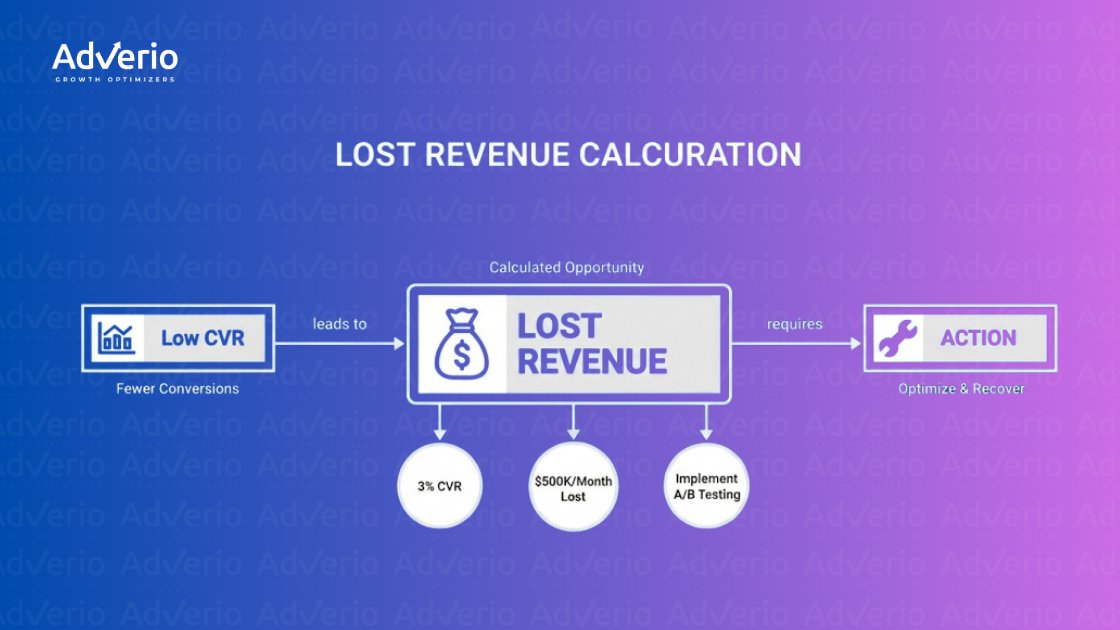
As you can see, a low CVR isn’t just a number on a dashboard; it’s a hole in your pocket. A structured, tool-based approach is required to plug it.
From Diagnosis to Dominance
Our process starts where most agencies give up. We use advanced analysis to find the real reason your listings aren’t converting. This includes our SKU Resurrection system for breathing life back into dying products and a Brand Drain Reversal playbook for clawing back sales lost to competitors.
With this integrated system, our client Mary Maxim saw their Unit Session Percentage jump from 1.68% to 3.70% (+120%) after a structured listing overhaul. For Shinesty, a conversion-first governance model moved their Unit Session % from 4.59% to 5.64% (+23%). Revenue accelerated without increasing ad spend.
The top-performing Amazon sellers consistently hit conversion rates of 30% or higher, making the 10-15% average look tiny. This elite group gets how the Amazon flywheel works: a high Unit Session Percentage earns you better A9 rankings, which drives more traffic, which creates exponential sales velocity. To learn more about how the best sellers get there, you can explore the latest findings on elite Amazon conversion rates on sellermetrics.app.
To get into that elite tier, you have to borrow from the best digital experiences out there. It’s about understanding the core psychology that drives action, which mirrors the principles of high-converting landing pages. An Amazon page has its own rules, but the core tenets of clarity, persuasion, and trust are universal.
Ultimately, our system transforms your brand from just another seller into a strategic asset. We don’t just optimize your listings; we take ownership of your growth. We turn a lagging conversion rate into a powerful weapon, which is mission-critical when you’re understanding the Amazon click-through rate benchmark and its role in the funnel.
The PPC and Conversion Rate Flywheel
Too many brands treat their PPC campaigns and their product listings as two separate jobs handled by two separate teams. This is a fatal, profit-killing mistake. Your ads and your listing’s ability to convert aren’t just related; they are two sides of the same powerful flywheel. Ignoring this connection is a guaranteed way to burn cash and watch your growth stall out.
The relationship is brutally simple: a higher Amazon listing conversion rate makes every dollar you spend on advertising more efficient. Each click you pay for is more likely to turn into a sale, which immediately drives down your Advertising Cost of Sales (ACoS) and sends your Return on Ad Spend (RoAS) soaring.
This is exactly the kind of signal Amazon’s A9 algorithm loves to see—especially when paired with full-funnel strategies like Amazon DSP that re-engage high-intent audiences. It recognizes that shoppers who click your ad actually buy the product, flagging it as highly relevant. That kicks off a positive feedback loop that boosts your organic rank and Share of Voice, creating a rising tide that lifts your entire product presence.
Avoiding Optimization Myopia
The opposite of this is a trap we see all the time, something we call “Optimization Myopia.” It’s the destructive habit of obsessing over a single ad metric like ACoS while completely ignoring the listing’s health—the very thing that makes those ads profitable in the first place. It’s like meticulously tuning a race car’s engine but forgetting to put tires on it.
At Adverio, we prevent this by managing listings and ads as one cohesive growth engine. A better-converting listing makes ads more effective. More effective ads drive higher-quality traffic back to that optimized listing, which in turn increases conversions even more. That’s the flywheel in action.
Amazon Sponsored Products ads, which generate over 75% of Amazon’s ad revenue, are a massive driver of this cycle. When you dial in your strategy for these ads, you’re not just getting a better ACoS; you’re pouring gasoline on the flywheel.
Connecting Ads and Listings for Growth
By creating this virtuous cycle, we break brands out of the familiar plateau where they’re forced to spend more and more just to maintain their position. Growth becomes more efficient, more sustainable, and more profitable.
To see how this integrated mindset is baked into our process, check out our guide on building an Amazon PPC strategy for scalable growth. It’s not about just running ads; it’s about building a profit-generating system where every single part works together.
Frequently Asked Questions
You’ve got questions, we’ve got direct, no-fluff answers. Here’s what brand operators really want to know about their Amazon conversion rate.
How Often Should I Check My Amazon Conversion Rate?
You need to be looking at your Unit Session Percentage weekly. You can find this in your ‘Detail Page Sales and Traffic’ report.
Daily swings are totally normal—don’t panic over a single bad day. But if you see a consistent downward slide for two or three weeks straight, that’s a major red flag. It’s time to drop what you’re doing and figure out what broke.
This weekly check-in is your early warning system. It’s how you spot a new competitor who just slashed their price, a sudden wave of negative reviews, or a listing suppression before they completely crater your sales and search rank.
Can I Have a High CVR but Still Have Low Sales?
Absolutely. We see this all the time. This is a classic traffic problem, not a conversion problem. It’s actually good news—it means your listing is fantastic at converting shoppers who find it. The problem is, not enough shoppers are finding it in the first place.
This almost always boils down to a few core issues:
- Bad Keyword Targeting: Your ads and organic efforts are chasing the wrong search terms.
- Low Organic Rank: You’re buried on page two (or worse) for the high-volume keywords that actually matter.
- Not Enough Ad Budget: You simply don’t have enough ad spend to get in front of a meaningful number of qualified buyers.
The fix here isn’t to tear apart your listing. It’s to go back to the drawing board on your marketing strategy and focus on driving more qualified traffic through smarter PPC and SEO.
What Is the First Thing to Fix to Improve My CVR?
Your main image and your title. Always start there.
Think about it: these two elements are doing all the heavy lifting on a crowded search results page. They have one job: earn the click. If shoppers don’t click, they can’t convert. It’s that simple.
Your main image needs to be crystal clear, instantly show what the product is, and visually pop against the competition. Your title has to grab your most important keywords while still being readable for a human, not just the A9 algorithm. Fixing these two “front door” elements almost always gives you the fastest, biggest lift to your Amazon listing conversion rate.
If your listing isn’t converting, you’re funding your competitors’ growth. We fix that—systematically.