



Table of Contents
Most 7-figure Amazon brands still obsess over ACoS and that’s exactly why their growth stalls. This is what we call Optimization Myopia and it quietly kills profitable growth a dangerous blind spot where brands celebrate a low ACoS while their overall growth flatlines. ACoS is fine for measuring campaign efficiency in a vacuum, but it completely misses the bigger picture: how your ads are actually lifting organic sales and building long-term brand equity.
This narrow view caps your growth. A low ACoS means nothing if it’s not driving organic lift, improving rank, or increasing total revenue. Otherwise, you’re not building a brand, you’re just buying temporary sales.
This guide shows you how to calculate TACoS, what it actually tells you about your business, and how to use it to make smarter decisions inside your Amazon PPC management system, not just ad efficiency.
At a Glance
• TACoS = Ad Spend ÷ Total Revenue
• Measures total business efficiency not just ads
• Falling TACoS = organic growth is working
• High TACoS = dependency on paid traffic
What Is TACoS?
TACoS stands for Total Advertising Cost of Sale. It’s the metric that tells you what’s really working by measuring your ad spend against your total revenue—not just the sales directly attributed to an ad click.
TACoS Formula:
TACoS = Ad Spend ÷ Total Revenue
This is its critical difference from ACoS, which only measures ad spend against ad-attributed revenue. While ACoS tells you the cost of a single transaction, TACoS reveals the true cost of your growth. It forces a holistic, profit-first look at your marketing investment and answers the questions that actually matter:
- Are my ad dollars building a sustainable business, or am I just buying temporary sales?
- Is my brand gaining organic traction and becoming less reliant on paid advertising over time?
- How do my advertising efforts truly contribute to my bottom line?
Getting a handle on what TACoS is and how it functions is the first step toward building a dominant marketplace presence. Forget just managing campaigns; it’s time to start managing your growth engine.
How to Calculate TACoS Step-by-Step
No need to dig for hours. Here’s the simple formula and exactly where to find the data in your Amazon account to get an immediate, accurate TACoS calculation.
Step 1: Pull Your Total Ad Spend
This is every dollar spent across Sponsored Products, Brands, Display, and DSP. Find it in your Advertising Console by running a report for your chosen date range.
Step 2: Pull Your Total Sales
This is the big number—every dollar generated from both ad clicks and organic sales. Find this in Seller Central by going to Reports > Business Reports > Sales and Traffic.
Step 3: Divide Ad Spend by Total Sales and Multiply by 100
The formula is straightforward:
TACoS % = (Total Ad Spend ÷ Total Revenue) x 100
Here’s a practical example:
- Total Ad Spend: $1,000
- Total Revenue: $10,000
- TACoS Calculation: ($1,000 ÷ $10,000) x 100 = 10% TACoS
This flowchart shows how the two data streams feed into one clear metric.
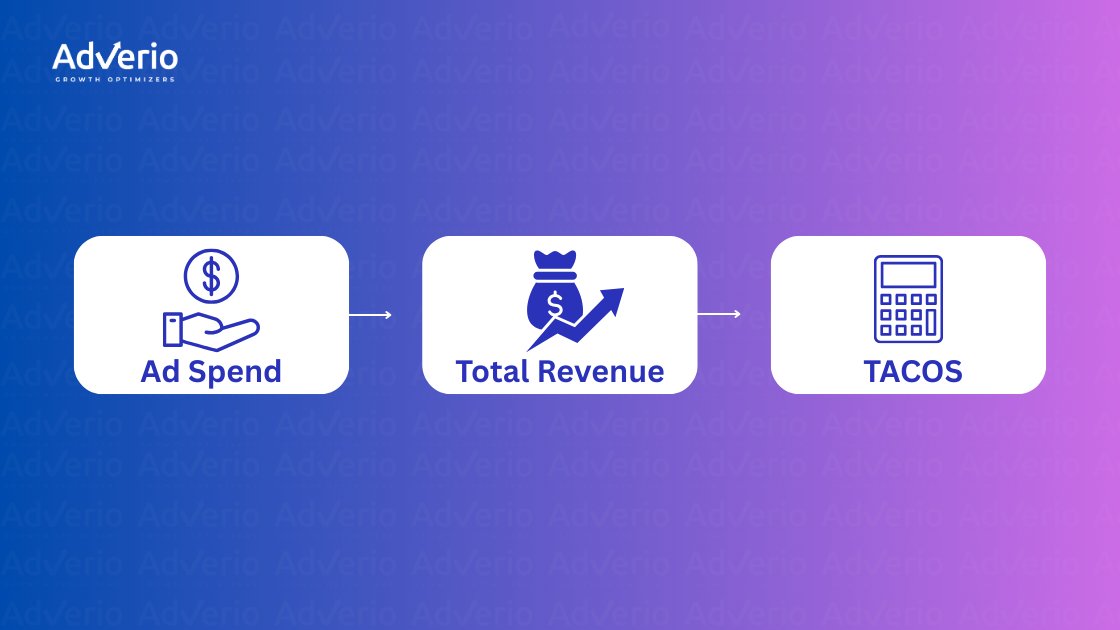
Remember, TACoS uses your total sales as the denominator. That’s why it gives you an honest, holistic view of how efficiently your ad dollars are working relative to your brand’s overall performance. A brand that gets this right needs a rock-solid system for tracking performance, which is where a structured eCommerce business intelligence system becomes non-negotiable if you want real visibility into profit and growth.
As you think about calculating your own metrics, it can be helpful to look at well-designed examples of SEO calculators for inspiration on presenting data clearly. Ultimately, your ability to apply the TACoS formula across different scenarios is what turns it from a vanity metric into a strategic weapon.
What’s a Good TACoS on Amazon?
You’ve calculated your TACoS, and now comes the big question: “Is this number any good?”
The honest answer? It depends. Anyone who gives you a single “good” number is selling you a fantasy. A healthy TACoS isn’t a fixed industry benchmark; it’s a moving target that changes based on your product category, your brand’s maturity, and your current strategic goals.
The real gold standard isn’t just a low TACoS. It’s a decreasing TACoS over time, especially while your ad spend is stable or even increasing. That trend is the clearest sign your ads are creating a halo effect, lifting organic sales, and building genuine, long-term brand value.
Figuring out what your TACoS is telling you is far more important than hitting some random number. A consistently high TACoS on a mature product is a red flag that you’re totally dependent on paid traffic. But a falling TACoS? That shows your ads are doing exactly what they’re supposed to—creating a sustainable growth engine, not just temporary sales spikes.
TACoS Benchmarks by Category and Business Stage
While a universal “good” TACoS is a myth, we can map out some realistic ranges based on where your brand or product is in its lifecycle. Think of these as strategic guardrails, not hard-and-fast rules.
- Launch Phase (0-3 Months): Expect your TACoS to be in the 20-40%+ range. Your ad spend is doing all the heavy lifting to get those initial sales, lock in reviews, and teach Amazon’s algorithm about your product. This is an investment in your future organic ranking.
- Growth Phase (3-12 Months): Your target TACoS should start to drop into the 15-25% range. As organic sales gain momentum, you become less reliant on paid clicks. The gap between your ACoS and TACoS should widen here—a clear sign of a healthy business.
- Maturity Phase (12+ Months): For established products, a TACoS between 5-15% is a great indicator of an efficient, healthy operation. This signals a strong organic presence where ads are used to defend market share and strategically accelerate growth.
Want to know what your TACoS should be based on your category and margin structure?
→ Request your Marketplace Profit Analysis
What High vs. Low TACoS Can Tell You
Think of your TACoS as a diagnostic tool. A “high” or “low” number isn’t automatically bad or good; it’s a signal that should make you ask a strategic question.
A high TACoS might mean:
- You’re in an aggressive launch or market-share grab.
- Your product listings are poorly optimized, killing your organic conversion rate.
- You’re too reliant on ads and haven’t built a brand that customers seek out.
A low TACoS usually indicates:
- Your brand has strong organic rankings and good brand recognition.
- Your advertising is highly efficient and creates a flywheel effect.
- You might have room to strategically increase ad spend to grow even faster without hurting profitability.
How to Use TACoS to Make Smarter Decisions
Your TACoS isn’t just another number for a weekly report; it’s a strategic lever for making profit-driven decisions. Once you know how to calculate it, you can stop reacting to daily performance spikes and start managing your Amazon business as a holistic growth engine. This is exactly where a structured Amazon PPC management strategy shifts from cost control to profit generation.
This metric cuts through the noise and answers the most critical question: are you building a sustainable brand or just renting customers? By tracking your TACoS trend over time, you can finally see if your ad spend is creating a real lift in organic sales. A declining TACoS is the ultimate proof that your ads are successfully building brand equity and organic rank—the flywheel is working.
Why Your TACoS Is High (It’s Not Just Ads)
If your TACoS is high, ads aren’t the root problem. One of these is:
• Inventory gaps (out of stock, suppressed listings)
• Weak conversion (poor PDP, pricing, reviews)
• Inefficient traffic (ads targeting the wrong demand)
Fixing TACoS means fixing the system—not just lowering bids.

Measuring Long-Term Ad Impact
The most common mistake sellers make is pulling the plug on a campaign with a “high” ACoS. But what if that campaign is your biggest driver of organic sales? TACoS gives you the clarity to make that call with confidence.
By analyzing TACoS, you can see if a high-ACoS campaign is a worthwhile investment because of the powerful organic halo it generates. If your total revenue is climbing and your TACoS is stable or decreasing, that “expensive” campaign is doing exactly what it’s supposed to: building brand recognition and driving customers to search for you directly.
A rising ACoS with a falling TACoS is not a problem—it’s a sign of a successful branding play. It means your top-of-funnel ads are working, and you’re building a brand that can eventually stand on its own.
This perspective shift is crucial. You move from optimizing ad clicks to optimizing for total market share and brand health.
Knowing When to Scale, Pause, or Reallocate
With TACoS as your guide, budget decisions become strategic, not just reactive. Instead of blindly slashing spend on high-ACoS keywords, you can analyze their real impact on your bottom line.
Here’s how TACoS can shape your budget strategy:
- Scale the Winners: If a campaign shows a low ACoS and contributes to a declining TACoS, it’s a clear signal to scale. This campaign is efficiently driving both paid and organic sales. Double down.
- Evaluate the “Losers”: For a campaign with a high ACoS, check the impact on TACoS. If your overall TACoS remains healthy, this campaign might be crucial for awareness. You can then optimize it for efficiency rather than cutting it entirely.
- Spot Over-Reliance on Ads: A consistently high TACoS suggests you’re too dependent on paid traffic. This is a red flag to shift budget toward initiatives that boost organic rank, like improving your listings through Amazon listing optimization
For a deeper dive into financial performance at the product level, understanding how to apply these principles by utilizing SKU economics on Amazon is the logical next step.
Identifying if Ads are Driving True Growth
Your TACoS is directly tied to your organic conversion rate. A weak product listing with poor copy, low-quality images, or confusing A+ Content will sink your organic sales, forcing you to spend more on ads to compensate. This inevitably drives your TACoS through the roof.
To ensure TACoS truly acts as your North Star, remember that effective Amazon product listing optimization is crucial for maximizing both organic and paid sales. When your listings are dialed in, every visitor—whether from an ad or an organic search—is more likely to convert. That lowers your ad dependency and improves profitability.
Thinking about the broader market puts this into perspective. For instance, Americans eat over 4.5 billion tacos every single year. That kind of big-picture view is exactly what TACoS provides for your brand’s health. You can see more surprising details about the U.S. taco market to understand how wide-angle data informs smart strategy.
Why TACoS Matters More Than Ever in 2025
In the hyper-competitive Amazon marketplace, a profit-first mindset isn’t a nice-to-have; it’s what keeps you in business. This is exactly why serious sellers live and die by their TACoS. While ACoS tells you what a single ad-driven sale cost, TACoS reveals the true cost of your growth.
Rising CPCs and Shrinking Margins
With CPCs climbing and margins getting squeezed, every ad dollar has to work harder. Relying on ACoS alone is a surefire way to bleed cash. TACoS links your ad spend directly to your brand’s P&L, giving you a brutally honest look at your advertising’s real contribution to the bottom line.
Organic Ranking is Harder to Earn
A solid organic presence is the only real competitive moat you can build on Amazon, and TACoS is the only metric that shows whether your paid campaigns are actually helping you build it. A declining TACoS over time is the clearest sign that your advertising is working. It’s proof that your ads aren’t just buying one-off sales; they’re boosting organic visibility and building a brand that customers start searching for by name.
ACoS measures a transaction. TACoS measures your trajectory. Sophisticated, profit-focused sellers don’t just track this metric; they use it to guide their entire marketplace strategy.
TACoS is also one of the first metrics reviewed in any serious Amazon PPC management engagement because it immediately shows whether ad spend is compounding organic growth or simply subsidizing sales that would have happened anyway.
Profit-First Sellers Track TACoS Religiously
Focusing only on ACoS is like a pilot staring at the fuel gauge while ignoring altitude and direction. TACoS gives you the full cockpit view. It forces you to see how advertising, conversion rate optimization, and brand building all work together as a single growth engine. It’s how you validate brand-building campaigns, identify ad dependency, and justify strategic spend with confidence.
How Adverio Turns TACoS Into Profit
Most agencies optimize ACoS. We optimize total business performance.
Adverio connects advertising, pricing, inventory, and conversion into one system—so TACoS actually trends down over time.
If your ads aren’t driving organic growth, we fix the constraint—not just the campaign.
→ Explore our Amazon PPC Management Services
If your TACoS isn’t trending down, you don’t have a scaling strategy—you have a spend problem.
Book your ROI Forecast, and we’ll break down exactly where your growth is leaking and how to fix it.
Read Next: