



Table of Contents
Most Amazon brands treat Amazon A+ Content like a design upgrade. That’s the problem.
If you’re running a multi-SKU catalog and stuck with flat conversion rates, your A+ Content isn’t just underperforming—it’s suppressing growth.
This guide breaks down how to turn A+ Content into a conversion system that drives measurable lifts in revenue—not just aesthetics.
At a Glance
• A+ Content can lift conversion rates by 8–20%
• Most brands underutilize A+ as a conversion system
• Premium A+ enables video, interactivity, and higher AOV
• Winning strategy = benefit-driven messaging + structured modules + CRO testing
What Is Amazon A+ Content?
Let’s cut the fluff. Amazon A+ Content is a feature that allows Brand Registered sellers to replace the standard, text-only product description with a visually rich, multimedia experience. Instead of a wall of text, you get to use a series of customizable modules to tell your brand story and showcase your product’s value.
This is your last chance to convert the click. If it fails, nothing else matters. It’s your chance to use high-impact visuals, comparison charts, and benefit-driven copy to answer customer questions, handle objections, and build trust before they even scroll down to the reviews. It’s a non-negotiable tool for any serious brand on the platform.
A+ Content is just one layer of your PDP. If the rest of your listing isn’t optimized, it won’t convert. See how a full Amazon listing optimization strategy ties everything together.
Why Your Current A+ Content Is Leaking Profit
The “set it and forget it” approach to Amazon A+ Content is dead. Throwing up a few generic images and a feature list is the fastest way to get lost in the noise. The real goal isn’t just to have A+ Content; it’s to build a conversion machine on every single product page.
Most brands think A+ Content is the problem. It’s not. It’s a symptom of a broken conversion system—where pricing, traffic quality, and PDP structure aren’t aligned.
For brands juggling hundreds of SKUs, this isn’t a small oversight—it’s a systemic profit leak. A weak A+ page doesn’t just fail to close the deal. It actively poisons your ad spend, holds back your organic rank, and rolls out the red carpet for competitors. Every shopper who clicks away, confused, represents revenue walking out the door.
This is where most brands fail—they treat content in isolation instead of as part of a unified profit-driven catalog optimization system.
From Static Page to Conversion Asset
A profit-first strategy turns A+ Content from a design task into a core driver of marketplace growth. It’s about creating a digital shelf experience that systematically lifts your conversion rate, one shopper at a time. This means you stop listing features and start showing benefits.
It’s the difference between saying “durable stitching” and showing a stunning lifestyle shot of your product surviving a rainstorm, instantly connecting with a customer’s real-world needs.
When you get it right, the numbers don’t lie. Amazon’s own data shows that Basic A+ Content can lift sales by up to 8%. A well-executed Premium A+ strategy can boost sales by as much as 20%. These aren’t just vanity metrics; they are direct injections of revenue, turning a creative “cost” into a measurable financial win. You can dig deeper into these powerful statistics and see how they impact your bottom line.
The core mistake is treating A+ Content as a cost center for the creative team. It’s a profit center. When optimized for conversion, it becomes one of the highest-leverage tools for increasing your Unit Session Percentage and maximizing the return on every dollar of ad spend.
By operationalizing A+ Content at scale, you stop plugging holes and start building a fortress of profitability around your brand. It’s about making sure every listing is engineered not just to inform, but to sell. This is how you finally break the cycle of flat growth and turn your product pages into consistent, reliable revenue drivers.
Amazon A+ vs. Premium A+ Content: What’s the Difference?
Deciding between standard Amazon A+ Content and Premium A+ Content isn’t just about unlocking a few extra bells and whistles. It’s a strategic call that directly shapes your brand perception and conversion rates. Thinking of Premium as a simple cosmetic upgrade is a common trap that leads brands to either over-invest on the wrong products or completely underuse its powerful capabilities.
Premium A+ only works if your brand foundation is set correctly—starting with Amazon Brand Registry setup and benefits.
Let’s cut through the noise. This isn’t about which one looks prettier; it’s about which one aligns with your growth objectives for a given product.
Understanding the Core Strategic Differences
Standard A+ Content is your foundational layer of brand storytelling. It lets you replace the plain text description with up to five modules, giving you space for high-quality images, your brand logo, and comparison charts. This is the non-negotiable minimum for any serious brand.
Premium A+ Content (A++) is in another league. It’s an immersive brand experience. With up to seven modules, Premium unlocks features that standard A+ can’t touch:
-
Full-Width Imagery: Creates a cinematic, high-impact visual that commands attention.
-
Integrated Video Content: Lets you embed 720p videos directly into the page—a game-changer for demonstrating complex products.
-
Interactive Modules: Features like clickable carousels and hover-to-reveal hotspots let shoppers actively engage with your content.
-
Shoppable Comparison Charts: These advanced charts can pull in pricing, review ratings, and an “Add to Cart” button, making cross-selling effortless.
Here’s a direct comparison to help you weigh the strategic trade-offs.
A+ Content vs Premium A+ Content Strategic Breakdown
| Feature | Standard A+ Content | Premium A+ (A++) Content | Strategic Implication |
|---|---|---|---|
| Module Slots | Up to 5 | Up to 7 | Premium offers more real estate for deeper storytelling and addressing more customer questions upfront. |
| Visuals | Basic image modules, comparison charts | Full-width imagery, interactive hotspots, video modules, advanced charts | Premium allows for a much more immersive, “website-like” experience that can justify higher price points. |
| Interactivity | Static content, text, and images | Clickable Q&A, image carousels, hover-over features | Interactive elements keep shoppers engaged longer, increasing the likelihood of conversion and reducing bounce rates. |
| Cross-Selling | Basic comparison charts | Shoppable comparison charts with “Add to Cart” functionality | Premium directly facilitates cross-selling within the A+ section, streamlining the path to purchase for related items. |
| Eligibility | All Brand Registered sellers | Strict criteria: Brand Story on all ASINs + 5 A+ approvals in 12 months | Premium is a reward for active, committed brands, signaling higher trust from Amazon and shoppers. |
| Best For | Foundational brand presence, lower AOV items, less competitive categories | Hero products, high-consideration items, competitive niches, new product launches | Standard A+ is essential for all products. Premium A+ is a strategic investment for SKUs where differentiation is critical. |
Eligibility: The Gatekeeper to Premium Power
Access to Premium A+ isn’t automatic. Amazon reserves this tier for established brands that meet strict criteria. Eligibility generally boils down to two key factors:
-
Brand Story: You must have a Brand Story published across your entire ASIN catalog.
-
Recent A+ Approvals: You need to have had at least five A+ Content projects approved within the last 12 months.
Meeting these requirements is just the starting line. You must be a registered brand owner to even access these features. For a detailed walkthrough, explore our complete Amazon Brand Registry benefits and setup guide.
The decision tree below visualizes how a passive versus a profit-driven approach to your A+ content strategy can lead to vastly different business outcomes.
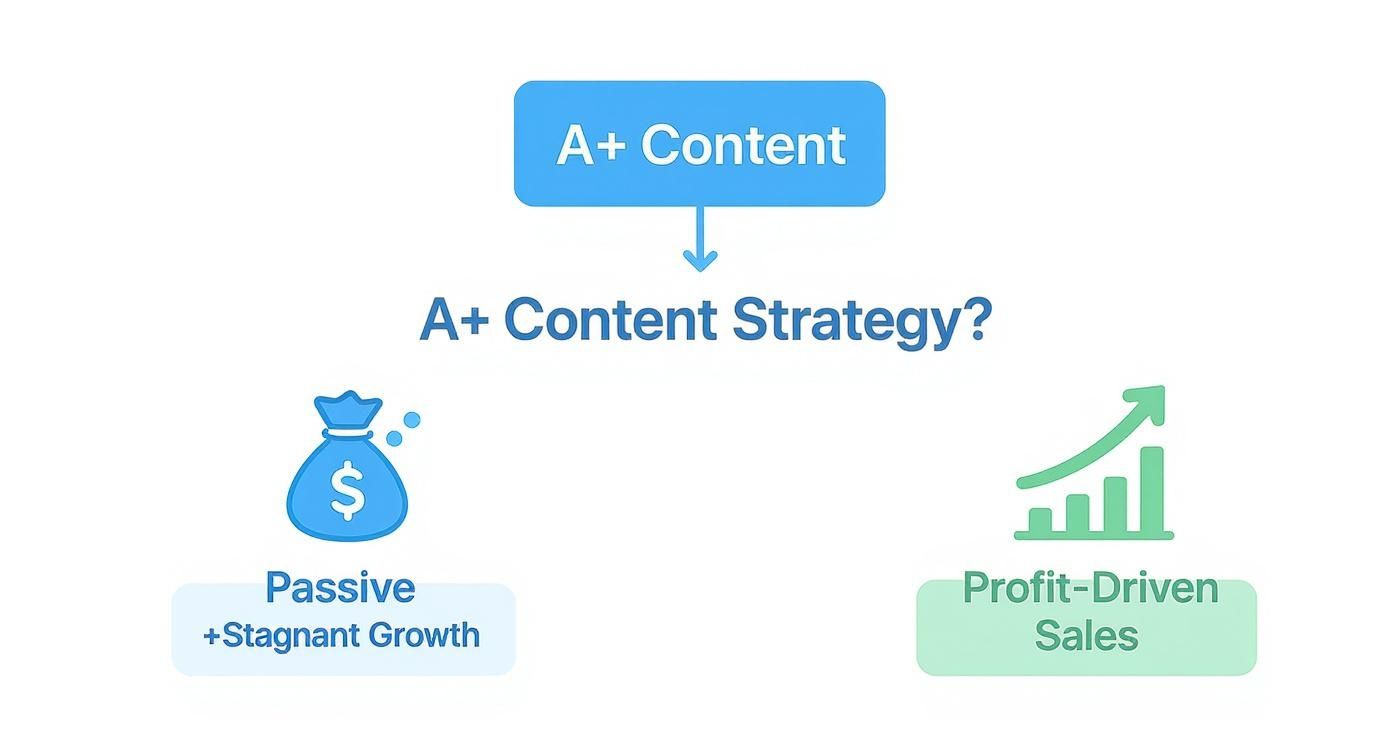
As the graphic shows, a strategic, profit-driven approach is the only path to meaningful sales growth. A passive, set-it-and-forget-it strategy just leads to stagnation.
How to Create High-Converting Amazon A+ Content
If your A+ Content isn’t driving conversion, it’s just expensive decoration. This isn’t about building modules. It’s about building a conversion system; it’s a framework for making your product detail page your most powerful conversion tool. The goal is to stop thinking like a graphic designer and start thinking like a growth strategist.
High-converting A+ Content doesn’t exist in a vacuum—it must align with your traffic strategy, especially your Amazon PPC management strategy.
Translate Your USP into Visuals and Copy
Your Unique Selling Proposition (USP) is the heartbeat of your brand. If it’s not front and center in your A+ Content, you’ve already lost. Boil down your core value into benefit-driven statements that speak directly to your ideal customer’s pain points.
-
Weak Copy (Feature-Focused): “Our backpack is made with water-resistant nylon.”
-
Strong Copy (Benefit-Driven): “Caught in the rain? Your laptop and documents stay bone-dry. We guarantee it.”
That subtle shift from what it is to what it does for them is everything. Use high-quality lifestyle photos to show your product solving a real-world problem. Don’t just show the backpack on a white background; show a commuter walking confidently through a downpour.
A+ Content is your chance to control the narrative. If you don’t clearly communicate why a customer should choose you over three nearly identical competitors, you’re forcing them to make a decision based on price alone—a race to the bottom you can’t win.
Even better, Amazon A+ Content is no longer just for show—Amazon now indexes the text within your modules. This means your copy is pulling double duty for SEO. Weaving in relevant, long-tail keywords can now give your organic visibility a real boost.
Strategically Deploy A+ Modules
Don’t just fill the space; give each module a strategic role.
Module Breakdown for Maximum Impact:
-
The Hero Banner: This is your opening act. Use a full-width, high-impact image with a headline that nails your main USP.
-
The Problem/Solution Layout: Use an image-with-text module to call out a common customer pain point, then show exactly how your product is the answer.
-
The Benefit Spotlight: Dedicate modules to breaking down your top 3-4 key benefits. Pair a close-up shot of a specific feature with short, sharp copy explaining its value.
-
The Comparison Chart: This is your secret weapon for reducing friction and cross-selling. Use it to clearly show how your product stacks up against competitors or other models in your own lineup.
-
The Brand Story Closer: End with a module that reinforces your brand’s mission. This builds a deeper connection that goes beyond just the product.
This is just one possible layout. The key is to map out a logical flow that walks the customer from initial curiosity to a confident “buy now” click. For brands looking to do this at scale, a structured approach to Amazon content optimization ensures every listing is built to perform from day one.
Designing for Mobile and Maintaining Consistency
Over 70% of Amazon traffic now comes from mobile devices, yet most A+ Content is still designed on a desktop. This is a massive—and costly—mistake.
Mobile-First Best Practices:
-
Keep Text Scannable: Use short sentences and bullet points. Break longer paragraphs into small, bite-sized chunks.
-
Use High-Contrast Images: Ensure your visuals are clear and punchy on a small screen. Avoid images with tiny, embedded text.
-
Test Your Layouts: Always use Amazon’s preview tool to see how your content will look on a mobile device before you publish.
Finally, brand consistency is non-negotiable. Your A+ Content should use the same fonts, color palette, and brand voice as your website. This creates a seamless, trustworthy experience. A great A+ page also needs to work in harmony with your wider marketing efforts; for example, see how you can build a comprehensive video content marketing strategy to ensure everything feels connected.
Common Pitfalls That Cripple A+ Content Performance
Even savvy brands make costly, unforced errors with their Amazon A+ Content. These are strategic blunders that get your submissions rejected, burn your budget, and tank your conversion rate.
Many brands treat A+ Content like a digital brochure, cramming every pixel with dense paragraphs. This is a fatal mistake on mobile, where text-heavy modules turn into unreadable walls of text. Another classic error is fumbling the technical details. Uploading low-resolution, blurry images makes your brand look amateurish and untrustworthy.
Violating Amazon Policies and Eroding Trust
Amazon’s guidelines are notoriously strict, and ignoring them is a surefire way to get rejected.
Here are the most common policy violations to avoid:
-
Unsupported Claims: Don’t use phrases like “best-selling” or “#1 product” unless you have official proof.
-
Warranty or Guarantee Information: Any mention of warranties, satisfaction guarantees, or return policies is strictly prohibited.
-
Pricing and Promotional Language: Forget about using words like “affordable,” “on sale,” or any reference to price.
-
External Links and Contact Info: Adding QR codes, URLs to your own website, or any company contact info is a direct violation of Amazon’s terms.
Every rejection is a delay that costs you sales, especially during high-traffic seasons. A proactive, by-the-book approach isn’t optional for serious brands.
The Small Mistakes with Big Consequences
Beyond policy no-nos, smaller mistakes can kill your A+ Content’s performance. Simple typos and grammatical errors project carelessness and erode credibility.
Failing to keep your brand consistent across modules creates a jarring experience. Using different fonts, clashing colors, or a shifting tone of voice makes your brand feel unprofessional. A cohesive visual identity is essential for building the trust you need to turn a browser into a buyer.
Measuring Success and Optimizing for Profit
Launching your Amazon A+ Content is the starting line, not the finish. If you aren’t actively measuring its performance, you’re just guessing with your profits. A data-driven optimization loop is non-negotiable. It turns your A+ Content from a static branding element into a dynamic conversion asset. Conversion doesn’t stop at the PDP. Retargeting shoppers who didn’t convert is where brands unlock the next layer of growth using Amazon DSP Management
Key Performance Indicators That Actually Matter
Many brands fall into the trap of Optimization Myopia—obsessing over a single metric while ignoring the bigger picture. To get a clear picture of your A+ Content’s real-world impact, track these critical metrics.
Conversion lifts from A+ Content should always be evaluated alongside incrementality—not just surface-level ROAS. See how this fits into a broader Amazon incrementality and TACoS strategy.
-
Unit Session Percentage (Conversion Rate): This is the ultimate test. A higher conversion rate after implementing new A+ Content is the clearest signal that your creative is resonating.
-
Average Order Value (AOV): Well-designed comparison charts and cross-selling modules can nudge shoppers to purchase higher-ticket items or add complementary products to their cart.
-
Return Rate: Clear, detailed A+ Content sets accurate expectations, reducing the chances of a customer ordering the wrong item and lowering costly returns.
-
Customer Reviews and Questions: A drop in questions about a specific feature often means your new content is doing its job and proactively answering customer concerns.
A/B Testing Your Way to Higher Conversions
Guesswork has no place in a profit-driven strategy. Amazon’s “Manage Your Experiments” tool lets you run a split test, showing one version of your A+ Content to half your audience and a different version to the other half.
To ensure your Amazon A+ content consistently drives profit, it’s crucial to regularly track its performance and optimize based on data. You can track content performance to make sure your efforts are paying off.
Amazon lets sellers run controlled experiments, with each test typically running between four and ten weeks. At the end, Amazon declares a statistically significant winner, giving you clear data on which version drove more sales.
A/B testing isn’t a one-time project; it’s an ongoing process of refinement. Continuously test different headlines, hero images, and module layouts. A small win of a 0.5% conversion lift on a high-volume ASIN can translate into significant annual revenue growth.
Integrating A+ Content with Your Holistic Strategy
Finally, remember that your A+ Content doesn’t exist in a vacuum. Its performance is directly tied to the overall health of your listing. Traffic from a brilliant PPC campaign will go to waste if it lands on a page with confusing or unpersuasive A+ Content.
This is where a unified view becomes essential. By looking at A+ performance alongside metrics like your ad spend, organic rank, and overall profitability, you can make smarter strategic decisions. This holistic approach connects creative optimization directly to your bottom line, ensuring every element of your listing is working together to drive growth. This is a core component of improving your overall Amazon Listing Quality Score.
Scaling A+ Content Across Your Entire Catalog
For brands with hundreds or thousands of SKUs, rolling out high-quality Amazon A+ Content for every product is a massive operational bottleneck. This is where generic agencies and overwhelmed in-house teams hit a wall, leaving huge chunks of your catalog under-optimized and quietly bleeding profit.
The old-school approach of building A+ pages one by one doesn’t fly at scale. It’s slow, expensive, and leads to brand inconsistencies that erode customer trust.
From Bottleneck to Growth Lever
The right partner transforms A+ Content from a logistical nightmare into a scalable growth engine. The secret is to stop treating it like a series of one-off design projects and instead build a systematic, repeatable process.
This starts by developing a library of pre-approved, high-converting templates built on your brand guidelines and proven CRO principles. This system weaves together:
-
Creative Optimization: Building a core library of visual assets and copy frameworks that can be adapted in minutes.
-
Intelligent Catalog Management: Prioritizing A+ updates based on traffic, sales velocity, and strategic importance.
-
Integrated Growth Marketing: Ensuring your A+ Content works hand-in-glove with PPC and DSP campaigns to maximize ROI.
The difference is stark: you’re moving from a simple vendor who designs pages to a strategic financial partner who builds a system for profitable growth. This shift removes complexity and frees you up to focus on scaling your business.
This systematic approach is how you turn your entire catalog into a conversion powerhouse. It’s the difference between chasing an endless list of creative tasks and engineering a predictable engine for marketplace growth that delivers measurable, ROI-backed results.
How Adverio Turns A+ Content Into a Revenue Engine
Most agencies design A+ Content. We engineer it for profit.
At Adverio, A+ Content sits inside a full-funnel conversion system—where pricing, PDP structure, traffic quality, and catalog strategy all work together.
We don’t just “build modules.” We:
-
Identify conversion constraints across your catalog
-
Align A+ Content with traffic and pricing strategy
-
Deploy scalable frameworks across hundreds of SKUs
-
Tie every change to a measurable lift in conversion and AOV
If your listings look good but don’t convert, that’s not a design issue. That’s a system failure.
👉 Explore our Amazon listing optimization services
Frequently Asked Questions About Amazon A+ Content
Let’s get straight to it. Here are direct, no-nonsense answers to the questions brand owners ask most about Amazon A+ Content.
Who Is Eligible to Create Amazon A+ Content?
The barrier to entry is simple but firm. A+ Content is an exclusive perk for professional sellers enrolled in the Amazon Brand Registry.
Once Amazon approves your brand, the A+ Content Manager automatically unlocks in your Seller Central account. From there, you can build A+ pages for any ASIN under that registered brand. This is the absolute first step—no Brand Registry, no A+ Content.
Does A+ Content Directly Impact My Amazon SEO Ranking?
Yes, but not in the way you might think. A+ Content isn’t a direct ranking factor like your title keywords, but it has a massive indirect effect on your SEO.
First, Amazon now indexes the text and image alt-text inside your A+ modules. This means keyword-rich copy can help your listing show up for specific, long-tail searches. More importantly, A+ Content is designed to boost your conversion rate, and that sends a powerful signal to Amazon’s A9 algorithm.
A rising conversion rate tells Amazon your product is exactly what shoppers are looking for. Over time, this leads to a real, sustainable bump in organic search rankings. It creates a flywheel: higher rank drives more traffic, which leads to more conversions, which pushes you even higher.
How Long Does It Take for Amazon to Approve A+ Content?
Amazon’s official line is up to seven business days, but in our experience, it’s often much quicker—sometimes landing within 24 to 48 hours. Don’t count on that, though. During peak retail seasons like Q4, the approval queue gets bogged down, and wait times stretch out.
To sidestep costly delays, submit your content well ahead of any launch or promotion. Make sure every module meets Amazon’s strict guidelines to avoid a rejection that could push your timeline back by weeks.
Ready to turn your A+ Content from a design project into a systematic conversion machine? Adverio builds profit-focused creative strategies that scale across your entire catalog, ensuring every listing is engineered to sell.