



Table of Contents
Your CAC isn’t “rising”—it’s exposing a broken growth system. And throwing more ad spend at it is exactly why it keeps getting worse. The old playbook of just throwing more money at ads is officially broken, especially for mid- to enterprise-level brands scaling across Amazon, Target, or Walmart with complex catalogs and rising acquisition pressure.
Campaign tweaks won’t fix a system problem. The only way to permanently lower your CAC is with a holistic, profit-first strategy. This means forcing your catalog, creative, and entire marketing funnel to work as one cohesive profit-generating machine. Anything less is just a temporary fix.
Why Your Customer Acquisition Cost Is Soaring
If your CAC is climbing, it’s not “the cost of doing business.” It’s a bright red flag signaling a disconnected, inefficient strategy. We see it constantly—brands stuck in a reactive cycle, tweaking surface-level metrics without ever diagnosing the root cause of the profit leak.
Yesterday’s winning tactics are today’s money pits. Escalating competition, relentless algorithm changes, and scattered data create a perfect storm for wasted ad spend. You might be winning bids on keywords, but are you actually winning profits? If you’re not sure, you’re already behind.
The Trap of Optimization Myopia
One of the biggest culprits inflating CAC is a disease we call Optimization Myopia. This is the obsessive, narrow-minded focus on a single metric, like Advertising Cost of Sales (ACoS), while completely ignoring total profitability.
Sure, a low ACoS looks great on a report. But it’s a vanity metric. It tells you nothing about your overall business health if your total sales are flatlining or, worse, declining.
Chasing a low ACoS without considering its impact on total sales volume and profit margins is like celebrating a victory in a battle while losing the war. Growth doesn’t come from efficiency alone; it comes from understanding the interplay between ad spend and overall revenue—a metric better captured by Total ACoS (TACoS).
This tunnel vision forces you into defensive, risk-averse ad strategies that starve your brand of the new customers it needs to grow. You end up over-optimizing for a tiny slice of the market while your competitors are out there grabbing valuable market share.
Disconnected Marketing Channels
Another massive drain on your budget? Running PPC and DSP campaigns in separate silos. Your Sponsored Products ads on Amazon might be crushing it, but if they aren’t strategically linked to your top-of-funnel DSP efforts, you’re lighting money on fire.
This lack of integration creates a choppy, disjointed customer journey. You spend a fortune on DSP to build brand awareness, but without a clean handoff to PPC to close the deal, that investment leaks value at every stage.
Here’s where the disconnect kills your budget:
-
Wasted Audience Data: The goldmine of insights from your DSP audiences—like in-market shoppers or competitor conquests—is never used to inform your PPC keyword targets or bidding strategies.
-
Inconsistent Messaging: The story you tell at the top of the funnel doesn’t match the product-focused ads at the bottom. This confuses potential buyers and craters conversion rates.
-
Lazy Retargeting: You end up chasing shoppers who have already bought from you or showed zero real intent, driving up costs without bringing in new sales.
Tearing down these walls is non-negotiable. An effective acquisition model treats the entire marketing funnel as one seamless system. This integrated approach is the only sustainable way to reduce customer acquisition cost and build a growth engine that scales.
Ready to see how a unified strategy impacts your numbers? Book Your ROI Forecast and we’ll show you the profit you’re leaving on the table.
Building a Profit-First Acquisition Engine
If you want to slash your customer acquisition costs, a few campaign tweaks won’t cut it. You need a new operating system—one engineered from the ground up for profit. It’s time to ditch the old playbook of chasing vanity metrics like ACoS and build a resilient, data-driven strategy that ties every marketing dollar to real profit growth.
This isn’t about spending less. It’s about spending smarter. A profit-first engine transforms your marketing from a cost center into your most powerful financial driver. It focuses on three strategic pillars that work in tandem to create a sustainable growth flywheel.
This is the core of Adverio’s proprietary Growth Cultivator™ framework—a system built to align catalog, ads, and conversion into one profit engine, the system we built to move brands beyond basic keyword bidding into a full-funnel dominance mindset.
Pillar 1: Profit-Driven Catalog Optimization
Most brands treat their catalog like a reporting layer—not a profit lever. That’s why CAC keeps climbing. We see it as the foundation of your entire marketplace presence. A profit-driven approach starts by dissecting your SKUs to find the true winners and losers—not by sales volume, but by actual margin.
It comes down to asking the hard questions:
-
Which products have the highest profit margins after all fees and ad spend?
-
Which SKUs are driving up your Average Order Value (AOV)?
-
Are there “sleeper” products with high potential but terrible visibility?
Using tools like our Profit Pulse System (PPS), we pinpoint your most profitable SKUs and immediately shift budget and strategic focus their way. This ensures your ad spend fuels your most lucrative products, instantly improving the efficiency of every dollar. It’s the difference between watering your whole garden and giving extra nutrients to the plants that bear the most fruit.
Pillar 2: Intelligent Growth Marketing
Once you’ve identified what to push, the next question is how. Intelligent Growth Marketing moves beyond siloed PPC campaigns and integrates all advertising into one cohesive, full-funnel strategy. This pillar creates a powerful synergy between bottom-funnel conversion tactics and top-of-funnel brand building.
It requires a sophisticated blend of:
-
High-Performance PPC: We use Sponsored Products and Brands to target bottom-funnel, high-intent keywords with surgical precision through high-performance Amazon PPC management, capturing immediate demand.
-
Advanced DSP Strategies: We use Amazon DSP advertising strategy to build and nurture audiences. This means retargeting cart abandoners, cross-selling to existing customers, and targeting shoppers browsing your competitors’ listings.
Most brands run DSP and PPC in isolation. That’s exactly why their CAC stays high. We use DSP to warm up an audience, then we retarget those engaged shoppers with PPC ads designed to close the deal. This integrated approach dramatically lowers your acquisition cost because you’re no longer bidding on cold traffic.
This is how you stop paying a premium for every click and start building an audience you can convert more efficiently over time.
Pillar 3: Holistic Marketplace Conversion Rate Optimization
Driving traffic is only half the battle. If your product listings don’t convert, you’re just pouring water into a leaky bucket, and your CAC will skyrocket. This final pillar ties everything together by ensuring your listings are meticulously optimized to turn browsers into buyers at the highest possible rate.
This goes beyond stuffing keywords into titles. It’s a deep dive into every element of the product detail page.
We focus on:
-
Conversion-Focused Copy: Writing bullet points and descriptions that address customer pain points and highlight benefits, not just rattle off features.
-
Compelling A+ Content: Using rich media and brand storytelling to build trust and show your product’s value in a way text never can.
-
Catalog Health: Maintaining a high Listing Quality Score (LQS) on platforms like Walmart and ensuring full compliance to avoid suppressed listings that kill momentum.
Improving your conversion rate means getting more sales from the traffic you already paid for. A 1% increase in conversion rate has a massive compounding effect on profitability, directly lowering your CAC without spending an extra dollar on ads.
Together, these three pillars create an engine that systematically drives down acquisition costs while scaling profits. This is exactly what a full-funnel Amazon PPC management strategy is built to do—align every lever of your business around profit, not just performance metrics.
Mastering Full-Funnel Advertising to Lower CAC
Stop treating your ad campaigns like a collection of siloed tactics. A lower customer acquisition cost isn’t a fluke—it’s the direct result of a cohesive, full-funnel strategy where every part works in concert. Too many brands run Sponsored Products and DSP campaigns on separate tracks, creating a disjointed customer journey that leaks money.
The secret is integration. Your top-of-funnel brand awareness efforts must feed your bottom-funnel conversion campaigns. This creates a powerful flywheel that doesn’t just find new customers but acquires them more efficiently over time.
Connecting DSP Awareness to PPC Conversion
Think of Amazon DSP as your demand generation engine. It lets you move beyond reacting to keywords and instead proactively build audiences based on shopping behaviors. Instead of waiting for a search, you’re reaching potential customers while they browse competitor products, read reviews in your category, or revisit your listings without buying.
But awareness alone doesn’t pay the bills. The real impact comes when you connect these high-intent DSP audiences to your Sponsored Products campaigns.
Here’s the playbook:
-
Build Hyper-Targeted Audiences: Use DSP to create specific segments like “in-market for [your product category],” “viewed Competitor X’s product,” or “cart abandoners from the last 30 days.”
-
Warm Up the Traffic: Serve these audiences engaging video or display ads that introduce your brand’s unique value and solve their problem.
-
Retarget with Precision PPC: As these shoppers return to Amazon, hit them with highly relevant Sponsored Products ads for the exact SKUs they showed interest in. Because you’ve already primed them, their likelihood of converting is far higher.
This sequence turns cold traffic into warm leads before you ever pay for an expensive, bottom-funnel click. You’re no longer fighting for every conversion from scratch; you’re guiding an interested shopper toward a purchase they were already considering.
Moving Beyond ACoS to TACoS
To understand if your full-funnel strategy is working, you have to look past ACoS. Advertising Cost of Sales only measures ad spend against ad-driven sales, completely missing the “halo effect” your awareness ads have on organic sales.
This is where Total Advertising Cost of Sales (TACoS) becomes your north star metric. TACoS measures your total ad spend against your total sales (ad-driven and organic). A declining TACoS is proof that your advertising is creating a rising tide that lifts all boats, boosting brand recognition and driving more organic purchases.
If your ACoS is holding steady but your TACoS is dropping, that’s a clear signal your full-funnel strategy is firing on all cylinders. Your ads are building brand equity, improving organic rank, and making your entire business more profitable. It’s the ultimate proof that your campaigns are an investment, not just an expense.
Still stuck optimizing ACoS? Read this: how to reduce Amazon TACoS without killing growth.
Our in-depth guide on developing a winning Amazon advertising strategy offers more frameworks for measuring this total impact.
Advanced Bidding and Budget Allocation
A full-funnel approach also unlocks smarter bidding. Instead of paying top dollar for hyper-competitive, bottom-funnel keywords for every customer, you can allocate your budget more strategically.
-
Top-of-Funnel: Use DSP for cost-effective reach and audience building. Your cost-per-impression is much lower here.
-
Mid-Funnel: Focus PPC spend on retargeting audiences you’ve warmed up with DSP. You can afford to be more aggressive with your bids here because the conversion probability is much higher.
-
Bottom-of-Funnel: Reserve your highest bids for branded search terms and long-tail keywords that show clear purchase intent, capturing shoppers at the finish line.
When you connect brand awareness directly to profitable conversions, you build a system that consistently drives down your customer acquisition cost while scaling your brand’s market share.
Using AI and Data for Smarter Acquisition
AI doesn’t lower CAC. Strategy does. AI just amplifies whatever system you already have—broken or not. Chasing the latest AI tool without a strategy is a fast way to burn cash. Real progress in lowering CAC comes from wielding technology as a strategic weapon, not a shiny object. It’s about using data to make smarter, faster, and more profitable decisions.
Stop thinking about AI as just an automation tool for bidding. Its real power is in deep market intelligence—uncovering opportunities your competitors are completely blind to. This is where you gain an unfair advantage.
Uncover Untapped Market Opportunities
Your next big growth opportunity is hiding in plain sight, buried in data. The trick is knowing where to look.
Tools like Amazon’s Product Opportunity Explorer (POE) and our proprietary Market Share Tracking systems (like AMOS) give you a direct line of sight into untapped niches and competitor vulnerabilities.
Instead of guessing, you can:
-
Identify High-Demand, Low-Competition Niches: POE shows you exactly what customers are searching for and where existing products are falling short. This is your roadmap for launching a new product or a hyper-targeted ad campaign.
-
Analyze Competitor Weaknesses: See precisely where rivals are losing Share of Voice (SOV). Are their listings poorly optimized? Are they ignoring valuable keywords? This data tells you exactly where to attack.
-
Spot Emerging Trends: Get ahead of the curve by identifying rising search terms before they become hyper-competitive and drive up your CPCs.
This data-first approach takes the guesswork out of expansion and ensures your ad dollars are aimed at targets with the highest probability of success. Want to go deeper? See how to use Amazon data to find profitable niches.
From Complex Data to Actionable Insights
Data is useless without interpretation. For brands with large catalogs, the biggest challenge is translating millions of data points from ads, listings, and inventory into clear, decisive actions. This is where integrated systems become critical.
An effective business intelligence platform pulls all your disparate data sources into a single, profit-focused lens. The right tech lets you see the whole picture, connecting ad performance directly to inventory levels, pricing, and overall profitability. To see how this works in practice, explore the benefits of a robust eCommerce business intelligence system.
Don’t mistake motion for progress. Having dozens of disconnected software tools creates more noise than signal. The goal is a single source of truth that tells you what to scale, what to cut, and where to invest next with absolute clarity.
AI has become a game-changer here. Companies that properly integrate AI into their marketing have seen up to a 50% reduction in CAC, mostly from superior targeting and personalization. It’s not just about AI, either—businesses using integrated platforms report 35% better outcomes than those trying to stitch together fragmented tools.
Predict and Personalize for Higher LTV
The ultimate way to slash your effective CAC is to acquire customers who will spend more over their lifetime. Predictive analytics helps you do just that.
AI models can analyze past purchase behavior, browsing history, and demographic data to predict which customer segments are likely to have the highest Customer Lifetime Value (cLTV).
This lets you:
-
Sharpen Your Targeting: Focus ad spend on acquiring lookalike audiences that mirror your best existing customers.
-
Personalize Creative at Scale: Automatically serve ad creative and promotions tailored to different audience segments, which boosts relevance and conversion rates.
-
Optimize for LTV, Not Just Clicks: Shift your campaign goals from chasing cheap clicks to acquiring high-value customers. This fundamentally improves the long-term economics of your marketing.
This is how you shift from buying transactions to building repeatable revenue.
Driving Down Costs with Conversion Rate Optimization
If your PDP doesn’t convert, every dollar you spend on traffic gets taxed. Pouring more ad spend onto a broken listing is like trying to fill a leaky bucket—inefficient and expensive.
The most powerful, yet overlooked, lever for slashing acquisition costs is Conversion Rate Optimization (CRO). By getting more value from every visitor, you take the most direct path to a lower CAC.
This isn’t a “nice-to-have.” As the average eCommerce CAC continues to climb, solid CRO has become non-negotiable. A conversion lift from 2% to 4% doesn’t just improve performance—it fundamentally resets your CAC economics. Suddenly, every marketing dollar is working twice as hard. You can read more about the rising average CAC in eCommerce from LoyaltyLion.
This isn’t about just tweaking keywords. It’s about building a retail-ready digital shelf that turns casual browsers into committed buyers. If your listings aren’t converting, start here: why your Amazon listing isn’t converting.
Optimize Titles and Bullets for Humans and Algorithms
Your product title is the first handshake. It needs to be clear, compelling, and packed with the right info for both search algorithms and human shoppers. Stop keyword-stuffing. Start communicating value.
A winning formula blends critical information with persuasive language:
-
For the Algorithm: Include the primary keyword, brand name, key features (size, color, quantity), and material. This is table stakes for showing up in relevant searches.
-
For Humans: Structure the title so it’s instantly readable. A shopper should know what your product is and why they should care in less than three seconds.
Your bullet points are your sales pitch. Don’t just list features—translate them into tangible benefits that solve a real customer problem. Frame each point around a pain point or a desire. That’s how you create an emotional connection that drives conversion.
Create A+ Content That Tells a Story
Generic A+ Content is a massive wasted opportunity. This is your prime real estate to build brand trust, crush objections, and visually prove your product’s superiority. Use high-quality lifestyle images, slick comparison charts, and brand storytelling to pull shoppers in.
Your A+ Content should answer the questions a shopper doesn’t even know they have yet. It’s your chance to control the narrative and differentiate your product from a sea of look-alikes, turning a simple transaction into a brand connection.
For a deeper dive into crafting pages that actually sell, check out our complete guide to Amazon listing optimization. This is where you can refine your approach and see a measurable lift.
Your product detail pages are where the magic happens. Fine-tuning these elements is often the fastest way to see a direct impact on your conversion rates and, by extension, your CAC. Here’s a breakdown of the highest-impact levers you can pull right now:
High-Impact CRO Levers for Marketplace Listings
| Listing Element | Optimization Tactic | Impact on CAC |
|---|---|---|
| Product Title | Front-load primary keyword, include key specs (size, quantity), and state a clear benefit. | Lowers cost by improving click-through rate from search results, bringing in more qualified traffic. |
| Main Image | Use a high-resolution, professional image on a pure white background that clearly shows the product. | Increases initial interest and clicks, reducing wasted ad spend on unqualified traffic. |
| Bullet Points | Focus on benefits, not just features. Start each bullet with an emoji or capitalized benefit statement. | Boosts conversion by quickly communicating value and solving customer problems. |
| A+ Content | Use comparison charts to upsell or cross-sell, and lifestyle images to show the product in use. | Reduces bounce rate and increases time on page, leading to higher conversion and lower cost per sale. |
| Customer Reviews | Actively solicit reviews and respond to negative feedback to build social proof and trust. | Higher review counts and ratings directly correlate with higher conversion rates, making ad spend more efficient. |
| Pricing & Promotions | Test different price points and run strategic coupons or deals to create urgency. | Can provide a quick conversion lift, turning hesitant shoppers into buyers and lowering acquisition cost. |
Getting these elements right isn’t a one-time task; it’s an ongoing process of testing and refinement. But the payoff is huge—a more efficient marketing engine and a healthier bottom line.
Master Catalog Management and Listing Quality Score
A messy catalog is a silent profit killer. Suppressed listings, compliance issues, or incorrect product variations create friction that kills conversions and inflates your CAC.
On platforms like Walmart, maintaining a high Listing Quality Score (LQS) is crucial for visibility and ad performance. You can’t afford to ignore it.
Proactive catalog management looks like this:
-
Regular Audits: Routinely check for suppressed listings, wrong categorizations, or compliance flags before they become a problem.
-
Smart Variant Strategy: Make sure variations (like size or color) are correctly grouped to consolidate reviews and give shoppers a seamless experience.
-
Content Freshness: Regularly update your images, copy, and A+ Content to keep your listings relevant and engaging.
When you treat your listings as dynamic assets, you ensure every dollar of paid traffic lands on a page optimized to convert. This foundational work makes every other marketing effort more effective, directly leading to a lower, more sustainable customer acquisition cost.
Your Roadmap to a Lower CAC
If this doesn’t change how you allocate budget next week, it’s useless.
This roadmap is a clear, actionable plan to systematically drive down your customer acquisition cost. The goal is to prove the ROI of every move, stop guessing, and finally turn your acquisition strategy from a cost leak into a genuine profit engine.
It all starts with a baseline audit. You can’t fix what you don’t measure. The first step is a brutally honest assessment of your current CAC, LTV, and Total ACoS (TACoS). This isn’t just pulling ad reports; it’s connecting the dots to see where your biggest opportunities—and your worst profit drains—are hiding.
Your Phased Rollout Plan
Once you have your baseline numbers, roll out optimizations. A structured, phased approach keeps your team from getting overwhelmed and ensures every change is deliberate and measurable.
-
Phase 1: The Foundation (Weeks 1-4): Go after the lowest-hanging fruit: your catalog.
This is where a structured Amazon catalog optimization strategy becomes non-negotiable. Run a full audit to fix any suppressed listings, pump up your Listing Quality Score (LQS), and ensure all product variations are structured correctly. This foundational cleanup instantly makes every dollar you spend on traffic work harder. -
Phase 2: CRO and Initial Testing (Weeks 5-8): Now, shift focus to conversion. Rewrite the titles and bullet points for your top 10 SKUs, concentrating on customer benefits, not features. Start A/B testing your main images and developing A+ Content that tells a compelling brand story while tackling customer objections head-on.
-
Phase 3: Full-Funnel Activation (Weeks 9-12): With a solid foundation, you’re ready for advanced campaigns. Launch a tightly-themed DSP campaign to build a high-intent audience. Then, hit them with precision PPC retargeting ads. Keep a close eye on your TACoS to measure the halo effect on your organic sales.
This simple flow shows how every piece connects—from pulling in traffic to optimizing the listing—and funnels directly into the final conversion.
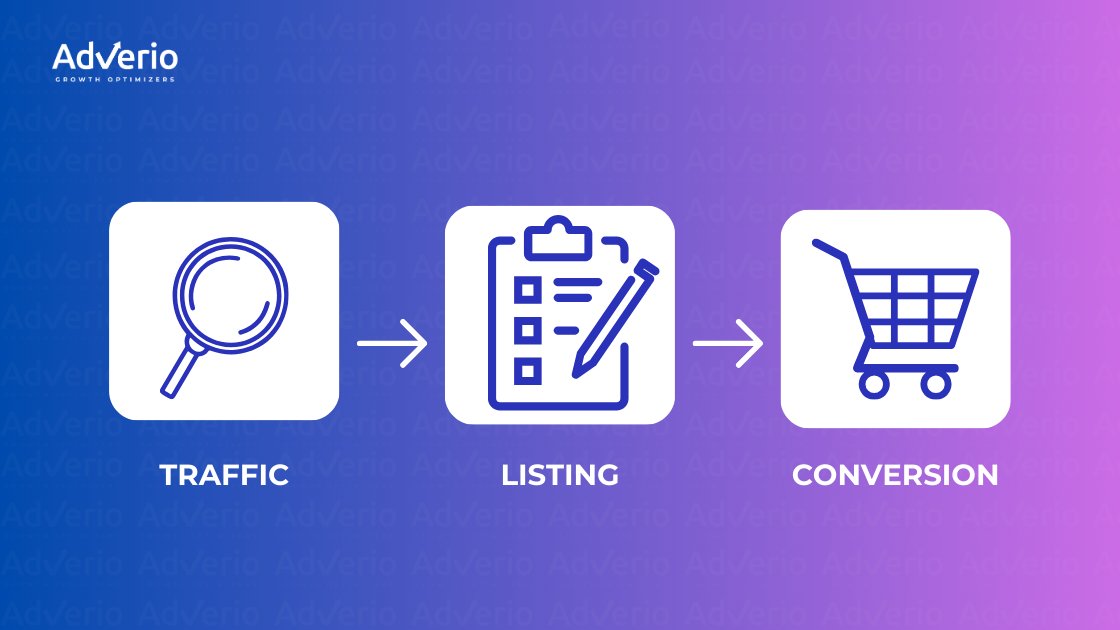
This highlights that improving the middle stage—the listing itself—is the most direct lever for getting more value from the traffic you’re already paying for. For more data-driven strategies to reduce customer acquisition cost on Shopify, exploring different frameworks can be incredibly valuable.
It’s a continuous cycle: audit, optimize, and scale. That’s how you turn your marketing into a predictable growth machine.
Frequently Asked Questions About CAC
We get it. When you’re managing a big catalog and juggling multi-channel ad spend, the same questions about customer acquisition cost pop up again and again. Here are the straight answers we give brand leaders.
How do I calculate CAC payback period for my Amazon campaigns?
Your CAC payback period on Amazon is the time it takes to recoup the cost of acquiring a new customer through the profit they generate. It’s not just about the first sale.
The formula is: CAC / (Average Monthly Revenue Per Customer x Gross Margin %).
For example, if your CAC is $40 and a new customer generates $20 in profit per month, your payback period is 2 months. A payback period under 12 months is solid, but top CPG brands we work with aim for 3-6 months. They achieve this by relentlessly driving repeat purchases to increase customer lifetime value (LTV).
Are Amazon coupons profitable or just brand awareness plays?
Amazon coupons are a surgical tool for conversion, not a sledgehammer for brand awareness. They are profitable only when used strategically to lower the barrier for a first-time purchase from a New-to-Brand (NTB) customer. This directly cuts your CAC for that specific acquisition.
The trap is letting them cannibalize sales from loyal customers who would have bought anyway. Use them for product launches, conquering competitive keywords, or executing a SKU Resurrection on a stagnant listing. To show ROI to leadership, track the conversion lift versus the discount cost for NTB customers only.
How do coupons influence customer lifetime value (LTV)?
Coupons can be a powerful LTV booster if they successfully acquire a high-value customer who goes on to make repeat purchases. The initial discount becomes a small investment for a long-term profitable relationship.
However, a poorly executed coupon strategy attracts one-time deal hunters with no brand loyalty, ultimately lowering your average LTV. The key is to analyze the post-coupon purchase behavior of NTB customers. If they come back and buy again at full price, the strategy is working. If not, you’re just training your audience to wait for discounts.
If you’re looking for a precise handle on your current spend, a good Customer Acquisition Cost Calculator is the best place to start. Getting that clarity is the first step toward building a more profitable acquisition machine.
If your CAC is rising, your system is broken—not your ads. Adverio fixes the system.
Book Your ROI Forecast