


Table of Contents
Here’s the uncomfortable truth: most Amazon sellers are paying for clicks that were never going to convert. Most Amazon sellers are burning cash on clicks that will never convert—and they don’t even see it happening. Mastering negative keywords on Amazon isn’t optional. It’s a non-negotiable part of a profitable ad strategy.
Without a solid negative keyword strategy, you’re essentially telling Amazon’s algorithm that your premium coffee grinder is a perfect match for someone searching for a “cheap plastic coffee grinder.” It’s how you quietly destroy profitability.
This is exactly where most brands fail—and where structured Amazon PPC management services change the outcome.
At a Glance
• Negative keywords stop wasted ad spend and improve conversion rates • Use exact match for precision, phrase match for scale • 15–20 clicks without sales = negation candidate • Top accounts have 3–5x more negatives than positives
Your Secret Weapon for Profitability
Irrelevant clicks are silent profit killers. They drag down your conversion rates —and if your PDP isn’t built to convert, even the right traffic won’t save you. That’s where Amazon listing optimization becomes critical and quietly destroys your ability to scale profitably. This is the core problem of hidden ad waste, a pain point that separates brands stuck in a cycle of declining profits from those hitting triple-digit growth.
We audit this exact failure pattern in almost every account we take over. Spending goes up. Profit doesn’t. That’s the pattern. The answer is always in the search term report—a graveyard of unqualified clicks they’ve paid for. This is precisely why a proactive negation strategy is baked into our profit-first approach.
The Real Cost of Neglect
Ignoring negative keywords isn’t a minor slip-up; it’s a direct financial drain. A stark example of this hit one of our clients hard before they came to us: over just 60 days, a lack of negative keyword management led to $10,625 in wasted ad spend.
This accounted for 40% of their total budget, burned entirely on irrelevant searches driving completely unqualified traffic. This pattern is all too common in unoptimized accounts where ads show up for low-intent, tire-kicker queries.
The strategic use of negative keywords is a fundamental principle across all paid advertising. Understanding how it’s applied in other ecosystems can provide valuable insights for Amazon advertisers. Learn more about Google Ads marketing strategies.
But this isn’t just about stopping bad clicks. It’s about redirecting that wasted capital toward campaigns that actually fuel profitable growth. This is where most brands miss scale—because they rely only on search. A full-funnel approach using Amazon DSP management is what unlocks net-new demand. Every dollar saved from an irrelevant search for “dog toys for aggressive chewers” on your plush cat toy ad is a dollar you can reinvest to capture high-intent buyers who are ready to pull out their wallets. Our guide on Amazon PPC optimization strategies that actually improve profitability
Ultimately, mastering negative keywords is the first step in turning your ad spend from a cost center into a powerful growth engine. It’s about making every single click count and ensuring your budget is exclusively funding your path to profitability.
Hunting Down and Eliminating Wasted Ad Spend
Alright, it’s time to roll up your sleeves and turn your raw advertising data into a surgical hit list of profit-draining keywords. The real work happens inside your Amazon Search Term Reports, where every single click and dollar spent tells a story.
This isn’t about zero-sales terms. It’s about identifying patterns of waste. It’s about learning to spot the patterns of waste—the red flags signaling a serious budget leak. This is the fastest way to recover wasted budget
This whole process is a vicious cycle: an irrelevant click leads to wasted spend, which tanks your conversion rate.
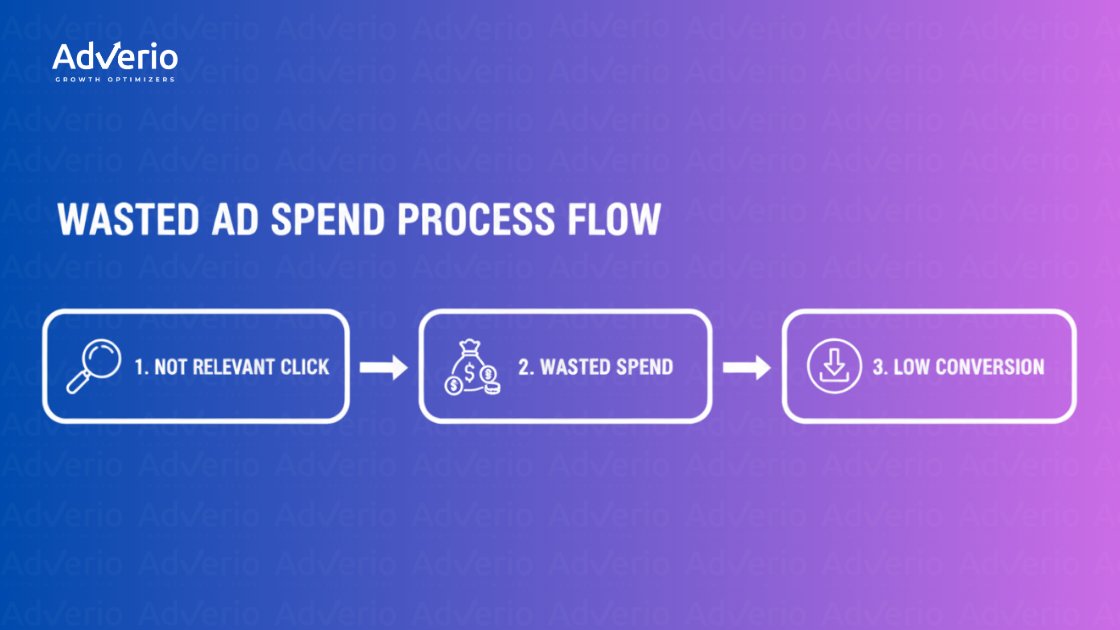
As you can see, it’s a straight line from attracting the wrong shopper to damaging your campaign’s profitability and relevance in Amazon’s algorithm.
Spotting the Red Flags of Wasted Spend
Your first pass through any Search Term Report should focus on the most obvious offenders. This is the fastest way to recover wasted budget that can give you an immediate boost to your campaign efficiency once you trim it.
Here’s what to eliminate first:
-
High-Click, Zero-Conversion Terms: Any search term that’s racked up a significant number of clicks—15–20+—without a single sale is a prime candidate for the chopping block. The search intent just doesn’t match what your product delivers.
-
Low-Relevance Queries: You sell premium leather dog collars, but you’re paying for clicks on “cheap nylon puppy leashes.” These are fundamentally misaligned queries that attract shoppers who will never convert.
-
Wrong Demographic Terms: If your product is a high-end, professional-grade kitchen knife, clicks from searches like “safe knives for kids” or “beginner cooking set” are completely wasted spend.
Manual analysis doesn’t scale, but it simply isn’t scalable, especially if you have a large catalog with tons of variations. You need a more systematic way to find and kill these wasteful word stems at scale.
To help with this, I’ve put together a quick-reference guide for pinpointing common types of wasted ad spend you’ll find in your reports and what to do about them.
Identifying Negative Keyword Candidates
| Waste Type | What to Look For | Action to Take |
|---|---|---|
| Clear Irrelevance | Terms for completely different products (e.g., you sell “iPhone 15 case,” but get clicks for “Samsung screen protector”). | Add the irrelevant product name or category (“Samsung,” “screen protector”) as a Negative Phrase Match. |
| High Clicks, No Sales | Any search term with 15-20+ clicks and zero sales. The traffic is interested but not converting. | Add the full term as a Negative Exact Match to stop spending on that specific, non-performing query. |
| Wrong Intent/Qualifier | Terms including words like “cheap,” “free,” “used,” “repair,” or “for parts” when you sell new, premium items. | Add qualifiers like “cheap,” “free,” “parts” as Negative Phrase Match to block any search containing them. |
| Competitor Brands | Clicks on competitor brand names that aren’t converting and have high ACoS. | If a specific competitor’s brand name is bleeding your budget, add it as a Negative Exact Match. Use with caution. |
| Wrong Audience | Your product is for adults, but you’re getting clicks for “for kids,” “for toddlers,” or “for school.” | Add demographic terms like “kids,” “toddler,” or “school” as a Negative Phrase Match. |
This table should serve as your go-to checklist when you dive into your reports. It’s all about building a repeatable process.
If your search term reports are full of wasted spend but you don’t know where to start, this is exactly where most brands get stuck.
👉 Book Your ROI Forecast and see where your budget is leaking.
Using N-Gram Analysis for Scalable Negation
This is where n-gram analysis becomes scalable for anyone managing ads at scale. An “n-gram” is just a sequence of words from your search term data. By analyzing the performance of individual words (1-grams) or short phrases (2-grams, 3-grams) across all of your search terms, you can spot the common, profit-draining culprits.
For instance, your analysis might reveal that any search term containing the word “refurbished,” “parts,” or “free” consistently fails to convert. Instead of finding and negating hundreds of different search terms one by one, you can just add “refurbished” as a negative phrase match and block all of them at once.
This is the very foundation of a proactive and scalable strategy for reducing Amazon PPC ad spend.
To truly master the elimination of wasted ad spend, leveraging insights from AI-driven e-commerce analytics can provide a data-backed approach to identifying underperforming areas.
By shifting from a reactive, one-off approach to a systematic framework, you turn your negation strategy from a tedious chore into a powerful lever for profitability.
Negative Match Types: The Strategic Difference
Using the wrong negative match type on Amazon is it destroys more than it fixes—it does far more harm than good. You think you’re trimming waste, but you’re actually killing off profitable traffic. Understanding the strategic difference between negative exact and negative phrase isn’t just a best practice; it’s fundamental to controlling your ad spend with precision.
This is the difference between guesswork and a profit-first Amazon PPC strategy.
Get this wrong, and performance drops fast; your best campaigns have suddenly flatlined. The distinction is simple, but the impact on your bottom line is massive.
Negative Exact: The Surgical Strike
Think of Negative Exact Match as a sniper’s rifle. It eliminates one specific, highly problematic search term without any collateral damage. You pull this trigger when a single search query is obviously irrelevant or a total cash drain, but close variations of it might still hold value.
Let’s say your brand sells premium, genuine leather dog collars. Digging into your search term report, you notice clicks from the query “FidoBrand cheap nylon collar” are converting at a clean 0%.
-
Action: Add
[FidoBrand cheap nylon collar]as a negative exact match. -
Result: Your ads will no longer show for that exact search. Simple. But you can still appear for valuable related queries like “leather FidoBrand alternative” or “premium dog collars,” preserving your visibility where it actually matters.
Negative Phrase: The Broad Shield
In contrast, Negative Phrase Match is your riot shield. It blocks any search query that contains a specific sequence of words, no matter what comes before or after it. This is your go-to tool for wiping out entire categories of irrelevant traffic.
Using the same leather dog collar example, you spot a pattern: any search term containing the word “nylon” or “used” consistently wastes clicks.
-
Action: Add
"nylon"and"used"as negative phrase matches. -
Result: Your ads are now blocked from any search containing those words, like “blue nylon dog collar,” “used large dog collar,” or “best price nylon collars.” This blocks entire categories of wasted spend.
The key is pattern recognition. A single bad search term calls for a scalpel (negative exact). A recurring wasteful word or phrase demands a shield (negative phrase). Diving into your data is essential, and there are plenty of hacks Amazon never intended for you to leverage from your Search Query Performance that can reveal these patterns.
The Hidden Danger of Negative ASINs
The nuance doesn’t stop with keywords. A common mistake we see involves negative product targeting, specifically with ASINs. Brands find a competitor’s ASIN performing poorly on their product detail pages and, logically, add it as a negative target.
The risk: Negating an ASIN doesn’t just block your ad from appearing on that specific product page. As our founder, Mike Danford discussed on The PPC Den podcast, internal data shows it can also prevent you from appearing for the valuable search terms that the same ASIN ranks for.
You block one ASIN—and lose visibility across multiple high-value search terms. This is a critical blind spot that can quietly kill your campaign’s reach—a mistake even seasoned sellers make.
Turning Your Negative Keywords into a Scalable System
One-off cleanup doesn’t scale, and building a repeatable, intelligent system for negotiation is what separates the accounts that stagnate from the ones that scale profitably. At scale, this isn’t just campaign optimization—it’s account governance. That’s the difference between fragmented execution and structured Amazon account management. It’s about creating a defensive structure that constantly refines who you’re targeting and ruthlessly cuts out wasted spend.
“Broad vs exact” is the wrong question. The real answer is a hybrid model that uses both for what they do best: broad match for discovery and exact match for controlled profitability. This approach creates a powerful feedback loop where you’re always harvesting new, high-performing search terms while surgically removing the irrelevant traffic they uncover.
The Unspoken Sign of a Highly Optimized Ad Account
Here’s what a high-performing account actually looks like: In fact, it’s usually the opposite.
In high-performing accounts, the most profitable campaigns often have 3 to 5 times more negative keywords than positive ones. This isn’t random; it’s the natural outcome of systematically blocking the endless stream of irrelevant traffic you find in your Search Query Reports.
This high ratio is a hallmark of a mature, well-defended account. It signals that ad spend is being fiercely protected and channeled only toward shoppers with high purchase intent.
Campaign vs. Ad Group Level Negatives: Where You Place Them Matters
Placement determines control. It directly impacts your campaign architecture and your ability to control spend with any real precision.
-
Campaign-Level Negatives: Use these for your universal blockers. Think of terms like “free,” “used,” “repair,” or any other word that is always irrelevant to every single product in that campaign.
-
Ad Group-Level Negatives: This is where you get surgical. Use these to stop keyword cannibalization between different ad groups or to negate a term that’s a bad fit for one specific product but might be perfect for another in the same campaign.
For instance, say you have one ad group for “red running shoes” and another for “blue running shoes.” You’d add “blue” as a negative phrase match in the “red” ad group and “red” as a negative phrase in the “blue” one. This simple move ensures the most relevant ad always gets the click.
The structure: broad, campaign-wide exclusions at the top, and specific, granular control at the ad group level. This layered approach stops you from competing against yourself and pushes relevance through the roof.
Architecting for Control and Scale
An effective negation strategy is built on a smart campaign structure. For anyone with a large catalog, using n-grams is a complete game-changer. N-gram analysis helps you spot common, wasteful word stems (like “for kids” or “for dogs”) across thousands of different search queries at once.
Instead of playing whack-a-mole with your Search Query Report every week, you can add “for kids” as a negative phrase match at the campaign level. This single action can instantly block hundreds of future irrelevant searches before they ever cost you a dime.
This is how you scale negation. Our deep dive into how you can leverage n-gram analysis to transform your Amazon PPC breaks down exactly how to implement this at scale. Building this kind of framework is how you turn negative keywords from a defensive chore into a proactive tool for driving profit.
The Hidden Risk of Over-Negation and How to Avoid It
Most brands get this wrong: being too aggressive with negative keywords can absolutely kill your growth. While cutting waste is critical, a knee-jerk reaction to every underperforming search term is a fast track to choking off future revenue streams.
True expertise isn’t just about cutting what isn’t working right now. It’s about understanding when to let data develop. Some keywords aren’t duds; they’re just maturing, gathering the data they need before they start to convert.
Negate too early, and you kill future revenue. You save a little water today at the cost of the entire harvest tomorrow. This is where strategic patience separates the profitable brands from the ones who constantly churn their campaigns into oblivion.
Setting Intelligent Negation Thresholds
Instead of reacting emotionally to a few non-converting clicks, you need a data-driven framework. A search term isn’t “bad” just because it hasn’t converted yet. You have to give it a fair shot to prove its worth.
This means setting clear, logical thresholds before you even consider adding a term to your negative list. Your rules should be based on a combination of metrics, not just one.
-
Spend Threshold: Don’t even think about negating a keyword until it has spent an amount equal to or greater than your product’s average profit per sale. If your profit is $20, a term that has only spent $5 is still deep in the testing phase.
-
Click Threshold: Establish a statistically significant number of clicks before making a call. For most products, this is anywhere from 10-20 clicks. Anything less is just noise in the data.
-
Time Threshold: Look at performance over a reasonable timeframe, like 30-60 days. A keyword might not convert this week, but it could be a winner next month due to shifts in market demand or seasonality.
Challenging conventional wisdom, one nine-month study found that aggressively negating low-performing keywords can cost brands up to half their revenue over 285 days. The research showed that many of these so-called “underperforming” terms eventually stabilized and performed well, proving their long-term value. You can dig into more of their findings on the long-term value of keywords on M19.
The takeaway is simple: stop making impulsive decisions. Let the data tell the full story. A patient, disciplined approach to negation prevents you from cutting off valuable, long-tail search traffic that your competitors are happily scooping up.
True optimization is all about balance. It’s knowing when to be ruthless and when to be patient. Your bottom line depends on getting that balance right.
How Adverio Turns Wasted Spend into Profit
Most brands don’t have a traffic problem—they have a control problem.
At Adverio, we don’t just “optimize PPC.” We rebuild how your account filters, prioritizes, and scales traffic using a profit-first framework. That means eliminating wasted spend, improving incrementality, and reallocating budget toward high-converting demand.
If your campaigns are scaling spend but not profit, the issue isn’t effort—it’s strategy.
👉 Explore our Amazon PPC Management Services
Frequently Asked Questions About Amazon Negative Keywords
Getting the high-level strategy right is one thing, but execution is where the real profit is made. Let’s get straight to the most common tactical questions we hear from brands about actually putting a negative keyword strategy to work on Amazon.
When Should I Negative Match a Search Term?
Negative a search term as soon as it hits your predefined “waste” threshold. Don’t act on a whim or a gut feeling. A solid starting point is to flag any term that’s racked up 15-20 clicks without a single conversion or has spent more than your product’s average profit per sale. Acting before you have this data is a classic mistake that cuts off potentially valuable keywords before they’ve had a chance to mature.
What’s the Difference Between Negative Phrase and Negative Exact?
Think of it as a scalpel versus a shield.
-
Negative Exact: Your surgical strike. Use it on a single, specific search term that is underperforming (e.g.,
[competitor brand cheap model]). It stops spend on that exact query but lets close variations show. -
Negative Phrase: Your broad shield. If you sell premium espresso machines, adding
"cheap"or"used"as a negative phrase blocks any search containing those words, protecting your budget at scale.
Is There a Good Ratio of Negative to Positive Keywords?
Yes, and it’s almost always much higher than brands expect. In our most highly optimized, profitable client accounts, it’s common to see a ratio of 3 to 5 times more negative keywords than positive ones. A high ratio is the hallmark of a mature, well-defended account where ad spend is fiercely protected and funneled only toward high-intent shoppers.
What Is the Maximum Amount of Negatives per Campaign?
While Amazon doesn’t publish a hard limit on the total number of negatives you can have, there are practical constraints. A negative phrase keyword can have a maximum of four words, and a negative exact keyword can have up to ten words. Focus on quality over quantity. Smart n-gram analysis is far more effective for finding high-impact negative stems (like “replacement” or “parts”) than just dumping thousands of one-off irrelevant terms into a list. For more detailed answers, explore our comprehensive Adverio FAQ section.
Do Negative Keywords and Negative Product Targets (ASINs) Work Differently?
Absolutely, and this is a critical distinction that trips up a lot of sellers. Negating a keyword is straightforward—it blocks your ad from showing for that specific search term. Simple. However, negating an ASIN is way more complex. It doesn’t just stop your ad from appearing on that specific product detail page. It can also prevent you from showing up for valuable search terms that ASIN happens to rank for. This is a common blind spot that can inadvertently throttle your campaign reach.
Is it better to use broad/auto campaigns with heavy negation vs. mostly exact match?
It’s a false choice. The most sophisticated strategy is a hybrid model. Use broad and auto campaigns for discovery—they are your intelligence-gathering tools. Then, use heavy, systematic negation to sculpt that traffic, cutting out waste. Simultaneously, move your proven, high-converting search terms into exact match campaigns where you can control bids and profitability with surgical precision. This creates a powerful flywheel: constant discovery coupled with ruthless efficiency.
If your ad spend is increasing but your profit isn’t, the issue isn’t effort—it’s control.
At Adverio, we rebuild Amazon ad accounts around profitability, incrementality, and scalable growth—not vanity metrics.
👉 Book Your ROI Forecast and see exactly where your budget is being wasted—and how to fix it.