



Table of Contents
If you’re running a $3M+ brand on Amazon and unauthorized sellers keep showing up on your listings, the problem isn’t Amazon’s enforcement tools. It’s your distribution architecture.
Buy Box share rotates to sellers you never approved. MAP breaks. Ad spend fires but the offer that converts belongs to someone else. Authorized partners start protecting their own margins. Your P&L absorbs the damage while your team files complaints that go nowhere.
This piece breaks down why unauthorized sellers keep coming back, what Amazon will and won’t do, and how to build a channel system that stops the leak at the source — not just the symptom.
Ready to see what seller sprawl is costing you in real dollars? Book Your ROI Forecast
At a glance
-
Why unauthorized sellers appear
Your inventory leaked. Distributors oversold. Wholesale buyers flipped excess stock. Retail arbitrage pulled product from channels you thought were clean. -
What Amazon won’t do
Amazon won’t remove sellers just because you say they’re unauthorized. That’s a commercial dispute unless you bring evidence tied to policy, IP, or product mismatch. -
What works
Tighten distribution governance, build listing architecture resellers can’t easily exploit, and run a documented enforcement workflow.
Book Your ROI Forecast: Amazon profit recovery starts with channel control
Why Unauthorized Sellers Are a Distribution Problem
Most brands blame Amazon because Amazon is where the damage shows up. That’s the wrong diagnosis. The platform is just where the damage shows up.
The source is usually upstream. Product leaves your warehouse through an approved channel, then it gets resold through a path you never modeled. A distributor dumps excess units. A wholesale account lists against your own ASINs. A retailer or liquidator turns inventory into marketplace cash. Then your team acts shocked when random sellers appear on your hero listings.

If you’re serious about fixing this, audit your channel before you touch Seller Central. That means tracing who bought what, in what volume, under what terms, and what happened after delivery. Brands that skip this step waste months arguing with sellers while the same inventory keeps leaking back onto Amazon.
Where the leak usually starts
There are a few recurring patterns.
-
Distributor overspill
You approved broad distribution because it looked like revenue. Then one of those partners sold into side channels to clear stock faster. -
Wholesale relisting
A buyer who wasn’t supposed to sell on marketplaces decides margin is margin and lists anyway. -
Retail arbitrage from your own footprint
Product gets purchased from legitimate retail shelves or online storefronts, then flipped onto Amazon by third parties.
Practical rule: If the same unauthorized seller keeps coming back, the issue isn’t enforcement. It’s replenishment.
This is why MAP enforcement and unauthorized seller control are joined at the hip. If your pricing policy is weak, vague, or inconsistently enforced, you train the channel that undercutting has no consequence. If you need to tighten that side of the system, start with this breakdown of Amazon MAP violation enforcement.
Your contracts matter more than your complaints
A soft channel policy is an engraved invitation to gray market behavior. You need terms that define who may sell on marketplaces, how product can be represented, what happens when inventory gets diverted, and what documentation you can demand when something goes wrong. If your channel architecture is loose, the enforcement problem never resolves — it just rotates.
You also need to get honest about your reseller model. Some brands still haven’t decided whether they want controlled marketplace representation or open channel chaos. If that’s still fuzzy internally, this guide on how to become an Amazon reseller is useful because it shows exactly how reseller participation should be structured when it’s intentional, not accidental.
What to do this week
Don’t start by emailing a random seller. Start here:
-
Pull your top ASINs and identify where unauthorized offers are concentrated.
-
Match seller names to channel records and distributor invoices.
-
Look for inventory mismatch patterns such as sudden seller appearance after wholesale shipments or retail promos.
-
Flag products most vulnerable to diversion like evergreen SKUs, simple packs, and widely distributed units.
The brands that solve amazon unauthorized sellers long term stop treating the symptom as the disease. Amazon is where you notice the leak. Your distribution system is where you stop it.
What to Expect from Amazon’s Enforcement Tools
Amazon is not your brand police. That’s the first correction many businesses need.
If a seller is offering a genuine product that reached them through a channel you don’t like, Amazon often treats that as a commercial dispute. That means your repeated “they are unauthorized” reports usually go nowhere. You can be right and still get no action.
Frequent seller forum complaints show how limited that system can feel in practice. A 2024 analysis of forum patterns suggests hijack recurrence rates can be as high as 20-50%, with removal times often exceeding 30 days, even for enrolled brands after multiple reports, as noted in Amazon Seller Central forum pattern analysis.
What Amazon will act on
Amazon responds best when you stop arguing authorization and start documenting violations that fit platform rules.
That usually falls into three buckets:
-
Intellectual property issues
Trademark misuse, counterfeit indicators, or content misuse tied to your protected assets. -
Material product differences
The offer doesn’t match the listing in a meaningful way. Packaging, warranty support, condition, inserts, labeling, or bundled components can matter. -
Policy-linked marketplace abuse
Review manipulation, inaccurate condition claims, or other violations that go beyond channel disagreement.
Amazon doesn’t care much about your internal reseller policy unless you translate it into evidence Amazon can evaluate.
What your evidence file should include
Don’t send emotional complaints. Build a case file.
| Evidence type | Why it matters |
|---|---|
| Test buys | Confirms what the buyer actually receives |
| Photos of packaging and contents | Helps document mismatch against the official listing |
| Warranty or support exclusion proof | Supports a material difference argument |
| Invoice trail requests | Forces sourcing scrutiny when inventory origin is questionable |
| Screenshots of listing misuse | Preserves proof before sellers edit or disappear |
That workflow gets stronger when your content, trademark assets, and listing ownership are already organized. If they aren’t, fix that first with a proper Amazon brand protection strategy.
Brand Registry helps, but it doesn’t solve this for you
Brand Registry is useful. It gives you better reporting access and more control over branded content. It is not a permanent shield against persistent sellers.
That’s why brands get frustrated. They enroll, assume the problem is handled, then watch the same pattern repeat. The issue isn’t that the tool is worthless. The issue is that the tool is narrow, and your problem is broader.
Use Brand Registry for what it is:
-
Content control
-
Violation reporting
-
Asset ownership support
-
A stronger paper trail
Don’t use it as an excuse to avoid channel cleanup.
The wrong and right way to escalate
The wrong way is support-ticket roulette. One case after another. No unified documentation. No test buys. No repeatable argument.
The right way is operational:
-
Identify the seller and the affected ASIN
-
Determine whether the issue is counterfeit, gray market, or listing mismatch
-
Run a test buy if facts are unclear
-
Document material differences
-
Submit a clean, evidence-backed report
-
Track recurrence and escalate based on pattern, not emotion
If you expect Amazon to remove every unauthorized seller on request, you’re going to burn time and lose margin. Use the tools. Just stop pretending the tools are the strategy.
The 3-Part Framework for Eradicating Unauthorized Sellers
A brand cleans up one seller, then three more appear on the same ASIN a week later. That is not an enforcement problem. It is a distribution governance failure.
You remove unauthorized sellers for good by fixing three things at the same time: where inventory leaks, how listings are built, and whether the economics attract resellers in the first place. Brands that treat this like Amazon whack-a-mole stay stuck in maintenance mode. Brands that fix the architecture get control back.
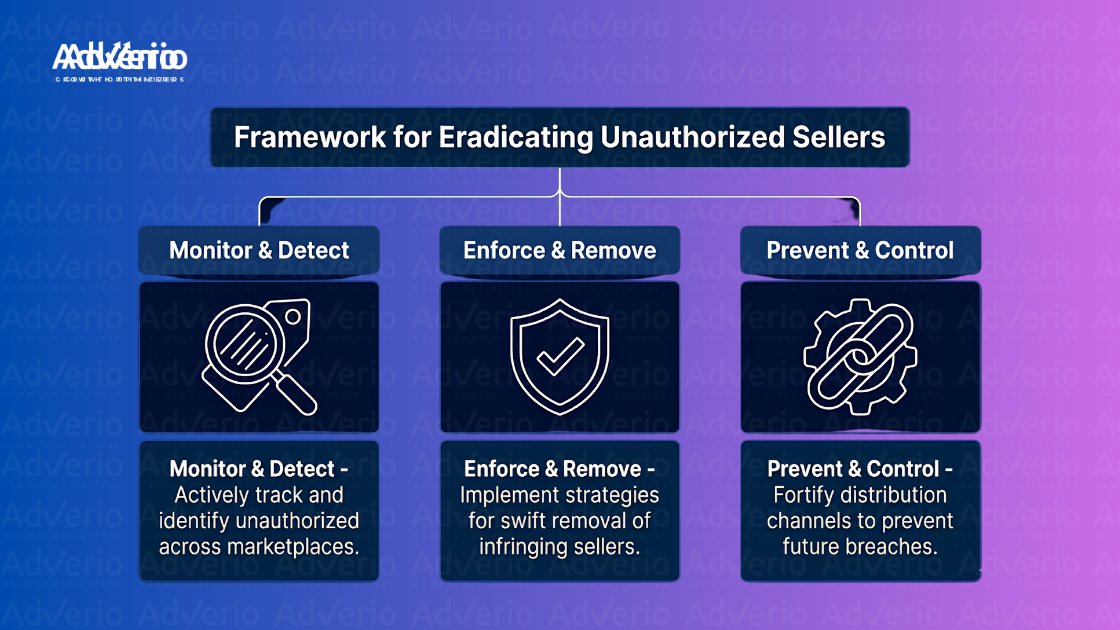
Distribution architecture
Start at the source. If the same SKU moves through wholesale, retail, distributors, and Amazon with no channel distinction, you have built a resale engine for other people.
Fix that by separating channel-agnostic SKUs from brand-controlled Amazon SKUs. Give Amazon its own product logic. That can mean:
-
Amazon-specific bundles
Resellers have a harder time sourcing and matching the exact offer. -
Multipacks with channel-specific identifiers
Different pack structures, inserts, or labeling give you clearer grounds to challenge offer attachment. -
Brand-owned variations
Packaging changes, warranty differences, or compliance materials create a real boundary between authorized and diverted inventory.
This approach does two things. It cuts off easy diversion paths, and it gives your team a cleaner case when a seller attaches to a listing they should not be on.
It also improves catalog control. Clean variations, clear ownership, and documented branded assets make enforcement easier. Used correctly, Amazon Brand Registry benefits for catalog control and reporting support that system. They do not replace it.
Build SKUs for channel control. Convenience is what created the leak.
Brand Registry and enforcement workflow
Once the channel is tighter, enforcement starts working like an operating process instead of a support-ticket habit.
Watch offer count changes, sudden pricing drops, recurring seller names, and conversion shifts on affected ASINs. If unit session percentage falls while traffic holds, check the offer stack immediately. That pattern usually signals seller interference, pricing pressure, or listing contamination.
Your workflow should be disciplined:
-
Monitor seller recurrence by ASIN
Track who appears, how often, and at what price. -
Review listing performance changes
Look for conversion deterioration that lines up with new seller activity. -
Request sourcing documentation
Invoices matter. Vague answers matter too. -
Run test buys when the facts are unclear
Inspect packaging, inserts, expiration dating, compliance labeling, and condition. -
File policy-specific reports
Match the complaint to the actual issue, such as material difference, counterfeit indicators, or listing mismatch.
Sloppy claims get ignored. Precise claims with documented evidence get traction.
For sellers who have crossed into review abuse or manipulated feedback to suppress your listings, a structured Amazon review removal process is the right escalation path.
Making the economics unattractive
Unauthorized sellers stay where the math works.
If your products are widely available, easy to match, frequently out of stock, and priced inconsistently across channels, third-party sellers will keep showing up because the opportunity is obvious. You need to make your catalog harder to source and less profitable to flip.
That means tightening distributor access, limiting broad SKU availability, controlling replenishment windows, and protecting price integrity across the channel. It also means being honest about gray market reality. Many unauthorized sellers are offering genuine units from the wrong source. Amazon often leaves those offers alone unless you can show a material difference or a policy breach.
That is why permanent seller cleanup requires all three pillars working together. Distribution control reduces leakage. Listing architecture limits attachment. Enforcement removes the sellers who still get through. Miss one pillar and the problem comes back.
The Compounding Cost of a Lost Buy Box
Monday starts with a familiar lie. Sales look soft, so the team tweaks bids, blames creative, and waits for ads to recover. The underlying problem sits one layer deeper. You lost control of the offer, and Amazon is now routing demand through someone else’s economics.

A lost Buy Box is not a traffic problem. It is a distribution governance failure showing up in your P&L.
Once offer ownership starts rotating, your operation gets distorted fast. Ad delivery becomes inconsistent because the seller holding the Buy Box controls the moment of conversion. Rank gets harder to defend because your sales velocity no longer compounds under one seller record. Forecasting slips because demand is still there, but your ability to capture it comes and goes. Margin gets hit twice, once from price pressure and again from wasted ad spend.
| Trigger | Business effect |
|---|---|
| Buy Box rotation | Revenue capture becomes inconsistent |
| Ad interruption | Spend efficiency drops because your offer is not always eligible |
| Rank volatility | Organic position gets harder to hold and more expensive to rebuild |
| Recovery spend | You pay to win back traffic you already earned |
| Margin compression | Discounting and ad inefficiency cut profit at the same time |
This is why brands underestimate the cost. They react to the visible symptom, a lower price, a new seller, a bad week in PPC. They miss the structural damage underneath. Once Amazon sees unstable offer ownership, every downstream metric gets noisier. Your TACoS rises. Your forecasting gets less reliable. Your authorized partners see public channel disorder and start protecting themselves, usually with more aggressive pricing or less commitment.
At that point, your Amazon PPC management strategy is working against a structural problem — spending to recover demand that a channel fix would have protected in the first place.
The expensive mistake is treating Buy Box loss as an Amazon event. It is an architecture event. If unauthorized sellers can repeatedly take the offer, your distribution rules are too loose, your listing is too attachable, or your inventory position is too weak to defend continuity.
Inventory discipline matters here more than many brands admit. If you go out of stock, replenish unevenly, or hand Amazon an inconsistent fulfillment profile, you create openings for other sellers to become the default option. Tighten that layer with stronger Amazon inventory management systems and replenishment controls or you will keep paying to recover demand that should have stayed yours.
Use a simple operating rule. Treat every Buy Box loss like a margin leak with a known upstream cause. If your team waits for rank erosion, review issues, or a full pricing spiral, the profit is already gone.
Building a Reseller-Proof Listing Architecture
Most brands sit in one of three states. The trick is admitting which one you’re in.
Model A reseller-led chaos
This is the default mess. Multiple sellers attach to the same ASINs. Price moves without your approval. Content quality gets dragged around by whoever shows up. Your team spends its time reacting.
If this is your setup, you’re not managing a marketplace. You’re renting shelf space from randomness.
Model B brand-controlled listing
This is the minimum acceptable standard for an established brand. You control the listing itself even if resellers still exist around it.
That means:
-
you own the content,
-
you structure the variation family intentionally,
-
you align images, A+ content, and copy around conversion,
-
and you monitor who is attaching and why.
If your listings still look generic or interchangeable, fix that now with stronger Amazon listing optimization. Cleaner architecture doesn’t remove every unauthorized seller, but it does tighten control over how your brand shows up while you fix channel leakage.
Model C brand-owned exclusivity
This is the gold standard. Brand-owned SKUs. Brand-owned bundles. Brand-owned configurations that third-party sellers can’t cleanly replicate.
The reason this matters is simple. Amazon often resists takedowns for genuine but unauthorized gray market products, and even brands that leave Amazon can still see unauthorized sellers exploiting existing ASINs, as discussed in Emplicit’s analysis of gray market seller persistence. Platform policy won’t fully solve a structural product-matching problem.
The more generic your SKU architecture is, the easier you make unauthorized selling.
How to move up the ladder
Don’t try to jump from chaos to full exclusivity overnight. Sequence it.
-
Stabilize your hero ASINs first
Prioritize products with the most margin exposure and seller clutter. -
Create channel-distinct offers
Bundles and multipacks are usually the easiest starting point. -
Narrow reseller permissions
Fewer approved marketplace participants. Clearer rules. Faster consequences. -
Retire vulnerable duplicate structures
If a SKU design invites attachment, redesign it.
Model C isn’t always immediate. But every serious brand should at least be moving toward Model B, then building a path to C. If you’re not, you’re choosing recurring margin erosion as an operating expense.
How Adverio Deploys the Brand Drain Reversal System
Reactive seller chasing doesn’t scale. A structured operating system does.
Adverio applies a monitoring and enforcement workflow built around Brand Drain Reversal and the Buy Box Domination Protocol — part of a full Amazon account management system that treats channel control as an operational discipline, not a support function.
The process centers on continuous ASIN monitoring, evidence collection, seller pattern tracking, and escalation paths tied to MAP breaches, offer disruption, and recurring unauthorized activity. Instead of treating each seller as an isolated support ticket, the system treats unauthorized seller behavior as a profit leak that needs root-cause correction.
That approach works best when enforcement connects to the full commercial system. Listing control and channel governance are more effective when paired with disciplined demand capture. Ranking, content quality, and offer ownership all compound the same outcome — and they all degrade when unauthorized sellers own the Buy Box.
If your team is still managing this manually — chasing seller reports one at a time — you’re converting senior headcount into controlled losses. That’s not enforcement. That’s managed decline.
Frequently Asked Questions About Unauthorized Sellers
Can I report an unauthorized seller to Amazon
Yes. File the complaint under a violation Amazon recognizes, or expect nothing to happen.
“Unauthorized” is not a policy category that gets action on its own. Amazon responds to counterfeit claims, trademark misuse, listing inaccuracies, condition misrepresentation, review abuse, and material product differences. If your team submits a complaint that amounts to “we do not like this seller,” Amazon treats it as a private distribution dispute and leaves the offer live.
Use a tighter process:
-
Track recurring seller names, price drops, and Buy Box rotation
-
Run test buys when the source or condition is unclear
-
Document differences in packaging, warranty coverage, inserts, or item quality
-
Report the case under the specific violation you can prove
What’s the difference between an unauthorized seller and a hijacker
An unauthorized seller is selling your product without your approval. The unit may still be genuine.
A hijacker creates listing-level risk. That usually means counterfeit inventory, false condition claims, wrong variations, altered bundles, or an offer attached to your ASIN that breaks customer trust. The label matters because Amazon cares less about your channel rules than it does about buyer harm and policy violations.
Treat unauthorized sellers as a distribution governance problem. Treat hijackers as an immediate listing integrity problem. The response path is different.
Do I need a lawyer to remove unauthorized sellers
No. You need evidence first.
Start with test buys, seller pattern tracking, invoice requests where appropriate, and platform complaints tied to provable violations. Bring in legal support when a seller keeps resurfacing, a distributor clearly violated contract terms, or the financial damage justifies pressure outside Amazon.
Legal action works best after the operational case is built. Without documentation, legal spend turns into expensive theater.
Will removing sellers hurt my sales velocity
It can reduce low-quality volume in the short term. That is often a good trade.
If unauthorized sellers are cutting price, rotating the Buy Box, and training customers to buy from whoever is cheapest, your topline may look healthy while margin, ad efficiency, and reseller trust deteriorate. Revenue that strips out contribution profit is not growth. It is channel decay.
Strong brands protect controlled revenue. They do not subsidize seller sprawl.
How do I prevent new unauthorized sellers from appearing
Prevention starts upstream, with distribution controls that make diversion harder and easier to trace.
Watch for early warning signs. MAP breaks, repeated seller reappearances, sudden drops in unit session percentage with stable traffic, and invoice trails that do not line up with approved channels all point to leakage. Automated monitoring helps surface these patterns faster than manual checks, but monitoring alone does not fix the source.
What prevents recurrence:
-
Tighter distributor agreements and enforcement
-
Channel-specific SKUs or bundles that expose diversion
-
Fewer sellers with marketplace access
-
Routine test buys on vulnerable ASINs
-
A documented escalation path when the same seller network returns
Teams that wait for a listing to fill up with random sellers have already lost control of the channel. Cleanup is always more expensive than prevention.
If unauthorized sellers are draining Buy Box ownership, margin, and ad efficiency, stop treating it like a support queue. This is a channel control failure with a calculable cost.
Adverio helps established brands identify distribution leaks, tighten listing architecture, and run an enforcement workflow built to protect revenue — not just remove individual sellers.
Book Your ROI Forecast → and see exactly what seller sprawl is costing you.
Read next: Amazon Brand Registry Benefits for Catalog Control and Reporting