


Table of Contents
Amazon’s retail strategy starts with one thing most brands overlook: the data you already own. You’ve built a seven-figure brand. Reviews are compounding, conversion rate beats the category, and PPC is running efficiently. Now, retail buyers are coming up in conversations. Before you take that meeting, here’s what most brands get wrong.
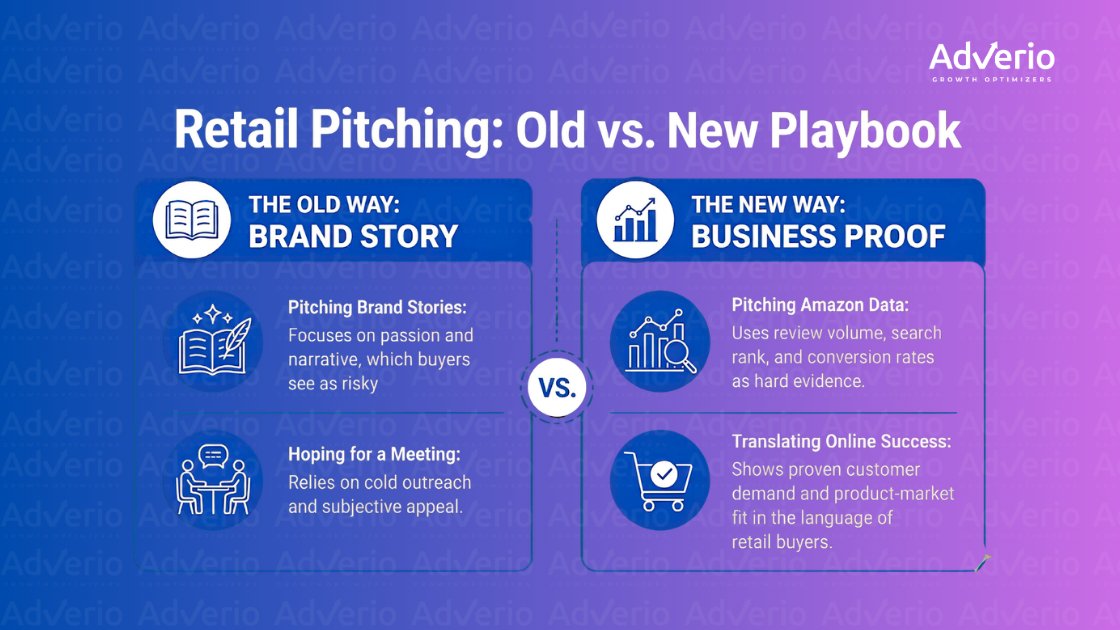
Most brands that lose at retail don’t lose on product. They lose because they walk in with a brand story when buyers are evaluating business risk. They overpitch the story and under-prove the demand.
Your Amazon data already speaks the language buyers want to hear. Conversion rate, review velocity, search rank, repeat purchase rate. That’s the business case. Your job is to frame it correctly and walk in operationally ready. This post breaks down exactly how to do both.
Ready to see if your data is strong enough? Book Your ROI Forecast and let’s translate your marketplace performance into a retail growth plan.
At a Glance
-
Your Amazon Data is Your Retail Pitch: Your Amazon performance—review volume, conversion rate, search rank, and repeat purchase rate—is the business case retail buyers need to see.
-
Buyers Vet You on Amazon First: Before any meeting, buyers from Target and Walmart are on Amazon, checking your star ratings, A+ Content, and storefront to gauge your brand maturity.
-
Metrics Translate Directly to Risk: High review counts prove social validation. Strong conversion rates prove product-market fit. Top search ranks prove category authority. These metrics de-risk the buyer’s decision.
-
Operational Readiness is Non-Negotiable: If your margins are under 50%, your packaging isn’t retail-ready, or you can’t fulfill a massive PO without killing your Amazon sales, you aren’t ready. Period.
-
There is a Sequence to Success: The path from online to shelf isn’t random. Approaching Target, Walmart, or regional players first is a strategic choice based on your brand’s specific position and readiness.
Why Your Amazon to Retail Strategy Starts With the Data You Already Have
The brands that win with an Amazon-to-retail strategy aren’t reinventing their go-to-market. They’re translating what already works on Amazon into proof retail buyers can act on.
A buyer at Target or Walmart doesn’t need you to explain your product. They need you to prove there is demand for it at scale and that your brand can execute operationally. Your Amazon data does both.
Review count proves social validation. Search rank proves category relevance. Conversion rate proves the product sells without hand-holding. Repeat purchase rate proves the customer comes back. Frame each metric against the buyer’s real question: Will this product move on my shelf without me babysitting it?
What Retail Buyers Actually Look At Before Saying Yes
A retail buyer at Target or Walmart has already looked you up before you arrive. They’ve searched your product category on Amazon. They’ve read your reviews. They’ve judged your brand’s maturity based on your storefront and A+ Content.
That’s not a friendly look. That’s a pre-qualification audit. They are looking for signals that you are a serious operator, not an amateur with a good idea. A brand with a weak star rating, low review count, or—worst of all—no Amazon storefront is an immediate red flag. It signals you aren’t ready for primetime, and the meeting is over before it starts.
Here is the unwritten scorecard they use to vet you.
| What Buyers Check | What They Are Evaluating | Minimum Threshold to Be Credible |
|---|---|---|
| Review count | Social proof and sales volume | 200 plus reviews on hero SKU |
| Star rating | Product quality and customer satisfaction | 4.2 stars or above |
| Search rank | Category relevance and demand | Top 10 in primary category |
| Conversion rate | Product-market fit | Above category median |
| A+ content and storefront | Brand maturity and operational capability | Both must exist |
| Price point | Shopper demographic fit | Must align with retailer’s price architecture |
| Repeat purchase rate | Loyalty and LTV | Subscribe and Save data if available |
How to Read Your Amazon Data Through a Retail Buyer’s Eyes
Your Amazon metrics are useless unless you can frame them. Don’t just present numbers; present undeniable proof of future retail success. Here’s how you translate your data into the language buyers understand.
Review volume and velocity as social proof
A hero SKU with 500 reviews at 4.5 stars tells a buyer that real customers bought the product, used it, and came back to say it worked. That is demand validation no pitch deck can replace. Velocity—the rate of new reviews—matters just as much. A product accumulating 20 reviews per month signals active market pull. A product with 500 reviews from four years ago signals stagnation. You aren’t just showing numbers; you’re showing momentum.
Conversion rate as demand signal
A conversion rate above the category median tells a buyer one thing: when shoppers find the product, they buy it. That’s not a marketing win; it’s a product win. Buyers aren’t just evaluating whether your brand can generate traffic. They are evaluating whether your product can close a sale on a crowded shelf without support. A high conversion rate is the cleanest proof of product-market fit available, and it’s a critical component of any strong Amazon listing optimization strategy.
Search rank as category authority
Ranking in the top 10 organically for a high-volume category keyword tells a buyer that Amazon’s algorithm has validated your product as relevant and performing. That is third-party category authority that is hard to manufacture. If you rank for the category’s most competitive keyword, you own a position in the shopper’s consideration set that retail placement will amplify, not create. That ranking is rarely an accident. It’s the result of a disciplined Amazon PPC management system working in sync with your organic strategy.
Repeat purchase rate as loyalty proof
Subscribe & Save penetration and repeat purchase data from Brand Analytics show a buyer that customers come back without a discount prompt. For consumable and replenishment categories, this is the single most compelling metric in a retail pitch. It proves your brand creates habitual buyers, not one-time triers. Loyalty proven online transfers to the shelf.
It’s also the kind of data that informs a smarter Amazon account management strategy for protecting that revenue as you scale into new channels.
The Retail Readiness Checklist: Are You Actually Ready for the Shelf?
Wanting shelf space and being ready for it are two different things. Run this checklist before booking a single buyer meeting. If you’re in the “Not Ready” column on more than two rows, you’re not ready. Fix the foundation first.

| Area | Ready Signal | Not Ready Signal |
|---|---|---|
| Hero SKU review count | 200 plus at 4.2 stars or above | Under 100 or below 4.0 stars |
| Operational capacity | Can fulfill retail POs without disrupting Amazon | FBA-only operation with no 3PL or retail fulfillment capability |
| Pricing architecture | MAP enforced consistently across all channels | Active reseller violations or price instability on Amazon |
| Packaging | Retail-ready packaging with shelf-facing design | Amazon-only packaging—poly bags, plain boxes |
| Margin structure | Gross margin above 50 percent to absorb retail terms | Margin below 40 percent—retail terms will destroy profitability |
| Brand assets | Storefront, A+ content, professional imagery | No storefront or thin brand presentation on Amazon |
A thin storefront or missing A+ content isn’t a cosmetic problem. It’s a signal to buyers that your brand isn’t ready. Amazon listing optimization is the fix before any buyer meeting.
Pro tip: Fix your Amazon storefront before any retail buyer meeting. Buyers check it. A brand with no storefront or a thin one signals that you are not ready for the shelf—regardless of how strong your pitch is. — Adverio Account Team
Not sure where your brand sits on this checklist? An Amazon Profit ROI Forecast gives you the data-backed answer before you commit to a retail path.
How to Approach Target, Walmart, and Other Retailers—And in What Order
Don’t mistake preference for strategy. The decision to approach Target, Walmart, or a regional player first is a cold, calculated choice based on your brand’s position, margin, and operational maturity. Get the sequence wrong, and you’re dead on arrival.
Target—premium positioning and demographic fit
Target is for brands with a strong aesthetic and a story that resonates with its premium shopper demographic. Buyers here look for brand coherence and design, not just raw sales data. The standard path to a physical shelf runs through Target Plus, their online marketplace. Prove you can perform on Target.com first. No exceptions. Performance there is your audition for an endcap.
Walmart—volume and household penetration
Walmart is a volume game. The largest retail footprint in the U.S. runs on velocity and margin. Buyers want proof you can handle scale on their platform before they talk brick-and-mortar. Dominate Walmart Marketplace first. That’s your audition. Like Target, shelf placement is earned online, not pitched in a meeting. Like Target, the path to brick-and-mortar starts online. Dominate the Walmart Marketplace to prove you can handle the scale.
Regional and specialty retailers—lower barrier, faster proof of concept
For many brands, the smartest first move is to go small. Regional grocery chains, specialty outdoor retailers, and category-specific chains have a lower barrier to entry, move faster, and demand less compliance overhead. A strong regional placement is not a compromise; it’s a strategic first step. It builds the sales data and operational credibility you need to confidently walk into a meeting with a national buyer later.
What Happens to Your Amazon Business When You Go Retail?
The biggest fear for Amazon-native brands is that retail will cannibalize their online sales. That’s a valid concern, but it’s not the real threat. The real threat is operational implosion. Going to retail unprepared doesn’t just put your new partnership at risk—it can cripple the profitable Amazon business you already built.

Here are the three scenarios every brand must navigate:
-
Pricing conflict: If your product hits a retail shelf at a price below your Amazon MAP, you’ve just created a channel war you cannot win. This isn’t something to solve later; it must be fixed before placement. Without a solid Amazon brand protection plan, retail pricing will destroy your MAP and your margins.
-
Inventory tension: That first massive retail purchase order feels like a victory, but it’s a direct threat to your Amazon stock. Brands without a dedicated 3PL or a split inventory strategy routinely stock out on Amazon while fulfilling their first retail PO. Don’t solve your supply chain during the crisis; solve it before the placement. The hidden costs of managing marketplaces in silos are most apparent here.
-
The halo effect: When done correctly, retail placement accelerates Amazon performance. A physical presence on shelves drives a measurable lift in branded search on Amazon. Shoppers see your product at Target and search for it by name later. Shelf placement at a major retailer becomes social proof for other buyers. This is the omnichannel flywheel, but it only spins if your operations can handle the pressure. A well-executed multi-marketplace strategy guide is essential.
How Adverio Connects Digital Performance to Physical Retail
Adverio builds the business case your Amazon data already supports. We translate review velocity, conversion rate, search rank, and repeat purchase data into a retail pitch buyers can act on. We also help you sequence retailer outreach correctly and protect your Amazon revenue from the operational pressure of a new channel. The brands that come to us already have the numbers. We make sure those numbers work hard in the right room.
If you’re sitting on strong Amazon numbers and want to know if retail is the right next move, start with an ROI Forecast. We’ll tell you what the data says before you spend a dollar chasing placement.
FAQs
What is a realistic gross margin needed to survive big-box retail?
If your gross margin is below 50%, do not attempt a national retail launch. The math will not work. Between slotting fees, mandatory co-op marketing, chargebacks for minor infractions, and the retailer’s margin requirements, a sub-50% margin structure will leave you losing money on every unit sold. For most brands, a 60%+ margin is a safer baseline to absorb the true cost of doing business with a major retailer.
Do I need a broker to get into Target or Walmart?
For national chains, a reputable broker is a necessary evil. They have the relationships and direct lines to buyers that you don’t. While they take a 3-5% commission on sales, they can get you meetings that would take you years to secure on your own. Going direct might save you the commission, but you’ll likely spend more in time and lost opportunity trying to break through the noise. Choose your broker carefully—their reputation becomes your reputation.
What happens if my product doesn’t sell well in retail?
If your product fails to meet the agreed-upon sales velocity targets, the retailer will make it your problem. You’ll either be forced to pay “markdown money” to fund the discounts needed to clear your inventory, or you’ll be delisted. Many contracts also include buy-back clauses, forcing you to purchase all unsold inventory at your own cost. You are a line item on a spreadsheet, and if you don’t perform, you will be replaced.
How much inventory do I need for a national retail launch?
Plan for a first purchase order that is 3 to 6 times your current monthly sales volume on Amazon. You must have the capital to fund this production run upfront and the 3PL infrastructure to manage it separately from your FBA inventory. Failing to deliver the first PO on time and in full is the fastest way to get delisted before you even start.
Ready to turn your Amazon data into a retail growth plan?
Book Your ROI Forecast and let Adverio show you what your marketplace performance is actually worth on the shelf.
Read Next: Full Amazon Account Management System
References
-
Retail E-Commerce Sales in the United States. Statista.
-
Omnichannel Retail Trends Report. NielsenIQ.
-
Become a Target Plus Partner. Target Corporation.
-
Getting Started on Walmart Marketplace. Walmart.
-
The State of Omnichannel Retail 2026. BigCommerce.