

Table of Contents
Most Amazon brands don’t have a traffic problem — they have a profit problem disguised as keyword strategy.
If you’re a $3M+ brand stuck with rising ad spend, flat growth, or inconsistent performance, your keyword strategy is optimizing for visibility — not incremental revenue.
This guide shows you how to build a profit-first Amazon keyword strategy that drives conversion, market share, and scalable growth — not just clicks.
At a Glance
• Keywords don’t drive profit—conversion-backed keywords do
• ACoS is a vanity metric without TACoS and incrementality
• High-intent + long-tail keywords outperform volume chasing
• Keyword strategy must align with listing + pricing + inventory
Stop Wasting Ad Spend on the Wrong Keywords

Most brands are leaking profit because they’re chasing the wrong numbers. They obsess over vanity metrics like low ACoS (Advertising Cost of Sales), falling into what we call Optimization Myopia.
This tunnel vision ignores what actually matters: total profitability.
It leads to wasted ad spend on keywords that generate clicks—but no sustainable growth.
This is where high-intent keyword targeting strategies separate profitable brands from wasted spend → https://www.adverio.io/reducing-amazon-ppc-ad-spend/
It’s a classic sign of mediocrity.
A profit-driven keyword strategy moves beyond vanity metrics. It’s about digging into customer intent, carving out valuable market share, and making sure every ad dollar you invest generates a real, measurable return.
Shifting From Vanity Metrics to Profit Drivers
To build an effective keyword strategy, you must fundamentally change your mindset. Ditch the reactive, metric-chasing approach and adopt a proactive, profit-first one. It’s knowing the crucial difference between keywords that attract traffic and those that convert shoppers ready to buy now.
It’s a night-and-day difference. This table breaks down the shift from the flawed, common way of thinking to a strategy that actually drives the business forward.
From Generic Keywords to Profit Drivers
| Flawed Approach (Optimization Myopia) | Profit-Driven Strategy |
|---|---|
| Primary Goal: Lower ACoS at all costs. | Primary Goal: Maximize Total Advertising Cost of Sales (TACoS) and net profit. |
| Keyword Focus: High-volume, broad terms. | Keyword Focus: High-intent, long-tail, and competitor terms that convert. |
| Measurement: Isolated campaign performance. | Measurement: Full-funnel impact on organic rank, market share, and profitability. |
| Outcome: Stagnant growth and hidden profit leaks. | Outcome: Scalable, predictable growth and increased market dominance. |
Ultimately, a smart strategy recognizes that keywords aren’t just about getting seen; they’re about getting sold.
At Adverio, we build keyword strategies with one purpose: to drive predictable, scalable profit. This isn’t about just tweaking bids.
A true understanding of Amazon PPC cost reduction strategies that protect profit
comes from targeting the right audience with surgical precision.
That’s how you go from wasting money to leading the market.
How the A10 Algorithm Interprets Your Keywords
Here’s what most brands get wrong. Amazon’s A10 algorithm is a hyper-efficient matchmaker. Its only job is to connect a shopper with the perfect product, instantly. Your Amazon search keywords are how you signal to the algorithm that your product is the one.
But this isn’t about stuffing keywords everywhere. It’s a strategic conversation. The algorithm pays more attention to certain parts of your listing—a keyword in your title shouts relevance, while one buried in your A+ Content just whispers.
Getting this hierarchy right is non-negotiable—and it’s the foundation of effective Amazon listing optimization strategies
It’s the difference between telling the algorithm exactly who your product is for and just hoping it figures things out. This foundation dictates your organic rank and sets the stage for profitable ad campaigns.
The Keyword Hierarchy Matters
The A10 algorithm doesn’t see a wall of text. It sees a structured document, and each section carries a different weight. Your job is to put the right keywords in the right places to send the strongest possible signals for relevance and conversion.
Here’s the breakdown of how the algorithm prioritizes information:
-
Product Title: This is your prime real estate. Keywords here have the biggest impact on search visibility, period. Your most critical, high-volume search terms must live here.
-
Backend Search Terms: Invisible to shoppers but crucial for the algorithm. This is your dedicated space for synonyms, long-tail variations, and common misspellings that would clutter the front end.
-
Bullet Points: Your secondary keyword hubs. They carry serious weight and are perfect for weaving in terms that explain features, benefits, and use cases—hitting both SEO and conversion.
-
Product Description & A+ Content: While these have less direct ranking power, they are still indexed. This content helps the algorithm build a wider, contextual understanding of your product. It’s the ideal spot for long-tail phrases that support your core terms.
A common mistake is treating all keyword placements as equal. A high-value keyword in your title can outperform the same term scattered across your description ten times over. Prioritization is everything.
Keyword Intent and Sales Velocity
The algorithm is smart. It doesn’t just match words; it watches what happens next. It’s obsessed with sales velocity—the rate and volume of your sales tied to a specific keyword. When a shopper searches a term, clicks your product, and buys it, you send a powerful signal to Amazon: “Hey, this is a great result for this query.”
This creates a self-reinforcing loop that separates the winners from the losers:
-
Relevance: Your keywords get you in front of the right shoppers.
-
Conversion: A killer listing convinces them to buy.
-
Ranking: That sale proves your relevance, boosting your rank for that keyword, which leads to more sales. Repeat.
This is exactly why your keyword research must be anchored in conversion potential. Sure, a term like ‘coffee’ gets over 16.6 million monthly searches. But chasing that term is a recipe for burning cash unless your product can actually compete and convert that massive, generic traffic. See more data on Amazon’s most searched terms.
When you master how A10 interprets your keyword signals, you stop guessing and start engineering visibility.
Building Your Keyword Arsenal Step by Step
If your keyword strategy still relies on “best guesses,” you’re already behind.
Forget throwing random phrases at your listings and hoping something sticks. To build a true arsenal of Amazon search keywords that actually drives profit, you need a repeatable, data-driven process.
This framework goes beyond basic tools and gets into what your customers actually type into the search bar. We’ll start with foundational ‘seed’ keywords and then expand into the profitable long-tail, competitor, and complementary terms your rivals are probably ignoring.
If your keyword strategy isn’t translating into profit, it’s time to fix the system—not just the keywords.
→ Book Your ROI Forecast
Phase 1: Brainstorming Your Seed Keywords
This is ground zero. Define your product in the simplest terms. Don’t overthink it—how would a real person describe what you’re selling?
Start by listing your product’s core identity. If you’re selling a black leather dog collar, your seed keywords are exactly that: “leather dog collar,” “black dog collar,” and “dog collar.”
From there, branch out by thinking about:
-
Use Cases: “dog training collar,” “puppy collar,” “heavy duty dog collar.”
-
Features & Materials: “padded leather collar,” “adjustable dog collar.”
-
Target Audience: “collar for large dogs,” “small breed dog collar.”
This initial list is the raw material you’ll feed into the next phases.
Phase 2: Harvesting Keywords with Amazon Tools
Now we take those seed keywords and plug them into Amazon’s own data goldmines. This is where you uncover the exact language your customers are using. Third-party tools can be a start, but nothing beats getting your data straight from the source.
Your most powerful tool is the Search Query Performance (SQP) report inside Brand Analytics. It shows you the real queries shoppers use to find your products, complete with hard data on impressions, clicks, and conversions. It’s a game-changer.
Below is an illustration showing how to properly place keywords in your title, bullets, and backend search terms for maximum SEO impact.
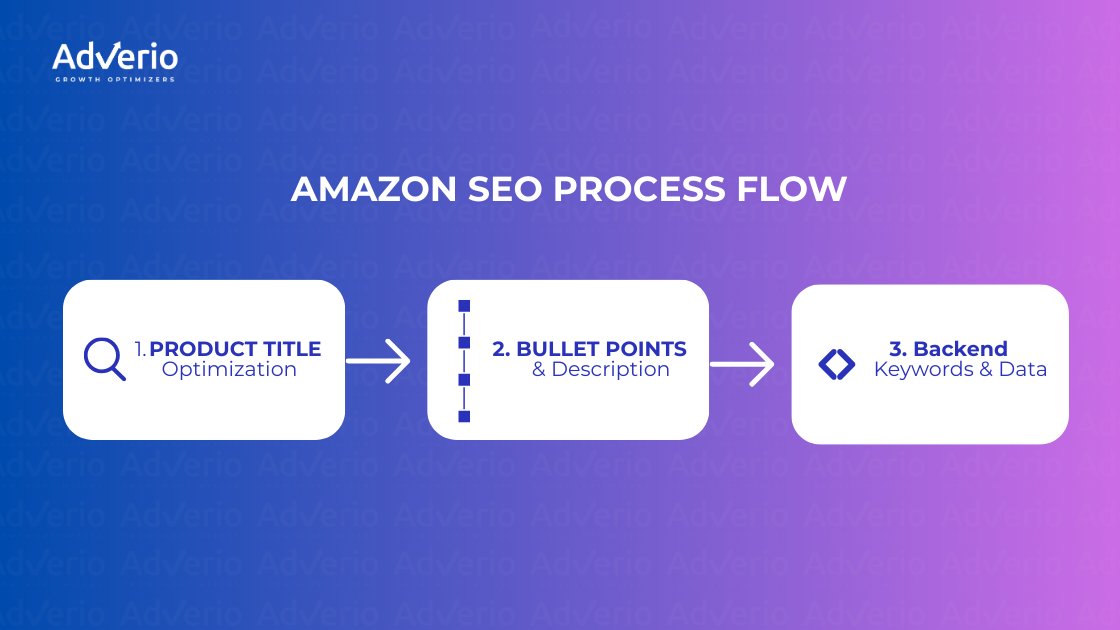
This workflow shows the pecking order for keyword placement, highlighting how each part of your listing signals relevance to Amazon’s A10 algorithm.
Also, use the “Top Search Terms” dashboard in Brand Analytics. It lets you see the most popular keywords in your entire category—a fantastic way to harvest proven, high-volume terms your top competitors are ranking for.
Phase 3: Refining Your Keyword List
The harvested list will be long and messy. This phase is about cleaning it up and organizing it for action. First, cut any irrelevant or low-intent terms. A query like “dog pictures” has nothing to do with your dog collar, so get rid of it.
Next, group your keywords by shopper intent:
-
Branded: Searches for your specific brand name (“Adverio dog collar”).
-
Competitor: Searches for one of your rivals (“Acme dog collar”).
-
Category/Generic: Broad, top-of-funnel searches (“dog collars”).
-
Long-Tail: Super-specific, multi-word phrases (“black leather dog collar for German Shepherd”).
A great strategy for quick wins involves finding low competition keywords. These are usually long-tail terms with less search volume but sky-high conversion rates because the shopper knows exactly what they want.
Keyword behavior isn’t static. Smart sellers optimize their listings 6 to 8 weeks ahead of peak seasons, weaving in terms like ‘gift ideas’ or ‘summer essentials’ to catch that wave of buyer interest. Top products like the Kindle can pull in over 2.3 million searches in a 30-day period during peak demand—failing to prepare means leaving money on the table.
Phase 4: Prioritizing for Profit
The final step is to prioritize your refined list. Not all keywords are created equal. You need to identify which ones will drive the most profitable traffic.
Analyze your list using three core factors:
-
Relevance: How perfectly does this keyword match your product? (High, Medium, Low)
-
Search Volume: How many people are searching for this? (High, Medium, Low)
-
Conversion Potential: How likely is a searcher to buy? (High, Medium, Low)
Your highest-priority keywords are the ones that score high across the board: high relevance, high conversion potential, and solid search volume. These are the money-makers that belong in your product title and will form the backbone of your exact-match PPC campaigns.
This four-phase system turns keyword research from a chaotic guessing game into a strategic, repeatable process that builds the foundation for profitable growth.
Integrating Keywords for Maximum Conversion
Finding the right Amazon search keywords is just the first half of the battle. Having a killer list is useless until you get those words working for you inside your product listing. This is where your research hits the road—the make-or-break step connecting your data to your customer.
Getting this right isn’t about keyword stuffing. It’s about strategically weaving your terms into the front-end and back-end of your listing to satisfy both Amazon’s A10 algorithm and a real human shopper. Nail it, and your conversion rate will thank you. Get it wrong, and you’ll confuse the algorithm and turn off buyers with robotic copy.
Weaving Keywords into Your Listing’s Front-End
Your listing’s front-end—the title, bullet points, and A+ Content—is your direct sales pitch. This is exactly where strong Amazon listing optimization becomes the difference between traffic and revenue. Every keyword here has to pull double duty, signaling relevance to the algorithm while showing a shopper you have the solution they need.
-
The Title: Your Unbeatable Hook
Your product title has the single biggest impact on your organic ranking. This is non-negotiable: your most important, highest-volume keyword has to be here, ideally near the front. It needs to grab the attention of both shoppers and Amazon’s search engine instantly. -
Bullet Points: Your Conversion Drivers
The bullet points are where you deliver on the promise made in the title. This is prime real estate for your secondary keywords—terms that describe key features, benefits, and materials. Frame each bullet around what the customer gets, and slide a relevant keyword in naturally. Instead of a flat “Durable material,” try “Built for Adventure: Features a tear-resistant nylon strap perfect for active dogs.” -
A+ Content: Your Semantic Storyteller
While A+ Content has a lighter direct impact on ranking, it’s a goldmine for building deep, contextual relevance. Use this space to integrate long-tail and semantic keywords naturally into your brand story, comparison charts, and lifestyle photos. This helps Amazon understand your product on a deeper level, connecting it to a much wider net of related customer searches.
Optimizing Your Backend Search Terms
The backend is your secret weapon. The “Generic Keywords” field is a direct line to the A10 algorithm, completely invisible to customers. This is where you put all the valuable keywords that don’t fit gracefully on the front-end. Wasting this space is leaving money on the table.
Think of your backend search terms as the ultimate spillover container. It’s for every relevant query that didn’t make the cut for the front-end copy—synonyms, common misspellings, and foreign-language equivalents. If a customer might use a term to find your product, it belongs here.
Get the most out of this field by loading it up with:
-
Synonyms and Variations: Include all the different ways people might describe your product (e.g., “sofa” and “couch,” “blender” and “smoothie maker”).
-
Common Misspellings: Don’t let a typo cost you a sale. Add common misspellings of your brand and top keywords.
-
Long-Tail Queries: The perfect spot for those super-specific, multi-word phrases that show a shopper is ready to buy but are too clunky for your title or bullets.
-
Competitor Terms (Use with Caution): While technically against Amazon’s rules to use brand names here, the real value comes from targeting competitor ASINs directly in your PPC campaigns, not stuffing their names in your backend.
Here’s a breakdown of where your keywords will have the most impact across your listing.
Keyword Placement Impact Matrix
| Listing Section | Keyword Type | Primary Goal | Impact Level |
|---|---|---|---|
| Title | Primary, High-Volume | Indexing & Ranking | Very High |
| Bullet Points | Secondary, Feature/Benefit | Conversion & Ranking | High |
| Backend Search Terms | Synonyms, Long-Tail, Misc. | Indexing & Discovery | High |
| A+ Content | Long-Tail, Semantic | Contextual Relevance & Conversion | Medium |
| Product Description | Secondary, Long-Tail | Indexing & Conversion | Low to Medium |
By strategically filling out both the front-end and back-end, you create a complete keyword footprint. This tells Amazon exactly what your product is, who it’s for, and why it’s the best choice for a customer’s search.
Fueling Growth with Keyword-Driven Advertising
Getting your organic visibility right is the foundation. Paid advertising is the accelerator. A powerful list of Amazon search keywords is just raw fuel until you pour it into a high-performance advertising engine. This is where the game shifts from just being found to aggressively dominating your market.
Forget boosting posts or running basic Sponsored Product ads. We’re talking about translating your keyword research into surgically precise PPC and DSP campaigns that drive profitable growth, not just empty clicks.
This only works when supported by an Amazon PPC structure built for profitability. It all boils down to structuring your campaigns around customer intent.
Structuring Campaigns Around Intent
Your customers don’t all search the same way, so your campaigns shouldn’t be a one-size-fits-all mess. An effective structure segments keywords based on where a shopper is in their buying journey. This ensures every ad dollar is aimed at the highest possible conversion potential.
-
Branded Campaigns: These target searches for your brand name. The goal is pure defense—protecting your digital shelf space from competitors trying to siphon off your hard-won traffic. These campaigns should always run at a low ACoS and a high conversion rate.
-
Category Campaigns: Here, you’re targeting broader, top-of-funnel terms like “leather dog collar.” This is your offensive play. You’re capturing new customers who are still exploring options. It’s all about expanding your market share.
-
Competitor Campaigns: This is where you go head-to-head, targeting the keywords and ASINs of your direct rivals. It’s a bold strategy for peeling customers away from the competition right when they’re ready to buy.
Most agencies stop at these basic campaign structures. A profit-driven approach treats keywords as dynamic assets. They move through a lifecycle, constantly being refined and optimized for maximum return.
Mastering the Keyword Lifecycle
Keywords aren’t static. The best ones are discovered, tested, and promoted through a deliberate process we call the “keyword lifecycle.” This system turns your ad account into a perpetual research machine that’s constantly unearthing new, profitable search terms.
This is the same principle behind building a profit-first Amazon advertising strategy
This lifecycle is a simple but powerful flow:
-
Discovery (Auto Campaigns): You start with broad-match or automatic campaigns. Amazon’s algorithm does the heavy lifting, matching your products to a wide range of customer search queries. This is your keyword harvesting ground.
-
Graduation (Manual Campaigns): You regularly dive into the Search Term reports from your auto campaigns. When you find a query that has converted into one or more sales, you “graduate” it.
-
Optimization (Exact Match): That graduated keyword is then moved into a highly targeted manual campaign as an exact-match keyword. Now, you can control the bid with absolute precision, ensuring every dollar is spent on a term you know converts.
This methodical process removes the guesswork and ensures your ad budget gets more concentrated on proven winners over time.
Bidding for Profit, Not Just for Clicks
Ultimately, it all comes down to how you bid. Chasing a low ACoS is a rookie mistake—it’s Optimization Myopia in action. A profit-first strategy focuses on Total Advertising Cost of Sales (TACoS) and uses bidding to hit specific goals, whether that’s launching a new product, liquidating old inventory, or dominating a category.
This requires a sophisticated Amazon advertising strategy that balances offensive and defensive bidding to grow your total market share. By translating your keyword research into a structured, lifecycle-driven advertising machine, you move from simply participating in the marketplace to actively shaping it.
Advanced Tactics for Scaling and Pruning
Sustainable growth isn’t about finding a magic set of keywords and letting them run on autopilot. Sustainable growth only happens when keywords, ads, inventory, and pricing are managed as one system—this is where Amazon account management becomes critical. It’s a constant, active discipline—a cycle of pruning wasted ad spend and strategically scaling your winners. This is what separates brands that plateau from those that achieve true, profit-obsessed scale.
Two areas are critical but often neglected: aggressive negative keyword hygiene and data-driven bid scaling. Getting these right turns your ad account from a cost center into a finely tuned growth engine.
Pruning Your Campaigns with Negative Keywords
Negative keywords are your shield against profit leaks. They tell Amazon which searches you don’t want your ads showing up for, stopping you from burning money on irrelevant clicks. Think of it as trimming dead branches to help the healthy ones grow stronger. A consistent pruning process is non-negotiable for improving your ROAS.
Start by regularly pulling your Search Term reports. Hunt for queries that are:
-
Irrelevant: Terms that have nothing to do with your product.
-
Low-Converting: Clicks that rarely lead to a sale.
-
Unprofitable: Terms where the cost-per-acquisition is torpedoing your margins.
Don’t treat negative keyword management as a one-time task. It’s an ongoing process of financial hygiene. Every dollar saved from an irrelevant click is a dollar you can reinvest into a keyword that actually drives profitable sales. This discipline is a core tenet of our Growth Cultivator framework.
Scaling Your Winners with Precision
Once you’ve cut the waste, it’s time to double down on what works. But scaling isn’t just cranking up budgets. It’s about identifying your high-performance Amazon search keywords and strategically increasing their bids to capture more market share.
Look for keywords with a proven track record: strong conversion rates, healthy profitability, and a good sales history. These are the terms ready for a bigger investment. Sometimes, a small, incremental bid increase is all it takes to push your ad into a more prominent position, driving significantly more qualified traffic and sales.
Real-time data reveals crucial insights here. For instance, a keyword’s autocomplete position (AP) signals its search volume; an AP of 1 means it’s the top suggestion, indicating massive demand. Similarly, long-tail keywords—phrases with six or more words—often show high popularity and competition, signaling strong buyer intent that’s ripe for scaling. You can discover more about these high-intent keyword metrics. By focusing on these data-backed winners, you ensure your scaling efforts are aimed squarely at profitable growth.
How Adverio Turns Keywords Into Profit
Most keyword strategies fail because they operate in isolation.
At Adverio, keywords are governed within a full-funnel system—where pricing, inventory, listing conversion, and ads work together to drive incremental growth.
We don’t just find keywords. We:
• Identify which keywords actually drive incremental revenue (not just demand capture)
• Align keyword strategy with PDP conversion systems
• Build lifecycle-driven PPC structures that scale profit—not just spend
• Eliminate wasted spend through governance frameworks like the Growth Cultivator
If your keyword strategy isn’t tied to profit, it’s just noise.
→ Explore our Amazon PPC Management Services
Frequently Asked Questions
How do I find the best SEO keywords for my Amazon product listings?
Finding the best Amazon search keywords means blending real shopper data with buying intent. Stop guessing and start digging into Amazon’s own tools.
Your first stop should be your Search Query Performance report. It shows you the literal phrases customers typed to find your products, complete with conversion data. Next, use the Top Search Terms dashboard to see what’s driving traffic for your competitors. But don’t just chase high-volume terms; look for long-tail keywords (3+ words). A search for “organic cotton baby swaddle for newborns” is infinitely more valuable than “baby blanket” because it signals a shopper knows exactly what they want.
What’s the most effective way to generate Amazon keywords that actually convert?
Focus obsessively on what leads to a sale. The most effective method is a “keyword lifecycle” approach. Start with automatic PPC campaigns—think of them as your discovery engine. Amazon’s algorithm will match your product to a huge range of customer searches.
Then, be systematic. Dig into your search term reports from these auto campaigns and find the exact phrases that generated sales, not just clicks. These are your proven winners. “Graduate” these high-performers into their own manual campaigns as exact-match keywords. This gives you total control over bids, turning a broad discovery effort into a laser-focused sales machine. No more guesswork.
How does Amazon’s algorithm use keywords in titles, bullets, and backend fields?
Amazon’s A10 algorithm reads your listing in a clear hierarchy. You need to build your listing the same way.
-
Title: This is prime real estate. Keywords here carry the most weight and have the biggest impact on your search ranking. End of story.
-
Backend Search Terms: Your secret weapon. Hidden from shoppers but fully visible to the algorithm, it’s the perfect spot for synonyms, long-tail variations, and misspellings you can’t fit on the front end.
-
Bullet Points: These are almost as important for SEO as they are for converting a human. They carry significant weight for secondary keywords that explain features, benefits, and use cases.
-
A+ Content/Description: While these have less direct ranking power, they give the algorithm crucial context. This helps Amazon understand your product on a deeper level, connecting it to a wider net of relevant searches over time.
At Adverio, we move beyond basic keyword tactics to build a comprehensive, profit-driven strategy that fuels sustainable growth across marketplaces. If your keyword strategy isn’t driving profit, it’s costing you more than you think.
Stop guessing. Start scaling with a system built for incrementality.