



Table of Contents
You don’t have a traffic problem. You have a conversion infrastructure problem.
Brands waste absurd amounts of money on Amazon because they treat flat revenue like a top-of-funnel issue. Sessions go up. Spend goes up. Revenue barely moves. Then someone in the room says the answer is more budget. That’s how profit disappears.
Amazon already carries unusually high purchase intent. Product page conversion rates on Amazon average 9.87% to 15% across categories, and Amazon ads conversion rates average 9.5% to 11.55% according to SellerMetrics and Saras Analytics. If your listing still can’t turn that traffic into sales, your PDP is the bottleneck.
Every paid click sent to a weak listing is a tax on your margin.
If a PDP can’t convert, no ad can save it.
If that sounds uncomfortably familiar, Book Your ROI Forecast.
The Traffic Trap: Why More Ad Spend Is a Death Spiral
More ad spend creates the illusion of progress. The dashboard looks busy. Clicks rise. Sessions rise. The team feels productive. Profit says otherwise.
A weak PDP turns paid acquisition into a margin shredder. You keep buying traffic, conversion stays soft, and Amazon charges you again to learn the same lesson. The page is not carrying its share of the load.
Amazon traffic already arrives with strong purchase intent, as noted earlier. If those shoppers click and fail to buy, the problem usually sits on the product page. Weak images, unclear value, poor offer structure, buried benefits, thin reviews, bad title logic, and mismatched keyword targeting all push conversion down. Once conversion slips, ad efficiency slips with it. You need more spend to produce the same revenue, and your margin gets squeezed from both sides.
That’s the death spiral. And the fix has nothing to do with your media budget.
What this usually looks like inside a brand
-
Paid media asks for more budget: Click volume looks healthy, so the default answer is scale.
-
Creative blames demand: The team assumes shoppers lost interest.
-
Operations points to price or inventory: Sometimes that’s true. It rarely explains the full drop.
-
Leadership sees stagnant revenue and rising ad dependence: Sales plateau while customer acquisition gets more expensive.
Each team is reacting to a symptom. The choke point is still the PDP.
Practical rule: Fix the page before you scale the campaign. Otherwise, you are paying Amazon to confirm that your listing underperforms.
The cost is bigger than wasted ad spend. A poor PDP also drags down organic growth because weak conversion slows sales velocity and signals poor listing quality. Brands that ignore this keep feeding traffic into a broken system, then act surprised when TACoS rises and profit stalls.
The Brutal Truth At a Glance
If you’re skimming, this is the part that matters.
-
Stop blaming traffic: Amazon shoppers already arrive with strong buying intent. Poor conversion usually means your page is losing them.
-
Your PDP is the asset: Ads rent attention. Your product detail page turns that attention into revenue.
-
Low conversion is a margin leak: Every click, coupon, and campaign gets less efficient when the listing underperforms.
-
Average isn’t safe: On Amazon, average conversion leaves you exposed. Competitors with stronger pages can out-rank and out-scale you.
-
Prime and offer structure matter: Conversion benchmarks move hard based on price tier and fulfillment setup.
-
The fix is not random testing: The winning path is structured. Diagnose friction, fix specific elements, measure the change, then scale what proves itself.
If your Unit Session Percentage is below the level your category and price point should support, you are not dealing with a traffic constraint. You’re dealing with a page-level revenue problem.
The 3-Minute Diagnosis: How to Tell If Your PDP Is the Problem
Start with Unit Session Percentage. If you are paying for traffic and not checking USP by ASIN, you are flying blind.
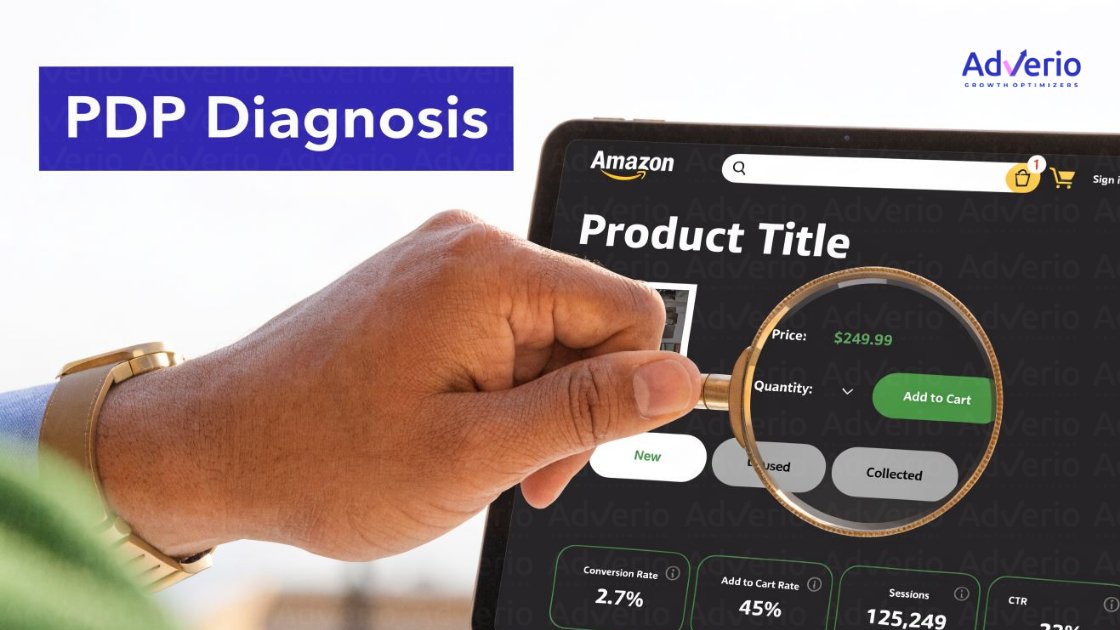
USP is Amazon’s clearest read on PDP performance because it shows how often a session turns into a unit sold. You can find it in Seller Central under Business Reports, then Detail Page Sales and Traffic. Use it as a diagnosis tool, not a vanity metric. A page can look polished and still fail where it counts.
Run this check in order
-
Pull USP by ASIN
Review parent and child variations separately. Parent-level averages hide weak children, and weak children waste ad spend fast. -
Judge it against your price point
Higher-priced products convert differently from low-cost replenishable items. That does not excuse poor performance. It tells you what level of friction the page should be overcoming. -
Check Prime status and offer setup
If the product is not Prime-eligible, conversion gets harder immediately. The same goes for weak delivery promises, poor review coverage, or an offer structure that looks risky next to competing listings. -
Use a real date range
One strong day proves nothing. Look at a stable window so you can separate noise from a real page problem.
What the reading usually means
Use this filter.
| USP reading | Likely diagnosis |
|---|---|
| Healthy for the product type and price | Your PDP is probably not the main constraint |
| Middle of the pack | You are leaving room for competitors to take the sale |
| Clearly weak for the offer | Treat the PDP as the problem until proven otherwise |
There is one catch. Sample size matters. A flashy conversion spike on thin traffic gives false confidence, while a steadier number across meaningful sessions gives you something you can act on.
If you want a faster way to pressure-test the page before buying more clicks, run a structured Amazon listing quality check. The goal is simple. Find the exact page elements that are suppressing sales, fix them, then send traffic.
A listing can look acceptable to your team and still feel risky, confusing, or incomplete to a buyer.
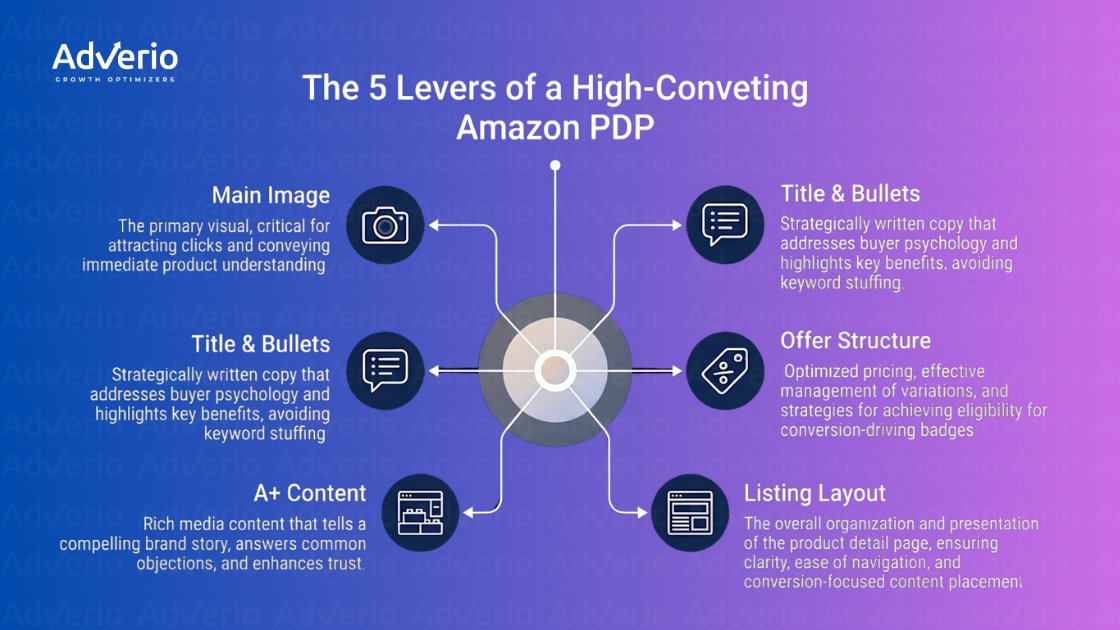
The 5 Levers of a High-Converting Amazon PDP
A strong PDP is not a design exercise. It’s salesmanship under platform constraints. Every block on the page needs to reduce doubt, increase clarity, or strengthen the offer.
Main image and the thumbnail test
Your main image earns the click before your copy gets a chance. On Amazon, the first battle is won at thumbnail size.
If the product isn’t instantly understandable in search results, the shopper keeps scrolling. At this point, brands lose before the PDP even loads. The main image should communicate product type, scale, core differentiator, and cleanliness at a glance. Not eventually. Immediately.
Poor image work creates expensive downstream problems. The broader ecommerce world has long treated image quality as a conversion issue, and resources on how to increase conversion rates using analytics are useful because they push teams to connect user behavior with creative performance instead of debating taste.
What to fix first
-
Clarity over style: If the product silhouette is confusing, reshoot it.
-
Visual hierarchy: The buyer should know what they’re buying in under a second.
-
Variation discipline: If color or size options matter, your image stack needs to reduce wrong-click risk.
-
Mobile readability: Teams often review on desktop and overlook what happens on a phone.
A gorgeous image that doesn’t clarify the product is decorative failure.
Title and bullets built for buyers
Most Amazon copy is written like the legal team and the keyword tool fought to a draw. That’s not persuasion. That’s clutter.
The title should help the shopper self-qualify. The bullets should remove friction. That means clear benefit framing, plain language, and a logical order that matches buying psychology. Lead with what matters most to the buyer, not what matters most to your internal stakeholders.
What buyer-first copy looks like
-
The title identifies fast: Product type, use case, critical spec, and brand should work together.
-
The bullets answer objections: Fit, material, compatibility, ingredients, durability, usage, care, or whatever the customer worries about.
-
The language sounds human: Keyword stuffing makes pages feel untrustworthy.
A buyer doesn’t reward effort. They reward clarity.
For teams rebuilding pages at scale, this Amazon listing optimization guide is a useful reference point because it pushes beyond metadata and into conversion mechanics.
Non-negotiable: Write for the person about to buy, not the spreadsheet tracking indexed terms.
A+ content that closes the gap
A+ content is not a brochure. It exists to handle unresolved objections after the shopper scans the top of the page.
Most brands misuse it. They fill it with brand story, mood photography, and generic claims. That can look polished while doing almost nothing for conversion. Good A+ content functions like a smart sales rep. It answers the buyer’s next question before they bounce to a competitor.
Use A+ to resolve uncertainty that the title and bullets couldn’t fully address. Show comparisons. Explain use cases. Clarify who the product is for and who it isn’t for. Make the sequence intuitive.
A practical A+ structure
-
Problem or use-case framing
-
Core differentiators
-
Comparison or selection guidance
-
Trust-building detail
-
Supportive brand proof without overdoing it
If your A+ content reads like a brand manifesto, it’s probably underperforming.
Review signal and trust compression
Reviews don’t just validate the product. They compress risk.
A buyer scanning your PDP is asking a blunt question. “Has this worked for enough people like me?” Review count, recency, and sentiment all shape that answer. A page with stale, mixed, or thin review coverage has to work harder everywhere else.
Many brands get lazy. They think review management is a separate function from conversion optimization. It isn’t. Reviews shape how every other PDP element gets interpreted.
Look at reviews operationally:
-
Recency matters: Old praise loses persuasive force.
-
Pattern matters: Repeated complaints expose objection gaps your copy should address.
-
Variation matters: Child ASIN issues can poison parent perception.
When your reviews repeatedly mention confusion, sizing surprises, breakage, or mismatch between expectation and reality, that’s not just a CX issue. It’s PDP messaging failure.
Offer structure and close mechanics
Some brands talk about conversion as if it’s all copy and creative. Wrong. The offer closes the sale.
Offer structure includes price position, coupon visibility, pack architecture, variation logic, Prime eligibility, and whether the page makes selection easy or irritating. A solid listing can still under-convert if the shopper has to think too hard about what to choose.
Here are the common ways brands sabotage the offer:
-
Messy variation families: Too many weakly related options create hesitation.
-
Poor price signaling: The listing feels overpriced because value framing is weak.
-
Badge gaps: No Prime, no urgency, no trust reinforcement.
-
Inconsistent selection flow: Buyers land on the wrong child and assume the product isn’t for them.
Your offer needs to feel easy to buy. That sounds obvious. Most pages fail it anyway.
Listing layout and reading flow
The final lever is the page experience as a whole. Buyers don’t consume your PDP in the neat order your team imagines. They scan, jump, compare, and sanity-check.
A strong page respects that behavior. The order of information should feel natural. The images should answer different questions, not repeat themselves. The bullets should front-load key persuasion points. A+ should continue the argument, not restart it.
When the page feels disjointed, the buyer experiences drag. Drag kills conversion.
The Revenue Math What a 1% CVR Lift Is Worth
A small conversion lift is not small money.
Use a simple framework. If your revenue stays tied to the same traffic base, a higher conversion rate means more value extracted from sessions you’re already paying for or already earned. That matters because the incremental gain lands on a stronger efficiency profile than chasing fresh traffic.
Use this formula
New Revenue = Current Annual Revenue / Current CVR × New CVR
If you want a benchmark lens before doing the math, this Amazon listing conversion rate benchmarks page helps frame what’s realistic by context.
A clean example
Say your brand is doing $5M in annual revenue at an 8% conversion rate. Improve conversion to 9% with the same traffic quality and the math becomes:
| Scenario | Revenue outcome |
|---|---|
| Current | $5,000,000 |
| At 9% CVR | $5,625,000 |
That is an additional $625,000.
This is why “just one point” matters. It is not a cosmetic metric. It’s a financial lever with compounding side effects. Better conversion can support stronger paid efficiency, better organic traction, and less pressure to brute-force growth through spend alone.
A weak PDP forces you to buy growth. A stronger PDP lets you earn more from the traffic you already own.
If your leadership team treats conversion optimization like minor creative polish, they’re misclassifying a profit driver as a content task.
The Adverio CRO Flywheel: Diagnose, Fix, Measure, Scale
Traffic does not fix a weak PDP. It just exposes it faster.
Brands lose money when conversion work gets treated like a cleanup sprint instead of an operating system. The right model is repetitive and disciplined. Diagnose the friction. Fix the highest-value problems. Measure the effect. Scale only after the page proves it can carry more demand profitably.

Diagnose
Start with buyer friction and operational friction in the same review.
Audit the page for image clarity, title readability, bullet hierarchy, review objections, variation confusion, and price-to-value alignment. Then compare that page read with performance signals such as session quality, ad conversion, and child ASIN inconsistency. A PDP can look polished and still fail at the job of converting qualified traffic.
Teams that want a wider DTC perspective can borrow useful principles from guides on how to improve ecommerce conversion rate, then adapt those principles to Amazon’s constraints.
A simple scoring model helps force objectivity. If the listing scores poorly on trust, clarity, differentiation, and offer strength, you have your bottleneck.
Fix
Prioritize the elements that change buying behavior first.
That usually means the main image, the first part of the title, the bullet sequence, the A+ story flow, and the offer structure. If reviews show the same objection again and again, address it on the page immediately. Leaving known friction untouched while buying more traffic is lazy account management.
Adverio’s Amazon PPC management and listing teams work in coordination—so page fixes are tied directly to media performance, not executed in isolation from the campaigns funding that traffic.
Measure
Measurement decides whether the change was profitable or cosmetic.
Track Unit Session Percentage, ad conversion rate, refund trends, and variation-level movement after each meaningful update. Keep the test clean. If you change the hero image, rewrite bullets, and alter price at the same time, you ruin attribution and learn nothing. Strong operators run tighter experiments than that.
For a sharper testing process, review this guide on split testing small tweaks that drive big results on Amazon.
Scale
Scale after proof.
A page that converts better gives media more room to work. A page that still leaks demand makes every extra ad dollar less efficient than it looks in a dashboard. The sequence is simple. Earn the right to scale by fixing conversion first, then increase spend behind what already works.
Proof in Action: How Adverio Turns a PDP Into a Profit Center
The theory is straightforward. The proof matters more.
Mary Maxim didn’t need a bigger traffic hose first. The page needed to convert. After PDP fixes, CTR moved from 0.28% to 0.63% and Unit Session % moved from 1.68% to 3.70%. That is a 125% CTR lift and a 120% USP lift. The lesson is obvious. Better page conversion changes the economics of the whole account.
Shinesty tells a similar story, but with an operational twist. CTR improved from 0.13% to 0.30%. USP improved from 4.59% to 5.64%. Refund rate dropped 13%. That matters because conversion gains that increase post-purchase problems are fake gains. These weren’t fake.
What these examples actually prove
-
The PDP can be the primary bottleneck: More traffic wasn’t the first answer.
-
Conversion work improves more than one metric: Click-through, Unit Session %, and post-purchase quality can move together.
-
Weak pages create hidden costs: You don’t just lose sales. You create refund pressure and ad inefficiency.
A listing that scores under 6/10 in LQS terms is not “good enough for now.” It is usually suppressing performance in plain sight.
If you want another real-world performance example tied to profit control, this case study on Amazon TACoS dropping to 10 percent shows what happens when account decisions are made through an efficiency lens instead of a vanity-growth lens.
The central rule still stands.
If a PDP can’t convert, no ad can save it.
If your team keeps trying to media-buy its way out of a page problem, you’re paying premium rates for a fix that lives inside the listing.
How Adverio Fixes the PDP Problem at the System Level
Most brands treat listing work like a one-time cleanup. Adverio treats it as an operating layer tied directly to media efficiency and margin.
Our Amazon listing optimization system connects PDP performance to paid traffic decisions—so every image update, copy change, and offer adjustment is evaluated against conversion data, not creative preference.
When PDP issues are tied to broader account performance, our Amazon account management team handles the cross-functional coordination between ads, catalog, and content that siloed teams can’t execute cleanly.
If you’re running paid campaigns against a listing that hasn’t been conversion-audited, you’re paying for traffic your page can’t close.
Book your ROI Forecast and find out exactly where the margin leak is.
Frequently Asked Questions About PDP Conversion
What is a good amazon product page conversion rate
Category averages are a starting point, not a target. According to Parah Group’s Amazon conversion rate benchmarks, Amazon product page conversion rates often land around 10% to 15% across categories, with grocery-style multi-unit products running much higher and some fashion listings sitting lower. Price point, purchase frequency, and Prime eligibility all shift the baseline.
The mistake is using category averages to excuse a weak page. If your traffic is qualified and your PDP still struggles, the page is the problem.
Should I fix the PDP before increasing ad spend
Yes.
Sending more paid traffic to an under-converting listing is how brands burn margin and call it growth. Get the page converting first. Then scale spend into a system that can turn clicks into revenue.
How should I think about Prime eligibility
Prime reduces friction. It strengthens trust, speeds up the decision, and makes comparison shopping less dangerous for your listing.
If you lack Prime coverage, you are asking the PDP to overcome a trust deficit on its own. That raises the standard for your images, copy, reviews, and offer.
How do I test without hurting sales velocity
Test one major variable at a time. Main image, title structure, bullets, A+ flow, pricing, offer mechanics. Pick one.
Stacked changes create noise, and noisy tests produce bad decisions. If you cannot tell which edit caused the lift or drop, you are not testing. You are guessing with revenue on the line.
What about Amazon Rufus and AI-driven CRO
AI shopping tools matter because they expose unanswered buyer questions faster. That is the true opportunity.
Use reviews, Q&A, and customer language to spot objections your PDP still leaves open. Then fix those gaps in the visual story, bullets, and comparison logic. Treat AI as a research input, not a shortcut.
Your team does not need more activity. It needs conversion infrastructure that can support paid traffic without wasting it. Adverio helps brands identify profit leaks inside Amazon listings, tie PDP fixes to media efficiency, and turn the product page into a profit center.
If spend is rising faster than revenue, the answer isn’t a bigger budget. It’s a smarter page.
Book your ROI Forecast and find out exactly where your conversion system is leaking margin.