


Table of Contents
Using the same SKU across DTC, Amazon, and retail isn’t efficient—it’s a structural margin leak that compounds as you scale (especially without a clear Amazon SEO foundation). SKU differentiation isn’t about product codes—it’s about aligning your catalog with channel economics (which is exactly what a strong Amazon strategy is built on) to prevent margin compression, retail conflict, and pricing breakdown.
What Happens When Brands Use the Same SKU Everywhere

Many brands default to a single SKU across all channels, believing it’s the gold standard for simplicity. It looks efficient on paper. In reality, this approach systematically erodes margins across every channel. It creates a structural mismatch that pits your retail partners directly against your marketplace listings, guaranteeing a race to the bottom that you will always lose.
When the same product—with the same UPC—is sold in a Target store and on Amazon, you’re engineering direct price comparisons that are impossible to win. Marketplaces operate on dynamic, algorithm-driven pricing, while traditional retail is built on negotiated margins and MSRP. This mismatch is a direct threat to your price integrity.
How Margin Compression and Channel Conflict Erode Profits
When a retail buyer sees your product priced 20% lower on Amazon. Their first call is to demand a price match, which immediately crushes your retail margin. Their next move? Delist your product entirely to avoid being undercut. Suddenly, a strategy meant for simplicity has put a critical revenue stream on the chopping block.
This conflict bleeds directly into advertising performance. As marketplace prices drop to compete with third-party sellers, your ad campaigns become unprofitable. ACoS that works at $100 pricing becomes unprofitable the moment price compression pushes it to $75.
The core problem is forcing channels with completely different economic models to play by the same rules. It’s like entering a marathon runner into a powerlifting competition—the mismatch guarantees failure.
Operational and Compliance Nightmares
Beyond pricing, a single SKU strategy creates unseen operational headaches. The logistics and compliance for a retail distribution center are wildly different from FBA prep requirements. A poorly planned strategy can spiral into serious issues that damage profitability and brand reputation. The hidden costs of non-compliance in regulated product shipping underscore how critical a solid SKU strategy is.
Effective Amazon inventory management becomes impossible when forecasting is muddied by conflicting channel demands. A stockout on Amazon because of an unexpected retail PO—or vice versa—means lost sales and a direct hit to your seller performance metrics.
SKU differentiation isn’t optional at scale. It requires active Amazon account management to continuously align pricing, inventory, and channel strategy. It’s a foundational element of a resilient, multi-channel business and a strategic necessity for any brand tired of watching profits evaporate even as top-line sales grow.
Why Retail and Marketplaces Operate on Completely Different Economics
Treating retail and marketplace channels as if they run on the same financial playbook is one of the most common—and costly—mistakes a growing brand can make. Their underlying economics are worlds apart. Ignoring this structural mismatch creates friction, eats into margins, and hobbles growth.
Traditional retail operates on a model of stacked, predictable costs. The entire model is built around a negotiated Manufacturer’s Suggested Retail Price (MSRP), from which all other costs are deducted. You must account for wholesale pricing, trade promotions, marketing development funds (MDF), and sometimes even slotting fees just to land on the shelf. It’s a linear, top-down financial structure. Your profitability is locked in long before a single unit sells.
The Marketplace Variable Cost Gauntlet
Marketplaces like Amazon and Walmart flip this model on its head. Instead of a predictable, stacked margin, you operate inside a variable cost structure— which is why active Amazon PPC management becomes non-negotiable for protecting margin.
This isn’t a neat, tidy cost structure. It’s a fluid list of deductions:
-
Referral Fees: A straight commission on every transaction, typically ranging from 8% to 15%.
-
Fulfillment Costs: Whether using FBA, WFS, or a 3PL, these costs shift based on product size, weight, and seasonality.
-
Advertising Spend: PPC and DSP costs are dynamic, demanding constant management just to maintain a target ACoS or ROAS.
-
Storage and Other Fees: Long-term storage fees, return processing fees, and other small operational costs add layers of complexity.
Unlike a fixed retail agreement, these costs are anything but stable. A sudden spike in FBA fees or an aggressive competitor driving up ad bids can wipe out your margin overnight.
The core conflict is simple: retail demands price stability to protect its margins, while marketplaces thrive on price dynamism to win the sale. When you use the same SKU for both, you force these opposing economic models into a direct conflict, with profitability taking the hit.
How Price Integrity Breaks Under Pressure
This structural conflict is a direct threat to your price integrity. Retail buyers are constantly watching online prices. If they spot your product on Amazon for 20% less than their MSRP, it triggers an immediate and painful conversation. They’ll either demand chargebacks to match the lower price or, worse, delist your product to avoid looking overpriced.
This isn’t hypothetical; it’s a daily reality for brands without a clear SKU differentiation strategy. You end up stuck: sacrifice marketplace sales to keep a retail partner happy, or sacrifice a massive retail relationship to stay competitive online?
If you don’t have a distinct SKU for your marketplace channel, you can’t build a financial model that absorbs variable costs without cannibalizing the very pricing structure your retail partners rely on. You’re creating a permanent state of channel conflict where one side’s success comes at the direct expense of the other. That isn’t a sustainable path to profitable growth; it’s a recipe for margin compression and brand dilution. This is where most brands need a structured Amazon strategy to realign pricing and channel roles.
How Premium Brands Design Retail-Safe SKU Architectures
You’ve identified the problem. The solution is a resilient, retail-safe SKU architecture. This isn’t about creating confusing product variations that create operational headaches. It’s about building in subtle, strategic differentiators that give each channel its own unique product ID, effectively insulating your retail relationships from the price volatility of online marketplaces.
A well-designed SKU differentiation strategy acts as a firewall between your channels. It lets your marketplace listings compete on price and promotions without kicking off a margin-crushing race to the bottom with your retail partners. The goal is channel separation without customer confusion.
First, you must visualize where the friction points are between retail and marketplace economics to build a stronger defense.
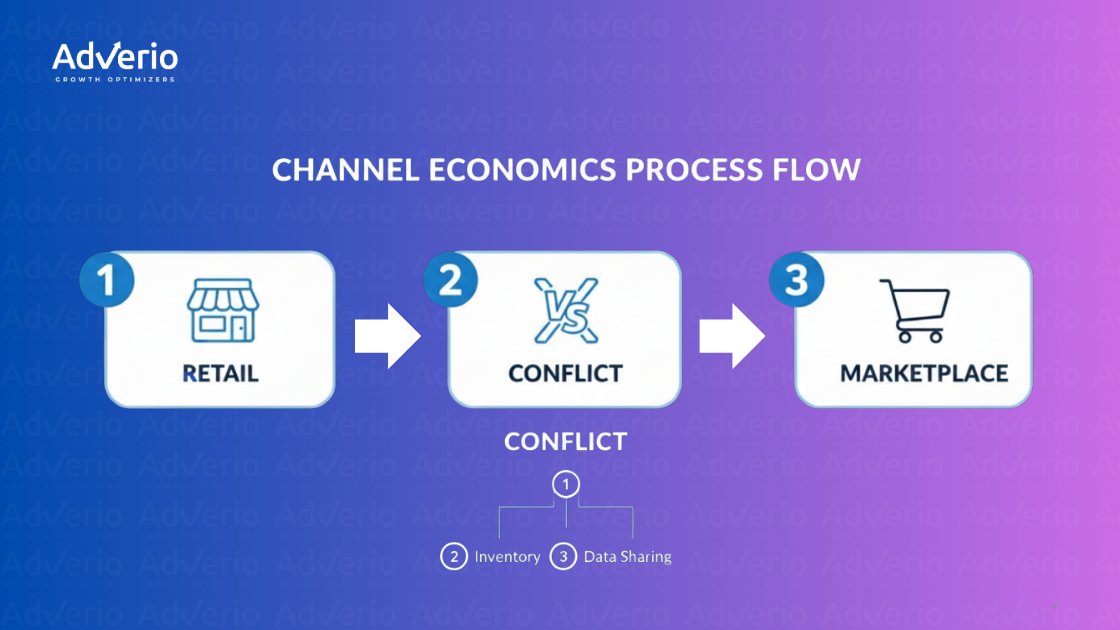
This flow zeroes in on the fundamental friction in inventory and data sharing. When you use a single SKU across channels, that’s where the conflict begins.
Subtle Differentiation Tactics That Work
The best SKU architectures are built on small but meaningful distinctions. These changes are significant enough for retail buyers and marketplace algorithms to see them as different products, yet subtle enough that they don’t disrupt the customer’s brand experience.
Here are the most effective tactics premium brands use:
-
Pack Size and Multipacks: This is the simplest and often most powerful play. A single unit might be sold in Target stores, while a 3-pack or 6-pack is created exclusively for Amazon. This instantly creates a distinct product with a different value proposition and price point.
-
Bundling and Kitting: Create a unique marketplace offer by bundling a core product with a complementary accessory—a camera sold with a memory card, or a skincare product sold with a special applicator. This creates a new SKU that can’t be directly price-matched against the standalone item. To streamline this, implementing kitting in manufacturing practices can give your operations a serious lean boost.
-
Minor Feature or Cosmetic Tweaks: A slight change in color, a different finish, or a minor feature update can justify a new model number and UPC. This is common in electronics and home goods, where “Model 100-R” is for retail and “Model 100-M” is built for marketplaces.
The key is to make the differentiation meaningful from a logistical and financial standpoint. This isn’t about manipulation; you’re giving each channel an asset optimized for its specific economic environment.
Here’s how these tactics translate into a practical SKU blueprint.
SKU Architecture Blueprint: Standard vs. Differentiated Marketplace SKUs
| Differentiation Tactic | Standard Retail SKU (Example) | Differentiated Marketplace SKU (Example) | Strategic Rationale |
|---|---|---|---|
| Pack Size | Single bottle of premium shampoo | 3-pack of premium shampoo | Creates a new UPC, prevents 1:1 price matching, and targets stock-up behavior on Amazon. |
| Bundling | High-end coffee maker | Coffee maker + pack of filters + travel mug | Offers unique value, makes direct price comparison impossible, and increases Average Order Value (AOV). |
| Minor Feature | Smart plug (Model A-100) | Smart plug with slightly different housing (Model A-101M) | Justifies a new model number and UPC, blocking automated price-matching bots used by retailers. |
| Cosmetic Change | Blue kitchen knife set | “Midnight Blue” kitchen knife set (exclusive color) | Provides a channel-exclusive offering that can be marketed as unique without altering core product function. |
This table shows it’s not about reinventing your product for every channel. It’s about creating just enough separation to protect your margins and partnerships. At its core, a retail-safe architecture boils down to unique identifiers. Assigning a different UPC or model number is a non-negotiable first step. This simple action stops automated retail systems from flagging a price match and putting your buyer relationships at risk.
By creating these distinct assets, you also get cleaner data. That level of visibility typically requires proper Amazon analytics infrastructure.
You can accurately track profitability, sales velocity, and inventory turns for each channel without the noise of shared SKUs clouding your judgment. That clarity is crucial for making smart decisions about where to invest ad spend and inventory. For brands ready to master this, the SKU economics strategy is the next critical step toward achieving true channel profitability and control.
Common SKU Mistakes Brands Make When Expanding Channels
Expanding into new sales channels is a sign of growth. But launching that expansion with a broken SKU strategy is like building a skyscraper on a shaky foundation—it’s only a matter of time before it all comes crashing down.
The mistakes brands make here are not small operational hiccups. They are strategic blunders that lead directly to shrinking margins, brand dilution, and torched relationships with retail partners. Almost every error boils down to one flawed assumption: what works on one channel will work on another. This “copy-paste” mindset is the fastest way to lose control of your pricing and profitability.
The Copy-Paste Listing Disaster
The most common and damaging mistake is lifting a product listing—title, bullets, images, and UPC—from one marketplace and dropping it onto another. A brand takes its star performer on Amazon and uses it word-for-word on Walmart or Target.com.
It looks efficient, but breaks performance immediately. But it completely ignores the DNA of each platform. Their algorithms are different, their compliance rules are different, and their customers have different expectations. An Amazon title packed with keywords might be too long or spammy for Walmart’s algorithm, killing your visibility out of the gate. Worse, using the same UPC across channels creates a direct link for price-matching bots. The second your Amazon price drops for a Lightning Deal, your retail partners’ systems will see it. That’s when the chargebacks and delisting threats start.
Ignoring Each Channel’s Rulebook
Every marketplace has its own set of rules. Amazon has extensive listing policies, while Walmart has its Listing Quality Score (LQS). Blowing past these platform-specific requirements is a surefire recipe for suppressed listings and throttled visibility. A product bundle that’s perfectly fine on your DTC site could violate Walmart’s multipack policies, getting it delisted instantly.
Speed without structure is what breaks profitability at scale. Brands chase top-line growth by flooding new channels, only to find their profits eroded by compliance penalties, poor search rank, and relentless price matching. A proactive SKU differentiation strategy isn’t just about offense; it’s your primary line of defense.
Creating Accidental SKU Duplicates
In the dash to expand, internal teams can easily create duplicate SKUs for the same core product. This fractures your sales history and splits customer reviews, demolishing your product’s authority and search rank. Instead of one powerful listing with thousands of reviews, you end up with a handful of weak ones fighting each other. This internal chaos can be just as damaging as external threats from counterfeiters, a problem we break down in our guide on dealing with knock-off brands on Amazon. You must consolidate your rank and reviews under a single, channel-appropriate SKU to maintain momentum.
How SKU Differentiation Sets the Stage for Fighter Brands and Value Lines

Fixing channel conflict and protecting margins is a necessary defense. But a truly dialed-in SKU differentiation strategy is also your most powerful offensive weapon. It’s the shift from plugging holes in the ship to building a fleet designed for profitable expansion. This is where the SKU strategy shifts from defensive to growth infrastructure.
Precision Targeting and Smarter Ad Spend
A unified SKU strategy neuters your advertising. You can’t get aggressive with PPC or DSP campaigns without sending retail partners into a panic. Every deep discount you run online directly threatens your MSRP integrity everywhere else.
Channel-specific SKUs sever this link. They create a “safe zone” to scale ad spend aggressively. With a distinct marketplace SKU, you can:
-
Run Aggressive Promotions: Launch a Lightning Deal on a marketplace-exclusive bundle without a retail buyer seeing a direct price drop on their in-store product.
-
Build Channel-Specific Funnels: Build Channel-Specific Funnels using both PPC and Amazon DSP to target different audiences across channels
-
Optimize Bids Confidently: Push ad spend on your highest-performing marketplace SKUs without constantly looking over your shoulder at the downstream impact on your retail margin structure.
This separation empowers you to treat each channel as its own P&L, optimizing your ad strategy for the unique economics and customer behaviors of that specific platform.
A differentiated SKU doesn’t just protect your retail partnerships; it unshackles your marketplace growth engine. It lets you go full throttle on platforms like Amazon without having to constantly manage downstream retail pricing risk.
Unlocking New Market Segments with Value-Tier Lines
SKU differentiation is also your ticket to capturing entirely new market segments without diluting core brand equity. Many premium brands hesitate to compete at lower price points, terrified it will cheapen their image. A distinct SKU architecture lets you launch value-focused product lines—sometimes called “fighter brands”—that can coexist peacefully with your premium offerings.
This strategy lets you:
-
Compete with Private Labels: Introduce a simplified, lower-cost version of a flagship product under a new SKU to challenge store brands on price.
-
Capture Value-Conscious Shoppers: Create multipacks or bundles that offer a lower per-unit cost, appealing to a different customer segment.
-
Test New Product Concepts: Launch experimental or entry-level products as marketplace exclusives to gauge demand before committing to a full, expensive retail rollout.
Each of these moves is unlocked by having a unique SKU. Without it, any value-tier product is seen as a direct discount on your premium brand, causing immediate damage. Creating this separation allows you to run a multi-tiered brand strategy. Mastering an Amazon anchor pricing strategy is the next step to positioning these different tiers effectively.
Ultimately, a forward-thinking SKU strategy is about building a more resilient, scalable, and profitable business. It transforms your product catalog from a source of conflict into a portfolio of strategic assets, each purpose-built to win in its designated channel.
Why Retailers Like Costco and Target Expect Unique SKUs
When we talk about building a channel-specific SKU strategy, a few questions always come up. Here are the straight answers to the most common concerns we hear from brands on the front lines.
Will Creating New SKUs Confuse Our Customers?
Not if you do it right. The goal isn’t to create a jarringly different product that makes a loyal customer scratch their head. It’s about subtle distinctions that are meaningful to a retailer or a marketplace algorithm but almost invisible to the end consumer.
Think about unique pack sizes (a 3-pack for Amazon, a 5-pack for Costco), exclusive bundles, or even minor cosmetic tweaks to packaging. These tactics create distinct identifiers for retail buyers and logistics systems, giving you the channel harmony you need without causing any brand confusion.
How Much Does It Cost to Implement SKU Differentiation?
Most brands evaluate the wrong cost. The real question is: “How much is it costing you not to differentiate?”
The initial investment in new UPCs or packaging adjustments is tiny compared to the long-term, bleeding cost of margin erosion from channel conflict. When a retailer like Target sees your product cheaper on Amazon, they don’t just ask for a discount—they demand it.
A proper SKU strategy isn’t a cost center; it’s an insurance policy for your margins. It’s a profit-protection measure that prevents far more significant financial losses down the line.
Can We Differentiate SKUs Without Changing the Core Product?
Absolutely. In fact, some of the most effective SKU differentiation tactics have nothing to do with altering the product itself.
The playbook is usually straightforward:
-
Create marketplace-exclusive multipacks or bundles with complementary items.
-
Assign a unique model number or UPC, even if the product inside the box is identical.
-
Use different packaging designs, materials, or even just label art for each channel.
These methods are enough to create distinct SKUs in the eyes of retailer systems and marketplace algorithms, which is all that matters for avoiding channel conflict. The core product your customer loves stays the same.
When Is the Right Time to Think About SKU Differentiation?
The trigger isn’t hitting a certain revenue milestone; it’s channel complexity.
The moment you find yourself selling on a major marketplace (like Amazon or Walmart) AND through a traditional retail channel with strict MSRP policies, the clock is ticking. You need a differentiation strategy immediately.
The conflict between these channels is structural. It’s not a matter of if it will cause problems, but when. As you scale, that conflict will inevitably lead to painful conversations with retail buyers and serious margin compression. The sooner you get ahead of it, the better.
At Adverio, we help brands design SKU strategies that scale across Amazon, Target, Walmart, and retail—without destroying margins or brand equity. Get Your Profitability Audit & ROI Forecast to see how a purpose-built SKU architecture can protect your profitability.