


Table of Contents
On Amazon, the difference between stagnant sales and triple-digit growth isn’t luck or a bigger ad budget—it’s data mastery. Most plateaued Amazon brands aren’t under-spending; they’re trapped in Optimization Myopia, obsessing over ACoS while margin, inventory efficiency, and market share quietly erode. They’re drowning in dashboards but can’t answer the questions that actually matter: Which SKUs are incrementally profitable? Where is ad spend propping up broken listings? Which variants are draining the margin? The real competitive edge comes from interpreting the right data, not just collecting more of it.
A strategic approach to analytics reveals exactly what’s working and what’s not across your entire Amazon operation. It’s about asking smarter questions: which search terms drive not just clicks, but profitable sales? How does our market share for a core product compare to our top three competitors? Which product variations are draining our ad budget with low conversion rates? To truly achieve data mastery and drive growth, you must evaluate your brand’s analytical capabilities against an established analytics maturity model to identify gaps and opportunities.
This guide cuts through the noise of countless Amazon analytics tools to give you a definitive list of the platforms that matter. We’ll break down the essential Amazon-native tools and third-party platforms — and, more importantly, when tools help and when they mask deeper growth constraints. It’s time to move from guessing to knowing.
Quick Answer:
The most important Amazon analytics tools start with what’s free, Amazon Brand Analytics, Search Query Performance reports, and the Ads Console. Third-party platforms like Helium 10, Keepa, and Intentwise add depth. But tools alone don’t drive growth. The brands that win use analytics to answer profit-level questions, not just track surface metrics like ACoS.
Most brands evaluating Amazon analytics tools are solving a data problem. The real problem is what to do with the data once you have it. Tools surface numbers. They don’t tell you which number to move first.
Get My Profit ROI Forecast→
We show you which levers to pull before recommending a single tool or platform change.
1. Adverio
While many Amazon analytics tools focus narrowly on a single metric, Adverio unifies data across the entire e-commerce ecosystem. Adverio isn’t a software platform — it’s a profit-governed growth system, powered by proprietary BI and executed by dedicated marketplace strategy pods. Our system is engineered to diagnose hidden profit leaks by connecting disparate data points, offering a consolidated “profit lens” that aligns advertising, listing performance, pricing, and inventory management with your bottom line.
This profit-first approach moves beyond surface-level metrics like ACoS, providing a holistic view of your marketplace health. For established brands, this means decisions are no longer made in silos. Adverio’s Growth Optimizers use this unified data to deploy advanced tactics, such as deep dives into Search Query Performance (SQP) reports, Share of Voice (SOV) analysis, and sophisticated variant bidding strategies that squeeze incremental profit from both paid and organic channels. Our Growth Cultivator framework is designed to reverse margin erosion and reclaim market share, making Adverio the definitive choice for brands frustrated with fragmented data and plateaued growth.
Key Features & Strengths
- Profit-First BI Platform: Our proprietary Growth Cultivator framework ties ads, listings, inventory, and reviews directly to profitability, eliminating “optimization myopia.”
- Omni-Channel Execution: Adverio provides expert management not just for Amazon but also for Walmart and Target, ensuring strategies are cohesive and efficient across marketplaces.
- Proprietary Analytics Tools: We deploy a suite of internal systems like our Profit Pulse System (PPS), Listing Quality Score (LQS), and Amazon Marketplace Opportunity Score (AMOS) to uncover hidden growth levers.
- Proven Results & ROI Guarantee: Adverio backs its methodology with case studies showing triple-digit growth and rapid profit recovery, supported by an ROI-backed delivery model.
- Strategic Support Beyond Ads: We function as a strategic financial partner, aligning high-level growth strategy with day-to-day execution through our Done-for-You and Done-with-You service models.
These aren’t tools you subscribe to. They’re the diagnostic layer we run on every account before making a single recommendation. The difference between a tool and a system is that a system tells you what to do next and takes responsibility for the result.
See what the diagnostic finds in your account.
Get My Profit ROI Forecast →
Free diagnostic. We model the profit upside before you commit to anything.
Pricing & Ideal Use Case
Adverio provides custom proposals based on a brand’s specific needs and scale. Engagements are structured around outcomes, not task volume supported by an ROI-backed delivery model designed for brands scaling past operational complexity.
It is the ideal solution for brands with complex catalogs aiming to protect margins while aggressively scaling across multiple marketplaces. Sellers who need a true strategic partner to connect complex data points to clear, profitable actions will find Adverio’s model uniquely effective.
Website: https://www.adverio.io
2. Amazon Brand Analytics (Seller Central)
Before you spend a dime on third-party software, master the powerful, first-party data available directly from Amazon. Amazon Brand Analytics is the native intelligence suite built into Seller Central, offering unfiltered insights into shopper behavior that external tools can only estimate. This platform is an indispensable starting point for any serious brand looking to understand customer search patterns, purchase habits, and audience demographics without an additional subscription fee.
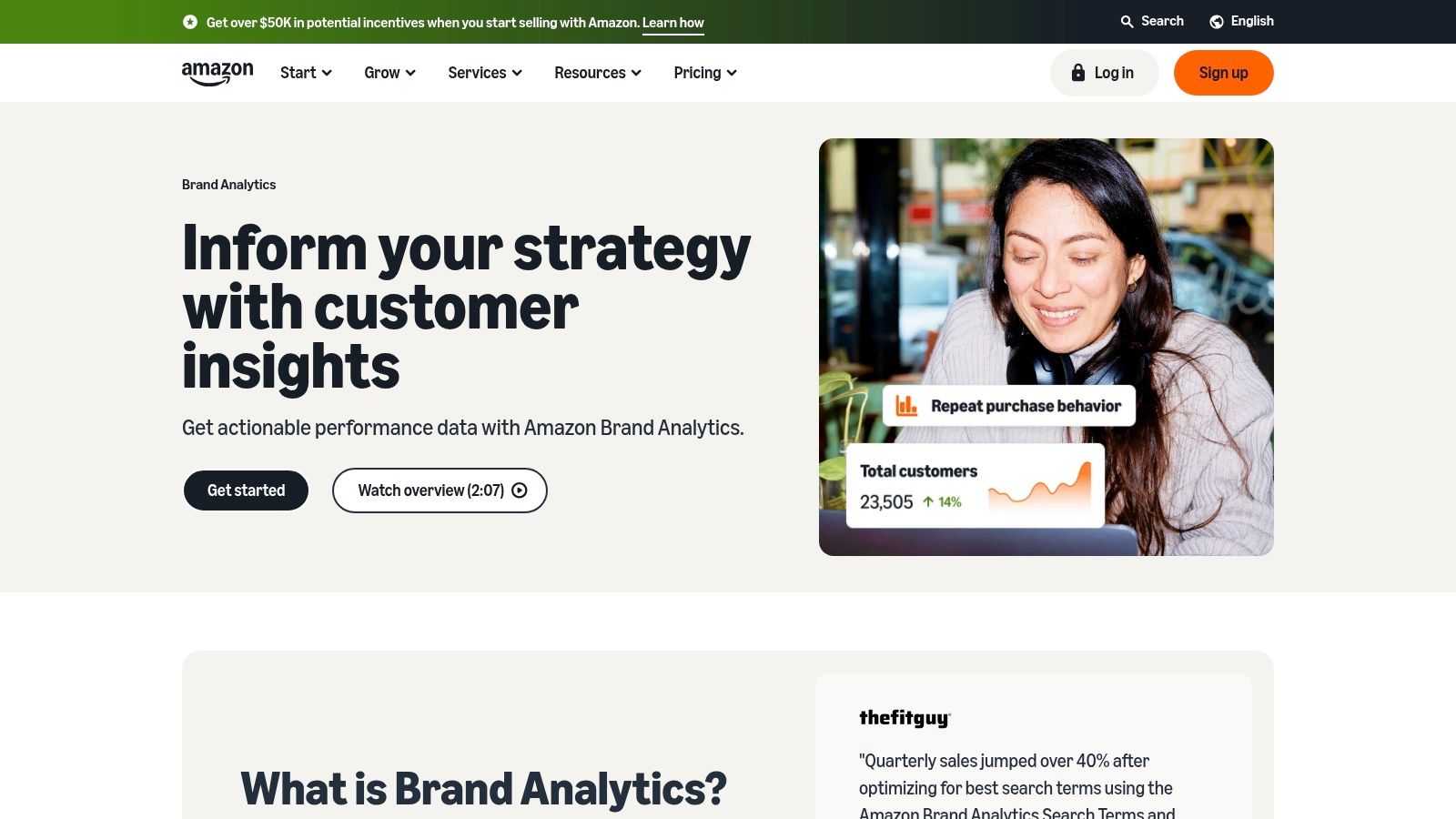
Its direct integration within Seller Central means the data is always accurate and frequently refreshed, providing a reliable source of truth. As one of the foundational Amazon analytics tools, it empowers brands to make strategic decisions based on actual marketplace activity rather than speculation.
Key Features & Use Cases
- Search Query Performance Report (SQPR): Uncover the exact search terms shoppers use to find your products, along with impression share, clicks, cart adds, and purchases for each query. This is invaluable for optimizing listing copy and PPC campaigns.
- Market Basket Analysis: See which other products customers most frequently purchase alongside yours. This data is a goldmine for creating product bundles, cross-promotional strategies, and informed new product development.
- Audience Demographics: Gain insights into your customer base, including age, household income, education level, and gender. This allows you to refine your brand voice and advertising creative to better resonate with your core audience.
- Repeat Purchase Behavior: Analyze how often customers return to buy your products. This is a critical metric for understanding customer lifetime value (cLTV) and brand loyalty.
Pros and Cons
- Pros: The data is 100% first-party accurate and comes directly from Amazon at no extra cost. Its seamless integration into Seller Central eliminates the need to manage another login or subscription.
- Cons: Access is restricted to sellers enrolled in Amazon’s Brand Registry. The visualization and reporting capabilities are less flexible compared to advanced third-party BI tools.
Website: https://sell.amazon.com/tools/amazon-brand-analytics
3. Amazon Ads Console & Marketing Stream
For advertisers operating at scale, the Amazon Ads Console, combined with Amazon Marketing Stream, sits at the center of serious Amazon PPC management. While the standard console relies on aggregated, last-touch attribution, Marketing Stream unlocks near real-time, event-level data that exposes how spend actually moves the needle. This goes beyond surface dashboards, enabling granular analysis required to optimize bids, budgets, and incrementality at scale.
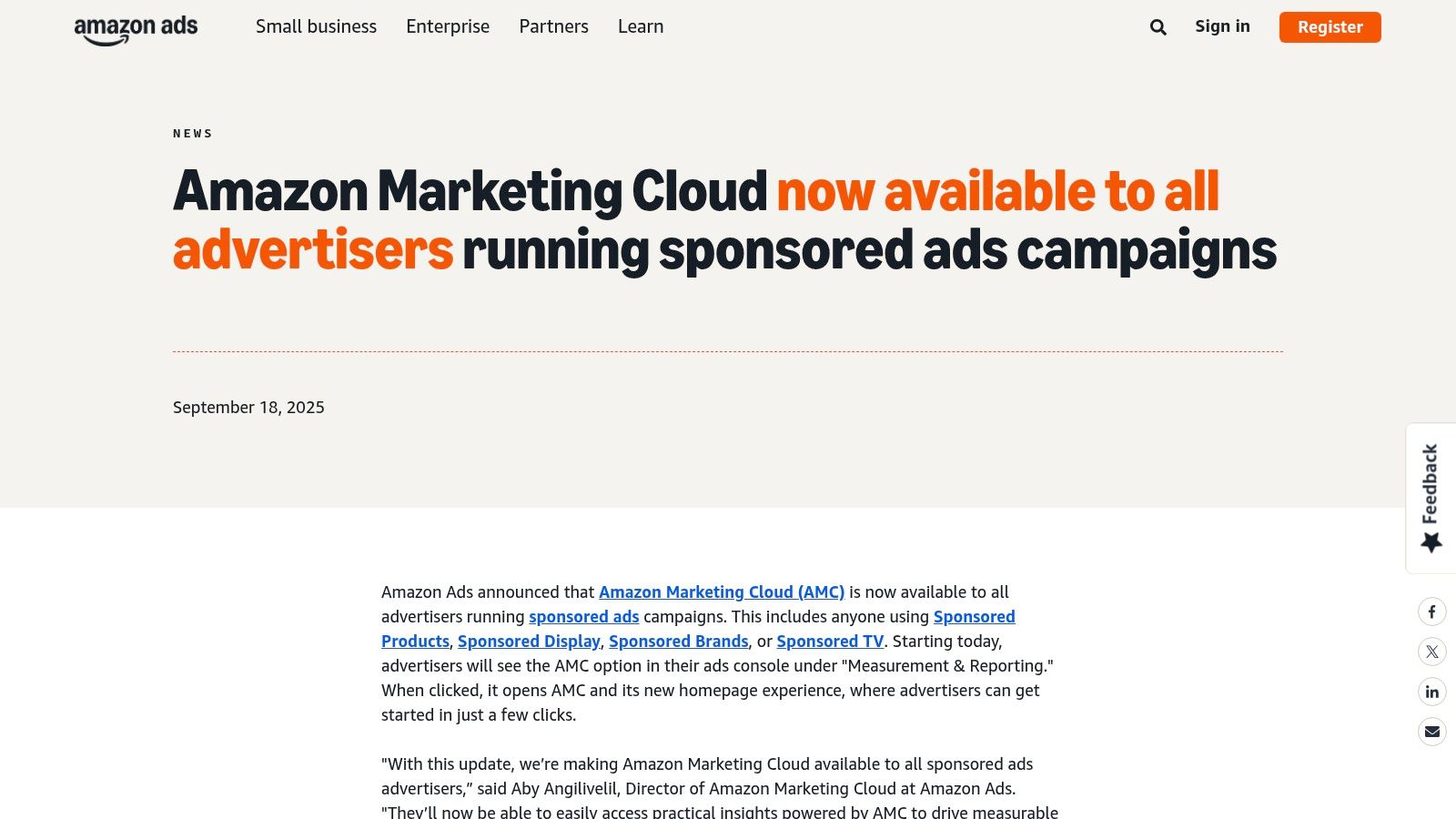
Unlike pre-built reports, this data stream allows advertisers to run near real-time optimizations and custom analysis. It is the definitive solution for understanding cross-channel effects, especially when combining Sponsored Ads with programmatic campaigns. To learn more about how this fits into a broader strategy, discover the nuances of programmatic advertising on Amazon DSP. Its purpose is not just reporting but deep, strategic discovery for brands with significant data volume.
Key Features & Use Cases
- Real-Time Ad Performance: Track ad spend, ROAS, impressions, and keyword performance with minimal latency.
- Amazon Marketing Stream Integration: Access hourly performance data for intraday bid optimizations, crucial during high-traffic events like Prime Day.
- Custom Attribution (via AMC): The data can be fed into Amazon Marketing Cloud (AMC) to build bespoke multi-touch attribution models and analyze complex customer journeys.
- Path-to-Purchase Analysis: Trace the sequence of ad exposures and engagements that lead to a conversion, providing clarity on which touchpoints are most effective.
Pros and Cons
- Pros: Provides unparalleled depth for campaign analysis using first-party Amazon signals. Enables advanced measurement far beyond standard advertising dashboards.
- Cons: Unlocking the full potential of Marketing Stream requires technical resources to process the data feed. The value is only realized with sufficient ad spend and data volume to generate meaningful insights.
Website: https://advertising.amazon.com/library/news/amc-for-sponsored-ads
Amazon’s native tools give you the right data. They don’t tell you what it means at the catalog level or which SKUs are bleeding margin while the dashboard looks fine. That gap is where most 7-figure brands stall. If your Brand Analytics data looks healthy but profit isn’t moving, the constraint isn’t the tool. It’s the diagnostic layer on top of it.
Get My Profit ROI Forecast→
We run the diagnostic your analytics tools can’t. 15 minutes. No pitch deck.
4. Helium 10
Helium 10 is one of the most comprehensive all-in-one software suites for Amazon and Walmart sellers. Its broad toolset supports the entire seller journey from Amazon product research and keyword intelligence to listing optimization and profitability tracking. While best known for its research depth, it also delivers performance analytics that help brands scale methodically instead of guessing their next move.
As one of the leading keyword tools for Amazon, Helium 10 consolidates multiple functions that would otherwise require several subscriptions. This integration allows sellers to connect initial research data directly to ongoing performance metrics, creating a seamless feedback loop for continuous optimization.
Key Features & Use Cases
- Profits & Market Tracker: The Profits tool provides a detailed financial analytics dashboard, tracking sales, expenses, refunds, and net profit. Market Tracker lets you monitor your market share and competitor performance.
- Keyword & SEO Tools: Tools like Cerebro (reverse ASIN lookup) and Magnet (keyword research) are fundamental for uncovering high-intent search terms. This is essential for both SEO and PPC campaign creation and a key part of effective Amazon product research.
- Keyword Rank Tracking: Monitor your product’s organic and sponsored rank for critical keywords. This feature helps you measure the direct impact of your listing optimization and advertising efforts on search visibility.
- PPC Automation (Adtomic): Included in higher tiers, Adtomic is Helium 10’s advertising platform that uses AI-powered rules to automate bid adjustments and keyword harvesting.
Pros and Cons
- Pros: Its extensive toolset covers nearly every aspect of the Amazon seller lifecycle, from research to scaling. The platform boasts large data coverage and receives frequent updates.
- Cons: The total cost can increase significantly with add-ons. Some enterprise-level benchmarking features are reserved for the highest-priced plans, making it less cost-effective for larger brands compared to dedicated solutions.
Website: https://www.helium10.com
5. Jungle Scout
Jungle Scout is one of the most recognized platforms in the Amazon seller ecosystem, evolving from a product research tool into a full-suite analytics and business management solution. It’s designed to guide sellers through the entire lifecycle, from identifying profitable product opportunities to tracking daily performance and optimizing advertising spend. The platform provides a unified view of critical business metrics, making it a powerful operational hub.
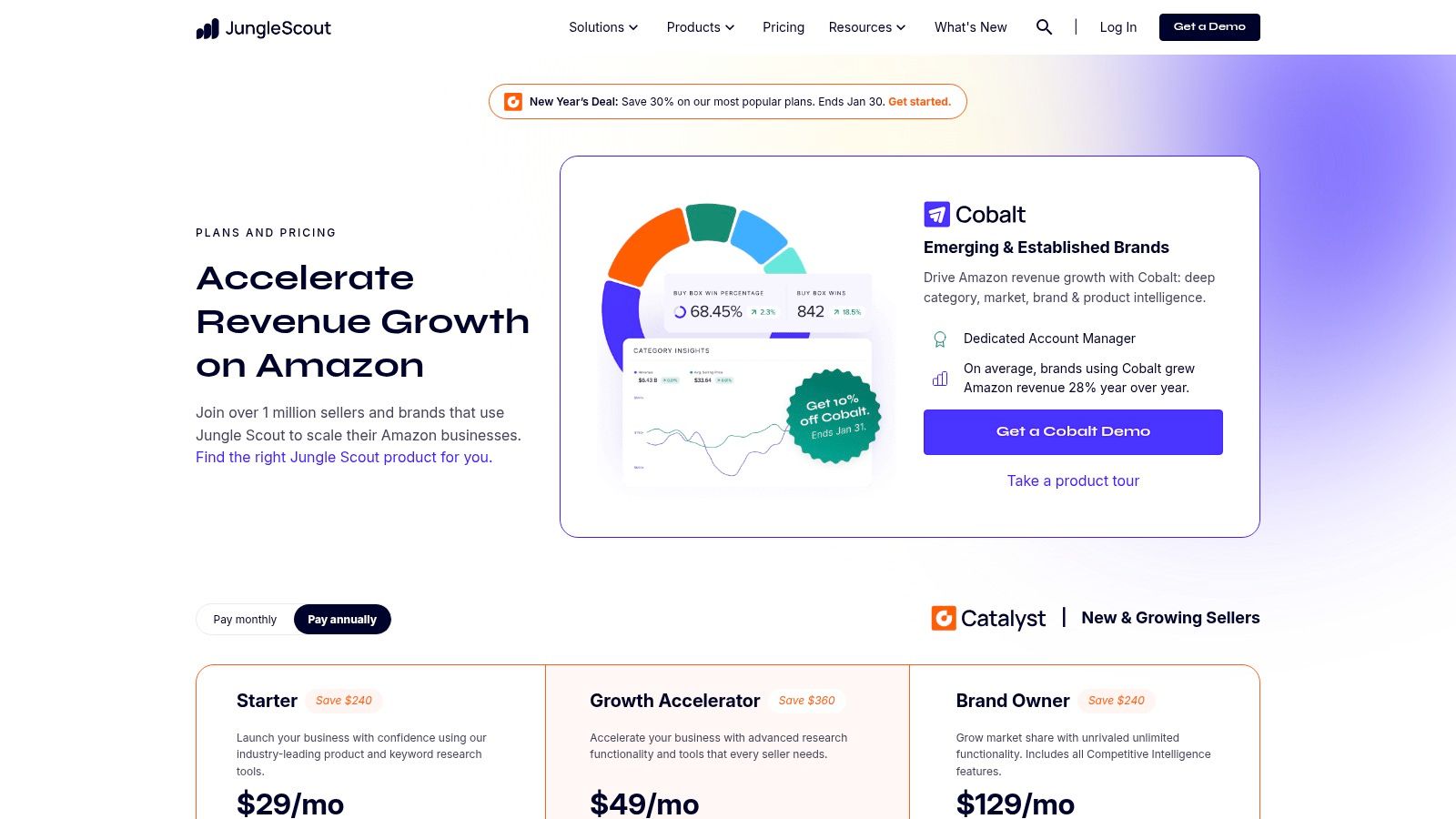
As one of the foundational third party Amazon analytics software, Jungle Scout excels at simplifying complex data into actionable workflows. Its clear interface and guided processes for product research, keyword tracking, and performance analysis empower both new sellers and established brand teams to make data-driven decisions confidently and efficiently.
Key Features & Use Cases
- Profitability Dashboards: Syncs directly with Seller Central to provide a real-time view of your business profitability, automatically calculating revenue, costs, Amazon fees, and net profit.
- Competitive Intelligence & Market Tracking: Use the Opportunity Finder and Product Database to analyze market trends and demand. Track competitor sales, pricing changes, and BSR history to stay ahead of the market.
- Advertising Analytics: The platform includes tools to analyze PPC performance, discover high-converting keywords, and manage campaigns, helping connect ad spend directly to profitability.
- Inventory Forecasting: Monitor inventory levels and receive restock recommendations to avoid stockouts that can kill sales momentum and organic rank. This is a critical component for effective Amazon conversion rate optimization.
Pros and Cons
- Pros: Offers clear, structured workflows for product research and ongoing performance tracking. The tiered plans make it accessible for individual sellers.
- Cons: Some advanced ad automation and optimization features are less robust compared to dedicated, ad-focused platforms. Can be outgrown by enterprise brands needing deeper competitive intelligence.
Website: https://www.junglescout.com/pricing/
6. Teikametrics
Teikametrics moves beyond pure analytics by integrating AI-driven automation directly with its performance dashboards. This platform is designed for advertisers who want to both analyze and execute within a single ecosystem. It bridges the gap between insight and action by combining product-level profitability data, inventory signals, and sophisticated campaign management into a unified, goal-oriented workflow. This makes it a powerful choice for brands looking to automate their bidding and keyword strategies based on real-time financial metrics.
Unlike many Amazon ads analytics tools that focus solely on reporting, Teikametrics uses its data to power algorithmic bidding and campaign optimization. This unique combination helps sellers connect their advertising spend directly to profitability, ensuring that automated decisions are aligned with overarching business objectives.
Key Features & Use Cases
- Goal-Based Campaign Optimization: Set specific targets like ACoS or ROAS, and the platform’s AI will automatically adjust bids and keyword targeting to achieve them.
- Product-Level Profitability: Connect your COGS to see true profit margins after ad spend and fees. Inventory-linked alerts help prevent advertising spend on out-of-stock items.
- Consolidated Reporting: View performance data across all campaigns, keywords, and products in a single dashboard to identify trends or issues quickly.
- Market Intelligence Add-On: Gain insights into competitor strategies, market share, and category trends to inform your advertising and product decisions.
Pros and Cons
- Pros: The platform pairs strong automation capabilities with robust analytics for direct action. Its spend-tiered pricing model includes a free entry-level plan.
- Cons: Higher-tier plans may include a percentage of ad spend fee, which can become costly for large advertisers. Often positioned as a “black-box” tech platform with limited transparency into its strategic decision-making.
Website: https://www.teikametrics.com
7. Perpetua
For enterprise-level brands and large advertisers, Perpetua offers a sophisticated retail media platform that combines advanced ad automation with deep analytics. It moves beyond standard PPC management to provide a holistic view of market share, organic rank, and total profitability. This tool is engineered for scale, making it one of the go-to Amazon analytics tools for advertisers managing significant budgets across multiple retail media networks.
Perpetua’s strength lies in its AI-powered bidding algorithms and its ability to connect ad performance directly to critical business outcomes like market share. By integrating with Amazon Marketing Stream, it provides hourly reporting that allows for near real-time campaign adjustments, giving large-scale advertisers a significant competitive edge.
Key Features & Use Cases
- AI-Powered Ad Bidding: Automates bid adjustments and keyword harvesting for Sponsored Products, Brands, and Display ads to maximize performance against strategic goals.
- Share-of-Voice & Organic Rank Dashboards: Track your visibility against key competitors for top search terms to quantify the impact of ad spend on both paid and organic placement.
- Hourly Reporting via Marketing Stream: Access granular, intraday performance data to make rapid, informed decisions on ad campaigns, crucial for high-stakes events like Prime Day.
- Profitability & Finance Tools: Tools like Sellerboard and A2X provide a detailed Amazon profitability dashboard by integrating COGS, ad spend, and other fees.
Pros and Cons
- Pros: The platform excels at scaling large advertising budgets and provides deep ad analytics tied directly to execution. Its multi-retailer support is ideal for brands selling on Amazon, Walmart, and other marketplaces.
- Cons: The entry price point is higher than tools designed for small or medium-sized businesses. Many of the most powerful features are gated behind its upper-tier pricing plans.
Website: https://perpetua.io
8. Intentwise
For agencies, aggregators, and large brands that need to centralize marketplace data, Intentwise ofpfers an end-to-end advertising optimization and analytics solution. Its core philosophy is enabling users to “own their data,” moving beyond siloed dashboards to create a unified data warehouse. This platform connects Amazon Seller/Vendor Central, Advertising, Walmart, and more, making it a powerful hub for multi-channel analysis.
Unlike closed-system platforms, Intentwise provides open connectors to popular business intelligence (BI) tools like Tableau and Power BI. This makes it one of the most flexible Amazon data tools for creating custom reports and dashboards that align with specific business KPIs, rather than being limited by pre-built templates.
Key Features & Use Cases
- PPC Optimization: Automate bidding strategies, keyword harvesting, and dayparting for Amazon and Walmart ad campaigns.
- Unified Data Warehouse: Consolidates data from disparate sources (e.g., Seller Central, Amazon Ads, Walmart) into a single, queryable location. This is ideal for multi-brand roll-ups or agency-level reporting.
- ASIN-Level Profitability: Drills down into Product 360 views to perform root-cause analysis on profitability, connecting ad spend, COGS, returns, and fees to individual SKUs.
- Anomaly Detection: Leverages AI to automatically flag unusual performance metrics, such as a sudden drop in conversion rate or a spike in ad spend.
Pros and Cons
- Pros: The “own-your-data” approach with open BI connectors offers unmatched flexibility for custom reporting. It is highly effective for centralizing data across multiple brands or marketplaces.
- Cons: Pricing is customized and can be a significant investment. The initial data modeling and BI tool setup may require technical expertise or professional services.
Website: https://www.intentwise.com/analytics-cloud
9. Data Dive
Data Dive is not an all-in-one suite but a specialized tool focused on deep product and keyword research. It’s built for sellers who prioritize a data-first approach to product validation and listing optimization. The platform guides users through a structured Master Keyword List (MKL) creation process, ensuring that every strategic decision is rooted in comprehensive search data. This makes it one of the best analytics tools for Amazon sellers focused on SEO and launch strategy.
Key Features & Use Cases
- Guided Research Process: Follows a systematic workflow to build a master keyword list, analyze the competitive landscape, and validate product niches.
- Deep Competitor Analysis: Go beyond surface-level metrics to understand competitor review velocity, keyword strategy, and historical performance.
- Listing Builder Integration: Use the validated master keyword list to construct highly optimized titles, bullet points, and backend search terms.
- Review Analysis: Synthesize thousands of competitor reviews to identify customer pain points, feature requests, and market gaps.
Pros and Cons
- Pros: Provides a rigorous, data-driven framework for product research and SEO. Excellent for sellers who want to build a bulletproof launch strategy.
- Cons: It’s a niche tool focused primarily on the research phase. It does not offer ongoing performance analytics, profitability tracking, or ad management.
Website: https://datadive.tools/
10. SmartScout
For brands focused on wholesale, private label, or competitive intelligence, SmartScout offers a unique set of tools that go beyond standard product research. It provides a visual, map-based interface to analyze subcategories, identify dominant brands, and uncover traffic patterns. This makes it an excellent tool for understanding the competitive landscape at a macro level and finding untapped opportunities.
Key Features & Use Cases
- Brand & Subcategory Analysis: Quickly identify all the brands selling within a specific subcategory, view their estimated revenue, and analyze their product catalogs.
- Traffic Graph: Visualize how traffic flows to a particular listing, including which other products are driving “Frequently Bought Together” sales.
- Wholesale & Arbitrage Tools: Use the Seller Map and Brand Search features to find profitable brands to partner with or products to source.
- Competitor Intelligence: Track competitor sales volumes, product launches, and keyword strategies to stay one step ahead.
Pros and Cons
- Pros: Offers powerful tools for wholesale sourcing and deep competitive analysis that aren’t available in many all-in-one suites. The visual interface is intuitive for market research.
- Cons: Less focused on the day-to-day operational needs of a private label seller, such as PPC management or profitability tracking.
Website: https://smartscout.com/
11. Keepa
Keepa is an essential tool for any serious Amazon seller, providing detailed historical data on pricing, sales rank (BSR), and Buy Box ownership for nearly every product on Amazon. While not a full analytics suite, its browser extension and data features are indispensable for competitive intelligence, product sourcing, and understanding market dynamics.
Key Features & Use Cases
- Price History Charts: Track the price history of any product to identify seasonal trends, competitor pricing strategies, and optimal buy/sell points.
- Sales Rank Tracking: Monitor the Best Sellers Rank (BSR) over time to gauge a product’s sales velocity and demand.
- Buy Box Analysis: See which sellers have historically owned the Buy Box and at what price, critical for FBA and wholesale sellers.
- Stock Level Monitoring: Keep an eye on competitor inventory levels to anticipate stockouts and capitalize on opportunities.
Pros and Cons
- Pros: Provides unparalleled historical data that is crucial for making informed sourcing and pricing decisions. The browser extension is lightweight and easy to use.
- Cons: It’s a highly specialized tool and does not offer features for keyword research, PPC management, or overall profitability analysis. Its focus is purely on product-level historical data.
Website: https://keepa.com/
Third-party tools add depth to what Amazon shows you. But more dashboards don’t fix a broken ad structure, an aging catalog, or margin erosion at the SKU level. At some point, the constraint isn’t data access, it’s knowing which problem to solve first. That’s what the profit diagnostic does. We use your existing data, run it through AMOS and the Profit Pulse System, and rank your highest-leverage fixes before touching spend.
Get My Profit ROI Forecast→
We work with what you already have. No new subscriptions required upfront.
12. Stackline
For enterprise-level brands that require an omnichannel view far beyond Amazon, Stackline provides a comprehensive ecommerce intelligence platform. It synthesizes data across major retailers like Walmart and Target, offering insights into market share, pricing compliance, digital shelf performance, and shopper behavior. This platform is built for CMOs and category managers who need to benchmark performance and model scenarios across the entire retail landscape.
Stackline’s strength lies in its scale, processing billions of data points to deliver competitive intelligence and forecasting. As one of the more powerful Amazon seller reporting tools available, it moves beyond simple performance tracking to enable high-level strategic planning based on broad market dynamics.
Key Features & Use Cases
- Competitive Intelligence: Analyze market share, pricing, and keyword visibility across billions of products and multiple retailers. This is ideal for identifying market-wide threats and opportunities.
- Pricing & MAP Compliance: Monitor and enforce pricing policies across different channels to protect brand value. The platform’s robust benchmarking helps in crafting a sophisticated pricing strategy.
- Digital Shelf Monitoring: Track your product’s keyword visibility, content, and ratings on the digital shelf to ensure your listings are consistently optimized.
- Shopper & Audience Analytics: Leverage shopper panels and surveys to understand consumer behavior across different platforms, informing product development and marketing campaigns.
Pros and Cons
- Pros: Delivers a broad omnichannel perspective beyond Amazon alone. Its robust benchmarking and scenario planning tools are invaluable for sophisticated pricing and promotional strategies.
- Cons: Access is demo-led with enterprise-level pricing, making it inaccessible for smaller sellers. The sheer breadth of features may be overwhelming for teams focused solely on Amazon.
Website: https://www.stackline.com
How Adverio Turns Analytics Into Incremental Growth
Most Amazon analytics tools diagnose symptoms. Adverio governs the system.
Using our Growth Cultivator framework, we align BI, ads, listings, pricing, and inventory through disciplined Amazon PPC management so decisions compound — not conflict. That’s how brands escape optimization loops and scale profitably across Amazon, Walmart, and Target.
Choosing the Right Amazon Analytics Stack
Navigating the landscape of Amazon analytics tools can feel overwhelming. The sheer volume of data available is immense, yet the core challenge for any established brand isn’t just accessing data; it’s transforming that raw information into a coherent, profit-driven growth strategy. This article has guided you through the most powerful tools available, from foundational SEO and keyword trackers to sophisticated enterprise-level advertising and business intelligence platforms.
The journey from data chaos to clarity requires a strategic shift. Instead of chasing vanity metrics like ACoS in isolation, the goal is to build a unified view of your marketplace performance. This means connecting advertising spend directly to net profit, understanding how inventory levels impact ad efficiency, and seeing how listing optimizations influence your total market share.
Staring at dashboards but still guessing?
Get a profit-level view of your marketplace with Adverio’s ROI Forecast built to expose hidden margin leaks, non-incremental spend, and stalled growth drivers
Building Your Analytics Stack by Seller Level
- Beginner Sellers: Stick with the free tools inside Seller Central. Master Brand Analytics, Business Reports, and the Search Query Performance Report before spending on third-party software.
- Scaling Brands: Combine the free Amazon tools with 1-2 specialized third-party platforms. A common stack includes Helium 10 for keywords/SEO and Sellerboard for profitability tracking.
- Advanced Operators: For brands with significant ad spend and complex catalogs, a full-stack solution like Intentwise or Perpetua becomes necessary. These platforms, often integrated with BI dashboards, provide the deep analytics and automation required to manage growth at scale.
Your Actionable Next Steps
Before you commit to a new subscription, take these steps to ensure you’re making a strategic investment, not just adding another line item to your P&L.
- Audit Your Data Gaps: What critical questions can’t you answer right now? Is it true profitability per SKU? Competitor market share? The lifetime value of a customer acquired via DSP? Identify the blind spots first.
- Define Your Primary Goal: Are you focused on launching new products, defending market share, or maximizing profit on your hero ASINs? Your primary objective will dictate which features are most critical in your chosen amazon analytics tools.
- Consider Your Team’s Bandwidth: Does your team have the expertise and time to manage a complex new platform? The most sophisticated tool is useless if it’s not implemented correctly. Be honest about your internal capacity versus the need for a “Done-for-You” or “Done-with-You” partner.
Ultimately, the goal is to create a predictable growth engine. The right tools provide the necessary diagnostics, but a clear strategy is what drives the machine forward. Avoid the “Shiny Object Syndrome” of adopting new tech without a clear purpose. Instead, build your analytics stack deliberately, ensuring each component serves your ultimate objective: sustainable and profitable growth on Amazon.
The most advanced amazon analytics tools provide the data, but turning that data into a decisive competitive advantage requires a strategic framework. Adverio integrates best-in-class analytics into our proprietary Growth Cultivator system, translating complex datasets into actionable profit levers. If your brand is ready to move beyond dashboards and build a truly intelligent growth engine, Book Your ROI Forecast and see exactly where profit is leaking before you add another tool or dollar of ad spend.
The brands that grow past 8 figures aren’t running more tools. They’re running fewer with a system that tells them exactly which number to move and when.
If you’ve evaluated the platforms on this page and still can’t answer “where is my profit leaking and what’s the highest-leverage fix right now” — that’s the diagnostic gap we close.
Get My Profit ROI Forecast→
We find the constraint your tools are showing you, but not solving. No retainer required upfront.