
+600%
Revenue Growth
Have a Question? Call Us at +1 (415) 741-5609 to Speak with a Marketplace Expert Today

The Snapshot
Brand Profile
The Results
+600%
Revenue Growth
+407%
Profit Growth
128
SKUs Optimized
Starting Condition5-month revenue plateau with flatlined daily sales.
Executive Summary
Bey-Berk had been stuck for five months. Daily sales flatlined. Profitability stagnated. And leadership was watching a 128-SKU catalog underperform without a clear path to break the ceiling.
Bey-Berk is a recognized brand in the Home and Kitchen space with a deep catalog of premium products. The old approach had produced what it was going to produce, and no amount of incremental bid adjustments or campaign tweaks was going to push past the plateau.
Adverio took over and rebuilt the growth architecture from the ground up. We expanded traffic sources beyond Amazon, optimized all 128 SKUs for profitability and conversion readiness, installed strict ROI guardrails, and built compounding optimization loops that produced month-over-month acceleration instead of flat performance.
Over 25 months, revenue grew 600% and profit grew 407%. The plateau that had stalled the brand for five months became the baseline for a compounding growth trajectory.
We put a huge value on relationships and that's what really separated Adverio from the other firms out there.
The Objective
Break a 5-month revenue plateau where daily sales had flatlined
Restore profitable growth without sacrificing margin for topline
Optimize a 128-SKU catalog for both scale and profitability
Diversify traffic sources to reduce dependency on a single channel
Build a system that compounds growth month-over-month instead of requiring constant manual intervention
The Challenge
A plateau is not the same thing as a decline. In some ways, it is worse. When revenue declines, leadership acts. When revenue flatlines, leadership waits. And waiting is expensive.
Bey-Berk had been flatlined for five months. Daily sales were stuck at a low run-rate. Profitability was stagnant. The brand had a 128-SKU catalog in Home and Kitchen, but the existing management approach was treating all 128 SKUs the same way: the same bids, budgets, and expectations across all 128
SKUs do not convert the same, rank on the same keywords, or carry the same margin.
Traffic was also concentrated. Amazon was the only channel receiving structured ad support. There was no Walmart strategy. No multi-channel acquisition. The brand's entire growth trajectory depended on a single marketplace, which meant every algorithm shift, every competitor entry, and every seasonal fluctuation hit the entire business at once.
The System
Profit Pulse is Adverio's proprietary system for compounding growth. For Bey-Berk, the deployment had four components, each building on the one before it.
We stopped treating 128 SKUs as one account and started treating them as 128 individual businesses.
Each ASIN was analyzed by margin structure, conversion rate, search demand, competitive positioning, and seasonal relevance. High-margin, high-conversion SKUs received scaled investment. Low-margin or conversion-constrained SKUs were either deprioritized until listing quality improved or restructured with different keyword and placement strategies.
This is the difference between managing a catalog and governing it. Managing means the same approach everywhere. Governing means every SKU earns its budget allocation based on profit contribution data.
128 SKUs moved from uniform treatment to individualized profit governance. Budget flowed to where the math supported it.
Bey-Berk was running 100% of structured ad support on Amazon. That is a single point of failure for a brand with 128 SKUs and real revenue targets.
Adverio expanded traffic acquisition across multiple channels, including Walmart. The goal was not just "be on more marketplaces." The goal was to reduce dependency on any single channel so that algorithm changes, competitive shifts, or seasonal softness on one platform did not crater the entire business.
Each channel received its own strategy. Not a copy of the Amazon playbook. A dedicated approach matched to the channel's buyer behavior, competitive dynamics, and advertising infrastructure.
Revenue became multi-channel. Growth on one marketplace reinforced, rather than cannibalized, growth on another.
Growing 600% over 25 months is meaningless if margins erode along the way. Bey-Berk's profit grew 407% alongside the topline because guardrails were built into the system from day one.
Every campaign, every SKU, and every channel had margin targets. Spend was governed against profit contribution, not just revenue output. When a campaign trended toward unprofitable territory, it was pulled back before margin damage compounded. When a campaign showed headroom, it was scaled.
This is not conservative management. It is profit-first scaling: calculated risk inside hard margin limits.
+407% profit growth alongside +600% revenue growth. The brand scaled without trading margin for topline.
The reason Bey-Berk's growth accelerated over 25 months instead of plateauing again is that the system was built to compound.
Every month, performance data from all 128 SKUs across all channels fed back into the optimization framework. Winning keywords expanded. Underperforming placements were cut. Better listings raised conversion. Conversion raised organic rank. Rank cut ad dependency, margins widened, and the savings funded the next push.
This is the flywheel effect. Each cycle of optimization makes the next cycle more effective. Over 25 months, that compounding produced sustained revenue acceleration. Not because spend scaled in lockstep. Because efficiency improved while spend scaled.
Month-over-month compounding produced sustained acceleration. The system did not plateau again because each cycle compounded the last.
Same numbers Bey-Berk hit start with one conversation. No pitch deck.
The Results
+600%
Revenue Growth
Over 25 months. From a flatlined daily run-rate to a compounding growth trajectory that reset the brand's revenue baseline.
+407%
Profit Growth
Profit scaled alongside revenue because margin guardrails were built into the system from day one. This was not "grow now, fix margins later." Both metrics moved together.
128
SKU Optimization
All 128 SKUs individually governed for profitability. Budget allocation driven by margin data, not uniform treatment.
Multi
Channel Foundation
Traffic broadened beyond Amazon into Walmart and additional acquisition channels. The brand's growth trajectory no longer depends on a single marketplace.
The Structural Recovery Result
Before
After
This was not a temporary spike. It was a structural transformation.
When a brand replaces uniform catalog management with SKU-level profit governance, broadens traffic across multiple channels, installs margin guardrails that scale with the business, and builds compounding optimization loops that accelerate over time, the growth does not flatten again. It compounds. Bey-Berk's 25-month trajectory is the proof: each quarter outperformed the last because the system was designed to improve, not just maintain.
The Lesson
Plateaus tell you something specific. They tell you the current system has produced everything it is going to produce. No amount of incremental optimization within that system will break the ceiling. The bids are where they should be. The keywords are harvested. The campaigns are structured. And the numbers are flat.
Bey-Berk had a 128-SKU catalog, a recognized brand, real customer demand, and five months of proof that the old approach could not grow the business further. The fix was not "try harder." The fix was rebuilding the growth system from the foundation: The fix was not 'try harder.' It was rebuilding the growth system from the foundation, the four moves laid out above
The numbers are above. The trajectory is the part that matters: the brand is still growing because the system is built to compound. But the more important result is the trajectory. The brand is still growing because the system is designed to compound. The plateau was not a destination. It was a signal that the old system had maxed out. The new system has not.
The Verdict
A 5-month plateau is not "things are stable." It is a system that has hit its ceiling, and every month you stay there is a month your competitors are compounding past you.
Adverio replaced the ceiling with a compounding engine. 600% revenue. 407% profit. 25 months. 128 SKUs.
That is what happens when the architecture changes.
If your brand has plateaued and the response has been "keep optimizing," we will show you where the ceiling is, what is causing it, and what a compounding growth system would produce over the next 12 to 24 months.
Forecast My Amazon Growth 15-minute diagnostic call. We either find the leak or confirm you are already optimized.Plateaus are signals. The question is what you do about them.
FAQs
You change the system, not the tactics. A plateau means the current architecture has produced its maximum output. Incremental changes within that architecture (bid tweaks, new keywords, campaign restructuring) will produce incremental results at best. Breaking the plateau requires structural changes: SKU-level profit governance instead of uniform management, multi-channel traffic expansion, margin-governed scaling, and compounding optimization loops. Bey-Berk was stuck for five months. The new architecture produced 600% growth over 25 months.
Yes, if profitability guardrails are built into the system from day one. Bey-Berk's profit grew 407% alongside 600% revenue growth because every campaign and every SKU was governed against margin targets, not just revenue targets. The common failure pattern is scaling revenue first and "fixing margins later." That approach creates a margin problem that gets harder to fix the larger the business gets. Profit-first scaling means both metrics move together.
It depends on catalog size, competitive dynamics, and how deep the structural issues run. Bey-Berk's trajectory was 25 months to reach +600% revenue, but the compounding started within the first few months once the new architecture was in place. The initial months focus on rebuilding the system (SKU analysis, campaign restructuring, channel expansion). Once the foundation is set, the compounding loops take over and growth accelerates quarter over quarter.
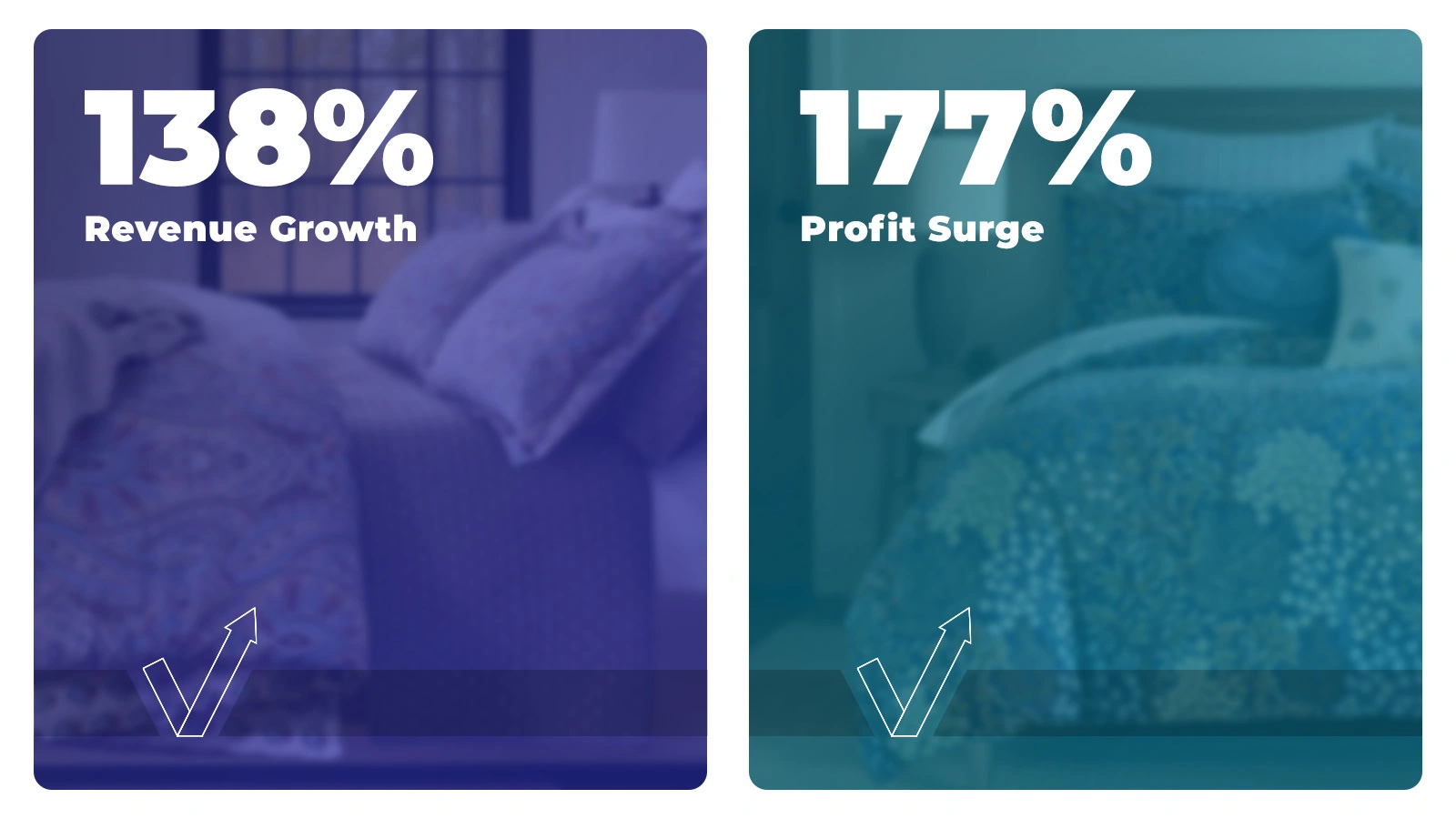

Product Category: Softlines > Home & Kitchen > Bedding
Explore Case Study
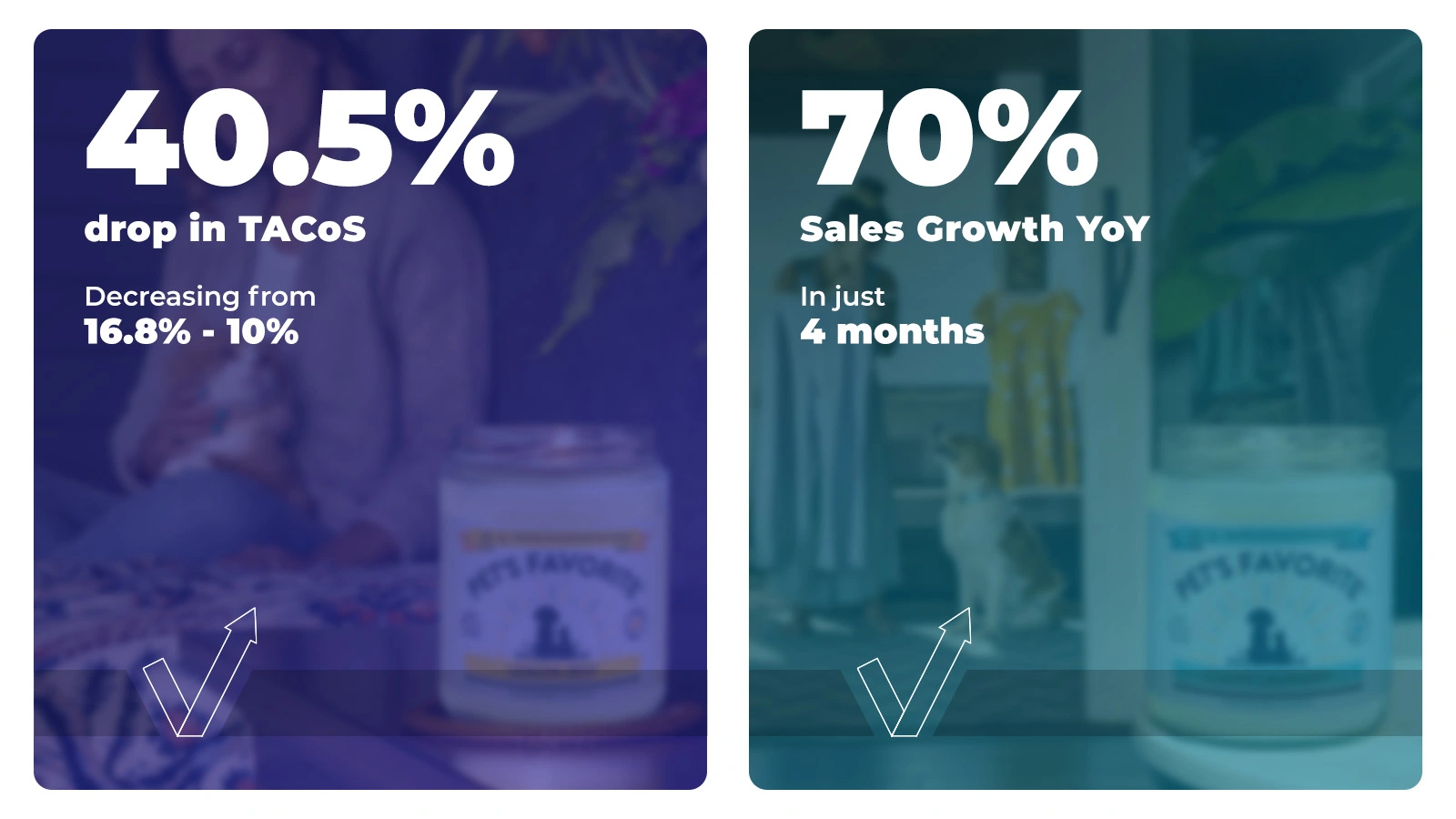

Product Category: Home & Kitchen > Pet Supplies
Explore Case Study


Product Category: Softlines > Clothing, Shoes, & Jewelry > Novelties
Explore Case Study
We’ll build your custom roadmap to higher profit.