


A winning seasonal pricing strategy on Amazon isn’t about discounting harder during Black Friday; it’s about pricing with intent before, during, and after demand peaks.
Take a cue from your favorite coffee chain (yes, the one that goes pumpkin-crazy every fall). Leading brands in highly seasonal categories engineer scarcity, timing, and pricing to protect perceived value, even when demand is volatile.. For established Amazon sellers, the introduction of limited edition and seasonal offerings is an invaluable opportunity to elevate brand visibility, enrich customer experience, and achieve notable sales growth.
Moving Beyond Reactive Discounting on Amazon
Table of Contents
Most brands panic when seasonality hits, defaulting to discounts instead of strategy.. They see it as a necessary evil, reactively matching competitor markdowns and bleeding margins on promotions, just hoping the volume makes up for it.
That’s how margins quietly die.
A proactive approach flips the script entirely. It’s about using historical data to know precisely when to buy low and when to price for maximum margin right before a demand surge. It’s about understanding the market’s rhythm, not just reacting to dates on a calendar.
The Arbitrage Mindset: Justifying Premium Prices
Seasonal pricing works because scarcity changes buyer behavior. Limited availability, time-bound relevance, and predictable demand spikes justify premium pricing if inventory, ads, and timing are aligned.
Avoiding Optimization Myopia
Too many brands suffer from Optimization Myopia, optimizing ACoS while ignoring margin, inventory risk, and incremental growth. A truly effective seasonal strategy integrates multiple operational pillars:
- Inventory Alignment: Your purchasing calendar must be perfectly synchronized with your pricing calendar. It’s non-negotiable.
- PPC Cadence: Ad spend should ramp up to support price increases during peak demand, not just to promote discounts.
- Promotional Timing: Instead of defaulting to standard deals, you need a clear understanding of the differences between coupons, Best Deals, and Lightning Deals on Amazon to select the right tool for the job.
At Adverio, we use our proprietary Growth Cultivator framework to create this exact alignment. It’s a system that turns chaotic seasonal trends into a predictable, profit-driven engine, ensuring your pricing, advertising, and inventory work in concert.
How to Forecast Seasonal Demand with Precision
Any effective seasonal pricing strategy on Amazon starts with data. Guesswork and gut feelings are margin killers. Forecasting isn’t just about spotting obvious peaks like Black Friday; it’s about uncovering “micro-seasons”—short, profitable windows created by competitor stockouts or niche trends.
This starts with a deep dive into your historical data, looking back at least 18-24 months. Anything less is pricing without context.
Tapping into Amazon’s Internal Intelligence
Amazon gives you powerful tools to decode market demand, but most sellers barely scratch the surface.
- Product Opportunity Explorer (POE): This is your crystal ball for identifying unmet demand. Analyze historical search volume trends to see when customers start looking. A spike in searches for “winter coats” in September is your cue that demand is building.
- Search Query Performance (SQP) Reports: POE shows you the market; SQP shows you your place in it. Track impression share for seasonal keywords over time. If impressions are high but clicks are low, it might signal a pricing or content issue that needs fixing before peak season.
Using Third-Party Tools for a Competitive Edge
While Amazon’s data is crucial, you have to layer in competitive intelligence. Tools like Keepa are table stakes for competitive pricing intelligence. They let you track competitor pricing, stock levels, and historical sales velocity with surgical precision.
Here’s an example of how a Keepa chart reveals historical pricing and sales rank fluctuations—critical inputs for your seasonal strategy.
This kind of historical chart lets you see exactly when your competitors raised prices or ran out of stock last year, giving you the ammo to build a proactive strategy.
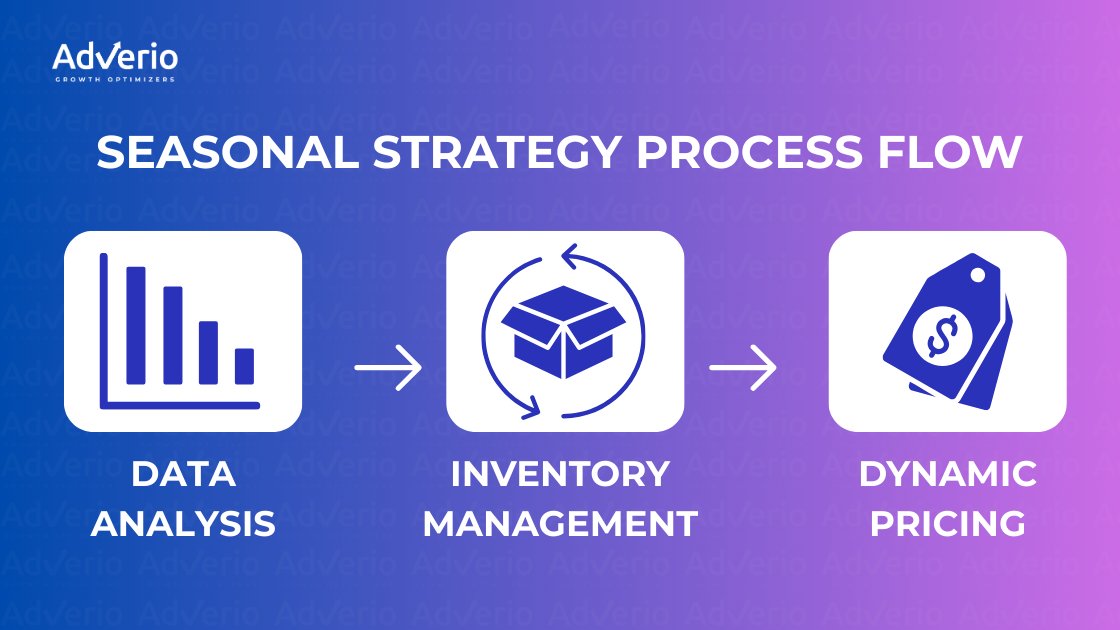
This infographic illustrates how a sound seasonal strategy flows, from data analysis to inventory planning and finally to pricing execution.
The key takeaway: pricing decisions are the result of careful forecasting and inventory alignment, not the starting point. To sharpen your predictions, dig into various e-commerce demand forecast methods.
A successful seasonal forecast tells you more than just when to stock up. It tells you when to liquidate aging inventory before a price crash and when to hold firm on your price right before a competitor stocks out. It’s about timing, not just volume.
This level of analysis is what separates amateur sellers from the 8-figure brands we partner with. Your forecast dictates purchasing, logistics, and marketing, ensuring every decision is synchronized and profit-driven.
If your pricing still reacts after demand spikes, you’re already late.
Building Your Pricing Playbook for Peak and Off-Peak Seasons
Once your forecast is locked in, it’s time to act. A truly effective seasonal pricing strategy on Amazon gives equal weight to both peak and off-peak periods. One builds your war chest, the other clears the battlefield.
Peak Season Price Maximization
Peak season is about controlled aggression. Your primary goal is to build margin before the promotional frenzy begins.
Start rolling out gradual price increases 4-6 weeks before a major event. As organic demand increases, your rising Best Sellers Rank (BSR) will support a higher price point without killing your conversion rate. This alone can add 5–10% incremental margin before promotions even start.
Strategic Promotional Deployment
When high-traffic events hit, every promotion needs a clear objective. Promotions without intent are just margin leaks.
- Lightning Deals: Use these for a quick velocity boost. The goal isn’t just sales; it’s a rapid BSR improvement that pays you back in organic ranking for weeks after.
- Coupons: Perfect for grabbing the attention of price-sensitive shoppers without permanently slashing your list price. This is a crucial part of any good Amazon anchor pricing strategy because it makes your final price feel more compelling.
- Sale Prices: Use this tactically to match a direct competitor or clear specific inventory. It’s a weapon, not your default setting.
The biggest mistake brands make is relying on promotions to drive all their peak-season volume. The smarter play is to use strategic price increases to build margin on your organic sales, then use promotions surgically to grab market share and boost rank.
For fresh ideas on structuring your offers, check out these holiday campaign examples that drive sales.
Off-Peak Cash Flow and Liquidation
The post-holiday window is where disciplined brands separate from desperate ones. It’s a critical window for optimizing cash flow. The focus flips from margin percentage to inventory velocity and cash recovery.
Your main goal is to clear out leftover seasonal stock efficiently, but without trashing your brand’s perceived value.
Tactics for Effective Off-Peak Management:
- Create High-Value Bundles: Pair a seasonal overstock item with a complementary, evergreen bestseller. This increases your Average Order Value (AOV) and moves slow-selling units without massive discounts.
- Run Targeted Clearance Promotions: Instead of a generic sale, build a dedicated “Last Chance” section in your storefront. Then, use targeted DSP audiences to reach customers who viewed that seasonal product but never bought.
- Leverage Gift Card Demand: In January, run a “New Year, New Gear” campaign with modest discounts (10-15%) to capture this wave of motivated buyers.
Every pricing decision, whether in July or December, must be deliberate. A strong playbook isn’t about having a price for every day; it’s about having a reason for every price.
Executing a Successful Campaign on Amazon
Once your strategy is set, flawless execution is what separates the winners from the rest. Here’s how to bring your seasonal plan to life on the Amazon battlefield.
Leverage Amazon’s Marketing Tools
- Amazon DSP + Sponsored Ads: Use Amazon DSP and other upper-funnel tactics to build highly engaging custom creatives. Tell a story with lifestyle imagery and video. Then, use lower-cost sponsored ads to maintain visibility for your seasonal products. When executed correctly, this consistently lifts conversion efficiency and RoAS — without brute-force spend.
- Optimized Creative: Enhance your main image, gallery, and A+ Content to vividly tell the story of your seasonal items. Use high-quality visuals and engaging copy that highlights the uniqueness and scarcity of your offering.
Optimize for Seasonal Search
- Keyword Rotation: Don’t forget to rotate in season- and event-specific text and alt-text within your A+ Content to capitalize on just-in-time (JIT) indexing. This will pump steroids into your paid marketing efforts.
- Real-Time Adjustments: Incorporate seasonal keywords into your titles, descriptions, and backend search terms. Monitor search query performance data to optimize your listings in real-time, ensuring maximum visibility when it matters most.

Create Exclusivity and Urgency
Clearly communicate the limited availability of your products in both quantity and time. This creates urgency, encouraging quicker purchase decisions. Use Amazon’s inventory management tools to maintain optimal stock levels, avoiding oversupply while meeting anticipated demand.
For a deeper dive, our guide on how to achieve optimal pricing on Amazon provides a detailed framework.
The Post-Holiday Playbook for Future Growth
The moment the holiday rush ends, most brands see the finish line. That’s a massive strategic mistake. For savvy sellers, this isn’t an epilogue; it’s the first chapter of next year’s success story.
A winning seasonal pricing strategy on Amazon transforms the post-holiday slump from a defensive fire sale into a calculated offensive maneuver. This is where real arbitrage opportunities are found.

Capitalizing on the January Reset
The post-holiday battlefield is defined by two dynamics: aggressive clearance sales and a surge of shoppers with gift cards. The goal is to not only move leftover stock but to acquire new, high-value customers at a low cost.
Instead of deep, brand-damaging markdowns that scream “desperation,” consider these smarter moves:
- Targeted “New Customer” Coupons: Offer a compelling discount exclusively to shoppers who have never purchased from your brand.
- High-Value Bundles: Pair a leftover holiday item with an evergreen bestseller to move the seasonal unit and increase AOV.
- Strategic Ad Campaigns: Use DSP to retarget holiday window shoppers with a “Second Chance” offer.
The Arbitrage Buy Window
While your team focuses on smart liquidation, your inventory planners should be in purchasing mode. January is predictably the cheapest time of year to source inventory for many categories.
Your competitors are dumping inventory at or below cost. This is your prime opportunity for inventory arbitrage. Analyze historical pricing data to pinpoint which products hit rock-bottom prices in Q1. Make strategic bulk buys, warehousing that inventory until demand—and prices—inevitably climb again.
The post-holiday period isn’t about cleaning up a mess. It’s a calculated financial strategy where you simultaneously sell high (clearing seasonal stock) and buy low (restocking for the next peak), funding your growth with the market’s own predictable cycles.
Analyzing the Data for Next Q4
Finally, the data you collect from late December through January is pure gold. Perform a detailed post-mortem while the information is fresh.
- Which promotions drove the highest ROI?
- At what price point did your conversion rate drop off?
- Which keywords saw the biggest search volume spikes, and when?
- Where did your inventory levels run too thin or too heavy?
This analysis becomes the foundation of your plan for the next peak season. It’s also critical to have a strong post-event advertising strategy ready to go to maintain momentum.
By treating the post-holiday period with this level of strategic intent, you create a powerful flywheel for continuous, year-over-year growth.
Ready to stop reacting to the market and start commanding it? The experts at Adverio build and execute profit-driven seasonal pricing strategies that turn market volatility into your competitive advantage. Stop letting seasonality dictate your margin