


Let’s cut the fluff. To relaunch a dormant Amazon listing without torching your budget, you treat it like a strategic asset, not a past failure. The playbook is simple: audit the ASIN’s history to find the real reason it died, overhaul the content for pure conversion, and then execute a controlled, phased paid media ramp-up to rebuild sales velocity without cratering your margins.
For established Amazon brands, it’s often a more capital-efficient growth lever than launching a net-new ASIN.
Your Dormant Listings Are a Hidden Goldmine
Table of Contents
Dormant ASINs are often misclassified as liabilities when they’re actually underutilized profit assets. Too many brands write these listings off, assuming Amazon’s algorithm has blacklisted them forever. This is a massively expensive mistake.
We see it constantly. It’s a classic case of what we call Optimization Myopia, over-optimizing a single metric (like ACoS) while ignoring total profit impact.
The reality? These listings have latent sales history, customer reviews, and even some lingering ranking potential that new listings don’t. Kicking the “dead listing” myth to the curb is the first step toward unlocking a stream of incremental revenue you didn’t know you had.

A methodical revival is simply a smarter way to grow than starting from zero. This isn’t about flipping a switch and hoping for the best; it’s about a calculated, step-by-step approach to waking a sleeping giant.
The True Potential of a Dormant Listing
Most brands completely underestimate the equity a dormant listing holds. Even with zero recent sales, it contains valuable data and a history within Amazon’s system. The algorithm doesn’t have total amnesia.
The table below breaks down the common thinking versus the strategic reality.
Dormant Listing Relaunch Potential At a Glance
| Metric | Common Misconception | Strategic Relaunch Opportunity |
|---|---|---|
| Sales History | The listing is “dead” and has no value. | Amazon’s algorithm retains historical data, which can accelerate ranking recovery. |
| Customer Reviews | Old reviews are irrelevant. | Existing reviews provide immediate social proof, a huge advantage over new listings. |
| Profitability | It’s a money pit with no ROI. | In Adverio-managed relaunches, dormant ASINs frequently return to positive contribution margin within 12 months. |
| BSR Impact | The BSR is too high to recover. | Even modest BSR improvements can materially impact daily unit velocity for established ASINs.. |
The data tells a very different story. These aren’t dead weight; they are assets with a head start.
Historical analyses show that relaunching an optimized dormant listing can yield profitability rates up to 64% within just 12 months. For established brands, a mere 1% improvement in Best Sellers Rank (BSR) can boost daily sales by an average of 4.2%.
Relaunching a dormant ASIN isn’t a gamble; it’s a calculated investment in an asset you already own. You’re leveraging existing history to shortcut the path to profitability.
This guide gives you the exact playbook. We’ll walk through the steps to turn forgotten SKUs into consistent, profitable revenue streams. We’re starting with a deep diagnostic audit and a complete overhaul of your strategic Amazon listing optimization. The goal is to move from reactive firefighting to a proactive system for capitalizing on hidden opportunities.
The Pre-Launch Audit: Uncover the Profit Leaks
Trying to relaunch a dormant listing with a blast of PPC is like racing with a flat tire. It’s expensive, ineffective, and misses the point. A profitable relaunch doesn’t start with ad spend; it begins with a forensic audit to figure out exactly why the listing went dark in the first place.
This relaunch approach aligns with Adverio’s Growth Cultivator framework, where catalog assets are only scaled after profit viability is proven.
This isn’t guesswork. It’s a methodical investigation. Was it a pricing issue that killed your Buy Box percentage? Poor keyword targeting that brought in tire-kickers instead of buyers? Or a string of negative reviews that tanked your conversion rate? Often, it’s as simple as inventory mismanagement leading to stockouts and a ranking death spiral.

Throwing ad dollars at the problem without this diagnosis is just pouring gasoline on a fire. The goal here is to create a clear “SKU Resurrection” plan that plugs every single profit leak before you spend a dollar on advertising.
Diagnosing the Root Cause of Dormancy
Every dormant listing has a story. Your job is to read it. At Adverio, we use our proprietary tools like the Listing Quality Score (LQS) and Profit Pulse System (PPS) to run this diagnostic, but you can get started with a structured approach. It’s about pulling back the layers and looking at historical data with a brutally honest eye.
Your diagnostic checklist needs to include:
-
Historical Sales & Traffic Data: Dive into your business reports. Pinpoint the exact moment sales and sessions fell off a cliff. Did it line up with a price hike, a new competitor, or a period of being out of stock?
-
Competitor Benchmarking: How does your listing stack up right now against the top three competitors for your main keyword? Get granular. Analyze their pricing, image quality, review count, and A+ Content. Identify the specific gaps you need to close.
-
Keyword Indexing & Ranking: Is your listing even indexed for its most critical keywords? Use a third-party tool to check your backend search terms and verify that Amazon’s algorithm actually understands what your product is. No ad spend can fix a fundamental indexing flaw.
-
Review & Feedback Analysis: Read every negative review. Don’t just skim them—categorize the feedback. Are customers complaining about product quality, misleading descriptions, or busted packaging? These are direct instructions on what to fix.
Evaluating Profitability and Market Fit
Beyond performance metrics, you have to get real about the numbers. Profitability isn’t an accident; it’s engineered. The audit must stress-test your unit economics to make sure the product is even worth relaunching.
A relaunch isn’t just about reviving sales; it’s about reviving profitable sales. If the margins aren’t there, you’re just building a bigger problem. Don’t be afraid to walk away from a SKU if the math doesn’t work.
This is where you dig into financial viability. Reassess your Cost of Goods Sold (COGS), all Amazon fees, and projected advertising costs. Can you price the product competitively and still walk away with a healthy margin using a defensible Amazon anchor pricing strategy? If your initial deep dive into utilizing SKU economics on Amazon shows paper-thin margins, solve that first.
This reality check forces you to answer the most critical question: Is this product worth resurrecting? Sometimes the answer is no. Killing an unprofitable SKU is just as strategic as relaunching a winner.
By the end of this audit, you should have a precise, actionable roadmap for the next phase—rebuilding the listing from the ground up to be a conversion machine.
Not sure which ASINs are worth reviving?
**
👉** Book Your ROI Forecast.
Rebuilding Your Listing to Be a Conversion Machine
With your audit done, you have a clear map of what broke. Now for the real work: rebuilding every customer-facing piece of your listing. This isn’t about small tweaks. It’s a complete overhaul designed to turn high-intent traffic into sales, period.
This is the foundation of effective Amazon listing optimization services, engineering every element of the detail page to convert traffic profitably, not just attract clicks.
The process kicks off with your title and bullet points. Forget keyword stuffing. We’re diving into Amazon’s Search Query Performance data to unearth the exact phrases real customers are typing right before they buy. This isn’t about guessing; it’s about embedding proven, high-conversion terms directly into your copy to pull in qualified shoppers.
Crafting Content That Sells
Think of your product description and A+ Content as your digital sales team. Their job is to do more than just rattle off features. Great content solves a customer’s problem, answering their unasked questions and squashing hesitations on the spot.
Instead of just saying “durable construction,” show it. Use a lifestyle image of your product surviving a real-world mess your ideal customer recognizes. You need to frame every feature as a direct benefit that makes their life easier, better, or less chaotic.
This is where you weave a compelling narrative using A+ Content and Brand Stories. Use modules to stack your product against competitors, call out key differentiators, and tell the story behind your brand. That emotional connection is what separates you from a sea of look-alikes.
Upgrading Your Visual Merchandising
On Amazon, your images are your product. A customer can’t touch it, feel it, or try it on, so your visuals have to do all the heavy lifting. This is a critical battleground for any profitable relaunch.
Your main image is non-negotiable. It has to be on a pure white background and meet every one of Amazon’s latest technical specs. Fail here, and you’ll get suppressed before you start. You need to understand the complete set of Amazon product image requirements to ensure you are compliant and optimized.
Beyond the main image, your other visuals need to tell a story:
-
Lifestyle Shots: Show your product being used by your ideal customer. Let them picture it in their own lives.
-
Infographics: Call out key features and benefits with clean, bold text overlays. Break down complex info into graphics they can scan in seconds.
-
Comparison Charts: Visually prove why your product is the smarter choice, highlighting specific advantages over the competition.
To ensure your revitalized listings actually turn browsers into buyers, dig into these actionable conversion rate optimization tips that cover everything from visual hierarchy to persuasive copywriting.
Managing Reviews to Rebuild Social Proof
Finally, you have to tackle your reviews. A dormant listing often comes with the baggage of old, negative feedback that can kill a relaunch before it gets off the ground.
Start by dissecting every piece of negative feedback. If you’ve fixed the issues they complained about (like improving packaging or updating the product design), subtly address those improvements in your A+ Content or main images. Don’t hide from the past—show customers you listened.
Your primary goal isn’t to erase old reviews, but to dilute them. Generate a fresh stream of positive feedback by ensuring an exceptional post-purchase experience for your new customers.
Dormant Amazon listings aren’t dead—they’re sleeping giants. Stats from seller reports highlight that 89% of Amazon sellers operate 50 or fewer listings, with a staggering 26% stuck on just one. Relaunching these profitably flips the script: sellers who thoughtfully expand to 10-20 active ASINs report peak 22% profit margins. Adding basic A+ Content to relaunched listings can drive 8% sales increases and 1.8x conversions.
By systematically rebuilding your title, bullets, A+ Content, images, and review strategy, you lay a rock-solid foundation. Your listing is no longer a passive catalog entry; it’s an active, persuasive tool engineered for one purpose: profitable growth.
A Phased Paid Media Relaunch Strategy
Now that your listing is rebuilt to convert, it’s time to flip the switch on the sales engine. But be warned: slamming the accelerator on ad spend from a dead stop is the fastest way to torch a budget. This phased rollout mirrors a profit-first Amazon advertising strategy—where spend scales only after conversion and margin signals are validated.
A profitable relaunch demands a controlled, intelligent, phased media ramp-up—not a brute-force attack.
It all starts with a foundational Sponsored Products campaign. Forget broad match. Your initial focus has to be on a tight, surgical list of exact-match, high-conversion keywords you identified in your audit. The goal is singular: Generate controlled sales velocity without breaching your TACoS guardrails.
This flow chart nails the core rebuild process that absolutely must happen before you spend a single dime on ads.
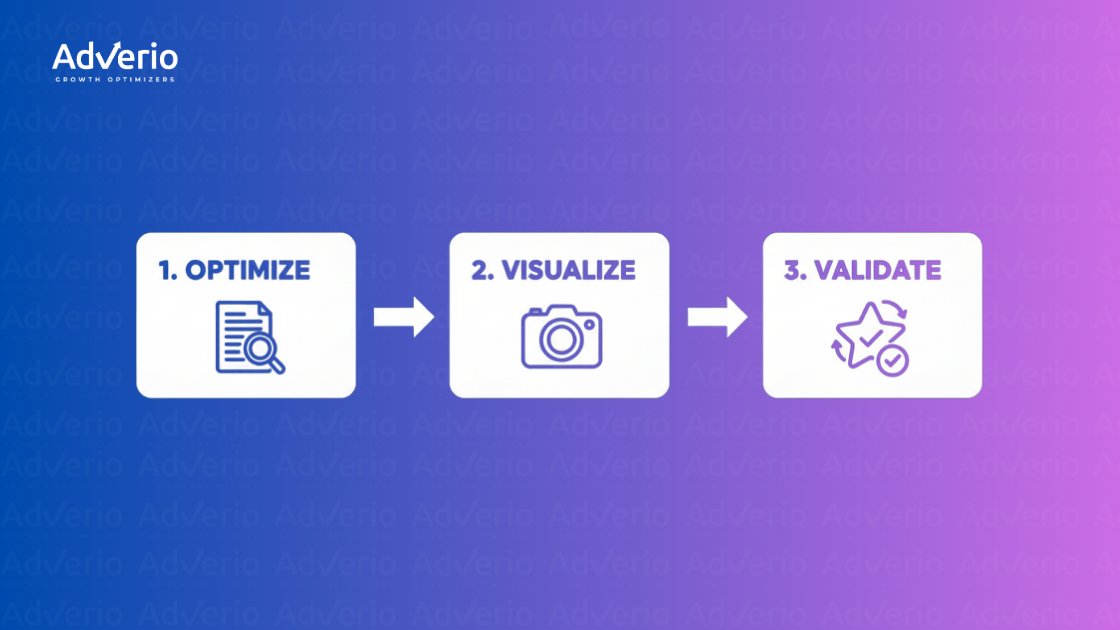
This simple flow—Optimize, Visualize, Validate—is the non-negotiable groundwork. Skipping these steps and jumping straight to paid media is like trying to advertise a store that’s still under construction.
Layering Ad Types for Full-Funnel Dominance
Once your Sponsored Products campaigns are stable, it’s time to layer in additional ad types. This isn’t about spending more; it’s about spending smarter across the entire customer journey.
Your next move should be Sponsored Brands. These top-of-search placements are less about immediate conversion and more about reclaiming your Share of Voice (SOV). Use them to target your core brand and category keywords, pushing traffic to your Storefront and reminding the market that you’re back.
At the same time, roll out Sponsored Display for defensive product targeting. Run ads on your own product detail pages to stop competitors from poaching your hard-won traffic. It’s a low-cost, high-impact way to protect your digital shelf space.
Integrating DSP and Strategic Promotions
With momentum building, you can bring in the heavy hitter: Amazon DSP. This is where you graduate from keyword targeting to audience-based advertising. Use DSP to retarget shoppers who viewed your product but didn’t buy, or to reach entirely new, in-market audiences based on their browsing and buying habits.
A strategically deployed coupon can be the final nudge needed to spike your sales rank. You don’t need to give away the farm; a simple 10-15% off coupon is often enough to get the algorithm’s attention without eroding your margins.
Think of it like this: Sponsored Products is your ignition. Sponsored Brands and Display are your steering and defense. And DSP with a well-timed deal is your turbocharger. Each component gets activated in a sequence dictated by data, not guesswork.
This phased approach ensures every ad dollar is accountable. In our experience, brands that follow a methodical rollout see up to a 35% improvement in ROAS compared to those who launch everything at once.
Expanding Your Reach Beyond Amazon
While Amazon channels are the priority, an effective relaunch often benefits from outside help. Consider developing a comprehensive social media marketing strategy as part of your game plan. Driving high-quality external traffic can be a massive boost for brand awareness and your newly reactivated listings.
Ultimately, a successful paid media relaunch is a controlled burn, not a wildfire. For a deeper dive, our guide to a winning Amazon advertising strategy and how to maximize your ROI breaks down the specific campaign structures and bidding strategies we use. This is how you turn a forgotten ASIN into a consistent profit generator.
Measuring Success and Protecting Your Margins
A relaunch is only successful if it’s profitable. Anyone can pour money into a dormant listing to generate sales; the real skill is generating sales that hit your bottom line. This is where we stop chasing vanity metrics and get serious about the KPIs that dictate whether this effort was a win or an expensive lesson.
Before you flip a single campaign on, you need to establish clear “guardrail metrics”—the non-negotiable performance targets that keep your ad spend efficient and protect your margins from day one.
Establishing Your KPI Guardrails
Think of these guardrails as the bumpers on a bowling lane, there to keep your relaunch from veering into unprofitability. Too many brands fall into the trap of Optimization Myopia, obsessing over a low ACoS while their total profit evaporates. We need a holistic view.
Your essential guardrail metrics should include:
-
Target ACoS (Advertising Cost of Sales): This can’t be a generic goal. It has to be calculated based on each product’s specific margin. A profitable ACoS for one SKU might be a money-loser for another.
-
Target TACoS (Total Advertising Cost of Sales): This is the real measure of your advertising’s health. It tells you if your ad spend is driving genuine, overall growth (organic + paid) or just cannibalizing sales you would have gotten anyway.
-
Minimum ROAS (Return on Ad Spend): Set a hard floor for your return. If a campaign dips below this number, it should trigger an immediate review and optimization—or a pause.
A relaunch without margin protection is just an expensive hobby.
That definition starts with SKU-level profitability analysis—factoring in COGS, fees, ad spend, and incremental lift before scale decisions are made. TACoS becomes the north star for measuring true incremental growth—not just paid efficiency.
Conducting Margin Tests and Maintaining a Holistic View
With your guardrails in place, you can interpret performance data as it rolls in. This is where a data-driven feedback loop becomes critical. Reviving a dormant listing isn’t guesswork; it’s about turning data into a profit machine.
Consider the leverage you have: improving reviews by just one star can drive a 26% sales surge. In apparel and home goods, which make up 30% of top-sellers, relaunching with better Q&As and content can slash return rates by 5%, directly adding 9% to your margins. You can discover more about these powerful Amazon seller statistics to see the full potential.
This data allows you to perform margin tests in real-time. For example, you can see how a 10% coupon impacts your conversion rate versus how it eats into your net profit per unit. Does the spike in sales volume make up for the thinner margin? Your Business Intelligence platform should give you a single dashboard to answer that question instantly. For a deeper look at how strategic pricing impacts margins and velocity, review our complete guide to building an Amazon anchor pricing strategy.
Here’s a simple framework to keep your relaunch on track financially.
Your Relaunch KPI Guardrail Framework
This table outlines the core metrics to monitor to ensure profitability. Think of it as your financial dashboard—if a light turns red, your team knows exactly what action to take.
| KPI | Target Range (Example) | What It Tells You | Action to Take if Off-Target |
|---|---|---|---|
| Target ACoS | 25-35% | The direct efficiency of your ad spend on a per-product basis. | Too High: Review keyword bids, placements, and negative keywords. Too Low: You may be leaving sales on the table; consider increasing bids. |
| Target TACoS | 8-12% | The overall health and leverage of your ad spend on total business growth. | Too High: Ad spend is not driving sufficient organic lift. Re-evaluate targeting. Stagnant: Ads are likely cannibalizing organic sales. Test reducing spend. |
| Minimum ROAS | 3.0 | The absolute floor for return on investment for any given campaign. | Below Threshold: Immediately audit the campaign. If no clear optimization path, pause it to protect margins. |
| Conversion Rate (CVR) | >15% | How effectively your listing (images, copy, price) turns clicks into sales. | Too Low: Your traffic isn’t converting. A/B test main images, titles, and A+ Content. Check competitor pricing. |
| Profit Margin / Unit | >$5.00 | The actual cash you make on each sale after all costs and fees. | Too Low: Your ACoS target might be too high, or COGS/fees are miscalculated. Re-evaluate your pricing or promotion strategy. |
This isn’t about setting one target and hoping for the best. It’s about creating a system that forces you to stay profitable.
This constant analysis lets you make sharp, decisive moves. You’ll know precisely when to scale a winning campaign, when to prune a struggling keyword, and when to pull back on spend to protect the bottom line. This transforms a temporary relaunch into a sustainable, long-term asset that will never go dormant again.
Frequently Asked Questions
Even with a solid game plan, reviving dormant listings brings up tough questions. It means shifting your mindset from seeing these SKUs as dead weight to seeing them as untapped assets. Let’s tackle the most common concerns.
How Long Does a Relaunch Take to Show Results?
Look, every product is different, but you don’t have to wait a year to know if you’re on the right track. A well-executed relaunch will show signs of life within the first 30 days. We’re talking about visible bumps in Best Sellers Rank (BSR), improved keyword positions, and the first trickles of sales velocity.
But let’s be real: stable, predictable profitability is a longer game. Expect that to take closer to 3-6 months. That’s the time it takes for organic rank to take hold and for your ad campaigns to be dialed in with real performance data. Patience and consistent, data-driven tweaks are everything.
Is It Better to Relaunch a Dormant Listing or Create a New One?
In almost every case, relaunching an existing listing is the superior move. An old listing, even with a shaky sales history, holds valuable assets that a brand-new ASIN can’t touch.
The biggest advantage is built-in equity. A dormant listing has historical sales data, old customer reviews, and SEO juice that a new listing completely lacks.
Starting a new ASIN from scratch is a brutal uphill battle. You’re fighting for every review and clawing your way up the rankings from absolute zero. Relaunching means you’re building on an existing foundation, making the path back to profit much faster and more cost-effective.
The only time I’d recommend starting over is if the original listing was shut down for a serious, unfixable compliance issue. Otherwise, reviving it is the smarter financial play.
What Is a Realistic Relaunch Budget?
A smart relaunch budget has two parts. The first is a one-time investment to overhaul your content—fresh photography, video, and A+ Content designed to nail your conversion rate.
The second is your monthly ad spend. We recommend starting with a controlled test budget for the first 30-60 days. This lets you gather critical performance data without burning cash. A solid starting point is usually 10-15% of your target monthly revenue for that specific SKU. From there, the budget should scale up only when you hit the ROAS and TACoS guardrails you’ve already defined.
How Do You Handle Old Negative Reviews?
Old negative reviews feel scary, but they are not a dealbreaker. First, do a forensic analysis. Dig into the feedback and pinpoint the exact problems customers were having. Then, confirm that those issues—whether it was the product, packaging, or a misleading description—have been permanently fixed.
Once that’s done, you can subtly highlight these fixes in your new A+ Content or Q&A section. But the real strategy isn’t about erasing the past; it’s about drowning it out with new, positive feedback.
Your main focus has to be a proactive push to generate a wave of new, positive reviews. This “review dilution” strategy pushes the old complaints down the page, ensuring the most recent, positive customer experiences are the first thing shoppers see. That’s the social proof that matters.
Ready to turn your dormant listings into a reliable profit center? The expert team at Adverio uses proprietary systems like our SKU Resurrection analysis and Growth Cultivator framework to build a data-backed relaunch strategy that protects your margins and drives sustainable growth. Book Your ROI Forecast to see whether your dormant ASINs are worth scaling or killing.