


Your main product hits page one, but its color and size variations are buried on page ten. This isn’t bad luck. It’s a structural failure in how your catalog is built. Too many brands treat variations as a housekeeping task instead of the ranking lever they actually are.
Consolidating sales history, reviews, and traffic onto a single parent ASIN sends a massive signal to Amazon’s A9 algorithm. You’re telling it your entire product family is a top performer, which directly improves your organic search position. Every misstructured variation quietly taxes your growth.
Struggling to diagnose where your catalog is leaking profit? Book Your ROI Forecast.
Why Your Amazon Rankings Are Stuck in Neutral
Fragmented listings are a silent profit killer. When you don’t consolidate, you split your sales velocity, dilute customer reviews, and leave the algorithm guessing which ASIN to prioritize. This is a classic case of Optimization Myopia—obsessing over individual child ASINs while savvy competitors with consolidated variations quietly steal your market share.
A disjointed strategy forces your own products to compete against each other for the same keywords. It’s a self-inflicted wound that many brands only notice after their rankings have tanked.
The True Cost of a Disjointed Variation Strategy
A poor variation strategy doesn’t just hurt visibility; it kicks off a negative feedback loop that actively damages your bottom line.
-
Diluted Sales Velocity: Each color or size variant listed separately spreads your sales thin. A product selling 100 units across five different listings looks weak to the A9 algorithm. But one parent listing selling 100 units? That’s a bestseller.
-
Fragmented Social Proof: Ten reviews on five separate listings can’t compete with the power of fifty reviews aggregated on one. Consolidation builds the critical social proof that boosts shopper confidence and drives up conversion rates.
-
Wasted Ad Spend: Advertising fragmented listings is a recipe for high ACoS. You’re trying to build momentum for multiple ASINs from scratch instead of pouring all that fuel into one powerful parent listing.
The core problem is that a fragmented catalog forces your own products into a civil war for ranking. This internal cannibalization is a silent profit killer that many brands overlook until they see an unexpected drop in their keyword rankings.
Across large catalogs (250+ SKUs), the same variation mistakes show up again and again, and they compound fast. These aren’t minor technical errors; they are fundamental flaws that directly impact how Amazon sees and ranks your entire product line.
Variation Mistakes That Are Costing You Market Share
| Common Mistake | Impact on Ranking | Consequence for Your Brand |
|---|---|---|
| Listing each color/size separately | Splits sales velocity & review count across multiple ASINs, weakening your ranking signals. | Your products compete against each other, and none gain enough momentum to dominate search results. |
| Using incorrect variation themes | Confuses both customers and the A9 algorithm, leading to poor indexing for relevant attributes. | Shoppers can’t easily find the specific style they want, leading to a frustrating experience and lost sales. |
| Inconsistent parent/child content | Creates a disjointed customer experience and can cause indexing issues or policy violations. | Trust erodes when a customer clicks a “blue” swatch and sees images or text for a “red” product. |
| Ignoring the best-performing child | Fails to feature the top-selling variant as the default, hiding your most compelling offer. | You miss out on the highest possible conversion rate by not leading with your proven winner. |
Fixing these isn’t just about cleaning up your catalog. It’s about building an Amazon listing optimization strategy that fundamentally changes how Amazon’s algorithm values your products and unlocks sustainable growth.
The Data-Backed Advantage of Consolidation
Let’s be clear: this isn’t just theory. Optimizing your product variations can dramatically boost your ranking, especially in crowded categories like apparel or home goods. When sales velocity and reviews are consolidated correctly, visibility lifts are immediate, especially in competitive softline categories. The data is undeniable. You can discover more insights about product offering optimization and see the impact for yourself.
To truly leverage this, you first need a solid grasp of the fundamentals of how to rank products on Amazon. From there, you can build a profit-driven variation architecture that creates unstoppable ranking momentum, helping you fix any sudden Amazon keyword ranking drops you might encounter along the way.
Designing a Profit-Driven Variation Architecture
A successful variation strategy is more than just grouping products; it’s an architectural decision. You’re building a logical hierarchy that speaks directly to Amazon’s algorithm and your customers, guiding both toward a conversion. Stop thinking about it as a cataloging task and start seeing it as a core pillar of your ranking strategy.
This means asking the tough questions. When should you merge listings to consolidate power, and when should you keep them separate to target distinct customer intents? The wrong choice creates a weak foundation that no amount of PPC spend can fix. A scattered approach is a recipe for disaster.
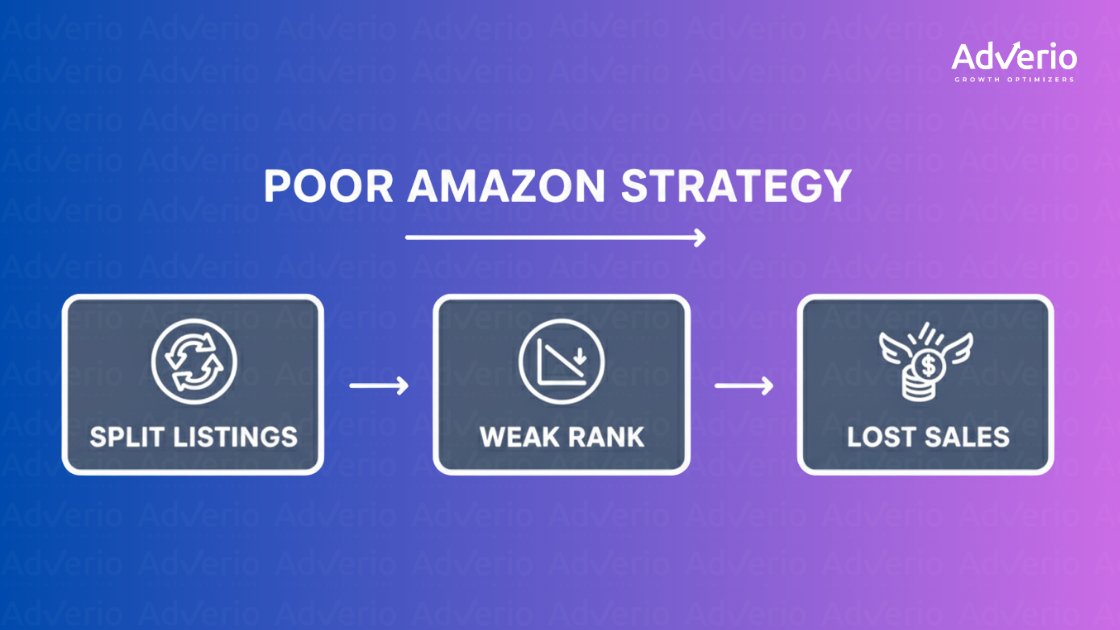
As you can see, splitting your listings directly weakens your ranking signals, which inevitably leads to lost sales and market share.
The Rule of Relevance: Your Guiding Principle
To avoid this downward spiral, you need a framework. We call it the ‘Rule of Relevance.’ Before merging any two ASINs, ask yourself one simple question: “Does a customer shopping for Product A realistically expect to find Product B on the same page?”
If the answer is no, don’t combine them. It’s that simple.
A shopper looking for a blue cotton t-shirt expects to see size options (S, M, L) and maybe other colors. They do not expect to find a long-sleeve version or a completely different shirt design on the same detail page. Violating this rule creates a confusing customer journey and signals to Amazon that your listing is poorly structured, hurting your indexing for specific attributes.
The goal is to ensure every child ASIN contributes positively to the group’s performance. When done right, you create a flywheel effect where the combined sales history and reviews propel the entire product family up the search results.
This isn’t just theory; it’s backed by hard data. Top-performing brands treat variation architecture as a ranking asset, not a catalog task. This led to a 30% sales uplift from consolidated variations that also improved ACoS by up to 22%.
Choosing the Right Variation Theme
The variation theme—like Size, Color, or StyleName—is the backbone of your structure. It’s the attribute customers will use to select their desired option from the dropdown menu or swatches on the product page. Picking the wrong one is a common and costly mistake.
Here’s how to get it right:
-
Analyze Category Norms: Go to your category’s Best Sellers list. What themes are the top-ranking products using? This tells you what Amazon’s algorithm prioritizes and what customers in that niche expect.
-
Prioritize the Primary Difference: If your products differ by both color and size, the theme
SizeName-ColorNameis almost always the correct choice. This allows shoppers to select both attributes easily. -
Avoid Generic Themes: Using a generic theme like
StyleNamefor simple color or size variants is a red flag. Be as specific as the category allows to give Amazon precise data for indexing.
For brands with hundreds or thousands of SKUs, manually restructuring your catalog is impossible. This is where mastering flat files (inventory templates) becomes a non-negotiable skill. A single, well-structured upload can restructure your entire catalog, merge ASINs, and correct theme errors at scale.
But be warned: a small mistake in that file can suppress your bestsellers. Precision is everything.
A profit-driven architecture isn’t just about making your listings look clean. It’s about building a powerful ranking asset. By combining sales velocity and pooling social proof, you give Amazon exactly what it wants: a clear, high-performing product family that deserves to be on page one.
Making these structural decisions correctly is a critical first step in understanding and SKU-level profitability modeling on Amazon to drive profitable growth.
Mastering On-Page Optimization for Each Variation
Once your variation architecture is solid, the real work begins. Treating every child ASIN as a carbon copy of the parent is a rookie mistake that leaves ranking potential and profit on the table. Each variation—every size, color, or style—is its own unique product, and it deserves its own tailored on-page optimization.
Generic copy and reused images create a flat, uninspired customer experience. It signals laziness to shoppers and, more importantly, fails to give Amazon’s A9 algorithm the specific, granular data it needs to properly index each child ASIN for those valuable long-tail searches.
This is where you move from a structurally sound listing to a high-converting one.

Crafting Variation-Specific Titles and Bullets
Your product title is the single most important piece of on-page SEO real estate. Instead of a generic title for the whole family, simply append the specific variation attribute at the end. For instance, “Women’s Performance V-Neck T-Shirt” becomes “Women’s Performance V-Neck T-Shirt, Royal Blue.”
This small tweak accomplishes two critical things:
-
Improves Keyword Indexing: It tells Amazon to index that child ASIN for searches like “royal blue v-neck shirt,” capturing highly specific buyer intent.
-
Enhances User Experience: The customer’s selection is immediately confirmed right in the title, which reduces confusion and the chance they’ll bounce.
The same logic applies to your bullet points. While the core product features will be consistent, dedicate at least one bullet to call out what makes that specific variation unique.
-
For a color variation, describe the shade: “Vibrant Royal Blue dye that resists fading wash after wash.”
-
For a size variation, offer a sizing tip: “Size Large fits chest sizes 42-44 inches for a comfortable, athletic fit.”
This level of detail transforms a generic listing into a custom-fit shopping experience, which is a cornerstone of effective Amazon listing optimization.
Why Unique Visuals Are Non-Negotiable
If a customer clicks the “Royal Blue” swatch and sees a picture of a red shirt, you’ve just introduced friction. That moment of hesitation, however brief, is often enough to kill a sale. Every single child ASIN must have its own complete set of high-resolution images and, if you can swing it, a unique video.
This goes beyond showing the product; it’s about building trust and managing expectations. A full, specific image gallery confirms the customer has made the right choice and lets them visualize the exact product they’ll receive.
This has a direct and massive impact on conversion rates—listings with variant-specific images consistently outperform those that rely on a single, generic set.
A lazy visual strategy is a direct tax on your conversion rate. Shoppers buy with their eyes, and failing to show them exactly what they’ve selected is one of the fastest ways to lose a sale to a competitor who did the work.
Leveraging A+ Content for Comparison
For more complex products, your A+ Content is the perfect place to eliminate purchase friction. Use it to build out a compelling comparison chart that clearly outlines the key differences between your variants.
A well-designed chart can answer a customer’s questions before they even think to ask them, guiding them to the best choice for their specific needs. This tactic is especially powerful for products where the variations have slightly different features, materials, or intended uses.
By making the comparison effortless, you accelerate the path to purchase and reduce the likelihood of returns. To help manage the demanding task of creating unique content for each variant, consider exploring AI content creation tools to streamline the process.
Aligning PPC and Pricing for Maximum Profit
A solid variation structure is only half the battle. If your advertising and pricing strategies aren’t perfectly synced with it, you’re just building a high-performance engine and filling it with low-grade fuel. Variation-level bidding only works when it’s tied to a disciplined Amazon PPC management framework.
Running generic PPC campaigns that target a parent ASIN is one of the fastest ways to burn cash and watch your ACoS skyrocket. It’s a common mistake that treats all child ASINs as equals, when in reality, they have vastly different roles to play in your profitability.
This is where you stop thinking like a catalog manager and start acting like a portfolio manager. Each child ASIN is an asset with its own margin, inventory level, and conversion potential. A sophisticated approach requires you to align your paid media and pricing to exploit these differences at the SKU level.
Implement Variant-Level Bidding
Instead of launching a broad Sponsored Products campaign for a parent listing, you need to get granular. Create ad groups that target specific child ASINs. This is variant-level bidding, and it gives you precise control over your ad spend and campaign objectives.
This strategy unlocks a few powerful levers:
-
Promote High-Margin SKUs: Got a colorway or size that’s pure profit? Bid more aggressively on that specific child ASIN to push it harder. It’s just common sense—why spend the same amount advertising a low-margin variant as a high-margin one?
-
Liquidate Excess Inventory: Is a particular size or color gathering dust in an FBA warehouse? Create a dedicated, aggressive campaign for that ASIN to accelerate sell-through and dodge those painful long-term storage fees.
-
Push the “Default” Winner: If one child ASIN consistently converts better than all the others, give it more ad budget. Let it serve as the primary entry point for the entire variation family, drawing shoppers in through your highest-performing option.
Running a single, parent-level PPC campaign is like flying blind. You’re letting Amazon decide which variation to show, and its algorithm will almost always default to the bestseller.
That means you miss huge opportunities to push more profitable or overstocked items. Granular bidding puts you back in the pilot’s seat.
Use Strategic Pricing to Drive Traffic and Profit
Pricing within a variation family should almost never be uniform. Strategic price differences—when governed by a dynamic pricing strategy on Amazon- create psychological anchors that drive traffic and maximize overall profitability across the entire listing.
For example, you can set a specific, less popular variant as a loss-leader—pricing it slightly lower to grab the initial click and pull shoppers into the detail page. Once they’re there, they can discover the full range of options, including your higher-margin, premium-priced variants.
This approach leverages the power of a well-structured Amazon anchor pricing strategy to make your primary offers look more attractive by comparison.
Variations are also the perfect sandbox for A/B testing price points. You can test a $19.99 price on the blue variant and a $21.99 price on the red one to see which finds the sweet spot between conversion rate and profit margin—all without disrupting the sales history of your core ASINs.
Variant Bidding vs Parent Level Bidding
Deciding between variant-level and parent-level bidding comes down to how much control you want over your profitability. For most brands, the extra setup for variant bidding pays for itself almost immediately by eliminating wasted ad spend.
| Strategy | Best For | Key Benefit | Potential Pitfall |
|---|---|---|---|
| Variant-Level Bidding | Brands with diverse margins, inventory levels, or conversion rates across child ASINs. | Precise control over ad spend, enabling profit-driven decisions at the SKU level. | Requires more complex campaign setup and ongoing management. |
| Parent-Level Bidding | Simple product lines where all variations have similar margins and sales velocity. | Simple and fast to launch, requiring minimal campaign segmentation. | Wasted ad spend on low-performing or unprofitable child ASINs. |
While parent-level bidding is easier, it’s a blunt instrument in a game that rewards precision. Variant-level bidding is the clear winner for any brand serious about optimizing its ad budget.
Finally, you can use Amazon DSP to close the loop. Retarget shoppers who viewed one variation (e.g., the blue shirt) with ads showcasing another (e.g., the red or black shirt). This advanced tactic not only recaptures potentially lost sales but also increases average order value by exposing them to the full breadth of your product line.
Unifying Reviews and Social Proof to Win the Buy Box
On Amazon, reviews are the ultimate currency of trust. A smart variation strategy is the fastest way to stack that currency. When you group child ASINs under a single parent, all their individual ratings and reviews merge into one powerful signal of social proof that speaks directly to both the A9 algorithm and your customers.
This directly impacts making your listing look popular; it’s a direct input into your organic ranking and conversion rate. Think about it: a single product showing 500+ reviews is exponentially more compelling than ten separate listings with fifty reviews each.
That consolidated number builds instant trust, slashes purchase hesitation, and tells Amazon your product family is a force to be reckoned with.

Capitalizing on Consolidated Feedback
Once you’ve unified your reviews, the work isn’t done—you need to actively manage them. Amazon’s system lets shoppers filter reviews by a specific variation, like “Size: Large” or “Color: Royal Blue.” This feature is your best friend for knocking down variant-specific objections and highlighting positive feedback.
Your mission is to make sure the most persuasive and relevant feedback gets seen. Get in there and use the “Helpful” button on glowing reviews that speak to the quality of a specific variant.
This little action pushes them to the top, helping shoppers on the fence about a particular color or size see the exact reinforcement they need from other buyers.
A high review count isn’t just a vanity metric—it’s a core pillar of your Buy Box eligibility. Amazon’s algorithm heavily favors listings with strong, consistent social proof because it signals a reliable customer experience. Weak or fragmented reviews are a fast track to losing the Buy Box to your competitors.
We’ve seen it time and time again: this kind of data-driven variation strategy directly correlates with a better Amazon Best Seller Rank (BSR). It’s not uncommon for brands to see sales boosts of 25-35%.
With review syndication across variants lifting conversions by up to 28%, unifying your ratings is no longer optional—it’s essential for survival.
Proactively Managing the Q&A Section
The “Customer questions & answers” section is another critical piece of the puzzle that gets shared across all your variations. This can be a double-edged sword. A question about the fit of a “Size Small” shirt will show up on the page even when a customer is looking at the “Size XXL.”
If you let this go unmanaged, it creates massive confusion and kills conversions.
Your team has to be vigilant here, monitoring this section daily and providing crystal-clear, variant-specific answers.
-
Clarify the Context: When you answer a question, always start by specifying which variant you’re talking about. For instance, “For the Royal Blue color, the fabric is a 60/40 cotton-poly blend…” This removes all ambiguity.
-
Answer Proactively: Don’t just wait for shoppers to ask. Seed the Q&A section yourself by asking and answering the most common questions you get about specific variants. You’re essentially building a helpful FAQ that preempts customer confusion before it starts.
This unified social proof—across both reviews and Q&A—is a critical factor in not just winning but holding the Buy Box. To really nail this down, you need to see how it fits into the bigger picture. We break it all down in our complete guide to building a resilient, profit-driven Buy Box control strategy and clawing back lost sales.
It’s Time to Move From Vendor to Strategic Financial Partner
Executing a flawless variation strategy across a massive catalog isn’t a one-and-done cleanup project. It’s a continuous cycle of analysis, testing, and refinement that demands a true strategic partner—not just another vendor executing tasks.
This is where most brands hit a wall. Internal teams are overwhelmed, and traditional agencies just don’t have the strategic depth to connect catalog management to bottom-line growth.
That’s precisely where Adverio’s Growth Cultivator framework comes in.
We Don’t Just Fix Listings; We Build a Profit Engine
We don’t just patch up your listings. We build a profit-driven engine that fully integrates your catalog with intelligent growth marketing and holistic conversion rate optimization. The reality is, how you structure your Amazon variations directly impacts your PPC efficiency, your market share, and ultimately, your profitability. These are not separate initiatives.
Our proprietary tools, like the Listing Quality Score (LQS) and our SKU Resurrection system, are built to uncover the hidden profit leaks that your team or a previous agency missed.
-
Listing Quality Score (LQS): This tool runs a deep audit on your entire catalog against hundreds of data points. It pinpoints underperforming listings, flags compliance risks, and finds missed optimization opportunities at the individual child ASIN level.
-
SKU Resurrection: We have a system for finding and reviving “dead” or suppressed ASINs that still have valuable sales history and reviews, pulling them back into your variation families to reclaim lost ranking power.
Stop treating variation optimization as a janitorial task. See it for what it is—a core component of a defensible marketplace strategy. A well-structured catalog is the foundation upon which profitable advertising and sustainable growth are built.
Instead of a black-box tech platform or a generic account manager, you get a dedicated strategy pod that acts as a true extension of your team. We provide full-funnel reporting that directly connects catalog health to ad performance and an ROI-backed delivery model with guarantees, like our 40% refund clause. It’s time to stop chasing algorithms and start building a real financial strategy for your marketplace business.
If your catalog is complex, your margins are under pressure, and rankings feel unstable, this is fixable. Book Your ROI Forecast, and let us show you the hidden profit potential sitting in your catalog.
Common Questions (and Straightforward Answers)
Let’s cut through the noise. Here are the most common questions we get about Amazon variation strategy, answered with the no-nonsense clarity you need to move forward.
How Many Variations Is Too Many for One Parent ASIN?
There’s no magic number here. The only thing that matters is relevance and the customer’s shopping experience. A single parent ASIN should only ever group products that differ by one or two key attributes—think color, size, or pack quantity.
For a t-shirt, having over 20 size and color combinations is totally normal. But for something like a coffee maker, showing ten different colors might just overwhelm the shopper. If the core features, materials, or benefits of the product change, it’s time for a completely new parent listing.
A classic mistake we find in catalog audits is brands over-consolidating unrelated items. This hurts your ranking potential just as much as failing to group obvious variants in the first place.
Can I Change My Variation Theme After Creating a Listing?
Yes, but it’s not a simple tweak in Seller Central. This is a technical process that absolutely requires a flat file (inventory template) upload. Trying to change a theme like ColorName to SizeName-ColorName demands precision.
Here’s the high-level process:
-
First, you have to delete the parent SKU from your catalog.
-
Next, you update all the child listings with the new, correct variation theme directly in the flat file.
-
Finally, you re-upload the file to build a new parent with the updated structure.
Be warned: this is a delicate operation. If you mess it up, you risk temporarily losing your reviews or watching your keyword rankings drop off a cliff. Always back up your listing data before you even think about attempting this.
Will Combining Listings Make Me Lose My Reviews?
No, not if you do it correctly. When you properly merge existing, separate listings into a new parent-child family, Amazon’s system is designed to consolidate all of their reviews and ratings. This pooled social proof is one of the most powerful ranking assets you can have.
However, the risk of losing them is very real if the merge is handled improperly. Accidentally creating duplicate listings instead of correctly merging them can cause your valuable review history to get fragmented or, in the worst-case scenario, disappear entirely.
The only reliable way to ensure all your hard-earned social proof is preserved and combined is by using a precise, flat-file-based approach. It eliminates the guesswork and minimizes the risk of technical errors that can cost you years of customer trust.
Executing a flawless variation strategy across a large, complex catalog is where most brands hit a wall. It demands more than just technical know-how; it requires a strategic partner who sees how your catalog architecture connects to the bigger picture. At Adverio, our Growth Cultivator framework links your variation structure directly to your PPC performance and bottom-line profitability.
Stop letting a disorganized catalog sabotage your growth.
Book Your ROI Forecast and let us show you the hidden profit potential sitting in your listings.