

Forget random discounts. A smart Amazon Lowest Price in 30 Days badge strategy is a governed pricing move designed to increase incremental demand, not just conversion. The badge signals validated recent value, reducing purchase hesitation at the exact moment buyers are comparing alternatives.
The Truth About Amazon’s Price Badge
Stop chasing shiny objects. In a marketplace flooded with noise, the ‘Lowest Price in 30 Days’ badge is one of the few signals that genuinely cuts through. It’s a psychological trigger telling shoppers they’ve found an incredible deal—a critical asset for any brand serious about growth.
This badge directly impacts shopper behavior. It builds trust, boosts click-through rates, and drives conversions. But if you’re only thinking about it as a discount tool, you’re missing the bigger picture. Its real power is as a lever for accelerating sales velocity.
Why This Badge Is a Strategic Growth Lever
This isn’t just about today’s sale; it’s about engineering tomorrow’s growth. A short-term, calculated price drop to earn the badge creates a sales surge. That surge creates real sales velocity, which Amazon’s ranking systems reward when inventory, pricing, and conversion fundamentals are already sound.
This spike in sales velocity translates into higher organic search ranking, creating a powerful flywheel effect. When executed correctly, you retain improved visibility after pricing normalizes, without permanently eroding margin.
The strategic value is multi-layered:
-
Skyrocketing Conversion Rates: The badge is a trust signal that tells customers they’re getting the best price right now, removing hesitation.
-
Fueling Sales Velocity: The sales spike boosts your product’s organic rank and overall marketplace momentum.
-
Gaining a Competitive Edge: Steal market share from competitors who aren’t as disciplined or quick to react with their pricing.
-
Supercharging Ad Performance: Products with the badge almost always perform better in Amazon PPC management service and DSP campaigns. Higher click-through and conversion rates mean a better return on your ad spend.
This badge isn’t a race to the bottom. It’s a calculated, temporary investment in velocity and rank. Brands that chase the badge without governance fall into Optimization Myopia—optimizing a tactic while ignoring inventory, pricing, and conversion constraints that actually determine scale.
The ‘Lowest Price in 30 Days’ badge is a massive trust signal that can drive huge sales uplifts, especially in competitive categories. During major sales events like Prime Day, which pulled in $14.2 billion in sales in 2024, this badge has been shown to boost conversion rates by up to 25%. That’s an impact on par with the famous Amazon’s Choice badge.
To give you a clearer picture of why this badge is so critical, let’s break down its impact.
Badge Impact At a Glance
The table below summarizes the key performance indicators affected by the badge and explains their strategic importance for your brand.
| Metric | Average Impact | Strategic Implication |
|---|---|---|
| Conversion Rate | +15-25% | Immediately turns more browsers into buyers by signaling unbeatable value. |
| Click-Through Rate (CTR) | +5-10% | The badge makes your listing stand out in search results, capturing more attention. |
| Sales Velocity | +20-40% | The short-term sales surge improves your organic ranking long after the promo ends. |
| Return on Ad Spend (RoAS) | +10-20% | Higher conversion rates from ad clicks lead to more efficient ad spend. |
As you can see, the badge is more than a visual flair; it’s a data-backed tool for accelerating growth across your most important business metrics.
Ultimately, a disciplined approach transforms a simple price adjustment into a powerful growth engine. However, this strategy must be executed carefully to avoid conflicts, especially when dealing with pricing policies. For brands navigating these complexities, understanding MAP violations is a critical first step.
Securing The Badge Without Destroying Your Margins
Anyone can slash prices. The art is capturing the “Lowest Price in 30 Days” badge while protecting—and improving—your bottom line. Without a profit-first mindset, you’re just swapping margin for a vanity metric. This isn’t a race to the bottom; it’s about making calculated moves that turn every price adjustment into a strategic investment.
A winning badge strategy comes down to three things: obsessive pricing analysis, surgical promotion selection, and rock-solid operational discipline. Get these right, and the badge becomes a powerful sales velocity engine. Get them wrong, and it’s a fast track to bleeding margin.
Proactive Pricing Analysis
Before changing a price, audit your 30-day pricing history. This isn’t optional. Your goal is to find the lowest price your ASIN has hit in the last month, including any flash sales or brief discounts you might have forgotten.
This historical price is your baseline. Your new “badge-triggering” price has to beat it. To avoid guessing, you need accurate, up-to-the-minute competitive data. For many brands, utilizing an Amazon Scraper is the most direct way to gather this intel without flying blind.
Once you have your true baseline, you can pinpoint the optimal discount—the sweet spot that grabs the badge with the smallest possible hit to your margin.
The most common mistake we see is brands guessing their 30-day low. Amazon’s algorithm doesn’t guess. It knows the exact price down to the cent. One miscalculation means no badge, wasted ad spend, and completely skewed performance data.
Surgical Promotion Selection
Not all promos are created equal. Your choice should depend on your product, margin structure, and specific goal. The two most common tools for triggering the badge are Lightning Deals and Coupons.
-
Lightning Deals: These are fantastic for creating massive urgency and driving a huge, short-term sales spike. They’re perfect for quickly boosting a product’s sales velocity and organic rank. The trade-off? You commit inventory and play by Amazon’s rigid scheduling rules.
-
Coupons: Coupons offer more flexibility. You can run them for longer periods and maintain tighter control over your budget. They are excellent for a sustained lift but likely won’t deliver the same immediate velocity shockwave as a Lightning Deal.
The decision comes down to your objective. Chasing a quick, aggressive rank boost? A Lightning Deal is your weapon. Need a more controlled, longer-term sales lift while still securing the badge? A well-timed coupon is the smarter play. A deep understanding of how these promotions work within a broader Amazon anchor pricing strategy is what separates brands that build value from those who just give it away.
Unwavering Operational Discipline
Amazon’s algorithm looks at more than just your price tag. Your overall account health is a critical, often overlooked, part of any Amazon lowest price in 30 days badge strategy. The algorithm heavily favors sellers who have their operational house in order when deciding which products to feature.
Here are the metrics you absolutely must maintain:
-
Valid Tracking Rate (VTR): Keep this consistently high. Any dip signals unreliability.
-
Order Defect Rate (ODR): This must stay well below the 1% threshold. A high ODR is a massive red flag.
-
Inventory Reality: You must have sufficient, Buy Box–eligible inventory before triggering demand. Driving velocity into a stockout destroys rank and wastes spend.
Amazon won’t award a badge built on trust to an unreliable seller, no matter how cheap their product is. Perfect operational health is the foundation. Without it, your pricing and promotion efforts are built on sand.
Your Tactical Playbook for Badge Acquisition
Strategy without execution is just theory. Let’s turn the framework into a repeatable playbook for capturing the ‘Lowest Price in 30 Days’ badge. This isn’t guesswork; it’s a disciplined cycle of implementation, monitoring, and analysis designed to turn a temporary price drop into a lasting asset.
Let’s run through a real-world scenario. You’ve pinpointed a high-potential SKU—a product with solid reviews and healthy inventory, but sales have gone flat. The mission is to use the badge to inject a burst of sales velocity and kickstart its organic rank.
The flowchart below maps out Adverio’s core, profit-first process for making this happen.
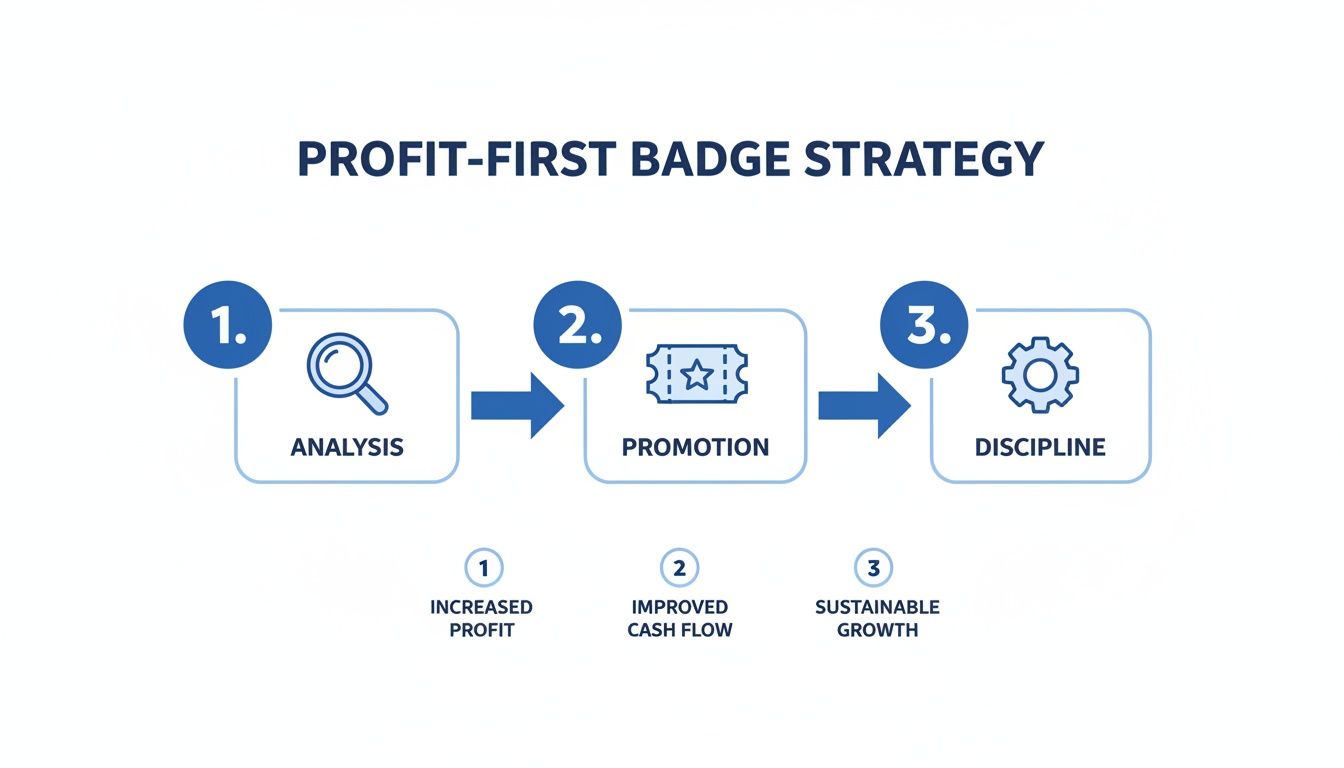
This visual drives home a critical point: getting the badge isn’t a one-and-done event. It’s a continuous loop built on disciplined analysis and promotion.
Pinpointing the Badge-Triggering Price
First, figure out the exact price point needed to trigger the badge. This means a meticulous audit of your ASIN’s 30-day pricing history. Log into Seller Central, pull the pricing data, and find the absolute lowest price your product sold for in the last month.
You must account for everything—brief weekend sales, coupon-adjusted prices, or even a momentary price drop you forgot about. The “badge-triggering” price must be at least $0.01 lower than that 30-day low.
I see brands fail here constantly because they only look at their ‘list price.’ Amazon’s algorithm doesn’t care; it only sees the final sale price, including all discounts. A single overlooked price drop from three weeks ago will kill your entire effort before it starts. Be obsessive.
Once you have your magic number, pick the right tool for the job. You have several options, each with pros and cons.
Comparing Promotion Types for Badge Acquisition
Not all promotions are created equal when hunting for the “Lowest Price” badge. The tool you choose impacts your margins, acquisition speed, and the type of customer you attract. Here’s a quick breakdown to help you decide which weapon to pull from your arsenal.
| Promotion Type | Typical Acquisition Speed | Margin Impact | Best For |
|---|---|---|---|
| Coupons | Fast (24-48 hours) | Moderate to High | Quick, targeted price drops to test elasticity or liquidate slow-movers. |
| Prime Exclusive Discounts | Fast (24-72 hours) | Moderate | Driving sales from high-converting Prime members, especially during key events. |
| Sale Price | Slow (Up to 72 hours) | Low to Moderate | Broader, less aggressive price adjustments that don’t require coupon clipping. |
| Lightning Deals | Instant (during deal) | Very High | Massive, short-term velocity spikes for a halo effect on rank. Costly but powerful. |
The right choice depends on your specific goal. For a quick, controlled test, a coupon is perfect. For a major sales event, a Lightning Deal might be worth the investment. For a more sustained push, a Prime Exclusive Discount is a solid middle ground.
Deploying and Monitoring the Change
Let’s say you’ve decided a Prime Exclusive Discount is the way to go. Once you set the promotion live in Seller Central, the waiting game begins. The badge doesn’t pop up instantly; it usually takes 24-72 hours for Amazon’s systems to catch up and award it.
During this window, keep a close eye on the ASIN’s detail page. Refresh it periodically to see when the badge appears. Once it’s live, you’ve nailed the acquisition phase. But the job is far from over.
This badge is a powerful psychological trigger. The ‘Lowest Price in 30 Days’ badge taps into a shopper’s fear of missing out, with data showing traffic increases of 17-45%. That’s on par with top-tier badges like Amazon’s Choice, which has been found to boost glance views by 17% and conversions by 25%—an effect closely mirrored by price-based badges in fast-moving categories.
Validating the Impact with Hard Data
Now it’s time to prove it worked. The badge is a means to an end, not the end itself. Head over to your Business Reports in Seller Central and start tracking these KPIs for the badged ASIN:
-
Glance Views: Is traffic to the detail page up? This tells you if the badge is grabbing attention in search results.
-
Unit Session Percentage (Conversion Rate): Are more window shoppers turning into actual buyers? A healthy lift proves the badge is driving purchase decisions.
-
Units Ordered: This is the bottom line. A clear spike in daily sales confirms the strategy is delivering the velocity you were after.
This validation step is non-negotiable. It gives you the hard data to prove ROI and make an informed decision about rolling this strategy out across other SKUs. Mastering visibility on Amazon is a long game; while the badge gets you noticed, a solid foundation built on advanced AI Amazon Search Optimisation strategies is what keeps you visible long-term.
Amplifying Badge Impact With PPC And DSP
Earning the “Lowest Price in 30 Days” badge isn’t the finish line; it’s the starting gun. Getting the badge is just securing the asset. The real growth comes from weaponizing it. A badge without a full-funnel marketing offensive is a powerful engine left idling—a massive missed opportunity.
The second that badge appears, its conversion potential skyrockets. It transforms from just another product into a high-octane conversion asset. This is where you fuse your pricing strategy with your PPC and DSP campaigns to spin up a powerful, self-reinforcing growth loop.
Supercharging Sponsored Products Campaigns
Once a product earns the badge, reallocate spend intentionally, prioritizing queries where higher conversion creates incremental lift, not just higher ROAS. For your Sponsored Products campaigns, get surgical and strategically crank up bids for your top-performing keywords tied to that ASIN.
The badge is a powerful conversion catalyst, and you’ll see a significant lift in both click-through and purchase rates.
This spike in performance sends all the right signals to Amazon’s ad algorithm. Your ads become more relevant, your quality score improves, and you’ll often see your cost-per-click (CPC) actually go down over time, even with higher bids.
You’re paying for premium placement but getting a much better return on every dollar because the badge is doing the heavy lifting on conversion.
Don’t just throw more budget at it; get surgical with your bids. Pinpoint the highest-intent keywords for your badged ASIN and push them, hard. That little red badge gives you an unfair advantage in the ad auction, and you need to press it.
Leveraging The Badge In Ad Creatives
That badge is pure, instant social proof. It screams “validated deal” to shoppers. This psychological trigger is too valuable to be confined to the product detail page. Your Sponsored Brands and Sponsored Display ad creatives need to reflect this newfound status.
-
Sponsored Brands: Tweak ad copy to call out the exceptional value. Phrases like “Limited-Time Best Price” or “Now at its Lowest Price” stop the scroll and pull in clicks from shoppers who might otherwise tune out a standard ad.
-
Sponsored Display: For on-platform ads, use custom imagery that visually telegraphs the deal. While you can’t add the badge graphic itself, you can use design elements and text overlays that communicate the same message of unbeatable value.
This isn’t just about running ads; it’s about running smarter ads. The badge gives you a fresh, compelling story to tell, and your creatives are the perfect place to tell it.
Closing The Loop With DSP Retargeting
This is where the strategy evolves into a full-funnel machine. Amazon DSP becomes the closing lever, re-engaging shoppers who viewed but didn’t convert once the price signal is active. This is where a disciplined Amazon DSP strategy compounds badge-driven demand. With the badge now active, you have the ultimate closing argument.
Set up DSP retargeting campaigns specifically for your badged ASINs. Serve display ads to audiences who previously visited the product page, reminding them of the item they were considering. The ad creative should prominently feature the product alongside messaging that reinforces the new low price. For many, this is the final nudge they need to pull the trigger.
For brands looking to master these upper-funnel tactics, you can learn more about how to use the Amazon Demand-Side Platform to turn those views into sales.
By building this system, your pricing strategy directly fuels your advertising efficiency. The sales generated from those hyper-efficient ad campaigns, in turn, boost your product’s organic rank and sales velocity.
It’s a flywheel where pricing, PPC, and DSP all work in concert to drive exponential growth.
Navigating The Risks And Advanced Considerations
Executing a powerful badge strategy means seeing around corners. Anyone can recommend a price drop. Real growth partners govern pricing so it drives velocity without damaging brand equity, reseller relationships, or long-term margin.
This is where amateurs get burned, and seasoned brands pull ahead.
The two biggest landmines are reseller conflicts and competitor retaliation. If you’re not prepared for both, you’re walking into a margin-destroying trap.
Protecting Brand Equity And Avoiding Price Wars
First: MAP (Minimum Advertised Price) policies. A poorly executed badge strategy can easily trigger a cascade of MAP violations from your reseller network. This creates channel conflict that poisons partnerships and devalues your brand overnight.
The key is surgical precision. Instead of a blunt, site-wide price drop, use targeted promotions like coupons or Prime Exclusive Discounts. This frames the lower price as a temporary, Amazon-specific event—not a permanent devaluation. That gives you a more defensible position with your retail partners.
Next, anticipate your competitors. The moment your badge goes live, aggressive rivals will notice. If their only move is to match your price, a profit-destroying race to the bottom is guaranteed.
Your best defense is a strong brand and a superior offer that isn’t just about being the cheapest. When you secure the badge, immediately amplify your value propositions—better reviews, faster shipping, superior A+ Content. Make them compete on more than just the price tag.
Strategic Application Across Large Catalogs
Applying this strategy across a massive catalog requires a scalpel, not a sledgehammer. Not every SKU is a good candidate, and a blanket approach will torch your margins. You need a clear framework for picking your battles.
The badge delivers the highest ROI on impulse-driven, lower-priced items where a small discount feels significant. A badge on a $15 CPG product often drives a much bigger sales velocity lift than one on a $250 piece of equipment, where brand trust and feature comparisons outweigh a minor price dip.
Historically, Amazon’s ‘Lowest Price in 30 Days’ badge emerged amid antitrust scrutiny in 2019 to enforce fair pricing, and its impact is most pronounced on specific product types. Unlike the sales-based Best Seller badge, which can boost traffic by 45%, this badge rewards pricing discipline and can yield conversion lifts of 25%.
Analysis of over 100,000 products showed the badge excels for lower-revenue items, creating an 81% sales spike in Lawn & Garden while showing flat gains in Clothing. You can get more details from this deep dive into Amazon badge performance.
Building Your SKU Eligibility Framework
Use this framework to assess which SKUs are ripe for a badge-driven push:
-
High Traffic, Low Conversion: Start with products that get plenty of eyeballs but aren’t converting. The badge can be the final nudge needed to push shoppers over the edge.
-
Competitive Categories: Deploy the badge in crowded markets where price is a key differentiator. It helps your product stand out in a sea of lookalikes.
-
Healthy Margins: Only target products with enough margin to absorb a temporary discount without going into the red. Set firm margin guardrails and stick to them.
-
Strong Inventory Position: Never run this play on a SKU with low stock. Driving a massive sales spike only to stock out is a catastrophic waste of momentum that can cripple your Buy Box eligibility. A disciplined Buy Box strategy is essential for any 7- or 8-figure brand looking to protect sales.
Knowing when to pull back is just as important as knowing when to push. If competitors engage in an irrational price war or if the badge isn’t delivering the expected velocity lift, kill the promotion. Protect your brand equity and live to fight another day.
Answering the Tough Questions About the Price Badge Strategy
Even a disciplined, data-driven approach to winning the Amazon lowest price in 30 days badge brings up tricky questions. Let’s cut through the noise and get you the straight answers we give our clients.
How Long Does It Take for the Badge to Show Up?
Don’t expect it to appear instantly. The badge typically shows up within 24 to 72 hours after your price officially becomes the lowest point in a rolling 30-day window.
This lag happens because Amazon’s systems need time to validate pricing data across its massive network. It’s not an automated switch. You have to be sure your new price undercuts every single price point from the last 30 days—that includes any coupon-driven prices or flash sales. Once you make the change, keep a close eye on your product detail page.
If I Raise My Price, Do I Lose the Badge?
Yes. Instantly.
The badge is completely dynamic. The second your price is no longer the “lowest in 30 days,” Amazon yanks it. There’s no grace period.
This isn’t a bug; it’s a feature of a surgical strategy. The goal is often to use the badge for a short, aggressive burst to spike sales velocity and climb organic rankings. Afterwards, you can ease the price back up to a more sustainable level. You’ll sacrifice the badge, but you keep the improved sales momentum and higher search placement it helped you earn.
Does the Badge Actually Work in Every Category?
Absolutely not, and assuming it does is a fast way to torch your margins. The badge’s impact varies wildly by product and customer. It lands the biggest punch in hyper-competitive markets where price is a huge part of the buying decision.
Here’s how we break it down:
-
High-Impact Categories: Think consumer electronics, home goods, CPG, and other consumables. In these spaces, shoppers are extremely price-sensitive, and the badge can be a massive conversion driver.
-
Lower-Impact Categories: For high-ticket, brand-driven purchases like luxury goods or specialized industrial equipment, the badge has far less sway. Shoppers here are focused on brand trust and features, not saving a few bucks.
-
Price Point Matters: The badge is generally most effective for items under $100. A 10% discount on a $30 product feels like a steal to an impulse buyer, while a 5% discount on a $500 item barely registers.
Think of the badge as an amplifier, not a magic wand. It works best on products that already have a solid foundation of traffic and reviews but need an extra nudge to turn browsers into buyers. It won’t save a failing product.
Will Chasing This Badge Devalue My Brand?
It can if you handle it like a rookie. Constant, aggressive discounting is the quickest way to teach customers to never pay full price, gutting your brand’s perceived value. The key is to avoid making your price drops look like a desperate, permanent fire sale.
This is where surgical execution comes in. Frame the discount as a strategic, limited-time event. When you pair it with a coupon, a Prime Exclusive Discount, or a timed sale, you position the drop as a special offer. This creates urgency and signals value without screaming “clearance.”
A well-planned Amazon lowest price in 30 days badge strategy protects brand equity by making the discount feel like a smart find for a savvy shopper, not a desperate race to the bottom.
At Adverio, we turn pricing from a defensive reaction into an offensive weapon. If your growth has stalled and you’re tired of bleeding margin on discounts that don’t work, it’s time for a new playbook. We build profit-first badge strategies that drive real velocity and sustainable rank.
Stop discounting blindly. Start governing pricing like a growth lever.