


Table of Contents
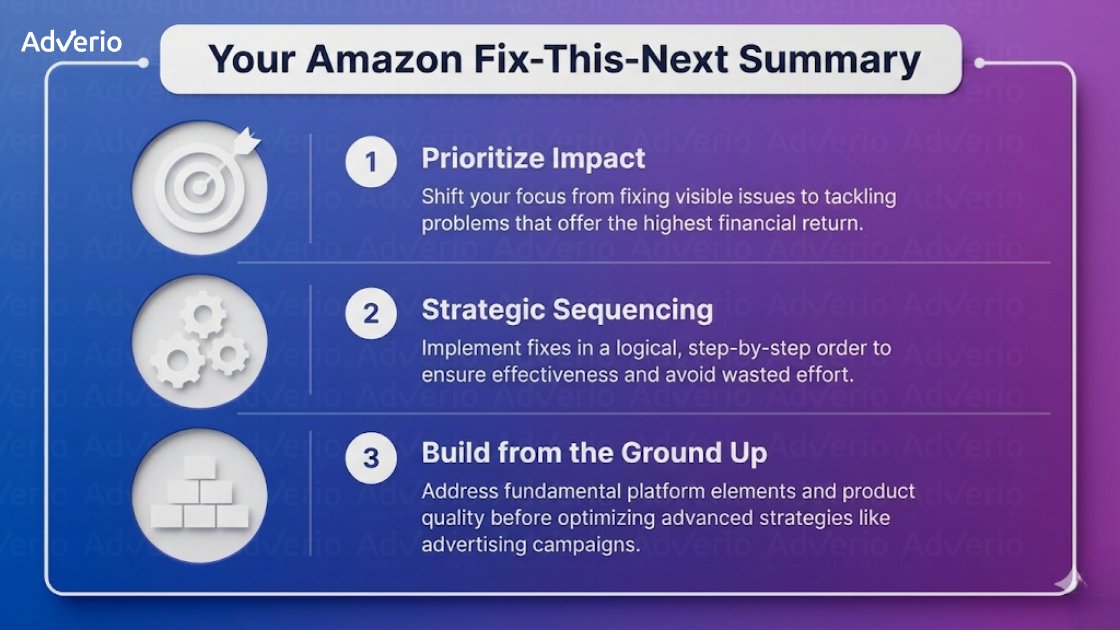
Most Amazon operators don’t have a workload problem. They have a sequencing problem.
They keep fixing the loudest issue instead of the most expensive one. So they rewrite campaigns while listings are broken, push more spend into ASINs with pricing alerts, and celebrate cleaner dashboards while profit keeps slipping.
That’s why the idea behind amazon fix this next matters on Amazon more than almost anywhere else. Marketplace issues stack. If you fix them out of order, one fix cancels the next. Busy teams call that progress. Operators who own a P&L call it waste.
If you run a serious brand on Amazon, stop asking, “What should we work on?” Start asking, “What must be fixed first so every later action pays off?”
-

Amazon fix this next: the 5-layer framework that sequences profit over busywork 15
Fixes only compound when they happen in the right order.
Why Sequence Matters More Than Speed
If you’re pouring time into Amazon PPC management before checking whether the listing can trade and convert, you’re not optimizing. You’re paying tuition to Amazon.
This is the hidden tax inside large accounts. Teams work hard. Agencies stay active. Meetings multiply. Sales don’t move the way they should, and profit gets thinner because the account is being “improved” in the wrong order.
The gap in standard business advice is obvious once you’ve managed real marketplace complexity. A gap analysis of Fix This Next discussions found 80% focus on general SMBs, while ignoring eCommerce specifics like rising TACoS that averages 25-35% for mid-tier brands, plus variant bidding leaks that can cost 15-20% of margins according to Fix This Next. Generic business prioritization is not enough for Amazon. Amazon has platform-specific failure points that can shut down growth while your dashboard still looks busy.
What wrong sequence looks like
A few common examples:
-
Ads get rebuilt while price alerts are killing visibility
-
Creative gets refreshed while suppressed listings stay unresolved
-
Budget gets increased on ASINs that should be deprioritized
-
Expansion work starts before core retail readiness is stable
That’s not a talent issue. It’s an order-of-operations issue.
Why operators keep making this mistake
Because different teams diagnose through the lens of their function. Media people see media problems. Catalog people see content problems. Marketplace operators need a broader operating system.
That’s the point of a disciplined framework and a sharper GMAP strategy for Amazon sellers. You need a way to identify the highest-revenue-impact fix first, then move up the chain without skipping steps.
The Five Diagnostic Layers of the Fix-This-Next Framework
The framework has five layers, built in a strict order. Break the lower layer and the work above it turns into expensive motion that looks productive on a weekly report and destroys profit on a monthly P and L.
Layer 0 Account State
Start with tradeability.
If policy flags, account health issues, suppressed offer conditions, or Buy Box loss are limiting your ability to sell, stop there and fix them first. An account that cannot trade normally does not need optimization. It needs clearance.
Priority: Immediate. Same day. All hands.
What breaks when this layer is unstable: revenue continuity, visibility, team focus, and recovery speed.
Layer 1 Conversion Foundation
This is the retail-readiness layer. It is fundamental to overall account health.
Layer 1 covers listing quality, pricing integrity, images, review profile, content clarity, and whether the ASIN can convert qualified traffic after the click. A common failure point is Amazon’s Potential High Price Error. These alerts suppress visibility without warning and stall sales on otherwise healthy ASINs. If that issue is active, any traffic work in Layer 2 is being pointed at a retail problem, not a media one.
Skip the busywork mindset here. Better bids will not rescue a weak detail page, a pricing flag, or a listing customers do not trust.
Practical rule: If the listing cannot hold visibility or convert qualified traffic, do not judge the ad account yet.
Layer 2 Traffic Efficiency
Paid traffic comes third, not first.
At this layer, assess campaign structure, bid control, search term coverage, waste, incrementality, branded versus non-branded mix, and whether spend is producing profitable demand instead of covering up conversion failure. Many operators waste the most time at this level because ads are easy to edit and easy to report on.
Easy does not mean important.
Traffic efficiency is one layer of a broader Amazon PPC management system. When it gets treated as the whole system, the lower layers stay broken and the account stays expensive.
What breaks when this layer is unstable: TACoS rises, budget gets trapped behind weak ASINs, and paid media starts protecting existing revenue instead of creating new profitable volume.
Layer 3 Catalog Economics
Now ask the question busy teams avoid. Are these even the right products to support?
Layer 3 looks at SKU mix, contribution margin, variant structure, inventory position, and strategic value by ASIN. Some products deserve more budget. Some deserve containment. Some deserve nothing. If your catalog economics are wrong, strong media execution just scales the wrong decisions faster.
This is the layer agencies often skip because it forces harder conversations about assortment, margin, and product truth instead of campaign mechanics.
Layer 4 Channel Expansion
Expansion sits at the top because it should be earned.
New marketplaces, Amazon DSP growth, fresh launches, and broader retail media bets make sense only after the base Amazon system is stable and profitable.
Otherwise, you spread the same leakage across a larger footprint. That is how brands get bigger while keeping less cash.
The operators with the best discipline sequence work across ads, catalog, and content under a unified growth system after the lower layers are under control. That is the AMOS doctrine in practice. Fix the first revenue-breaking layer, then move up. Any other order is an activity pretending to be a strategy.
How to Run the Diagnostic in 30 Minutes
You don’t need a week-long audit to find your next move. You need a first-pass diagnostic that tells you where the stack first breaks.

The 30-minute pass
-
Open Account Health first. Look for warnings, policy issues, performance flags, or anything that threatens tradeability.
-
Pull suppressed listings. Don’t scan the whole catalog equally. Start with top revenue ASINs.
-
Check pricing alerts and listing integrity. If a top seller has a pricing-related visibility issue, that outranks campaign work.
-
Review conversion by ASIN over the last 90 days. You’re looking for deterioration in key products, not random noise.
-
Pull TACoS by ASIN. Find where spend is rising while retail readiness is weak.
-
Review margin or contribution if available. If not, at least identify which SKUs are consuming spend without strategic value.
If you manage this through fragmented exports, you’ll move slowly and miss cross-functional cause and effect. A centralized view through marketplace business intelligence makes this process cleaner and harder to fake.
The rule that keeps you honest
Start at the lowest layer with a red flag. Not the most annoying issue. Not the issue your agency likes solving. The lowest unstable layer wins.
If Layer 1 is broken, don’t punt on Amazon listing optimization while media keeps spending now. Fix the foundation first.
The Fix-This-Next Decision Table
Operators misread symptoms all the time. This table forces the issue.
| What You See (The Symptom) | Where to Start (The Layer) |
|---|---|
| TACoS is rising on a core ASIN while conversion is sliding | Layer 1 |
| A listing update fails and ad performance deteriorates soon after | Layer 1 |
| Campaigns look clean but sales stay flat | Layer 1, then Layer 3 |
| Strong sessions but weak unit movement | Layer 1 |
| Good conversion on a product that still can’t scale profitably | Layer 3 |
| Team wants to launch DSP while core ASINs still have basic instability | Layer 0 or 1 first |
One of the easiest mistakes to make is treating a retail data problem like a media problem. Amazon Error Code 8541 can halt inventory updates and suppress an ASIN, and unresolved cases often inflate TACoS by 15-25% because lost sales velocity makes paid traffic look worse than it is, unresolved cases inflate TACoS because lost sales velocity makes paid traffic look worse than it is. The symptom shows up in Layer 2. The cause lives in Layer 1.
Why Most Agencies Fix in the Wrong Order
Most agencies don’t fail because they’re lazy. They fail because they’re trapped inside their specialty.
A PPC agency gets retained to improve PPC, so it finds a PPC problem. A listing shop gets hired to improve content, so it finds a copy problem. That’s not diagnostic integrity. That’s confirmation bias with an invoice attached.
The structural reason this keeps happening
Amazon doesn’t rank products based on ad inputs alone. Amazon’s recommendation engine drives a significant share of total sales and processes signals well beyond ad clicks, including inventory levels, conversion rates, and return history. If an agency only watches Layer 2, it’s blind to the signals in Layer 1 and Layer 3 that decide whether ads reach high-intent shoppers efficiently in the first place.
That’s why narrow-channel thinking produces uneven results.
-
Media-only teams overprescribe restructuring
-
Creative-only teams overprescribe listing rewrites
-
Operations-only teams overprescribe catalog cleanup
-
Profit-led operators sequence across all of it
A proper Amazon account management model doesn’t ask, “What can we improve?” It asks, “What is the first broken layer that is distorting every metric above it?”
If you want a cleaner version of the same argument, this is the debate around scaling Amazon profitability over ROAS. ROAS can look acceptable while profit quality gets worse. Sequence exposes that. Siloed service lines hide it.
Agencies often optimize what they sell. Serious operators prioritize what the P&L needs.
How Adverio Applies the Fix-This-Next Framework
Adverio uses AMOS doctrine to sequence work before any campaign rebuild, listing rewrite, or scale plan gets approved. That’s the point. Sequence first. Tactics second.
The Growth Cultivator framework applies this diagnostic stack to identify the biggest constraint on profit, then clears it in order. If the issue is account state, that gets fixed first. If the issue is conversion, traffic waits. If the issue is catalog economics, budget gets reallocated before expansion starts.
The same principle applies across every lever in the account. Scale only works when the base layer is sound. Expansion multiplies what already exists. If the foundation is leaking, you’re just spreading that leak further.
If you want a profit-first sequence instead of random acts of optimization,
Book your ROI Forecast at Adverio.
Frequently Asked Questions
What if I have red flags in multiple layers?
Start with the lowest-numbered layer. Always. If Layer 0 is unstable, nothing else matters yet. If Layer 0 is fine but Layer 1 is broken, don’t touch Layer 2. The lower layer is the prerequisite for the upper one. That isn’t theory. That’s how Amazon account mechanics work.
How often should I run this diagnostic?
Run a full diagnostic quarterly. Run a lighter pass on Layer 0 and Layer 1 every week. That cadence keeps small problems from turning into expensive recovery projects. Serious operators don’t wait for a month-end report to discover a foundational issue.
What if my TACoS is rising but my agency says it’s just a bidding problem?
Challenge that assumption. Ask for the ASIN-level conversion trend, listing status, pricing integrity, and retail readiness before approving more traffic changes. If you’re dealing with a conversion problem, your ad account is only reporting the damage. If you need a sharper lens, start with this breakdown of why TACoS keeps rising.
Can I skip straight to expansion if my brand is growing?
You can. You just shouldn’t. Growth can hide instability for a while. Then the cracks show up as weaker profitability, patchy visibility, and operational drag. Expansion magnifies strengths and weaknesses equally. If the core stack is messy, expansion spreads the mess.
Is the Fix-This-Next framework only useful for large brands?
No. It matters more as complexity rises, but the logic works at any scale. The bigger the catalog, the more dangerous bad sequence becomes. Larger brands just pay more for the mistake because they waste more media, more labor, and more inventory support while fixing the wrong thing first.
You don’t need more activity. You need the right order of operations. Adverio helps brands find the first broken layer, fix it fast, and turn marketplace chaos into controlled profit growth. Book your ROI Forecast if you’re done paying for busywork.