



Let’s be blunt: if your Amazon sales have flatlined, the problem isn’t your ad spend, it’s your strategy. An effective Amazon selling strategy isn’t a list of tactics. It’s a profit system—one that aligns catalog, ads, pricing, inventory, and operations toward a single outcome: sustainable market share.
Too many brands treat Amazon like a sales channel instead of what it actually is: a governed marketplace where every decision compounds or breaks profit. They throw money at ads, tweak a few listings, and hope for the best. This isn’t a strategy; it’s gambling with your margins. The winners see Amazon for what it is: a complex, competitive ecosystem where only the most integrated plans survive.
A powerful Amazon selling strategy moves beyond isolated actions. It’s not about running a few Sponsored Products campaigns or occasionally updating A+ Content. It’s a unified plan that connects every lever, ensuring each action supports the others to drive profitable growth, not just vanity revenue.
What Is an Amazon Selling Strategy?
Table of Contents
An Amazon selling strategy is an integrated plan designed to scale a brand profitably on the marketplace. It’s not just launching products or running ads; it’s a comprehensive framework that combines:
- Positioning: How your brand and products stand out against competitors.
- Channel Mix: How Amazon complements your other sales channels, like DTC.
- Fulfillment: The operational backbone (FBA, FBM, or hybrid) that ensures customer satisfaction and Buy Box ownership.
- Content & Creative: High-conversion listings, A+ Content, and storefronts that turn traffic into sales.
- Marketing & Advertising: A full-funnel approach using PPC and DSP to drive visibility and capture market share.
- Analytics & Reporting: Using the right KPIs (like TACoS, not just ACoS) to make data-driven decisions.
- Compliance: Navigating Amazon’s ever-changing rules to avoid costly account issues.
A real strategy aligns margin targets, inventory reality, and execution capacity before ads ever scale. Anything less is just a collection of disconnected tasks doomed to fail.
The 6 Pillars of a Winning Amazon Selling Strategy
Building a dominant brand on Amazon isn’t about finding a single silver bullet. It’s about mastering six interconnected pillars that create a sustainable growth engine. If one pillar crumbles, the whole structure fails. This isn’t a checklist; it’s a strategic framework where each part reinforces the others.
This flowchart shows how it all connects. Your main strategy sits at the top, powered by the tactical pillars like PPC, listing optimization, and operations.
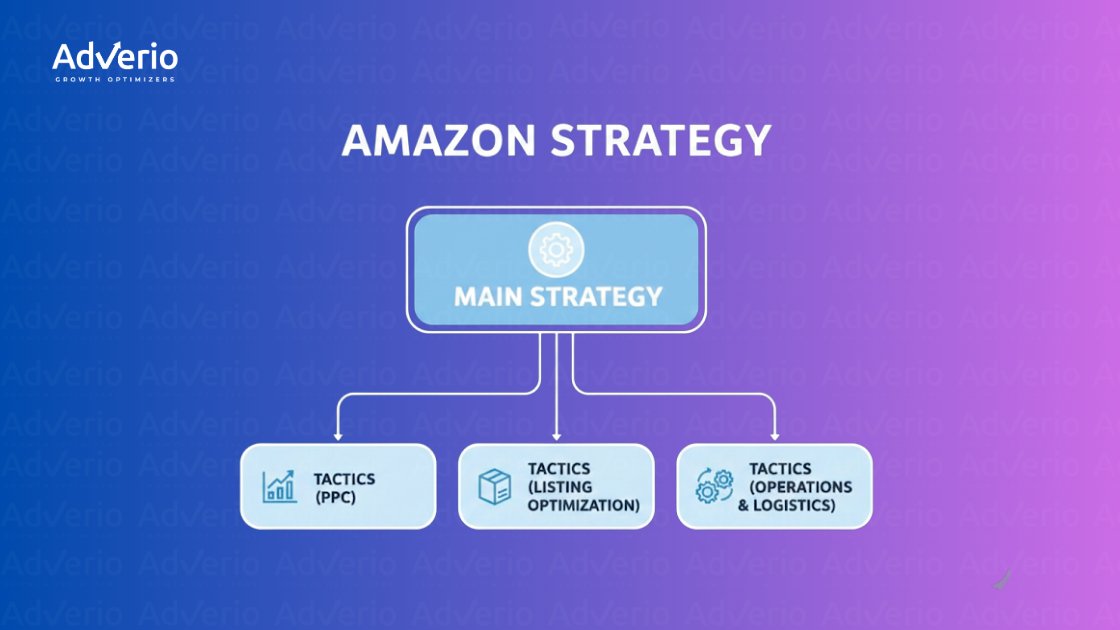
The takeaway? Tactics don’t operate in a vacuum. They must work in concert to power the growth engine, not run as isolated projects. Let’s break down the six pillars.
Pillar 1: Product & Market Fit
It starts here. Before you spend a dollar on ads, you must validate demand—and, more importantly, profitability. This means enforcing catalog governance: knowing exactly which SKUs deserve capital, traffic, and operational attention. A winning Amazon selling strategy identifies “hero” SKUs with proven sales velocity and healthy margins, then concentrates resources there instead of chasing empty top-line revenue across the board.
Pillar 2: Listing Optimization
Your product detail page is your digital storefront. It’s where traffic becomes revenue. Conversion-focused Amazon listing optimization is revenue engineering—every image, bullet, and module exists to remove friction and increase conversion.
It’s about:
- Keyword-Rich, Conversion-Focused Copy: Writing titles, bullets, and descriptions that answer a customer’s questions before they ask, always focusing on benefits over features.
- Compelling Visuals: Using high-res images, lifestyle shots, infographics, and video to show the product in action and build instant trust.
- Enhanced Content: Leveraging A+ Content, Brand Story, and video to create an immersive experience that crushes competitors.
Pouring money into ads without a highly optimized listing is like pouring water into a leaky bucket.
Pillar 3: Advertising & Visibility
Once your listings are primed to convert, the next pillar is driving the right kind of traffic. A sophisticated advertising strategy is essential for defending your brand’s turf, attacking competitors, and capturing new customer segments. This is where Amazon PPC management built for incrementality becomes a growth lever—not a spend engine. When listings, pricing, or inventory are broken, ads only accelerate the damage. This means a multi-layered PPC campaign structure (defensive, branded, competitor, category) and leveraging external traffic with tools like Amazon Attribution. For advanced brands, this includes programmatic buys via Amazon DSP audience strategy to build and retarget high-intent audiences.
Pillar 4: Fulfillment & Logistics
Your fulfillment model—FBA vs. FBM vs. a hybrid approach—has a direct and brutal impact on your Buy Box ownership, Prime eligibility, and customer reviews. An unreliable logistics operation will single-handedly sabotage an otherwise brilliant strategy. The goal is control: Buy Box stability, Prime eligibility, and zero stockouts on hero SKUs. Sharp inventory management tactics and maintaining a high Inventory Performance Index (IPI) score aren’t optional; they’re non-negotiable for scalable growth.
Pillar 5: Brand & Reputation Management
In a crowded marketplace, trust is your most valuable currency. This pillar is about proactively building and protecting that trust. It starts with enrolling in Brand Registry to access powerful tools that protect your IP. From there, it extends to actively managing customer reviews, monitoring Voice of the Customer (VOC) metrics to spot issues early, and defending your brand against hijackers and counterfeiters. Reputation decay is silent—and expensive. If you’re not actively defending it, you’re losing it.
Pillar 6: Analytics, KPIs, and Iteration
The final pillar ties everything together. A data-driven approach is what separates amateurs from pros. You must track the right Key Performance Indicators (KPIs) to make smart, informed decisions. Don’t fall into the trap of Optimization Myopia—obsessing over ACoS while ignoring the bigger picture. Track TACoS (Total Advertising Cost of Sales), conversion rate, sales velocity, and IPI. Use this data to pivot: decide which products to scale, which to discontinue, and where to reallocate your budget for maximum impact.
Matching Strategy to Business Model
There’s no universal Amazon selling strategy. The right playbook is dictated entirely by your business model. Applying the wrong one is a surefire way to burn cash and miss opportunities. Your goals, margins, and operational capabilities define which levers you should pull.
DTC Brands Launching on Amazon
For established Direct-to-Consumer brands, the challenge is tapping into Amazon’s audience without wrecking your brand equity or DTC profitability. Your focus should be on controlled exposure using Amazon to acquire incremental customers without cannibalizing DTC margin.
Amazon-Native Private Label Brands
If your brand was born on Amazon, you’re playing a different game. Your strategy needs to be aggressive, data-obsessed, and built for rapid market share capture. This means governed launch velocity scaling demand without breaking margin, inventory, or review compliance. You can find more details on how to use SKU-level data to make smarter decisions by utilizing SKU economics on Amazon.
Resellers / Arbitrage / Wholesale
For resellers, brand building takes a backseat to pure operational excellence. Your strategy revolves around three things: margin, velocity, and efficiency. You win by being smarter and faster. Success is a mathematical equation: sourcing profitable products, winning the Buy Box, and managing inventory with surgical precision.
The Amazon marketplace’s explosive growth is powered by third-party sellers, who now account for a staggering 62% of total sales—up from just 45% in 2015. For everyone, this means competing in a high-volume world where operational mastery is the key to survival. You can dig into more insights about this critical shift on amzprep.com.
Common Amazon Selling Strategy Mistakes
Even the sharpest brands fall into predictable traps that kill profitability and stall growth. These aren’t rookie mistakes; they’re strategic blind spots that emerge when scale outpaces strategy.
The most common—and dangerous—of these is what we call Optimization Myopia. This is the obsessive focus on a single, often misleading, metric like ACoS. Brands chase a lower ACoS, thinking it signals efficiency, while competitors steal their market share. A low ACoS is meaningless if your total sales are flat.
Other critical errors include:
- Over-indexing on Ads Without Margin Control: Pouring money into PPC can’t fix a broken business model. Without a firm grasp on your margins per SKU, you’re just buying revenue at a loss.
- Underinvesting in Listing Quality: Your listing is the final checkpoint for conversion. No amount of ad spend can fix a page with lazy copy, low-quality images, and a weak value proposition. A low conversion rate is a tax on every dollar you spend on traffic.
- Ignoring Inventory and Operations: Growth on paper means nothing if you can’t fulfill orders. Poor inventory health and frequent stockouts translate directly to lost sales and decreased search ranking. Operations are the foundation of profitable growth.
- Not Planning for Scale: Hitting seven figures is one thing; building the infrastructure for eight is another beast. Many brands hit a wall because their teams, tools, and partners were built for a smaller scale. To avoid a broken strategy, it’s crucial to understand and sidestep the classic errors with Amazon Ads and other common growth pitfalls.
Identifying these common growth pitfalls for established brands is the first step toward building a more resilient, profitable operation.
Why a Strategy Partner Matters
Trying to navigate the Amazon labyrinth alone is a recipe for mediocrity. The gap between a seven-figure seller and a dominant eight-figure brand isn’t a bigger ad budget—it’s a strategic framework that turns operational excellence into a weapon. That’s why working with a strategic Amazon growth partner changes the equation. This is where a true partner becomes your unfair advantage.
Vendors execute tasks. Strategic partners govern outcomes. A strategic partner like Adverio designs and executes a holistic, scalable growth plan built for one thing: profitable market share capture.

A partner operates as an extension of your team, bringing specialized expertise in PPC, DSP, creative optimization, and catalog management under one roof. This integrated approach is everything. A dedicated partner with proprietary systems, like our Growth Cultivator framework, has the bandwidth and tools to spot the hidden profit opportunities your team is too swamped to see. We align strategy with incrementality, margin protection, and defensible market share, not vanity growth.
The real value isn’t in managing campaigns; it’s in architecting a comprehensive Amazon selling strategy that aligns every single function with tangible, profitable results. An effective strategy requires more than knowing the rules. It requires a team that has already mastered the game. A strategic partner doesn’t just help you compete—they give you the plan, the tools, and the expertise to dominate.
Ready to replace guesswork with a governed Amazon growth system?
Frequently Asked Questions
What’s the single most important part of an Amazon strategy?
Product-market fit, expressed through world-class listing optimization. If your product page doesn’t convert, nothing else matters. You can’t advertise your way out of a poor offer or a weak listing. It’s the foundation of every other pillar.
How often should I review my strategy?
Your strategy should be a living document. Conduct a major review quarterly to align with business goals. However, ad performance, keyword rankings, and inventory health require weekly check-ins, while daily glances at ad budgets and stock levels for hero SKUs are non-negotiable.
Can we succeed on Amazon without using FBA?
It’s possible, but you’re choosing to play on hard mode. Fulfillment by Amazon (FBA) is deeply integrated into the platform’s algorithm, giving you a massive advantage in winning the Buy Box and securing the Prime badge. A successful Fulfillment by Merchant (FBM) strategy demands a bulletproof logistics operation. For most brands, a hybrid model is the sweet spot: use FBA for high-velocity heroes and FBM for long-tail or oversized items.
What’s the real difference between ACoS and TACoS?
Getting this wrong is a costly mistake. ACoS (Advertising Cost of Sales) measures ad spend against sales generated from ads. It’s a simple efficiency metric. TACoS (Total Advertising Cost of Sales) measures ad spend against your total sales (organic and ad-driven). TACoS answers the real question: “Is my advertising growing my overall business?” A low ACoS is a vanity metric if total sales are flat. A declining TACoS proves your ad spend is creating a halo effect, lifting organic rank and growing your brand’s market share. An effective Amazon selling strategy is always built to drive TACoS down over time.