



If you’re running a premium brand on Amazon, you’ve seen it happen: cheaper competitors show up, undercut your price with a “good enough” alternative, and start peeling away market share from the bottom of the category.
Most brands react one of two ways:
(1) Ignore the low-cost competitors and hope they disappear, or
(2) Join them in a race to the bottom that destroys margins and brand equity.
Both options lose.
How Premium Brands Can Win Against Low-Cost Amazon Competitors
There is a smarter third path — and it’s one used by brands like Ridge Wallet, Shinesty, and countless consumer giants: launch a fighter brand.
A fighter brand lets you “knock yourself off” intentionally:
- a lower-priced alternative
- a simplified assortment
- under a different brand name
- engineered specifically to win the price-sensitive shopper without dragging down your flagship brand
It becomes a defensive moat around your premium positioning—absorbing price pressure, stealing back share from bargain players, and letting your main brand stay premium where it belongs.
Why a Fighter Brand Works on Amazon
Instead of letting a sea of random, low-quality brands dictate the price point in your category, you get to control the game. You intentionally “knock yourself off” with a product that has:
- The Same Core Benefit: It solves the main problem your customers have, just without all the bells and whistles.
- A Lower Price Point: It’s priced to compete directly in the value segment.
- A Simplified Offering: Think less complex packaging, bulk offers, fewer features, or a more limited assortment.
- Different Branding: This is critical. It operates under a completely new brand name to protect your premium brand’s hard-won equity.
One of our founders described it perfectly as “just knocking yourselves off” to reclaim the market share you’re losing and would otherwise always lose. When you do it right, this play is incredibly effective. But it has to be driven by data, not just vibes. Knowing your rivals inside and out is the first step, and using advanced Competitor AI Analysis Tools can give you the intel needed to outmaneuver them from the start.
The core idea is simple: If someone is going to sell a more affordable version of your product, it might as well be you. This strategy allows you to control the narrative and capture revenue that would otherwise go straight to a competitor.
This guide will walk you through exactly how to build and launch a successful fighter brand—based on a recent strategy sprint we ran with a premium men’s underwear brand. It’s time to stop reacting and start fighting back on your own terms.
Step 1: Find the Price/Pack “Power Band” in Your Category
A winning fighter brand isn’t built on assumptions; it’s engineered with data. You have to find the “power band” in your category—that sweet spot where high volume, real customer demand, and competitor weakness all intersect. Simply launching a cheaper version of your hero product is a surefire way to fail.
You need to go deep. This means digging past surface-level observations and getting into the numbers that show how shoppers actually behave. A gut feeling about pricing just won’t cut it when you’re up against a competitor who has already mapped the battlefield. Real strategy starts with a forensic analysis of the Amazon landscape.
When a cheaper rival appears, premium brands often face a tough choice. This chart lays out the typical decision path, showing exactly why launching a fighter brand is a much smarter move than ignoring the problem or starting a destructive price war.
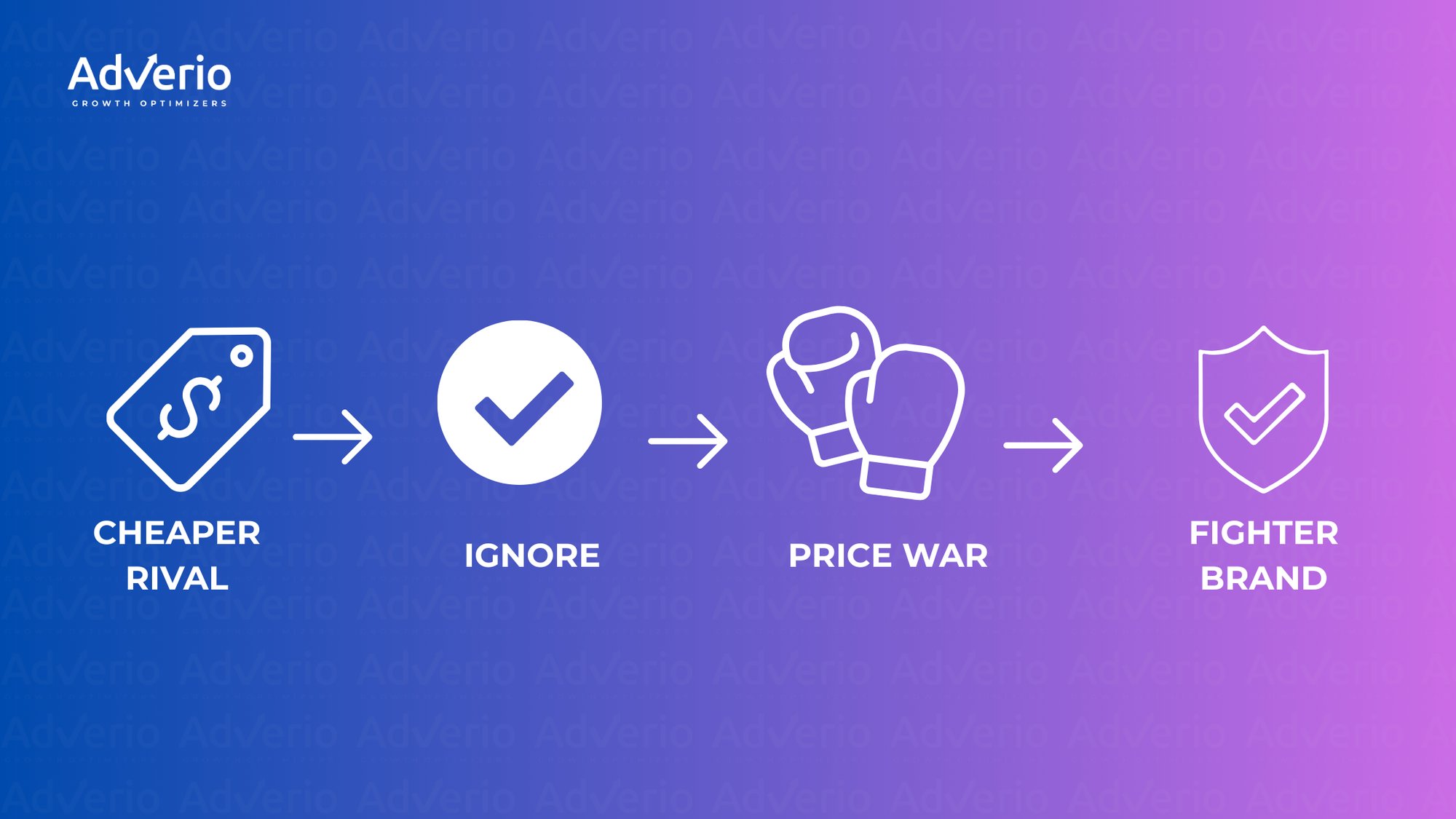
As you can see, inaction leads to lost market share, and a price war just tanks your margins. A fighter brand, on the other hand, creates a strategic defense that protects your core business without sacrificing profitability.
Map the Price and Pack Landscape
First things first: map your entire category, paying close attention to price per unit and pack size. Don’t guess where the volume is; prove it. In our underwear category analysis, we discovered that value competitors were all clustered around $7.00–$7.50 per pair. This wasn’t just a popular price—it was where roughly 50% of total revenue for the non-Hanes segment was concentrated.
To do this right, you need to map out:
- Price Per Unit: Forget the listing price. You need the cost per individual item. A $45 6-pack is really a $7.50 unit price.
- Pack Size Velocity: Are 3-packs, 6-packs, or 8-packs moving the most units? Find the configuration that shoppers can’t get enough of.
- Revenue Share by Price Bucket: Break the category into price tiers (e.g., $15-17, $27-29) to see where customers are actually spending their money.
This isn’t something you can figure out by just browsing Amazon. For a detailed breakdown of the tools that make this kind of analysis possible, check out some of the top Amazon product research tools available. These platforms let you see what’s really driving sales behind the scenes.
To pinpoint your fighter brand’s ideal market position, you need to analyze several key data points. This checklist breaks down what to look for and what it means for your strategy.
Fighter Brand Analysis Checklist
| Data Point | What to Look For | Strategic Implication |
|---|---|---|
| Price Per Unit | The dominant price point where most revenue is generated, not just the lowest price. | This is your target price. Aim to be competitive within this “power band.” |
| Pack Size Velocity | The pack configuration (e.g., 3-pack, 6-pack) with the highest sales volume and BSR. | This becomes your hero SKU configuration. Don’t guess; follow the demand. |
| BSR History | Competitors with a consistently low BSR over 90-180 days. | Identifies rivals with sustained demand, not just flash-in-the-pan success. |
| Promotional Cadence | Patterns in competitor price drops and their impact on BSR. | Reveals how often you’ll need to run promotions to maintain rank and market share. |
| Revenue Concentration | The percentage of category revenue captured by the top 1-3 value ASINs. | Shows how much market share is up for grabs if you can successfully disrupt the leaders. |
By systematically working through this checklist, you transform your fighter brand from a reactive defense into a proactive, data-driven market entry designed for maximum impact.
Analyze Historical Performance with BSR
Best Sellers Rank (BSR) history is your crystal ball. A consistently low BSR signals sustained demand, not just a one-off sale. By tracking the BSR of key value competitors over time, you can see exactly how their pricing and promotions affect their rank and, by extension, their sales volume.
A fighter brand’s success is defined before it ever launches. The goal is to create a precise, data-backed target like, “We want our fighter brand’s main listing sitting right in the heart of that $7.50-per-pair power band, with a 6 or 8-pack that looks like a no-brainer.” This clarity removes guesswork and aligns your entire team.
For example, we found one competitor whose hero 6-pack was pulling in ~24% of the category’s revenue all by itself. Their BSR history told a clear story: drop the price, BSR improves. As rank starts to slip, run another promo. This isn’t just random discounting; it’s a calculated rhythm designed to hold onto market share.
At Adverio, our proprietary Profit Pulse System is built for this exact scenario. It slices and dices category revenue and BSR data to identify the precise price and pack size that will cause the most disruption. This ensures your fighter brand is engineered for success from day one, turning what could be a risky guess into a calculated strategic strike.
Step 2: Decide What IP You’ll Carry Over (Your “Unfair Advantage”)
The whole point of a fighter brand is to offer a “stupidly good deal” on the core performance that made your flagship product famous. This isn’t about slapping your logo on a cheaper, lower-quality version. It’s a surgical decision about which parts of your intellectual property (IP) are absolutely non-negotiable.
This is where you build a value proposition that generic knock-offs on Amazon just can’t touch. You have to pinpoint the core technology, proprietary materials, or unique functional benefits that give you a real, defensible edge. The entire play hinges on keeping the one or two things that create a massive performance gap between you and the cheap alternatives.
Isolate Your Core IP
First, you need to list your brand’s non-negotiables. What’s the one thing that, if you took it away, would turn your product into just another commodity? I’m not talking about aesthetics or fancy packaging here; I mean the fundamental reason customers pay a premium for your brand in the first place.
We saw this play out perfectly with the premium men’s underwear brand. Their advantage was built on two pillars:
- Proprietary Pouch Technology: A unique design that competitors in the value space couldn’t legally or easily copy.
- Premium Fabric: A custom-developed material blend that offered superior comfort, something they’d spent months perfecting.
When we looked at the value competitors crowding the $7.50-per-pair price point, they all offered nice enough materials, but none had any real pouch technology. That was the opening. The fighter brand’s value proposition became instantly clear and powerful: “Value price. Premium pouch and fabric.”
The goal is to make the fighter brand feel like an inside deal on the core performance you’re known for. You’re not just selling a cheap product; you’re selling your best feature at an unbeatable price.
This brand knowingly accepted the extra sewing complexity and line time needed for the pouch because they understood it was their unfair advantage. They were still able to hit that critical $7–$8 per pair price point by focusing only on multi-packs instead of singles, which offset the higher unit cost with pure volume.
Strip Away the Premium Theater
Once you’ve locked in your core IP, it’s time to get ruthless with everything else. We call this stripping away the “premium theater”—all the bells and whistles that signal luxury but do absolutely nothing for the product’s core performance.
Your fighter brand needs to be a lean, mean, value-delivery machine.
Here’s what you cut:
- Luxe Packaging: Forget the expensive boxes, custom inserts, and high-touch unboxing experience. Think polybags.
- Expensive Designs: For the underwear brand, this meant getting rid of complex, seasonal prints that required more costly dye processes. Solid colors only.
- Extra Accessories: If your premium product comes with add-ons like a travel bag, leave them out.
- Deep Brand Story: The fighter brand is about function and price. The elaborate narrative belongs to the flagship.
The result is a product that is functionally miles ahead of its price-point competitors but looks and feels much simpler than your flagship. This separation is critical. It prevents brand confusion and protects your premium positioning.
While competitors are stuck in a race to the bottom on price, your fighter brand wins by being the best value. You’re delivering a key piece of premium technology at a mass-market price. It’s a subtle but crucial distinction that lets you dominate the value tier without destroying your brand.
Step 3: Engineer Packs for Amazon (Not Just Your DTC Store)
You can’t just copy your direct-to-consumer bundles onto Amazon and expect them to work. The platform is a totally different beast, and a winning fighter brand has to be engineered from the ground up for the A9 algorithm and the unique psychology of Amazon’s value shoppers.
This is not a place for subtlety. Value shoppers on Amazon are ruthless calculators, instantly breaking down a multi-pack price into a per-unit cost. If your competitor is offering six for the price of your three, you’ve already lost the mental math game before they even click.
Build Your Brand Around Multi-Packs
In almost every value-driven category, multi-packs consistently crush singles. The reasoning is simple: shoppers feel like they’re getting a better deal and love the convenience of stocking up. Singles often become an afterthought, rarely driving the volume you need to compete.
Your fighter brand should be built with this reality at its core:
- Lead with Multi-Packs: Make your 3-packs, 4-packs, or 6-packs the main event. Singles can be on the menu, but they shouldn’t be the star of the show.
- Obsess Over Per-Unit Price: Engineer your costs and pricing to hit that sweet spot on a per-item basis. A $24 6-pack is really a $4 product in the shopper’s mind.
- Make the Math Easy: The value proposition has to be dead simple. If the top value brand is selling at $7.50 per unit, your offer needs to be at or just below that number to even earn a click.
This problem gets even worse when you factor in the threat of counterfeit goods. With some estimates suggesting fake products are a huge issue on the platform, shoppers are already on high alert. Providing clear, undeniable value in your multi-packs helps build trust and separates your legitimate value brand from a true knockoff brand Amazon sellers might be pushing.
Master Your Listing Variations
A messy or confusing listing is a conversion killer. Full stop. Amazon’s category structure usually only lets you merchandise with set attributes such: size, color, and count wihtin the underwear category. If a shopper has to click through three different product pages to compare your 3-pack and your 6-pack, you’re adding friction they won’t tolerate.
Parent your variations correctly. A shopper must land on one single page and be able to easily toggle between pack counts, sizes, and colors. This streamlined experience is a critical, and frequently botched, part of conversion rate optimization.
Creating a clean, intuitive shopping experience isn’t just good practice; it’s non-negotiable for competing. Our complete guide covers the 4 pillars of Amazon product listing optimization in much more detail, showing how small structural fixes can lead to massive sales growth.
Design for the Value Segment
The slick, brand-led design choices that work on your premium DTC site often fall flat in the Amazon value space. Time and time again, our analysis shows that in these segments, solids massively outperform patterns. Novelty and complex designs might work wonders for your premium brand, but the Amazon value buyer overwhelmingly picks basic, solid colors.
This gives you a clear strategic advantage. Reserve your intricate, higher-cost patterns for your flagship line. Doing so creates another layer of brand separation and protects your premium aesthetic.
For your fighter brand, the playbook is simple:
- Lead with Basic Solids: Make your main variants the core, top-selling solid colors.
- Keep it Simple: Don’t drown shoppers in dozens of pattern choices.
- Experiment Later: If you decide to introduce patterns down the line, treat it as a “phase 2” test after the core solid-color SKUs have a strong sales history and rank.
By engineering your product packs, listing structure, and even your colorways specifically for the Amazon value shopper, you create a brand that is purpose-built to win in that arena. It’s a deliberate strategy that leaves nothing to chance.
Step 4: Use Amazon Data to Design, Don’t Guess
Your fighter brand’s success depends on out-executing competitors operationally. Pricing, promotions, and inventory aren’t just line items; they are strategic weapons in a price-sensitive category.
We pulled one major competitor’s long-term data and the pattern was obvious: they dropped their price, BSR improved, and then as rank decayed they ran promos again—monthly or more—to maintain share. On the client side, we saw the opposite: 10+ months of uninterrupted BSR decay, higher average prices, and inventory outages on key sizes.
From that, a few universal fighter-brand rules emerged:
- Pricing is not set-and-forget. You need a plan for testing elasticity and scheduling promotions to protect rank.
- Inventory is strategy. In our client’s case, Large, Medium, and XL represented ~88% of units sold, yet key Large sizes went out of stock. You cannot win a fighter brand game if your core sizes aren’t present.
- Don’t rely solely on AWD. Amazon Warehousing & Distribution was concentrating inventory into a single fulfillment center, hurting footprint. For scale, you still need FBA spread across multiple FCs.
Step 5: Launch Like a Market Leader, Not a Random Private Label
A fighter brand launch can’t feel like a scrappy side project. It has to hit the market with the force of an established leader. If you treat it like just another private label launch, you’ll get private label results. The whole point is rapid market penetration and immediate social proof, and that requires a plan.
Forget asking, “What’s the best month to launch?” The real question is, “When can your team reliably have inventory, assets, and a dynamic pricing strategy locked in and stable for at least 90 days?” A summer launch, for instance, could give you enough runway to dial in your operations and stack social proof before you ramp up hard for Q4.
Stack Early Social Proof with Amazon Vine
The Amazon Vine program is your first stop for building credibility, but most brands use it all wrong. They enroll a single parent SKU and hope for 30 reviews. We do things a bit differently.
There’s a completely legitimate way to juice your review count right out of the gate:
- Enroll Variations Separately: Before you combine your variations into a single listing, enroll each child ASIN into Vine on its own.
- Collect Reviews on Each: You can get up to 25 reviews for every single variation.
- Merge into a Parent SKU: Once the reviews start coming in, merge all those child ASINs under a single parent listing.
Suddenly, your new listing isn’t launching with 30 reviews—it’s launching with a massive base of social proof that can easily run into the hundreds. This instantly builds trust and gives your conversion rate a massive boost from day one. Be warned, though: Vine reviewers are brutally honest. This strategy only works if your product is genuinely good.
Reactivate a Price-Sensitive Customer Cohort
Instead of starting from zero with cold traffic, look at your main brand’s customer list. It’s a goldmine. But you can’t just blast your premium buyers with a link to a cheaper product. That’s a fast track to cannibalizing your sales.
The smarter move is to surgically target a specific, price-sensitive group that has already told you they won’t pay your premium price.
Build a list of customers who abandoned their carts, only clicked on discount emails, or even unsubscribed citing price as the reason. These are the perfect first customers for your fighter brand.
Introduce the new brand to them with precise messaging: “Same amazing comfort, simplified, at a price point built for everyday wear.” You drive this highly qualified, external traffic to your new Amazon listing, which kickstarts your sales velocity and ranking without touching your core high-intent, premium buyers.
And while you’re focused on launching, Amazon is working in the background to protect you. To combat the rampant issue of knockoff brands, the platform has deployed powerful countermeasures like Project Zero, which uses AI to scan billions of listings daily, proactively blocking suspected counterfeit listings. This underlying security lets you focus on strategy, knowing the platform is actively weeding out bad actors.
Step 6: Protect Your Premium Brand While Attacking from Below
The goal is not to turn your entire business into a discount machine. The whole point is to expand your market, not dilute the premium equity you’ve worked so hard to build.
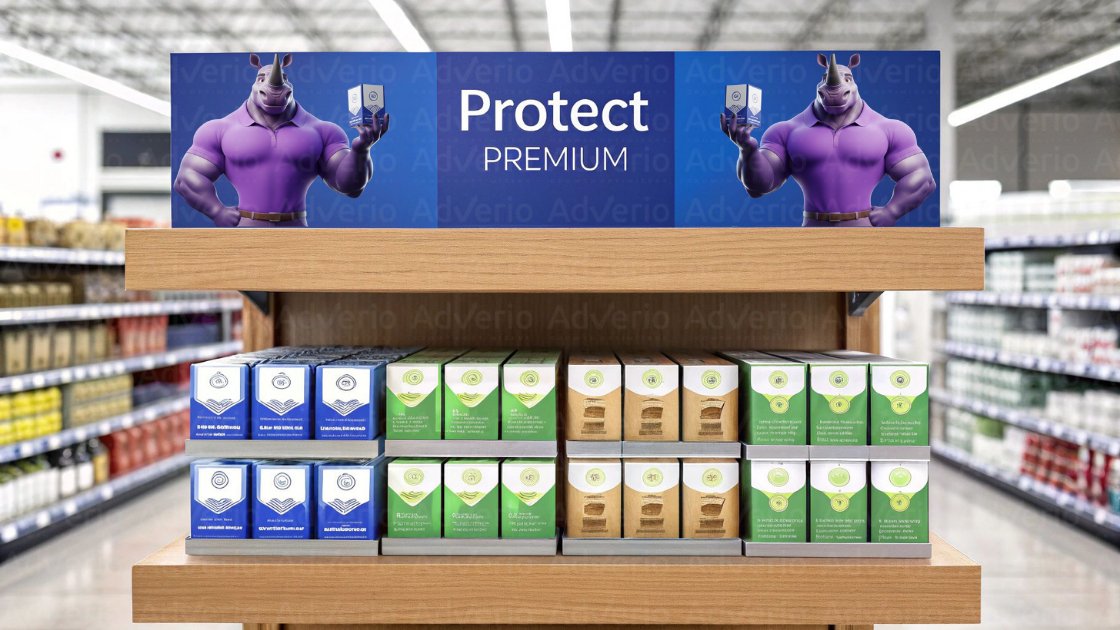
Think of your fighter brand as a defensive shield. Its mission is to soak up price pressure and capture shoppers who would never pay a premium anyway. Done right, the fighter brand absorbs price pressure, wins shoppers who would never pay premium, and creates a defensive moat against generic competitors.
Establish Clear Brand Separation
Rule number one: the two brands cannot look, feel, or sound related. This separation is your first line of defense against brand dilution and needs to go much deeper than just a different logo.
- Distinct Branding: Give the fighter brand its own name, logo, and color scheme. Make sure there are zero visual cues connecting it back to your premium line.
- Separate Messaging: Your premium brand’s story is all about quality, innovation, and lifestyle. The fighter brand’s message is simple and direct: unbeatable value and solid performance. No frills, just function.
- Share some IP, not all “premium theatre.” The fighter brand inherits your core tech (fabric, functional design) but leaves behind the crazy prints, high-touch packaging, and deep brand story.
If a customer can’t immediately tell the two are from the same company, you’ve done it right.
Implement Targeted Channel Strategies
Where you sell is just as important as how you brand. Your sales channels create a natural firewall, so don’t sell both brands in the same place to the same audience.
Your flagship brand should live in full-priced, brand-led environments. That means your DTC site, high-end retail partners, and the premium corners of Amazon.
The fighter brand, on the other hand, is built for the mass-market and value channels. Think Walmart, Target, Costco, and the price-sensitive trenches of Amazon where deals are everything.
By directing each brand to its natural habitat, you stop them from tripping over each other. The fighter brand meets value shoppers where they are, while your premium brand continues to serve its loyal, full-price customer base without compromise.
Protect Your IP and Enforce Your Rights
Even while you’re strategically “knocking yourself off,” bad actors will be trying to create actual counterfeits of both your brands. Protecting your intellectual property is non-negotiable.
You need to know the tools at your disposal. Our deep dive into the benefits and setup process of Amazon Brand Registry is the perfect place to start building your defense. And when you find a direct counterfeit, you have to act fast. This guide on how to report counterfeit products effectively walks you through the exact process.
Amazon is also stepping up its game, seizing millions of counterfeit products with the help of AI and global law enforcement. By combining your own strategic defenses with the protections Amazon offers, you create a robust shield for both your premium and fighter brands.
When Does a Fighter Brand Make Sense?
You should seriously consider this play if:
- You’re a premium brand being undercut in your category on Amazon.
- You have (or can develop) structural cost advantages at scale.
- You’re seeing BSR decay and lost share to cheaper players, even though demand is clearly still there.
- You want to expand into Costco/Target/Walmart-type retail with a more mass-friendly price point—without discounting your hero line.
If some or all of those boxes are checked, a fighter brand isn’t just a clever idea—it’s a smart way to future-proof your category position.
At Adverio, we build fighter brands that actually fight—and win. If you’re wondering whether this strategy makes sense for your category, let’s talk.