


If you’re still chasing ACoS like it’s a success metric, stop. The real Amazon growth game is profit, not vanity. Every dollar you invest should deliver measurable ROI. If it doesn’t, you’re not growing — you’re just being busy.
Why Your Amazon Sales Are Stuck
Table of Contents

Imagine revving a Ferrari in neutral. That’s what your Amazon account looks like when you’re pouring money into ads without a scalable profit system. The chart is flat, the results feel stale, and every expert tells you to “lower your ACoS” like that’s going to fix a fundamentally broken engine.
The truth? Your sales aren’t flat because you need more traffic or reviews. They’re flat because you’re not diagnosing the actual problem. Real growth comes from precision, not more hustle.
Exposing the Real Growth Blockers
The first mistake most brands make is getting trapped by Optimization Myopia. That’s our term for the dangerous habit of focusing on one metric—usually ACoS—at the expense of total profitability. An “efficient” ad campaign sending traffic to a low-margin, poor-converting product isn’t a win. It’s a silent profit drain.
Growth stalls when the core parts of your Amazon engine are out of sync. To figure out what’s really wrong, ask yourself
- Are your best-selling products actually profitable?
- Is your ad strategy aligned with conversion-first products?
- Are you running a cohesive strategy, or siloed spend fiefdoms?
Don’t mistake activity for progress. A low ACoS doesn’t pay the bills. The only metrics that matter are tied directly to profit and growing market share.
The Levers That Actually Matter First
Forget chasing shiny new tactics. The fastest way to reignite growth is a ruthless audit of your foundation.
Start by dissecting your catalog with a profit-first lens. Using a system like our Profit Pulse System (PPS) lets you analyze each SKU’s true contribution margin after factoring in all ad spend, fees, and logistics costs.
This analysis immediately shows which “hero” products to double down on and which underperformers to fix or cut. Next, audit your top ad campaigns against your best-performing products. Are you spending the most on the SKUs that deliver the highest profit? If not, you’ve found your first major leak. Our guide on the common reasons why Amazon sales are down offers a tactical checklist for this process.
Answering “Why are my Amazon sales flat?” means you have to stop guessing and start diagnosing. It’s not about working harder; it’s about applying focused pressure on the few levers that will actually move the needle. This foundational audit is the non-negotiable first step to building a growth strategy that’s both scalable and profitable.
Optimize Your Catalog for Profit Not Just Views

Your product catalog is the engine of your Amazon business. But for most brands stuck in a plateau, that engine is burning cash on underperforming SKUs and failing to convert valuable traffic. To increase Amazon sales, you must shift your focus from chasing views to engineering profit into every listing. Stop treating your catalog like a digital shelf and start managing it like a portfolio of financial assets.
Conduct a Ruthless Catalog Audit
First, you need a full-scale audit to separate your growth drivers from your profit drains. This isn’t a quick glance at sales volume. We’re talking about digging into the true profitability of every single SKU after all costs are factored in.
Many brands are shocked to find their supposed “bestsellers” are barely breaking even once ad spend and FBA fees are accounted for. This is where you uncover “zombie” SKUs—products that look alive thanks to ad-driven sales but are secretly eating your margins.
A proper audit analyzes:
- True Profit Margin: Calculate the actual net profit per unit after COGS, FBA fees, referral fees, and ad spend. No shortcuts.
- Conversion Rate: Pinpoint listings that get clicks but can’t close the deal. Low conversion is an alarm that your copy, images, or price is off.
- Inventory Health: Flag slow-moving stock that’s racking up storage fees and tying up capital.
This data-first approach gives you a clear, objective roadmap for where to invest your resources for maximum return.
Re-Engineer Your Listings for Conversion
Once you know which products deserve your attention, it’s time to re-engineer their detail pages. Your titles, bullet points, and A+ Content aren’t just descriptions; they’re your 24/7 sales team. Every element must work together to answer customer questions and push them to click “Add to Cart.”
Stop writing for algorithms and start writing for people. A good title should be clear, highlight a key benefit, and weave in primary keywords naturally. Your bullet points should be a mini-sales letter, translating dry features into tangible benefits that solve a real customer problem.
For example, don’t just say “Durable 600D Polyester.” Try “Built with Tear-Resistant 600D Polyester to withstand daily use and protect your gear.” That small shift from a feature to a benefit makes all the difference.
A product listing is not a library entry; it’s a direct-response advertisement. Its only job is to persuade a browser to become a buyer. If it’s failing, it’s not optimized.
To ensure your Amazon product listings are pulling their weight, you need to dive into comprehensive content optimization strategies. These are the fundamentals for turning traffic into profit.
Revive Underperformers with SKU Resurrection
What about those underperforming SKUs you found in the audit? Not all of them belong on the chopping block. Many are simply victims of bad optimization or hidden compliance issues.
This is where a targeted strategy like our SKU Resurrection framework comes in. It’s a proprietary process we use to diagnose exactly why a product is failing and execute a precise recovery plan.
This could involve:
- Fixing Hidden Compliance Issues: A suppressed listing or wrong categorization can kill visibility overnight.
- A/B Testing New Creative: A fresh main image or revised bullet points can reignite sales.
- Strategic Repricing: Test different price points to find the sweet spot between conversion rate and margin.
- Targeted Ad Campaigns: Drive highly relevant traffic to the newly optimized listing to rebuild sales velocity and boost its organic rank.
By systematically finding and fixing these issues, you can turn dormant products back into profitable assets. For a deeper look, check our guide to Amazon catalog optimization strategies for growth. Treating your catalog with this financial discipline is the key to breaking through that sales plateau.
Build a Profit-First Full Funnel Ad System
If you’re just running PPC ads and chasing a low ACoS, your playbook is about five years out of date. A strategy like that isn’t just leaving money on the table—it’s actively letting competitors steal market share.
To drive real growth, you have to build an intelligent, full-funnel advertising engine. This means getting your Sponsored Products, Sponsored Brands, and Amazon DSP campaigns to work together as a single, cohesive system. The goal isn’t just to capture existing demand. It’s to create new demand and guide shoppers from discovery to loyalty. Anything less is just lighting money on fire.
Go Beyond ACoS with a Profit-First PPC Structure
Your PPC campaigns are your frontline offense, but too many brands get bogged down obsessing over Advertising Cost of Sales (ACoS). A low ACoS means nothing if it’s coming from campaigns pushing your least profitable SKUs. We call this Optimization Myopia, and it’s a silent killer of growth.
A profit-first PPC structure means your ad spend is directly tied to your most profitable products. This takes a ruthless segmentation strategy.
Here’s how we build it:
- Isolate and Balance Top Performers: Create dedicated campaigns for your “hero” SKUs—the ones with the best profit margins and conversion rates. Fund these aggressively and make sure their share of total sales is balanced with their share of total spend. This is the chief KPI within our PPS (profit pulse system).
- Launch Challenger Campaigns: First, check your vanity and pride at the door; you must be highly methodical here, as a spaghetti-on-the-wall approach would be too wasteful and costly. Use Sponsored Products, Sponsored Brands, and Sponsored Display to target competitor listings and keywords deliberately with the utmost precision possible. This is pure offense, designed to pull market share directly from sleepy rivals and newcomers that don’t stand a chance.
- Utilize Defensive Plays: Run product-targeting ads, via both Sponsored Products and Sponsored Display, on your own listings to protect your digital shelf space from competitors.
- Test and Explore: Set aside 10-15% of your monthly budget for discovery campaigns to find new long-tail keywords and spot emerging search trends.
This structured approach ensures every dollar works its hardest to drive profitable sales. For brands ready to scale, a sophisticated Amazon advertising strategy that maximizes your ROI is the only way forward.
Demystify and Dominate with Amazon DSP
If Amazon PPC is your frontline, Amazon’s Demand-Side Platform (DSP) is your air support than can be a powerful tool for breaking through a sales plateau, but most brands either don’t touch it or use it completely wrong. DSP allows you to reach high-intent audiences both on and off Amazon, using Amazon’s priceless first-party shopper data.
Think of it this way: PPC helps you win the search. DSP helps you win the customer before they even think to search.
With DSP, you can run hyper-targeted campaigns to:
- Retarget Past Purchasers: Bring previous customers back to buy again, directly boosting their lifetime value (cLTV).
- Target In-Market Audiences: Get in front of shoppers actively browsing your competitors or related categories.
- Build Custom Audiences: Target users based on lifestyle interests, demographics, or past viewing habits on Amazon.
DSP isn’t a fluffy “brand awareness” tool. When used correctly, it fuels your entire growth flywheel. It introduces new customers at the top of the funnel, then uses powerful retargeting to push them toward a purchase—which, in turn, makes your PPC campaigns even more effective.
Create a Complete Growth Loop
The real magic happens when you integrate these strategies into a single, cohesive growth loop. You can discover more insights about Amazon’s sales growth on Oberlo.com, and it paints a clear picture: a passive strategy is a losing one.
A modern, full-funnel approach connects every touchpoint:
- Awareness (DSP): Introduce your brand to new, high-potential audiences off-Amazon.
- Consideration (Sponsored Display/Brands): Retarget anyone who visited your page but didn’t buy.
- Conversion (Sponsored Products): Close the deal with highly targeted ads the moment they search.
- Loyalty (DSP): Retarget past customers with new products or replenishment reminders.
This isn’t about just “running ads.” It’s about architecting a system where each part makes the others stronger. This is how you stop defending your current sales numbers and start aggressively conquering new territory.
Master Your Marketplace Conversion Rate
Getting traffic to your listings is only half the battle. The real work starts when you have to turn those clicks into sales—profitably. If your conversion rate is leaking, every dollar you pour into ads is just going down the drain. For any brand serious about growing sales on Amazon, a full-funnel approach to Conversion Rate Optimization (CRO) is essential.
This is way more than tweaking bullet points. Real CRO means engineering a seamless path to purchase that builds trust, delivers a cohesive brand experience, and gives shoppers the final nudge they need to click “Add to Cart.” It’s about turning your entire Amazon presence into a conversion machine.
Build Unshakable Social Proof with Reviews
On Amazon, customer reviews are the currency of social proof. A high star rating is the bare minimum; it’s the quality and consistency of those reviews that build the trust needed to turn a browser into a buyer.
A passive approach is a recipe for stagnation. You need an active strategy:
- Automate Your Review Requests: Use Amazon’s built-in “Request a Review” button or approved third-party tools like Jungle Scout to consistently ask for feedback.
- Handle Negativity with Grace: Address negative reviews publicly and professionally. Offer solutions and show potential buyers you stand behind your products.
- Mine Reviews for Gold: Dig into what your customers are actually saying. They’re giving you priceless insights for product development and marketing—for free.
Transform Your Storefront into a Brand Destination
Your Amazon Storefront is one of the only places on the platform where you control the entire narrative. Ignoring it is a massive missed opportunity. A well-designed Storefront elevates your brand from a collection of product pages into a curated, branded shopping experience.
This is your shot to tell your brand story, showcase your catalog in thoughtful collections, and guide shoppers toward cross-sells and upsells. A great Storefront doesn’t just look good; it boosts engagement and key metrics like Average Order Value (AOV).
Your product detail page is a transaction point. Your Storefront is a relationship-builder. Use it to create loyal customers, not just one-time buyers.
Win the Buy Box Without Destroying Your Margins
Pricing on Amazon is a delicate dance. You have to be competitive enough to win the Buy Box but not so aggressive that you tank your profit margins. Trying to do this manually is slow, inefficient, and almost always ends in a race to the bottom.
Smart pricing means using data-driven tools to find the sweet spot between sales velocity and profitability. It’s about looking at the whole picture:
- Competitor Pricing: Keep an eye on key competitors, but don’t just blindly follow them off a cliff.
- Inventory Levels: Adjust pricing to move aging stock or capitalize when a competitor is running low.
- Profitability Guardrails: Set hard floors for your automated repricers to ensure you never sell at a loss.
Mastering these conversion levers separates the winners from the losers. In 2023, the U.S. marketplace alone processed over 4.5 billion item sales. To capture your slice of that pie, you have to convert every possible click. And that comes down to building a purchase journey that is seamless, trustworthy, and strategically priced. You can discover more insights about Amazon’s massive sales volume at AMZScout.net, which underscores just how much opportunity is out there for brands that get their conversion strategy dialed in.
Build Your 90 Day Amazon Growth Action Plan
A world-class strategy is useless if it sits in a spreadsheet. All the audits in the world won’t move the needle until you translate those insights into a tangible action plan. This is where you move from theory to results, mapping out a clear, 90-day roadmap with specific milestones.
This isn’t about doing everything at once. It’s about sequencing your moves for the biggest impact, starting with foundational fixes before layering on advanced scaling tactics. A methodical approach ensures you’re building on solid ground, not just chasing shiny objects.
Think of it like mastering conversions: you have to build trust with reviews, create a cohesive brand world with your Storefront, and then seal the deal with smart pricing.
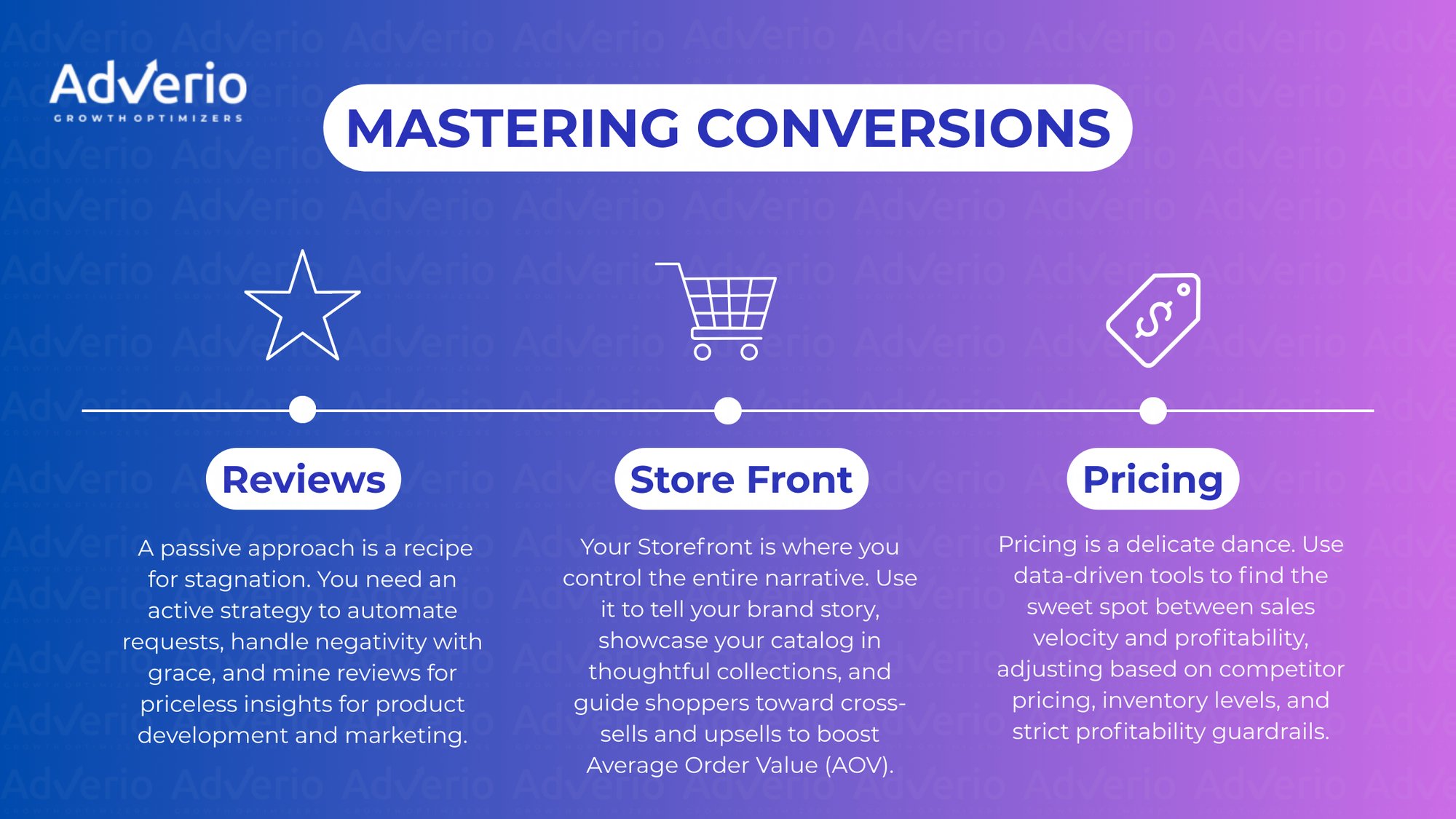
It’s a natural progression. You earn a customer’s trust first. Only then can you guide them through your brand’s ecosystem and ultimately win the sale.
Days 1-30: Foundational Fixes and Catalog Triage
The first 30 days are about stopping the bleed and shoring up your foundation. Your goal is to hunt down and fix the hidden profit drains sabotaging your growth. It’s not glamorous work, but it’s non-negotiable for long-term success.
Your priorities:
- Run a Full Catalog Audit: Get surgical. Analyze every SKU through a profit-first lens. Identify your “hero” products (high margin, high conversion) and your “zombie” products (low margin, high ad spend).
- Deploy Foundational Listing Fixes: Armed with your audit data, rewrite the titles and bullet points for your top 10-20 hero SKUs. Make them benefit-driven and keyword-optimized.
- Clean Up Compliance Issues: Dig into Seller Central and check for suppressed listings, incorrect categorizations, or any other hidden gremlins killing visibility.
This initial phase is pure triage. You can’t build a skyscraper on a cracked foundation. Before scaling ad spend, you must ensure your catalog is healthy and your best listings are optimized to convert.
Days 31-60: PPC Optimization and Scaling Prep
Your foundation is solid. Now it’s time to apply pressure to your advertising. The goal is to restructure your PPC campaigns around profitability and prep to scale your winners.
Your focus shifts to:
- Restructure PPC Campaigns: Rebuild your ad campaigns based on that “hero” and “zombie” SKU analysis. Funnel your budget aggressively toward your most profitable products and ruthlessly cut spend on underperformers.
- Launch Defensive and Offensive Plays: Start implementing product-targeting campaigns to defend your own listings. At the same time, launch challenger campaigns that specifically target key competitor ASINs to start chipping away at their market share.
- Prep for DSP: Begin defining your ideal customer avatars for future DSP campaigns. Dive into Amazon Brand Analytics and analyze existing customer data to spot patterns in purchase behavior.
Days 61-90: Advanced Scaling and CRO Refinement
With a profitable catalog and a finely tuned PPC engine, you’re ready to hit the accelerator. This final phase is about expanding your reach and refining your conversion machine for maximum efficiency. While we’re focused on Amazon, many of the universal principles behind good strategies to increase e-commerce sales can be adapted right here.
Key actions:
- Launch Your First DSP Campaigns: Don’t try to boil the ocean. Start with retargeting campaigns to recapture audiences who visited your listings but didn’t buy. This is the lowest-hanging fruit in DSP and almost always provides an immediate lift.
- A/B Test Your Creative: Get scientific. Systematically test different main images, A+ Content layouts, and even video assets on your top-performing listings to find the exact combination that maximizes conversion.
- Refine Your Storefront and AOV Strategy: Optimize your Amazon Storefront to be a sales tool. Guide shoppers toward complementary products using insights from Market Basket Analysis reports to create virtual bundles and promotions that drive up your Average Order Value (AOV).
Executing this 90-day plan takes real expertise. You have to decide if your in-house team has the capacity to manage this, or if partnering with a specialist agency that offers an ROI-backed guarantee is the smarter financial move to ensure these actions turn into measurable growth.
Frequently Asked Questions
Navigating Amazon’s complexities can feel like solving a puzzle with half the pieces missing. Here are direct, no-nonsense answers to the questions we hear most from brands stuck in a growth plateau.
Why Are My Amazon Sales Flat Even Though My Ads Are Running?
This is the classic sign of Optimization Myopia. Your ads might look “efficient” on an ACoS report, but that metric alone is a terrible indicator of business health. If ads are on but the sales needle isn’t moving, the problem is almost always elsewhere in the funnel.
Here are the usual suspects:
- Poor Listing Conversion: You’re paying to drive traffic to product pages that can’t close the deal. It’s like buying Super Bowl ads for a store with a broken front door.
- Cannibalized Ad Spend: Unidentified “zombie” SKUs—products with low margins or terrible conversion rates—are silently draining the budget and starving your high-potential products of cash.
- Siloed Ad Strategy: Your PPC campaigns are running in a vacuum, cut off from any top-of-funnel brand-building. You’re only fighting for existing demand instead of creating new customers.
Simply running ads isn’t a strategy. You need a holistic approach that connects your listing optimization, catalog health, and brand-building with tools like DSP to break the plateau and increase Amazon sales for good.
How Do I Know If My PPC Campaigns Are Actually Profitable?
Stop looking at ACoS. Start looking at TACoS (Total Advertising Cost of Sales) and, more importantly, SKU-level profitability. A low ACoS on a product with a 10% profit margin is a loss. A high ACoS on a product with a 60% profit margin can be a massive win.
To know if you’re actually profitable, you have to connect ad spend directly to product-level margins. This requires a system—like our proprietary Profit Pulse System (PPS)—that subtracts all associated costs (COGS, FBA fees, ad spend) from a sale to reveal its true net profit. Without this data, you’re flying blind.
What’s The Best Way To Scale Once We’ve Hit A Plateau?
Scaling isn’t about spending more money. It’s about systematically expanding your reach while maintaining profitability. Once you’ve fixed the foundational issues (catalog health, listing conversion), the best way to scale is by rolling out a full-funnel advertising strategy that combines PPC and DSP.
Use PPC to dominate bottom-of-funnel search terms and defend your brand space. Simultaneously, deploy Amazon DSP to build audiences, retarget shoppers who visited your listings, and poach customers from competitors. This integrated approach creates a growth flywheel where your top-of-funnel efforts make your conversion-focused ads more effective, leading to sustainable market share growth.
Growth on Amazon isn’t about doing more. It’s about doing what actually moves the needle. If your catalog isn’t engineered for profit, no ad spend will save it.
At Adverio, we don’t just “run ads.” We architect growth engines.
👉 Ready to see how your catalog stacks up? Click to book your ROI Forecast now at https://www.adverio.io/roi