



So, you want to get your product onto the shelves of a major retailer. The secret isn’t just a great product—it’s understanding that the rules that made you a direct-to-consumer (DTC) success story get thrown right out the window.
The single biggest mistake I see brands make is walking into a buyer meeting assuming their impressive DTC metrics are an automatic slam dunk for wholesale. A buyer isn’t looking for an online trend with vanity metrics; they need a scalable partner with a proven retail strategy.
The Biggest Mistake Brands Make When Pitching Retail Buyers
You’ve absolutely crushed it online. Your Amazon sales are climbing, your social media is buzzing, and you’ve got your customer acquisition cost down to a science. You feel unstoppable. Armed with a pitch deck full of these wins, you walk into a meeting with a buyer from Target or Walmart, expecting them to be floored.
And then you get a polite, “Thanks, but no thanks.” What just happened?
You made the #1 mistake: pitching your DTC success story instead of a retail partnership strategy.
Buyers for stores like Target, Walmart, or CVS live in a completely different universe. Your click-through rates mean nothing to them. They’re obsessed with their own set of numbers: profit margins, inventory turns, and how your product will drive foot traffic to their stores, not just clicks to your website.
A retail buyer’s job is simple: buy products that will sell profitably and move quickly in their specific store environment. Your entire pitch has to speak directly to their core needs—margin, velocity, and category growth—not just your brand’s online wins.
From DTC Darling to Retail-Ready Partner
To sidestep this killer mistake, you need to reframe your entire pitch. Think of your online success as a fantastic proof of concept, but it’s just the opening act. The real show begins when you translate that success into the language retail buyers actually speak.
Here’s how you pivot your story from an online brand to a serious wholesale contender.
- Reframe Your Data: Don’t just flash your big DTC sales numbers. Use that data to prove you have a hungry audience. Pinpoint geographic sales data that overlaps with the retailer’s key store locations. This shows them there’s already a built-in customer base waiting for your product on their shelves. To learn more, check out our guide on how to get your product in store by focusing on the right data points.
- Prove Your Operational Scalability: A buyer’s worst nightmare is a supplier who can’t keep up. Your slick DTC fulfillment system is irrelevant here. They need to see rock-solid proof you can handle massive purchase orders, meet strict shipping windows, and integrate with their specific logistics and EDI requirements. Come ready to talk about your supply chain, manufacturing capacity, and how you’ll manage inventory at scale.
- Package Your Brand Story for Their Shelves: That killer Instagram aesthetic might work wonders online, but how does it pop on a crowded store shelf next to ten competitors? Your pitch needs to show you’ve thought about merchandising, in-store marketing, and packaging that grabs a shopper’s attention in three seconds or less. Your brand story has to connect with their customers, not just your own. Thinking about how to build a purpose-driven brand strategy is a huge part of this.
At the end of the day, your goal is to shift the entire conversation. You’re not just presenting your brand; you’re presenting a business case. You have to show the buyer, in no uncertain terms, how a partnership with you will make them more successful.
When you prove you understand their world and have a solid plan to meet their needs, you stop being just another hopeful founder and become a strategic partner they can’t afford to ignore. This means mastering the art of emotional storytelling for eCommerce that hits home for both the buyer and their shoppers.
Building Your Foundation Before the First Hello
A killer pitch is won long before you ever step into the room or hop on the Zoom call. Too many brands think it’s all about a slick deck and a charming personality. Wrong. It’s about showing up more prepared than anyone else. This is your pre-pitch playbook—the groundwork that turns you from just another hopeful seller into an undeniable strategic partner.
This isn’t about a quick scan of a retailer’s homepage. We’re talking about digging for deep, actionable intelligence that transforms your pitch from a generic offer into a custom-built solution for their specific problems.
Pinpoint the Perfect Retail Partner
Your first move isn’t to shotgun your pitch to every buyer at Target or Walmart. The goal is to find the retailers where your product doesn’t just fit—it belongs. Start by building a laser-focused list of potential partners where your ideal customer is already swiping their credit card.
Ask yourself the hard questions to narrow the field:
- Who is my core customer? Get painfully specific. Where do they live, what do they do on weekends, and what’s in their pantry right now?
- Where do they shop today? Look past the obvious giants. Think specialty grocers, regional chains, and even independent boutiques.
- Which retailers align with my brand’s values and price point? If you’re selling a premium, organic product, a discount chain probably isn’t the right starting line. That alignment is everything for long-term success.
Getting this right from the start saves you from wasting months pitching to buyers whose shoppers will never connect with what you’re selling.
Conduct Deep Buyer and Category Intelligence
Once you’ve got your target list, it’s time to go deep. Your mission is to understand the retailer’s business so well that your pitch anticipates their needs before they even say them out loud. You need to become an expert on their category.
Walk their aisles, whether it’s in person or scrolling through their website. Meticulously analyze their current product assortment and hunt for the gap. Is their wellness section missing a high-quality vegan protein? Is their snack aisle full of tired, legacy brands but starving for something innovative and healthy? That gap is your golden ticket.
This infographic lays out the most common mistakes brands make when they cut corners on this foundational work.
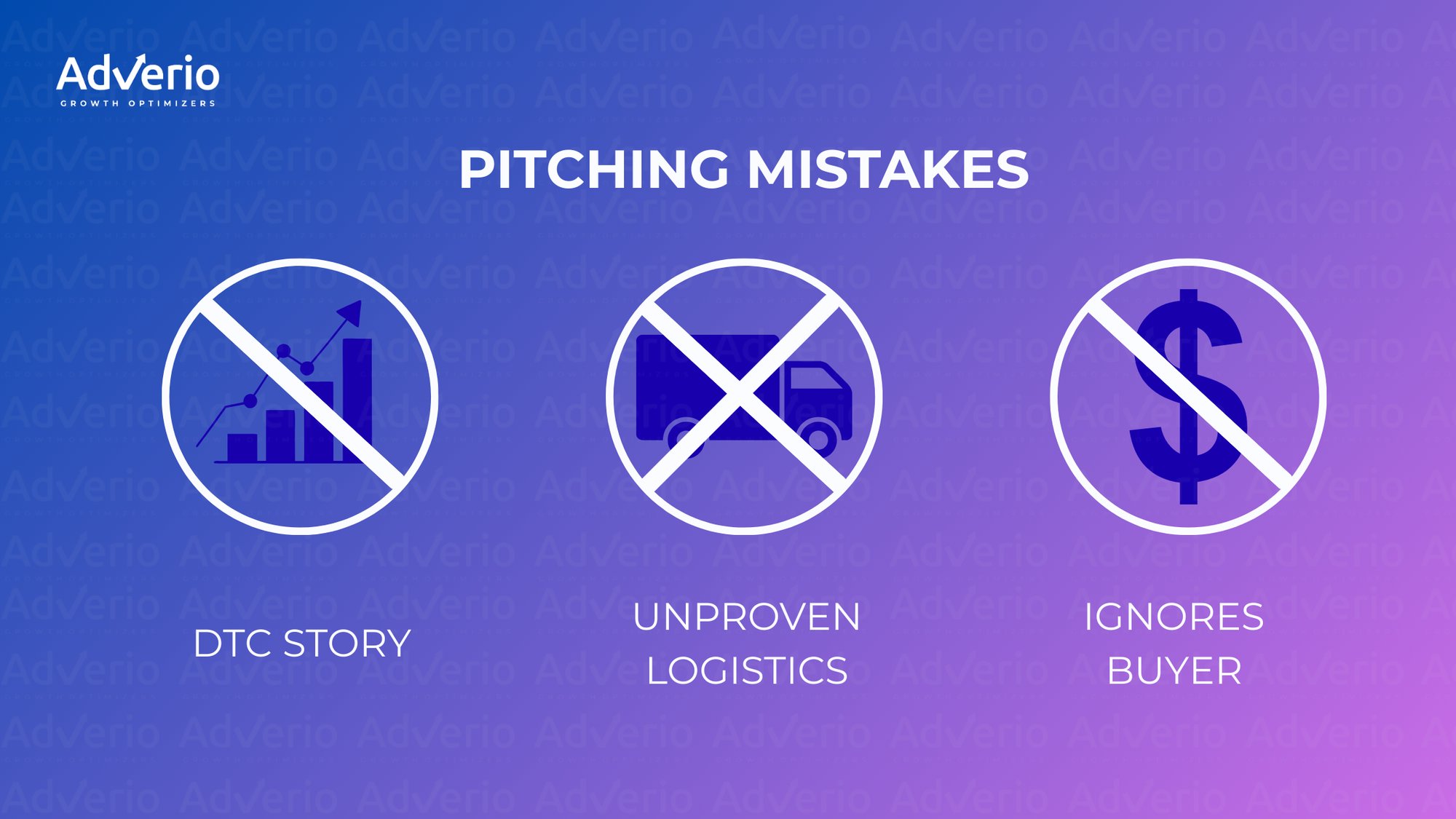
As it shows, failing to translate your DTC story, prove your logistics are solid, or understand the buyer’s financial model can kill a pitch before it even starts.
Your research needs to uncover the buyer’s professional priorities. Are they laser-focused on sustainability initiatives? Are they desperately trying to attract a younger demographic? Scour LinkedIn to see what they’re posting about or check company news for their latest strategic goals. This intel lets you frame your product not just as a great item, but as the perfect tool to help that specific buyer crush their KPIs. Your brand story is the glue that holds this all together. Dive deeper into building a purpose-driven brand strategy that connects with buyers and their shoppers.
Assemble Your Pre-Pitch Research Checklist
A systematic approach means nothing gets missed. Before you even think about drafting that first email, you need to have clear, documented answers to these questions.
A buyer can spot an unprepared brand from a mile away. The depth of your research is a direct reflection of how serious you are as a potential partner. Don’t cut corners here.
Your pre-pitch research file for each retailer should include:
- Category Analysis: A full list of direct and indirect competitors on their shelves, including price points, packaging, and placement.
- Identified Gap: A sharp, one-sentence statement explaining the specific, unmet customer need your product fills in their current lineup.
- Buyer Intelligence: The name and title of the right category buyer, plus notes on their recent professional activity or the company’s stated goals for that category.
- Logistical Preparedness: Confirmation that your product meets every packaging, labeling, and compliance standard they require. To get your team fully prepped, you need to anticipate roadblocks, so it’s smart to delve into retail sales training issues and solutions.
Completing this foundational work is non-negotiable. It’s the difference between a pitch that gets deleted instantly and one that lands you the meeting. It ensures that when you finally say “hello,” you’re not just introducing a product—you’re presenting an irrefutable business case.
Crafting Your Unforgettable Pitch Assets
You might only get 30 minutes in that meeting, but the assets you leave behind—your pitch deck and sell sheet—have to keep working for you long after you’ve walked out. Think of these documents as your silent sales team. They need to be sharp, persuasive, and dead simple for a swamped buyer to digest.
Get this part wrong, and even a great meeting can lose momentum. Get it right, and you make saying ‘yes’ the easiest decision they’ll make all day. This isn’t about making a pretty brand book. It’s about building tactical tools that answer a buyer’s two main questions: “How will this make me money?” and “Why should I give you my precious shelf space?
Deconstruct Your High-Impact Pitch Deck
Your pitch deck is the narrative—it’s the story of why your brand is an unmissable opportunity. It needs to look good, sure, but it has to be packed with substance. Every single slide should build on the last, guiding the buyer to one simple conclusion: they need your product on their shelves.
And remember, this deck isn’t really about you; it’s about solving their problem. The best pitches weave a powerful story backed by solid data. You have to show them you understand where the market is going. By 2025, global online retail sales are projected to hit an incredible $7.4 trillion, which is nearly a quarter of all retail spending. Your pitch needs to connect the dots, showing how your existing online success will fuel their omnichannel strategy and help them capture a piece of that massive digital wave.
Here are the slides you absolutely can’t skip:
- The Hook (Slide 1): Kick things off with a bold statement. What’s the market gap you’re here to fill?
- The Solution (Slide 2): Introduce your brand and product as the clear answer to that problem.
- The “Why Us” (Slide 3): This is where you shine. Showcase your unique selling proposition—special ingredients, a powerful mission, or proprietary tech. It’s your chance to master https://www.adverio.io/emotional-storytelling-ecommerce-create-brand/.
- The Target Customer (Slide 4): Prove you know their shopper inside and out. Use data, not just feelings.
- The Market Opportunity (Slides 5-6): Use hard numbers to show why the timing is perfect.
- The Business Case (Slides 7-8): Get down to brass tacks. Detail your pricing, margins, and the marketing support you’re bringing to the table.
- The Ask (Slide 9): Be direct. Clearly state what you want (e.g., a test run in 50 stores).
Design a Sell Sheet That Actually Sells
While your deck tells the story, the sell sheet is the tactical cheat sheet. This is the one-pager a buyer pins to their corkboard or forwards to their team. It has to be loaded with critical info but scannable in under 30 seconds.
Your sell sheet is the most practical tool in your arsenal. It needs to be 100% focused on giving a buyer the hard data they need to cut a purchase order. No fluff, no filler—just the facts.
A buyer shouldn’t have to hunt for information. Make it painfully easy for them. A great sell sheet has a clear visual hierarchy and includes every single data point they need. A compelling brand video can also make a huge difference here; check out this guide to brand video production and think about adding a QR code on your sell sheet that links directly to it.
Build a Bulletproof Pricing Model
Finally, your pricing model is where the rubber meets the road. This is the math that proves a partnership will be profitable for both of you. You need to walk in with a crystal-clear understanding of every number, from your cost of goods sold (COGS) to the retailer’s potential margin.
Your model should transparently break down:
- Your Wholesale Price: The price per unit the retailer pays you.
- Manufacturer’s Suggested Retail Price (MSRP): The price their customers will see on the shelf.
- Retailer Margin: The percentage of profit they make on each sale. For big retailers, you’re typically looking at a margin between 40-60%.
- Promotional Allowances: Any funds you’re offering for things like introductory discounts or marketing support.
Showing up with a well-researched pricing model proves you’ve done your homework and you respect their business. It shows you’re not just a founder with a cool product, but a serious partner ready to talk numbers and drive profit. Together, these assets elevate your pitch from a simple request into a compelling business proposal they can’t ignore.
Nailing the Pitch: How to Own the Room and Close the Deal
This is it. The moment everything has been building toward. All the research, the late nights perfecting your sell sheets, and the countless hours spent refining your pitch deck culminate in this single meeting.
This is where preparation meets performance. You’ve earned your 30 minutes on the buyer’s calendar. Now, it’s time to show them you’re a strategic partner, not just another vendor trying to push a product. The goal isn’t to steamroll them with slides; it’s to start a real conversation that proves you understand their world and have a clear, profitable solution to their challenges.
H3: Open With a Hook, Not a Handshake
Forget the tired small talk. Skip the long-winded company history. You have less than 60 seconds to grab a busy buyer’s full attention, and you can’t afford to waste a single one.
Your opening needs to immediately frame your product as the answer to a problem they’re facing or an opportunity they’re missing out on. Lead with the market gap you uncovered in your research. A powerful hook sounds less like a sales pitch and more like a strategic insight:
“I noticed your snack aisle is packed with legacy brands, but there’s a huge gap for a clean-label, high-protein option that speaks to the millennial shoppers you’re trying to attract. Our brand has already captured this exact demographic online, and we can bring them straight to your stores.”
An opening like that completely reframes the meeting. Suddenly, you’re not there to sell something; you’re there to help them win a specific customer and grow their category.

H3: Frame Your Brand as a Business Case
Once you’ve got them hooked, it’s time to tell your brand story—but through the lens of a business case. Use your pitch deck as a visual aid, not a script you read from. This is about confidently walking them through the data that proves your past success is a reliable predictor of future on-shelf velocity.
The retail world is part of a massive, dynamic global market expected to reach $30 trillion by 2025. Buyers are under immense pressure to find products that can perform. This is your moment to prove you’re not just a product, but a partner with the digital savvy to help them compete.
To truly understand the forces shaping modern retail, it’s worth digging into the global market’s digital transformation to better align your pitch with what buyers are thinking about every day.
A well-structured pitch meeting is a well-controlled one. Use an agenda to guide the conversation, ensuring you cover every critical point and demonstrate your preparedness. This isn’t just a script; it’s a roadmap to a successful partnership.
Pitch Meeting Agenda & Key Talking Points
| Time Allotment | Agenda Item | Key Talking Points / Objective |
|---|---|---|
| 0-2 mins | Introduction & The Hook | Grab their attention immediately with a market insight or category opportunity. Set the stage for why your brand is the solution. |
| 2-8 mins | The Brand Story & Business Case | Present your brand’s mission, core values, and unique selling proposition. Show market traction with data on sales, customer demographics, and online performance. |
| 8-15 mins | Product Deep Dive & Category Fit | Showcase the product line. Explain how your products fill a specific gap on their shelves and complement their existing assortment. |
| 15-20 mins | The Commercials: Pricing & Profit | Walk through your pricing model, wholesale costs, MSRP, and the resulting margin for them. Be transparent and ready to justify your numbers. |
| 20-25 mins | Go-to-Market & Marketing Support | Detail your launch plan, including promotional calendar, marketing support budget, and co-op opportunities to drive foot traffic to their stores. |
| 25-30 mins | Q&A, The “Ask,” & Next Steps | Welcome tough questions, then make your specific proposal (e.g., a 50-store test). Clearly define the next steps and timeline. |
Having a clear plan like this doesn’t just keep you on track; it shows the buyer you respect their time and know what you’re doing.
H3: Handle Tough Questions Like a Pro
A good buyer will interrupt. They’ll challenge your numbers and poke holes in your plan. This is a great sign—it means they’re paying attention.
Don’t get defensive. Embrace the questions. This is where all your prep work really pays off. Be ready to give sharp, detailed answers on:
- Logistics & Supply Chain: How will you handle a PO for 500 stores? What are your lead times? Are you EDI-compliant?
- Marketing Support: What’s your budget for driving customers to their stores? Do you have co-op funds available? What does your promotional calendar look like for the first 6 months?
- Pricing & Margins: Why is your wholesale price what it is? How did you calculate it to ensure a healthy margin for them? What’s your plan for promotions and markdowns?
Answering these questions with confidence and detail proves you’re a serious, retail-ready partner. If you need a deeper dive into the operational nitty-gritty, our guide on how to get your product in store breaks down these essential details.
H3: The Art of the Strategic Close
As you approach the end of the meeting, don’t leave the next steps up in the air. Your “ask” needs to be clear, direct, and, most importantly, reasonable. Ditch vague statements like, “I’d love to partner with you,” and instead propose a specific, logical next step.
Based on your goals for the category, I propose we start with a 50-store test in your key urban markets. This will give us the data we need to prove velocity and plan for a chain-wide rollout in Q4.
This approach positions you as a strategic thinker who understands the crawl-walk-run model of building a retail partnership. It makes saying “yes” a low-risk, high-reward decision for the buyer.
Finish by summarizing the next steps you’ve both agreed on, thank them for their time, and set the expectation for your follow-up. You’ve just turned a 30-minute meeting into the first step of a long-term, profitable partnership.
Mastering the Follow-Up to Seal the Deal
The meeting went great. You felt the connection, the buyer seemed engaged, and you left feeling optimistic. But let me be blunt: your work isn’t over. In fact, one of the most critical phases has just begun.
The real money is made in the follow-up. A strategic, persistent approach is often what turns a polite “maybe” into a signed purchase order.
This isn’t about spamming their inbox until you get a response. It’s about professional persistence that keeps you top-of-mind and continuously adds value, making you an ally, not just another vendor.
The Perfect Follow-Up Email
Timing is everything. You need to strike while the memory of your meeting is fresh, reinforcing the key takeaways without burying the buyer in information.
Make sure you send your first follow-up email within 24 hours of the meeting. If you wait any longer, you risk losing the momentum you worked so hard to build.
The goal of the first follow-up isn’t to ask for the purchase order. It’s to thank them for their time, recap the core value you discussed, and clearly outline the next steps you both agreed on. Think of it as a professional thank-you note that doubles as a strategic summary.
Keep your email concise and scannable. Use bullet points to reiterate the key business wins you bring to their category. For their convenience, attach your sell sheet and pitch deck, and always end with a clear, simple call to action based on your conversation.
Establish a Value-Driven Cadence
After that initial email, the waiting game begins. Don’t panic if you don’t hear back right away. Buyers are juggling hundreds of vendors, and your job is to stay on their radar with a follow-up cadence that adds value every single time.
Here’s a simple, effective system that works:
- Day 7 (Follow-up #2): Send a short, friendly check-in. This is your chance to add a piece of value—maybe a link to a new positive press feature, a glowing customer testimonial, or a relevant industry insight that shows you’re thinking about their category’s success.
- Day 14 (Follow-up #3): Share another win. Did you just hit a new sales milestone on Amazon? Did a new influencer post about your product? This kind of update demonstrates momentum and reduces the perceived risk of bringing you on board.
- Day 30 (Follow-up #4): If you still haven’t heard anything, send one final, polite check-in to see if they have any lingering questions. Keep it brief and professional.
This approach positions you as a proactive, informed partner, not a desperate salesperson.
Tracking Metrics and Reading the Signals
As you pitch more retail buyers, it’s crucial to understand the power dynamics at play. The retail world is consolidating. Forecasts for 2030 suggest fewer than 100 retailers will control a full third of the global market.
This means your pitch has to be about more than just a great product. It needs to show how you enhance the retailer’s entire profit engine, from logistics to customer data. You can dig deeper into these global retail power dynamics on Deloitte.com.
To refine your process, you need to track a few key metrics for your outreach:
- Open Rate: Are your subject lines actually getting clicked?
- Response Rate: How many buyers are engaging with your follow-ups?
- Meeting-to-Close Ratio: How many initial meetings are converting into real deals?
These numbers will tell you what’s working and what isn’t. Learn to read the buyer’s signals—a quick, positive reply is obviously a great sign. Vague, non-committal responses or complete silence after multiple value-added follow-ups might mean it’s time to respectfully move on. Your time is your most valuable asset, so focus it where it counts.
Common Questions About Pitching Retail Buyers
You’ve built your pitch deck, sell sheets, and pricing models. Now comes the tough part: getting a buyer to say “yes.” Even the savviest founders hit a wall of uncertainty when they face retail buyers.
This guide cuts straight to the chase. No fluff—just the practical, real-world answers you need to walk into that meeting with confidence.
How Much Inventory Do I Need Before Pitching A Major Retailer
Showing up with zero inventory planning is like training for a marathon by jogging once. Retail buyers want proof you can handle their orders today and restocks tomorrow. A stockout? Instant trust killer.
To nail your inventory calculation, think in three parts: initial order, test locations, and a safety buffer.
(Initial PO per Store x Number of Test Stores) + Safety Stock
Here’s how that breaks down:
- Initial PO per Store x Test Stores: Estimate the first shipment for each location.
- Safety Stock: Add 20–30% extra to cover surprises—sudden demand spikes or supplier delays.
Walk into the meeting with a clear production calendar showing lead times, reorder points, and contingency plans.
What Are Standard Wholesale Margins And How Do I Calculate Them
Retailers expect to hit 40–60% gross margin after buying from you. If you can’t speak their language—retail math—you’ll lose credibility fast.
Here’s the core formula to memorize:
Retailer Margin % = ((Retail Price – Wholesale Price) / Retail Price) x 100
Example:
- MSRP: $25
- Your Wholesale Price: $12.50
- Buyer’s Margin: 50%
Your job is to build a pricing model that covers COGS, freight, marketing, your profit—and still leaves them with that 40–60% slice. Show up with multiple scenarios so you can flex on volume, promotional support, or exclusivity without breaking their margin goals.
Should I Offer Exclusivity To A Retailer
Exclusivity can sweeten the pot—better placement, higher POs, co-op ad dollars. But it also shuts other doors.
Before you ink an exclusive deal, weigh the trade-offs. Consider these middle paths:
- Time-Bound Exclusivity
Limit the commitment to 6–12 months, then reopen your options. - Product-Specific Exclusivity
Create a retailer-only SKU, flavor, or bundle that leaves your core line free. - Channel Exclusivity
Give them sole rights in a mass-market channel while you pursue specialty or direct-to-consumer.
Move carefully. The goal is leverage, not handcuffs.
What Happens If A Retail Buyer Says No
Rejection stings—but it’s data in disguise. Every “no” gets you closer to a “not yet.”
First, always respond politely. A quick thank-you email sets you apart.
Next, ask for feedback. Was price too high? Packaging uninspiring? Use their insights to sharpen round two.
Finally, stay on their radar. Request permission to send updates every three to six months—new sales milestones, press hits, or distribution wins. Momentum can turn a “no” today into a “yes” down the road.
At Adverio, we guide brands through every twist and turn of retail pitching. We’re not just an ad agency; we’re your omni-channel growth partner, scaling your presence on Amazon, Walmart, Target, and beyond. Ready to stop guessing and start closing?
Book Your Free Omni-Channel Growth Strategy Call with Adverio