

A profit-first operating system that connects your Amazon, Walmart, and Target execution directly to revenue, margin, and market share growth.
Most marketplace brands aren’t failing from a lack of effort. They’re failing from a lack of alignment. Ads are running. Listings are updating. Promotions are firing. But profit? Flat. Market share? Stalled.
The GMAP strategy isn’t another agency buzzword. It’s Adverio’s proprietary framework for Goal-Driven Performance Mapping, a battle-tested system that connects your highest-level business goals to every single action your team takes. It’s about trading frantic activity for intentional, data-backed growth.
GMAP Strategy at a Glance
• Built for $3M+ revenue marketplace brands • Aligns Goals → Metrics → Actions → Performance • Eliminates Optimization Myopia • Connects ad spend to profit and incrementality • Creates cross-team governance across Ads + Catalog + Content
What Is The GMAP Strategy?
Table of Contents
Too many brands operate in a state of organized chaos. Their marketing is just a collection of disconnected tactics: launching ads, updating listings, testing promotions. There’s no clear feedback loop to confirm what’s actually driving growth.
We built GMAP to eliminate what we call Optimization Myopia—the dangerous obsession with ACoS while ignoring incrementality, contribution margin, and market share movement. It’s about eliminating random, disconnected efforts and connecting every metric, action, and pivot directly to measurable business goals.
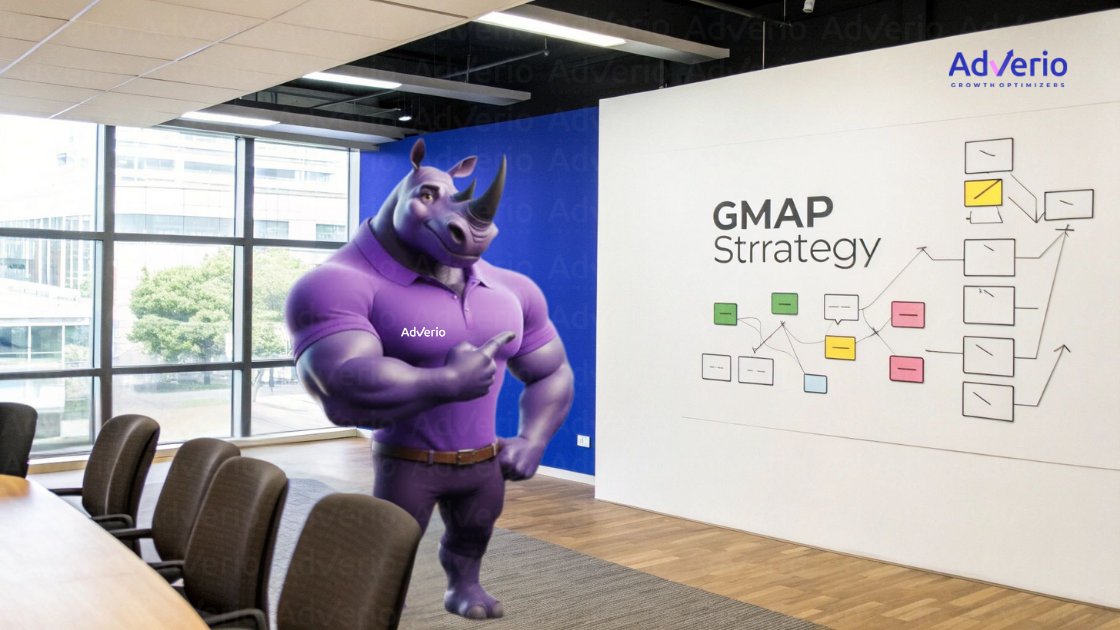
This framework is built on a simple but powerful feedback loop that aligns specific Goals → Metrics → Actions → Performance:
-
Goals: Define your specific, time-bound business objectives. What are you actually trying to achieve?
-
Metrics: Identify the core KPIs that truly measure progress toward those goals. Not just the easy ones.
-
Actions: Map out the exact execution plan needed to move those specific metrics.
-
Performance: Implement a continuous optimization loop to review, pivot, and refine your approach based on real data.
From Disconnected Actions to a Cohesive Engine
GMAP is the central operating system for your brand’s growth. It ensures every dollar spent and every hour invested is directly accountable to a measurable outcome. On Amazon, Walmart, and Target, misalignment compounds fast. Traffic gets more expensive. Margins shrink. Competitors out-position you. Governance isn’t optional; it’s survival.
The stakes have never been higher. With brands pouring billions into platforms like Amazon, just showing up isn’t enough. You need a methodical, goal-driven Amazon growth plan to defend your margins and win market share.
GMAP Framework At A Glance
| Pillar | Core Function | Example |
|---|---|---|
| Goals | Defines the “why” behind all activities. | “Increase Amazon sales by 20% in Q1.” |
| Metrics | Selects the key data points that measure goal progress. | “Track TACoS, New-to-Brand customer growth, and session CVR.” |
| Actions | Outlines the specific tasks to influence the metrics. | “Launch top-of-funnel DSP campaigns targeting competitor audiences.” |
| Performance | Establishes the review cadence to optimize actions. | “Weekly review of campaign performance against goal delta.” |
This table simplifies the flow from high-level strategy to on-the-ground execution, ensuring every action is purposeful.
GMAP forces a crucial question: “Can we draw a straight line from this task to our quarterly financial targets?” If the answer is no, the task gets deprioritized. It’s about trading frantic activity for intentional, data-backed progress.
Ultimately, this framework gives you the structure to confidently answer leadership’s toughest questions about ROI. It’s the essential tool for any brand that wants to learn exactly how to increase Amazon sales with precision and predictability, turning random acts of marketing into a synchronized growth engine.
Why Your Brand Needs the GMAP Strategy Now
Does this sound familiar? Your PPC team is laser-focused on lowering ACoS. Your content team is heads-down, A/B testing new images. Your promotions manager is pushing a flash sale. Individually, each team is hitting its targets. But when you zoom out, growth is flat and profits are mysteriously shrinking.
This is the reality for brands stuck in tactical noise. They operate in functional silos, where disconnected tactics create the illusion of progress while quietly bleeding the business dry. It’s a classic case of winning battles but losing the war—and one of the most common growth pitfalls mid-sized brands face on Amazon.
GMAP is the antidote. It helps avoid wasted spend and disjointed efforts by:
-
Defining what “success” actually looks like with crystal-clear, profit-driven KPIs.
-
Prioritizing resources toward needle-moving actions instead of busywork.
-
Allowing for fast iteration with clear ROI insights, so you can double down on what works and kill what doesn’t.
The Sobering Reality of Siloed Operations
Ask yourself a tough question: can you draw a straight line from your team’s daily tasks to your quarterly P&L objectives? For most, the answer is a sobering ‘no.’ Without a unifying framework, you’re flying blind in a marketplace that gets more competitive and expensive every day.
This approach leaves you wide open. Competitors with a cohesive strategy will outmaneuver you, capturing market share while you’re stuck juggling a dozen disjointed initiatives.
Without a clear feedback loop connecting actions to outcomes, you’re not advertising—you’re just gambling. Every dollar spent is a bet with unknown odds, making it impossible to scale predictably.
Moving from Guesswork to Intentional Growth
The solution to this chaos is accountability. Every action must be tied to a specific, measurable goal. To stop gambling with ad spend and ensure your efforts drive real business outcomes, you need a strategic framework that connects all the dots.
Here’s what a lack of a central strategy like GMAP is costing you:
-
Wasted Ad Spend: Campaigns chasing vanity metrics that don’t drive profit.
-
Operational Inefficiency: Teams working at cross-purposes, duplicating efforts and missing opportunities.
-
Zero Visibility: Leadership has no real way of knowing which initiatives are moving the needle.
-
Stagnant Growth: Despite constant activity, the business is stuck in a frustrating cycle of marginal gains.
This isn’t just inefficient; it’s unsustainable. In today’s economy, brands that can’t prove the ROI of their marketing spend will fall behind. GMAP was built to solve this exact problem, forcing alignment and creating a clear path from action to financial impact.
How The GMAP Framework Works
Theory is useless without action. Let’s break down how the GMAP framework goes from a concept to a living performance engine that drives brand growth. This isn’t about piling more tasks onto your team; it’s about making sure the work they’re already doing is the work that matters.
Constraint First: Inventory and Conversion Reality
GMAP never starts with ads. It starts with constraints. Inventory health, Buy Box stability, pricing competitiveness, review strength, and PDP merchandising determine whether traffic can even convert. Scaling ads without fixing these is how brands burn cash at scale.
Goals: Define Your Destination
Everything starts with a clear destination. Vague objectives like “grow sales” are worthless. The Goals phase of GMAP forces you to define specific, time-bound business objectives aligned across teams (ops, marketing, creative) that actually mean something to your P&L.
-
Weak Goal: “We need more customers.”
-
GMAP Goal: “Increase new-to-brand (NTB) customers acquired through Amazon Sponsored Brands by 15% in Q2 while maintaining a blended ROAS of 4.5.”
This level of specificity aligns everyone on a single, measurable target.
Metrics: Measure What Matters
Once the goal is set, you need to measure progress. The Metrics phase is about selecting the right key performance indicators (KPIs) that directly reflect your objective. Instead of chasing vanity metrics, GMAP zeroes in on KPIs that have a direct impact on profitability.
-
For profitable growth, you track Total Advertising Cost of Sales (TACoS), not just ACoS.
-
For a new product launch, you monitor review velocity and Search Query Performance Rank (SQPR).
-
For long-term value, you measure customer lifetime value (cLTV) and repeat purchase rates.
Picking the right Amazon growth KPIs ensures you’re measuring what matters, not just what’s easy to see. This is exactly how our Amazon PPC Management team structures campaign governance—by tying every ad dollar to incremental contribution margin instead of vanity metrics. These benchmarks become the vital signs of your growth engine.
Actions: Execute with Purpose
This is where strategy becomes tangible. The Actions phase connects your chosen metrics to specific, executable tasks with clear ownership. Each action—from campaign launches and listing optimization to ASIN bundling and DSP pushes—is designed with a single purpose: to move a specific metric.
That includes strategic Listing Optimization and Conversion Rate Optimization to ensure traffic converts before scaling spend.
-
Goal: Increase market share.
-
Metric: Track Share of Voice (SOV) for top keywords.
-
Action: Launch an aggressive top-of-search Sponsored Products campaign and a DSP consideration campaign targeting competitor ASINs.
These aren’t random acts of marketing; they are calculated moves designed to produce a specific result.
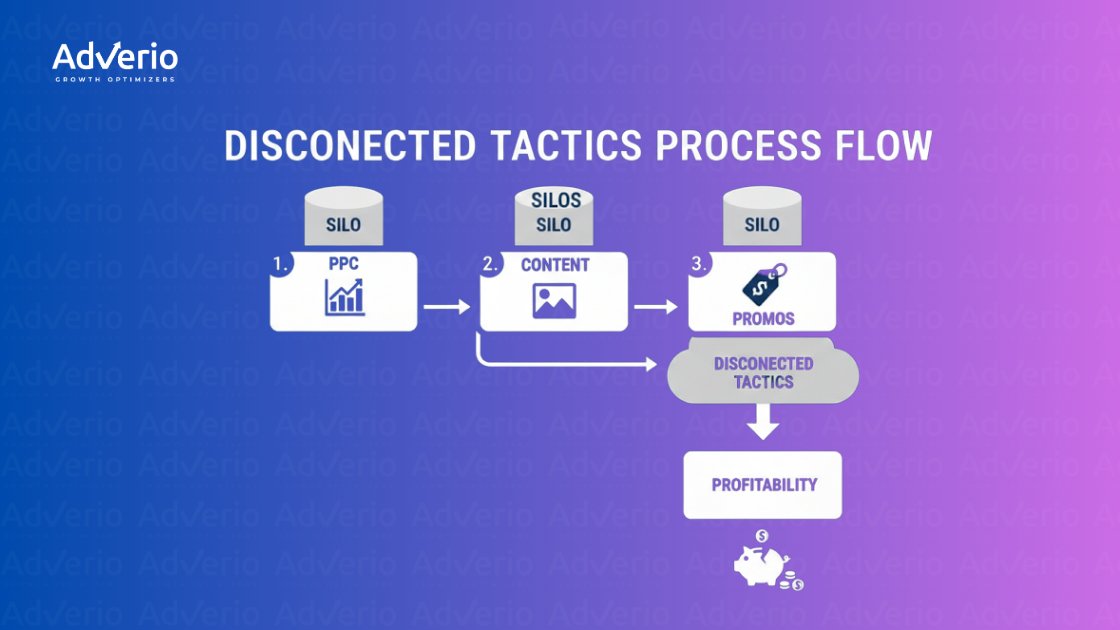
When teams operate independently without a unifying goal, their efforts lead directly to diminished profitability.
Performance: Close the Loop and Pivot
The final pillar, Performance, closes the feedback loop and turns the system into a dynamic engine. This is about continuous optimization based on the performance vs. goal delta, using a structured cadence of reviews and strategic pivots.
A true performance engine leverages data to continually refine efforts. You can learn more about optimizing campaigns for better ROI through careful tracking and analysis.
This loop typically involves:
-
Weekly Check-ins: Tactical reviews of campaign performance against metric benchmarks.
-
Quarterly Pivots: Strategic sessions to assess progress against the overarching goal and refine the approach.
This disciplined review process, powered by robust reporting and a deep understanding of eCommerce business intelligence, allows you to adapt quickly. It ensures you’re actively steering your brand toward its goals with precision.
When to Use GMAP
A structured amazon optimization framework isn’t just a “nice-to-have”—it’s a critical intervention for brands at specific, high-stakes moments. Recognizing these triggers is the first step toward trading operational chaos for predictable growth.
When launching new products or bundles
A new product launch is a massive bet. A GMAP strategy brings order to the chaos, ensuring every action is tied directly to launch-specific goals like driving trial and achieving profitability for new SKUs within the first 90 days.
When expanding off-Amazon (Target, Walmart, DTC, etc.)
Your Amazon playbook won’t work on Walmart. Each marketplace has its own algorithm and customer behaviors. Marching into a new channel without a dedicated plan is a recipe for wasted ad spend. GMAP forces you to build a new growth model from the ground up, defining what success looks like on that specific channel.
Our cross-channel execution across Amazon, Walmart, and Target marketplace management ensures strategy adapts to each algorithm—not copy-paste playbooks.
When struggling to understand ROI of current efforts
If you can’t confidently tell your leadership team which marketing initiative drove a specific sales lift, you have a measurement problem. A solid GMAP framework is built on transparency and accountability. It connects every campaign and optimization to a real-world performance metric, giving you a clear way to measure true incrementality on Amazon
When planning for peak season or capital raises
When stakes are high, guesswork is unacceptable. Whether you’re gearing up for Q4 or presenting to investors, you need a clear, data-backed plan that demonstrates how every dollar will be used to generate a return. GMAP provides that clarity.
When experiencing growth plateaus despite high ad spend
This is the most frustrating situation for any brand leader. You’re pouring money into ads, but revenue has stalled. It’s a classic sign your tactics are no longer aligned with your goals. A GMAP intervention forces a hard reset, realigning your ad spend toward actions that drive meaningful, measurable growth—not just vanity metrics.
Why GMAP Beats Traditional Amazon Growth Models
Let’s draw a line in the sand. Most agencies sell you a list of tactics. They run your PPC or handle your SEO, send a report filled with channel-specific metrics, and then send an invoice. That model is broken. It keeps brands trapped in a vendor relationship, paying for tasks without any real accountability for business outcomes.
Moving Beyond Tactical Reports
The Adverio GMAP strategy flips this model on its head. We don’t sell tasks; we deliver outcomes. Instead of getting bogged down in siloed channel metrics, our entire framework is engineered to connect every action directly to your P&L. It’s an outcome-first approach that transforms the agency relationship.
We don’t optimize for ROAS alone. We optimize for incrementality. That means separating branded demand capture from true growth drivers like competitor conquesting and generic keyword expansion.
GMAP forces a different kind of conversation. We move beyond tactical updates about ad campaigns and start discussing enterprise value, market share, and long-term profitability. This is what separates a vendor from a true strategic partner.
This shift is critical. Brands need more than a task manager; they need a partner accountable for growth. With our structured approach to mastering account management services, we ensure that accountability is built into our process from day one. You can discover more insights about Amazon’s marketplace dynamics on salesduo.com.
From Vendor To Financial Partner
The core difference is alignment. A traditional agency’s success is measured by executing a list of services. Our success is measured by your success. Simple as that. The GMAP framework gives senior leadership and marketing teams a clear way to measure the ROI of each initiative and align on what actually matters.
The old way just doesn’t cut it anymore. A tactical agency delivers reports; a strategic partner delivers results.
Tactical Agency Vs Strategic GMAP Partner
| Attribute | Traditional Agency Model | Adverio’s GMAP Model |
|---|---|---|
| Focus | Executing tactical tasks (PPC, SEO) | Driving business outcomes (Profit, Market Share) |
| Reporting | Channel-specific vanity metrics (ACoS, CTR) | Holistic performance against business goals (TACoS, LTV) |
| Relationship | Vendor executing a service | Strategic partner accountable for financial results |
| Alignment | Siloed teams with conflicting priorities | Cross-functional alignment on shared objectives |
This isn’t just a semantic difference; it’s a fundamental shift in responsibility and focus. The GMAP strategy ensures every dollar you invest is tied to a measurable business result, moving your agency relationship from a cost center to a powerful growth engine.
How Adverio Implements GMAP with Clients
A framework is only as good as its execution. It’s one thing to talk about a GMAP strategy; it’s another to see it come to life. Our process is built on discipline and a relentless focus on results.
We build, manage, and optimize the entire performance engine right alongside you.

From day one, we eliminate ambiguity. This is a tangible system designed to turn high-level ambition into on-the-ground execution.
Kickoff: Define Goals by Channel + Segment
This is where it all begins. We sit down with your leadership team for a deep dive to hammer out clear, time-bound objectives by channel, product line, and market segment. We challenge assumptions and pressure-test goals to ensure they’re both ambitious and achievable. This kickoff sets the North Star for our entire partnership.
Dashboard: Set Up KPI Benchmarking
Once the goals are locked in, we move to measurement. We set up KPI benchmarking and data pipelines in our proprietary BI platform. This isn’t a generic report; it’s your single source of truth for what’s working and what isn’t, giving you real-time visibility on everything from TACoS to new-to-brand customer acquisition.
Roadmap: Assign Actions, Allocate Resources
Next, we architect your growth roadmap. This is a detailed plan that assigns specific actions, allocates resources, and establishes clear ownership across both our teams. This roadmap connects every initiative—whether it’s a listing optimization sprint or a new DSP campaign launch—directly back to the metrics we defined.
Optimization Loop: Review Weekly, Pivot Quarterly
Finally, we bring the strategy to life with our Optimization Loop. This is the engine that drives continuous improvement, creating cross-functional visibility between marketing, ops, and creative.
-
Weekly Reviews: We analyze performance data, spot trends, and make tactical adjustments to campaigns and budgets.
-
Quarterly Pivots: We zoom out to assess progress against the bigger goals. This is where we make strategic calls on budget reallocation and long-term priorities.
This disciplined cadence ensures we are constantly learning and adapting. You can see the results of this methodical approach in our collection of marketplace growth case studies. It’s how we turn plans into profits.
This isn’t a “set it and forget it” model. GMAP is an active, living strategy. The optimization loop guarantees that your plan evolves with market conditions, competitive pressures, and your own business objectives, ensuring you’re always positioned to win.
Ready to Build a Profit-Driven Growth Engine?
If you’re done managing tactics and ready to govern growth, it’s time to shift from activity to accountability.
Request Your Marketplace Profit Analysis
Read Next:
How to Increase Amazon Sales Without Increasing Ad Spend