I’m all-in on brands that do good and prove it. Lift heavy. Eat more. Find me on the water—wake surfing, jet skiing, or chasing ocean time.
Stuck on Amazon, Walmart, or Target? Schedule your ROI Growth Forecast.
Amazon vs Walmart vs Target: Which Marketplace Is Best for Your Brand?
Table of Contents
If you’re a consumer brand selling online, one question eventually comes up:
Should we focus on Amazon, Walmart, or Target?
Each marketplace attracts millions of shoppers, but they operate on very different business models.
Amazon dominates online discovery. Walmart wins on price leadership. Target competes on brand and merchandising.
Understanding how these ecosystems work is critical for brands trying to scale across marketplaces.
In this guide, we break down:
The key differences between Amazon, Walmart, and Target marketplaces
Which platform performs best for different product categories
The strategies successful brands use to scale across all three
How to decide where your brand should invest first
Amazon vs Walmart vs Target: Which Marketplace Is Best?
The best marketplace depends on your brand’s strategy, pricing, and product category.
Here’s the quick breakdown:
Marketplace
Best For
Key Advantage
Amazon
Brands focused on scale
Massive product discovery and logistics
Walmart
Price-competitive products
Lower competition and strong value positioning
Target
Lifestyle and premium brands
Curated marketplace and brand-focused shoppers
When Amazon Is the Best Choice
Amazon is typically the strongest marketplace for brands that want to scale quickly.
Its massive customer base and search-driven product discovery allow brands to generate large sales volumes, especially when supported by strong Amazon PPC management services.
When Walmart Is the Best Choice
Walmart performs well for brands competing on price and everyday essentials.
Because competition is still growing, some categories offer lower advertising costs and easier visibility compared to Amazon.
When Target Is the Best Choice
Target’s marketplace is much more selective.
Brands that succeed on Target usually offer premium, design-focused, or lifestyle products that align with Target’s merchandising strategy.
At a Glance: Walmart vs Target vs Amazon
Marketplace
Core Strategy
Competitive Advantage
Amazon
Convenience & logistics
Massive product selection
Walmart
Price leadership
Supply chain scale
Target
Brand & merchandising
Curated shopping experience
Quick insight:
Amazon = scale and traffic
Walmart = value pricing
Target = brand positioning
Many successful consumer brands eventually sell across all three platforms.
Understanding the Retail Giants
Walmart: The King of Scale
Walmart built its empire on a simple promise: everyday low prices.
With more than 11,000 stores in 25+ countries, Walmart dominates retail through unmatched purchasing power and supply chain efficiency.
What Walmart Does Better Than Anyone
Supply Chain Efficiency
Walmart operates one of the most advanced retail logistics systems in the world. Buying products in bulk allows Walmart to negotiate lower supplier costs.
Massive Product Availability
From groceries to electronics, Walmart aims to be a one-stop shop for everyday needs.
Price Leadership
Price-sensitive shoppers know exactly what Walmart represents: reliable value at low prices.
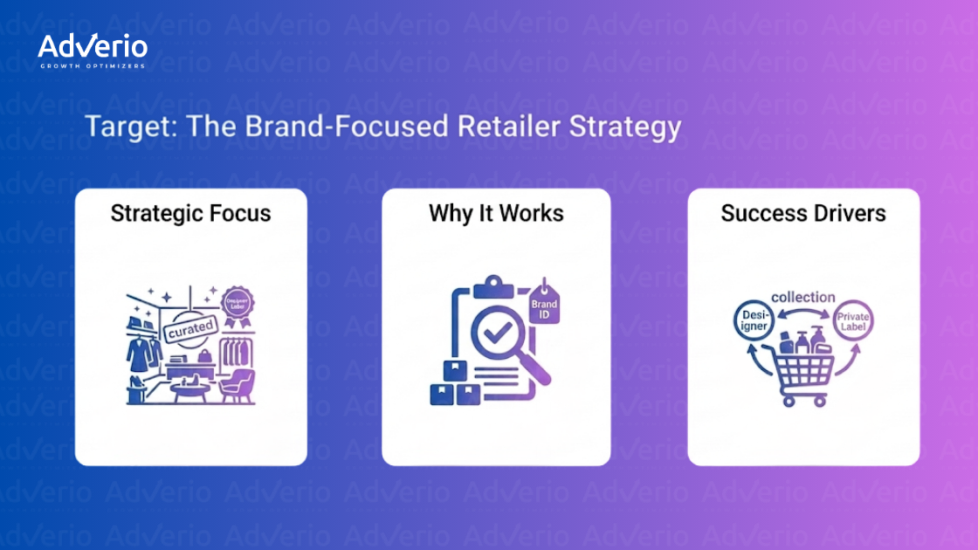
Target: The Brand-Focused Retailer
Target took a completely different path.
Instead of competing purely on price, Target focused on design, brand collaborations, and curated product assortments.
The goal isn’t just shopping; it’s an elevated shopping experience.
Why Target Works
Curated Product Selection
Target intentionally carries fewer SKUs than Walmart, focusing on products aligned with its brand identity.
Designer Collaborations
Partnerships with premium designers create exclusive collections that customers can’t find elsewhere.
Strong Private Labels
Target’s private label brands consistently perform well across apparel, home goods, and lifestyle categories.
Amazon: The Technology Disruptor
Amazon began as an online bookstore in 1994.
Today, it’s the largest e-commerce platform in the world.
Amazon didn’t win through physical stores; it won through technology, logistics, and customer obsession.
Amazon’s Key Advantages
Infinite Product Selection
Amazon’s marketplace allows millions of sellers to list products, creating nearly unlimited inventory.
Personalized Shopping
Recommendation algorithms analyze customer behavior to surface highly relevant products.
Fast Delivery
Amazon Prime fundamentally changed consumer expectations.
Two-day shipping used to feel fast. Today, customers expect next-day or even same-day delivery.
Amazon vs Walmart vs Target Marketplace Comparison
Feature
Amazon
Walmart
Target
Marketplace Size
Largest globally
Rapidly growing
Selective marketplace
Seller Access
Open marketplace
Moderately selective
Invitation-based
Customer Base
Convenience shoppers
Value shoppers
Brand-conscious consumers
Fulfillment
FBA logistics network
Walmart Fulfillment Services
Retail + curated partners
Competition
Very high
Increasing
Limited
Best For
High-demand products
Price-driven categories
Lifestyle brands
Key takeaway
Each platform attracts different consumer psychology, which means brands must adjust their marketplace strategy accordingly.
Product Range and Selection
Walmart: Maximum Coverage
Walmart carries a massive catalog including:
groceries
electronics
home goods
apparel
automotive products
This broad inventory reinforces Walmart’s role as a one-stop retail destination.
On marketplaces like Amazon, strong product pages are essential, which is why many brands rely on Amazon listing optimization services to improve titles, images, and A+ content that drive higher conversion rates.
Target: Curated Assortment
Target focuses on a narrower product range built around:
fashion-forward apparel
modern home décor
exclusive private labels
designer collaborations
The curated approach creates a strong brand identity.
For shoppers, Amazon feels like the largest digital store on Earth.
Technology and Digital Innovation
Walmart’s Digital Transformation
Walmart has invested heavily in:
eCommerce infrastructure
supply chain automation
grocery pickup services
same-day delivery
These improvements are turning Walmart into a powerful omnichannel retailer.
Target’s Omnichannel Strategy
Target successfully blends online and in-store shopping.
Customers can:
Order online and pick up in store
Use Drive-Up pickup
Browse products through the mobile app
Amazon’s Technology Ecosystem
Amazon pushes innovation across multiple industries.
Examples include:
Alexa voice shopping
Amazon Go cashierless stores
AWS cloud computing
AI-powered logistics networks
Few companies operate at Amazon’s level of technological scale.
Should Brands Sell on Multiple Marketplaces?
For most consumer brands, the answer is yes.
Expanded Customer Reach
Each marketplace attracts a different buyer.
Amazon → convenience shoppers
Walmart → price-focused customers
Target → brand-conscious consumers
Reduced Platform Risk
Algorithm changes, fee adjustments, or policy shifts can impact performance overnight.
Diversifying across marketplaces protects revenue streams.
Market Share Growth
Brands that succeed across multiple marketplaces gain:
stronger brand visibility
more discovery opportunities
larger customer bases
Pricing and Promotion Strategies Across Marketplaces
Pricing is one of the biggest drivers of marketplace performance.
Unlike traditional retail, marketplaces are highly dynamic environments where competitors can change prices, launch promotions, or increase advertising in real time.
Successful brands treat pricing as a strategic lever, not a static number.
Dynamic Pricing
Top-performing sellers constantly adjust prices based on demand, competition, and inventory levels.
More advanced brands also use Amazon Brand Tailored Promotions to retarget shoppers who have already interacted with their listings.
Pricing Psychology
Beyond discounts, pricing psychology also plays a major role in purchase decisions.
For example, techniques like Amazon’s anchor pricing strategy influence how customers perceive value by introducing higher-priced reference points.
When pricing, promotions, and advertising work together, brands can dramatically improve both conversion rate and profitability.
The Real Retail Showdown
Retailer
Core Strength
Competitive Advantage
Walmart
Price leadership
Supply chain dominance
Target
Brand positioning
Curated merchandising
Amazon
Technology & logistics
Convenience and scale
There isn’t a single winner.
Instead, these companies represent three powerful retail models shaping modern commerce.
How Adverio Helps Brands Scale Across Marketplaces
Growing across Amazon, Walmart, and Target requires more than simply listing products.
Brands must coordinate:
catalog optimization
marketplace advertising
pricing strategy
logistics
conversion optimization
Adverio helps consumer brands scale through the Growth Cultivator framework, combining:
profit-focused catalog optimization
high-performance PPC and DSP advertising
conversion-driven listing strategy
cross-marketplace expansion
Ready to Scale Across Amazon, Walmart, and Target?
Many brands struggle on marketplaces because they treat them like simple sales channels. If you’re looking for a team that can scale your performance through Amazon PPC management services, Adverio helps brands drive profitable growth across Amazon, Walmart, and Target.
In reality, each platform requires a sophisticated strategy combining:
advertising
catalog optimization
pricing strategy
logistics coordination
conversion-focused listings
Adverio helps consumer brands break through growth plateaus and scale profitably across Amazon, Walmart, and Target.
I’m all-in on brands that do good and prove it. Lift heavy. Eat more. Find me on the water—wake surfing, jet skiing, or chasing ocean time.
Stuck on Amazon, Walmart, or Target? Schedule your ROI Growth Forecast.