


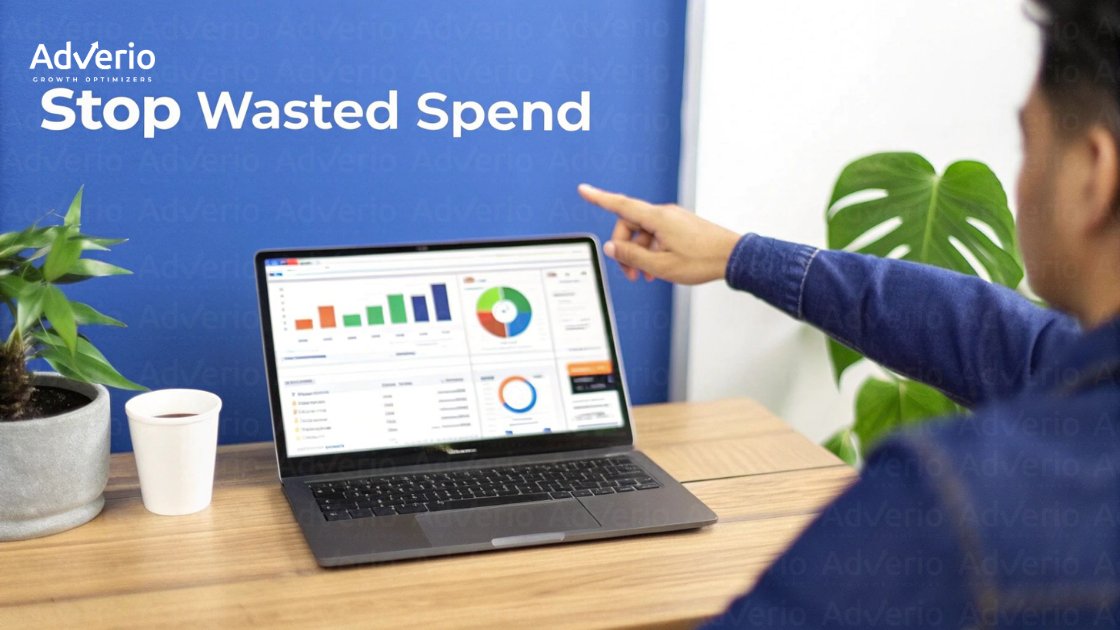
A truly effective amazon ad placements settings strategy isn’t about tweaking the defaults—it’s about breaking free from them entirely. The secret lies in duplicating your campaigns to isolate Top of Search and Product Page placements. This gives you surgical control over your bids, lets you slash wasted ad spend, and forces each placement to justify its existence based on real profit, not blended averages.
The Hidden Truth About Your Amazon Ad Placements
Table of Contents
Here’s the hard truth most agencies won’t tell you: up to 90% of your ad spend is likely evaporating on clicks that never convert. The default Amazon campaign setup is the main culprit.
It forces wildly different ad placements—like high-intent Top of Search and browser-heavy Product Pages—into the same bucket. You’re left optimizing for an “average” that simply doesn’t exist, chasing a blended ACoS that masks catastrophic inefficiencies under the hood. This is a classic case of what we at Adverio call Optimization Myopia—focusing so hard on one metric that you become blind to the real profit drains.
Why Default Settings Fail Profit-Driven Brands
For any brand serious about profitability, Amazon’s standard placement settings are fundamentally flawed. A click at the top of a search result page comes from a shopper ready to buy. A click on a competitor’s product detail page often comes from a window shopper. Yet, your campaigns are forced to treat them as if they’re the same.
This one-size-fits-all approach leads to two predictable and costly outcomes:
- You overbid for lower-converting Product Page placements, burning cash on clicks that go nowhere.
- You underbid for high-value Top of Search placements, sacrificing prime real estate and market share to competitors who understand the game.
The solution is a bold, yet simple, shift in strategy. By duplicating your campaigns to isolate specific placements, you reclaim control. This isn’t a minor tweak; it’s a fundamental change that allows you to stop the bleeding and redirect your budget to the placements that actually drive scalable growth.
The goal is to move beyond managing blended metrics and start making surgical, placement-specific decisions. This is how you turn your ad spend from a necessary evil into a predictable growth engine.
Here’s a quick comparison to show you exactly why the standard approach falls short and how a segmented strategy puts you back in the driver’s seat.
Default Vs Segmented Placement Strategy At a Glance
| Metric | Standard (Default) Approach | Adverio’s Segmented Strategy |
|---|---|---|
| Bid Control | Blended bids optimize for an ineffective average. | Precise bids are set for each placement’s unique performance. |
| Budget Allocation | Inefficiently spreads spend across all placements. | Budget is focused on high-ROI placements, starving poor performers. |
| Performance Data | Masked inefficiencies make true optimization impossible. | Clean, unblended data reveals clear opportunities for growth. |
| Strategic Outcome | Plateaued growth and wasted spend are common. | Accelerated, profitable growth driven by data-backed decisions. |
As you can see, segmenting your campaigns isn’t just about better organization—it’s about fundamentally changing the way you approach growth on Amazon. You gain the clarity needed to make decisions that directly impact your bottom line.
Why Blended Placement Data Is Costing You Thousands
Let’s get right into the numbers. The biggest flaw in a standard Amazon advertising setup is the assumption that every click is created equal. It’s a fundamentally broken way to look at your ad spend. When you let Amazon blend your data, you’re making decisions based on averages—and averages lie.
Top of Search placements are the beachfront property of Amazon’s search results. Shoppers landing here have typed in exactly what they want and are ready to buy. These spots are expensive and fiercely competitive for a reason: they convert.
Product Page placements are a completely different ballgame. These are the ads you see on competitor or related product pages. The shopper is still browsing, comparing, and kicking the tires. Clicks are cheaper, sure, but the intent is much lower, which almost always means a weaker conversion rate and higher ACoS.
The Problem with One-Size-Fits-All Bidding
When you throw both of these placements into one campaign with a single bid, you’re essentially bidding against yourself. You end up either overpaying for low-value Product Page clicks or, more often, underbidding for that prime Top of Search spot and missing out on the best traffic.
A one-size-fits-all bid modifier just doesn’t cut it. It’s a guaranteed way to bleed your budget somewhere. Digging into your own placement data is the only way to find and stop the bleeding.
The second you open your placement report, the story becomes crystal clear. You’ll almost always find that 80-90% of your wasted, non-converting ad spend is hiding in one specific placement, silently tanking your profits while your blended ACoS looks deceptively “okay.”
For example, we constantly see brands with large catalogs burning thousands on Product Page clicks that bring in a 40-50% ACoS. Meanwhile, their Top of Search clicks are humming along at a healthy 15%. The blended campaign data averages this out to a mediocre 30%, completely masking the massive opportunity to cut waste and pour that cash back into what’s actually working.
Unpacking the Financial Impact
On Amazon, every click has to count. The platform is crowded, with over 300,000 global sellers driving the average Cost Per Click (CPC) to around $1.04. In hot categories like health, that can jump to $1.41, while it might drop to $0.28 in quieter niches. With a good conversion rate hovering around 9-10% for a well-tuned listing, overpaying for the wrong click hits your margins instantly. You can see more details on these Amazon advertising statistics on sequencecommerce.com.
To make this real, here’s a classic scenario for an apparel brand with a decent-sized catalog:
| Metric | Top of Search Performance | Product Page Performance | Blended (Default) Result |
|---|---|---|---|
| Spend | $2,000 | $3,000 | $5,000 |
| Sales | $10,000 | $6,000 | $16,000 |
| ACoS | 20% | 50% | 31.25% |
| CPC | $2.50 | $0.90 | $1.45 (Average) |
| Conversion Rate | 15% | 5% | 8.5% (Average) |
At first glance, a 31.25% blended ACoS might not raise any red flags. But look closer. $3,000 is being torched on Product Pages at an unsustainable 50% ACoS. By failing to segment, this brand is propping up poor performance and leaving a ton of profit on the table.
This is exactly the kind of financial drain that a smart amazon ad placements settings strategy is built to fix. The first step is admitting that blended data isn’t just messy—it’s actively costing you money.
The Campaign Duplication Playbook for Placement Control
Alright, enough theory. Let’s get our hands dirty. If you want to reclaim control over your ad spend, you need a deliberate, structured approach. This playbook gives you the exact framework to duplicate your campaigns and isolate placements, turning a messy, blended strategy into a clean, surgical operation.
Forget tweaking your existing campaigns. The real leverage comes from creating two distinct, parallel versions of your highest-impact campaigns. We’re talking specifically about your automatic and category targeting campaigns, where Amazon’s algorithm has the most freedom—and where most of your uncontrolled spend is probably happening. One version will target the Search Engine Result Pages (SERPs), and the other will focus exclusively on Product Pages.
This diagram shows the problem with a standard, blended setup. It’s a straight line from jumbled data to messy bidding and, ultimately, wasted ad dollars.
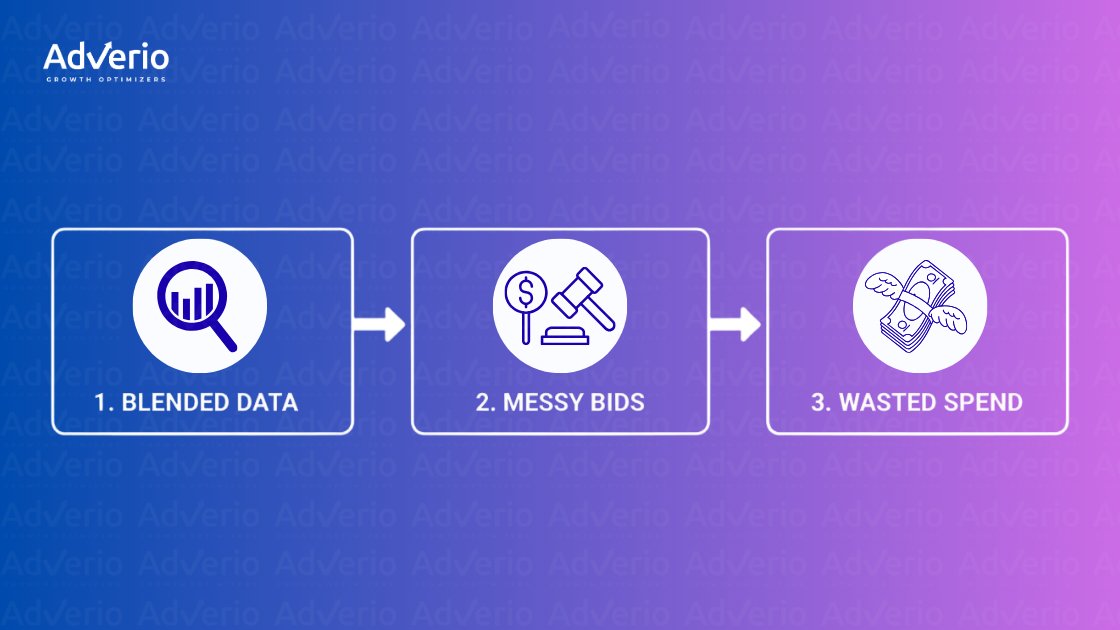
By separating these placements, you break this costly cycle. You build a structure where every dollar is accountable to a specific performance goal.
Architecting Your Placement-Specific Campaigns
The core of this strategy is mirroring a campaign to force the algorithm’s hand. You’re going to take one of your existing, high-traffic auto campaigns and create an exact duplicate.
Here’s how to set it up:
- Duplicate Your Campaign: Head into Campaign Manager, find your target campaign (let’s say it’s “Auto – Hero SKU”), and use the “Copy” function. Simple as that.
- Rename for Clarity: Immediately rename both campaigns to reflect their new purpose. Something like this works perfectly:
- “Auto – Hero SKU – SERP“
- “Auto – Hero SKU – Product Page“
- Pause the Original: Once the two new campaigns are live and running, pause the original blended campaign. This is crucial to avoid overlap and data contamination.
A clean naming convention like this is non-negotiable for tracking and optimization. Anyone on your team can instantly see what each campaign is for without having to dig into the settings.
Configuring Your Bids and Placement Modifiers
This is where the magic happens. These settings will force traffic where you want it and starve the placements you don’t.
For Your SERP (Search) Campaign:
- Set a Low Base Bid: Your starting keyword or ad group bid should be low enough that it won’t win Product Page placements on its own. A good starting point is often 50% of your category’s average CPC. So, if the average CPC is $1.50, start your base bid around $0.75.
- Apply Aggressive Placement Modifiers:
- Top of Search: Set a high bid modifier here, usually somewhere between +300% to +900%.
- Rest of Search: This can be more moderate, typically about half of your Top of Search boost (e.g., +150% to +450%).
- Product Pages: Set this to -100% (or 0%, depending on the interface). This is the kill switch. No exceptions.
For Your Product Page Campaign:
- Set a Similar Low Base Bid: Start with the same low base bid as your SERP campaign. You can always adjust it later based on performance.
- Invert Your Placement Modifiers:
- Product Pages: Apply a high bid modifier, again in the +300% to +900% range.
- Top of Search: Set this to -100%.
- Rest of Search: Set this to -100%.
By setting a low base bid and relying on aggressive modifiers, you’re telling Amazon’s algorithm exactly where you’re willing to pay a premium for a click. This prevents your campaigns from accidentally competing against each other for the same ad slot.
The “Placements” tab in your campaign settings is where you’ll make these critical bid adjustments. This is ground zero for segmenting your traffic effectively.
The Critical Role of Negation in This Structure
With great control comes great responsibility. This segmented structure makes your negation strategy even more important. One of the biggest mistakes we see brands make is negating an ASIN in a search-focused campaign just because it performed poorly on a product page somewhere else.
This is a catastrophic error.
When you negate an ASIN in a campaign targeting keywords, you don’t just block its product detail page; you risk blocking all the valuable search terms that ASIN also triggers. You could inadvertently cut off traffic from a high-converting keyword simply because it was associated with an underperforming competitor ASIN.
Our duplication playbook solves this problem by design. In your SERP campaign, you will only negate irrelevant search terms. In your Product Page campaign, you will only negate poor-performing ASINs. This separation keeps your data clean and prevents costly cross-contamination, ensuring you never accidentally starve your best keywords.
Optimizing Your New Placement-Specific Campaigns
Launching your duplicated campaigns is just the first move. The real power—and profit—comes from treating these segmented campaigns as entirely separate entities. This is where you shift from a reactive manager chasing a blended ACoS to a proactive strategist making calculated, profit-driven decisions.
Your SERP and Product Page campaigns have different goals, different audiences, and frankly, require completely different playbooks. You can’t manage them with a one-size-fits-all approach anymore.
Your SERP campaign is now your offensive line, built for aggression and grabbing market share. Your Product Page campaign, on the other hand, is your defensive specialist, hyper-focused on efficiency and cost control.
This granular control is a game-changer for budget allocation. You can now confidently fuel what’s working and ruthlessly cut what isn’t, without one placement’s poor performance dragging down the other. This is exactly how you escape the trap of average results and start building a truly optimized amazon ad placements settings strategy.
Adjusting Bids for Distinct Performance Goals
Your optimization approach has to be tailored to the unique objective of each campaign type. There’s just no room for a cookie-cutter strategy here.
For Your SERP Campaign (Aggression & Rank):
- Primary Goal: Dominate the top of search for your high-intent keywords. This drives the sales velocity needed to boost your organic ranking.
- Bidding Strategy: Be aggressive. This is where you push bids higher on your proven winners. If a keyword is converting well below your target ACoS, don’t be shy about cranking up the bid to capture more impression share.
- Placement Modifiers: Keep your Top of Search modifier high—think +300% to +900%. Monitor its impact on your impression share for your most critical keywords. The goal is to own the most valuable digital real estate.
For Your Product Page Campaign (Efficiency & ACoS):
- Primary Goal: Maintain a strict ACoS by targeting relevant competitor and complementary ASINs without overspending.
- Bidding Strategy: Be surgical and cost-conscious. Here, you’ll be lowering bids on any ASINs that creep past your ACoS threshold after a reasonable number of clicks.
- Placement Modifiers: Your Product Page modifier should be adjusted based on the campaign’s overall ACoS. If ACoS starts to climb, you can dial back the modifier slightly to bring down CPCs.
Think of it like this: your SERP campaign is your growth investment, where you’re willing to accept a slightly higher ACoS for market dominance. Your Product Page campaign is your profit protector, where efficiency is king.
Leveraging Data for Smarter Budget Allocation
This segmented structure finally gives you clean, unblended data—which is the ultimate competitive advantage. You can now see precisely how much you’re spending and what you’re getting in return for each placement. Use this newfound clarity to make bold decisions.
Is your SERP campaign delivering a 3x ROAS while your Product Page campaign is barely breaking even? It’s time to shift a larger chunk of your budget over to the SERP campaign. This ongoing process of analyzing and reallocating budget is the core of this advanced strategy. To truly optimize your placement specific campaigns and maximize ROI, consider exploring the top AI tools on major ad platforms.
By mastering this segmented approach now, you’re not just fixing today’s problems—you’re preparing for a future where this level of granular control is the baseline for success. For more actionable advice, check out our complete guide on Amazon PPC optimization tips and best practices.
Real World Results From Segmenting Ad Placements
Theory is great, but results are what matter. Does this placement segmentation strategy actually move the needle? Absolutely.
This isn’t just an interesting thought experiment; it’s a battle-tested approach we use to turn struggling campaigns into profit-generating machines. We’ve seen brands go from plateaued growth and runaway ACoS to achieving single-digit efficiency and scalable growth.
The change happens when you stop letting blended data dictate your strategy. Once you separate your campaigns, you gain the clarity to cut the dead weight and double down on what’s working. This shift transforms your advertising from a cost center into a strategic financial engine.
Case Study Prime Day Turnaround
One of the most powerful demonstrations of this strategy came during Prime Day for a large apparel brand. Historically, their ACoS would skyrocket during the event as they scaled spend to compete. Their blended campaigns were simply too blunt an instrument for such a high-stakes environment, forcing them to overspend on Product Page placements just to get visibility at the Top of Search.
By implementing our placement duplication strategy just weeks before the event, we flipped the script. We created two sets of their highest-traffic auto campaigns:
- SERP-Focused Campaigns: Bids and modifiers were set aggressively to dominate Top of Search, capturing high-intent shoppers ready to buy during the event.
- Product Page-Focused Campaigns: Bids were managed conservatively, maintaining a presence on competitor pages but with a strict ACoS ceiling to prevent runaway spend.
The results were immediate and dramatic. Instead of seeing a 5x spike in non-converting spend, the brand maintained control. Their SERP campaigns drove a massive influx of sales at a profitable ACoS, while the Product Page campaigns were kept in check, preventing the budget hemorrhage they’d experienced in previous years.
The real win wasn’t just surviving Prime Day; it was thriving. By reallocating the 85-95% of spend that was previously wasted on non-converting placements, we fueled profitable growth during the most competitive time of the year.
From Struggling ACoS to Single-Digit Efficiency
This amazon ad placements settings strategy isn’t just for tentpole events. We applied the same logic to a home goods brand with a large catalog whose campaigns were stuck at a 45% ACoS. The culprit, as usual, was blended data masking poor performance on Product Page placements.
After segmenting their campaigns, we quickly identified that nearly all their profit drain was coming from irrelevant ASINs on product pages. Within weeks of implementing the new structure and applying surgical negation, the results were transformative:
- Overall ACoS: Dropped from 45% to 18% in the first month.
- Product Page Campaign ACoS: Stabilized at a profitable 25% by eliminating poor performers.
- SERP Campaign ACoS: Achieved a remarkable 9% ACoS, driving significant sales volume.
This wasn’t about spending less; it was about spending smarter. By isolating the placements, we eliminated the non-converting spend and re-invested those dollars into the high-performing SERP placements.
This bold approach didn’t just lower their ACoS—it fundamentally improved their total profitability and set them on a new trajectory for scalable growth. The brand moved from a state of frustration to one of confidence, finally able to see exactly how their ad dollars were working.
Beyond Sponsored Products: Applying Placement Strategy to DSP
Getting your Sponsored Products placements dialed in is a huge win, but it’s just the first step. To really dominate your category, you have to apply the same strategic thinking across Amazon’s entire ad ecosystem—especially the Demand-Side Platform (DSP).
DSP is a completely different animal. It’s where you go beyond keyword targeting to reach highly specific audiences both on and off Amazon. We’re talking Fire TV, Twitch, and thousands of other sites where your ideal customers spend their time. Running DSP campaigns without a clear placement strategy is like buying a Super Bowl ad but letting the network decide when to air it. You’re leaving far too much to chance.
Connecting the Full Funnel
At Adverio, we use our Growth Cultivator framework to make sure our Sponsored Products insights directly inform our DSP campaigns. It creates a seamless feedback loop.
For example, if we discover that placing ads on a key competitor’s product detail page drives strong conversions, we don’t just stop there. We take that data and use DSP to retarget those same high-intent shoppers with display ads wherever they go online. This creates a cohesive journey, guiding customers from their first glance all the way to checkout.
This integrated, full-funnel approach is how you win serious market share. Amazon’s ad business is a juggernaut, pulling in billions each quarter, fueled by its ability to tap into data from over 300 million U.S. consumers across retail, Prime Video, and DSP, which makes its audience targeting incredibly powerful.
When your ad dollars are synchronized like this, you’re not just running ads anymore. You’re building a system for market takeover.
Frequently Asked Questions (FAQs)
Diving into a more advanced Amazon ad placements settings strategy is a big move, and it’s totally normal to have questions. Here are the straight answers our Growth Evangelists give to the most common questions from brands ready to take back control of their ad spend.
Which Campaign Types Are Best for This Duplication Strategy?
This strategy packs the biggest punch on your campaigns with the widest reach—think Automatic and Category Targeting campaigns. These generate a huge volume of impressions across all kinds of placements, making them perfect candidates for segmentation.
When you split them up, you can start harvesting valuable, low-cost keywords from your search-focused campaign while keeping a tight leash on the less predictable (and often less profitable) product page placements. It’s all about creating a structure where each campaign can do its specific job exceptionally well.
How Long Should I Test This New Structure Before Making Changes?
Patience is your best friend here. You need to give the new campaigns at least two weeks to collect enough data before you start making any big optimization moves. Amazon’s algorithm needs time to learn, and you need enough data to make informed decisions, not just knee-jerk reactions.
And this is crucial: run your test during a normal, stable sales period. Don’t launch it right before a major holiday or a massive event like Prime Day. That way, you’re working with clean, reliable performance data that shows you what typical customer behavior looks like.
Will Duplicating Campaigns Increase My Overall Ad Spend?
Not if you do it right. The goal isn’t to spend more—it’s to spend smarter. By isolating your placements, you’ll quickly spot and slash the 80-90% of non-converting spend that was silently killing the performance of your original campaigns.
This lets you reallocate that exact same budget to the placements that are actually driving profitable sales. You’ll end up improving your overall Return on Ad Spend (ROAS) without having to find more money in your budget. Think of it as a strategic reallocation, not an inflation of your ad spend.
Can I Use a Low Base Bid and a 900 Percent Placement Modifier?
You can, but it’s rarely a good idea. From what we’ve seen, Amazon’s algorithm looks at your base bid first to decide if your ad even qualifies for the auction.
If your bid is way too low (say, $0.10 in a category where the average CPC is $1.50), you might not get any impressions at all, no matter how high your modifier is. Your base bid has to be in the same ballpark as the category’s typical CPCs just to get a seat at the auction table.
Ready to stop guessing and start executing a placement strategy that drives real profit? Adverio builds growth engines for brands tired of average results.