Business intelligence

Ecommerce Business Intelligence for Marketplace Growth

Stop running the weekly meeting on instinct.

Ecommerce sold business intelligence as a visibility problem. The market bought visualization, and the dashboards turned prettier while the guesswork underneath stayed put. It isn't a reporting layer. It's a capital allocation instrument.

Finite operator hours and finite ad dollars have to go where the next marginal dollar returns the most. Adverio's system connects fragmented data across Amazon, Walmart, and Target into one governed decision layer built to answer exactly that.

Six decision lenses Amazon · Walmart · Target Scored on margin, not revenue

$56.2B

Amazon ad revenue in 2024, up 18% year over year. At that scale, governed vs ungoverned allocation is measured in seven figures. Amazon Q4 2024 earnings.

14.7%

of total revenue spent on ads by the average Amazon seller in 2025, up from 11.2% in 2022. Without incrementality, much of that defends organic sales. Marketplace Pulse, 2025.

Six lenses govern the decision. Each answers a single question and triggers a single instruction, at the item level, with the constraint layer cleared first.

Your dashboard says the quarter went fine. Your margin disagrees.

See Where My Next Dollar Wins

15-minute call. No pitch deck.

The definition

What Is Ecommerce Business Intelligence?

Ecommerce business intelligence connects fragmented marketplace data, advertising metrics, catalog performance, and pricing signals into one decision layer. You already have the data. What you lack is a system that tells you what to do with it. If your reporting shows what happened last month but can't tell you which SKU to fix tomorrow, you don't have intelligence. You have a scoreboard.

At a glance
  • Six lenses govern the decision: Incrementality, GEAR, Query IQ, CRO:SEO, Buy Box Stability, Profit Pulse.
  • Incrementality separates net-new revenue from revenue you would have won anyway.
  • Route the next dollar by GEAR delta, not by revenue.
  • Advertising is downstream. Inventory, pricing, and listing readiness get cleared first.
  • Prioritize at the item level. Parent-level views hide both the revenue and the waste.
  • Built for operators on Amazon, Walmart, and Target.
1
Section one

Why Reporting Stopped Being Enough

The usual setup connects data sources, builds dashboards, and watches the metrics. Nothing about that is wrong. It just stops one step short of the only question that matters, which is what to do on Monday.

Branded ROAS can look healthy while generics quietly erode and margin compresses. Efficiency holds, growth doesn't, and the dashboard reports both as green. Without incrementality modelling, a meaningful share of ad spend is defending sales you'd win organically.

What to do

Govern on TACoS. Total ad cost against total revenue is the only view that shows whether advertising is building the brand or renting it.

Compare shares, not totals. Ad spend share against total sales share is the number that moves first.

Make every read produce an instruction. A do and a do-not, by SKU, by query, by channel. If a chart doesn't end in a decision, it's decoration.

What to avoid

Don't treat a healthy branded number as proof of growth. It's the easiest figure to fool yourself with.

Don't scale a channel you can't attribute. Spend that can't show what it influenced can't be defended in a budget meeting.

Don't add another dashboard to fix a decision problem. More visibility into the same guesswork changes nothing.

2
Section two

The Six Lenses That Govern the Decision

Each lens answers one question and triggers one decision.

LensWhat it answersThe decision it triggers
Incrementality
Which revenue would have arrived anywayReallocate protected branded spend into generics
GEAR
Where the next dollar raises contribution marginFund only positive GEAR delta
Query IQ
Rank and impression share by query classScale only where PDP readiness and rank velocity align
CRO:SEO
Which of five conversion dials is brokenFix the top blockers before spending
Buy Box Stability
Whether ownership is stable enough to promoteAnchor spend to proven price bands
Profit Pulse
True P&L by SKU after fees, returns, and freightKill or fix profit-leaking SKUs

Incrementality Lens

What
Separates net-new revenue from revenue you'd have captured anyway.
Why it matters
Efficiency metrics stay green right up to the point category share is gone.
Do next
Reallocate protected spend into generics that expand reach without spiking TACoS. Then reinforce with conversion-ready PDPs. That work sits in Amazon listing optimization services.

GEAR

What
A composite KPI that finds where your next dollar increases contribution margin.
Why it matters
Revenue growth without margin growth is false scale.
Do next
Route budget only to SKUs and queries showing positive GEAR delta. The same read runs on Walmart, through Walmart PPC management.

Query IQ

What
Organic rank plus impression share by branded, generic, and competitor query class.
Why it matters
Category leaders know when to push and when to hold.
Do next
Only scale where PDP readiness, rank velocity, and conversion strength align. The same gate applies when you expand into Target PPC management.

CRO:SEO Scorecards

What
Five conversion dials, Quality, Copy, Media, Offer, Reviews, with status tags and next actions.
Why it matters
Traffic can't fix broken product pages.
Do next
Fix the top three blockers per PDP before scaling ads. Conversion-first discipline compounds faster than brute-force spend.

Buy Box Stability and Price to CVR

What
Daily Buy Box %, volatility flags, and price-elasticity versus conversion modelling.
Why it matters
Promoting a volatile Buy Box destroys efficiency and erodes margin.
Do next
Anchor spend only to stable ownership and proven price bands.

Profit Pulse System (PPS)

What
Live P&L by SKU and collection blending ad cost, marketplace fees, returns, freight, and promo impact.
Why it matters
Operators need CFO-grade clarity before allocating capital.
Do next
Kill or fix profit-leaking SKUs before scaling traffic.
What to avoid

Don't run one lens on its own. GEAR tells you where to spend, and Profit Pulse tells you whether the SKU deserves it.

Don't score before the constraint layer is clear. See section 4.

Don't average the six into a single health number. The value is in which one is failing, and an average hides that.

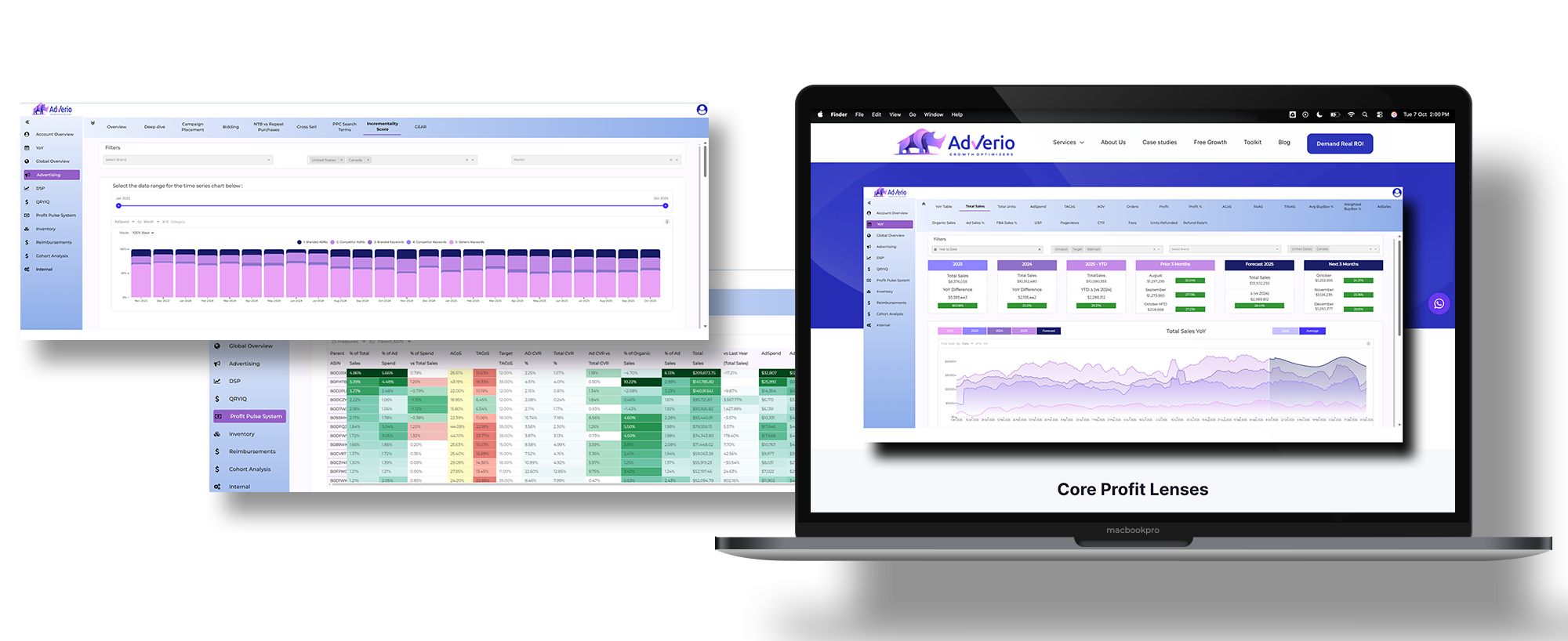
Adverio business intelligence dashboard showing performance across Amazon, Walmart, and Target in one view

All six lenses, one governed view across every marketplace.

Six lenses, and one of them is failing right now. An average would hide which.

Find My Profit-Leaking SKUs

20-minute call. We bring the account read.

Free worksheet

BI Readiness Worksheet

Six lenses decide where your next dollar goes. Score how many of them you can answer today.

List your data sources, mark the lenses you can currently answer, and the sheet names the one you're blind on.

  • Your six-lens coverage, scored
  • The gap between what you track and what you decide on
  • The one lens costing you the most to stay blind on

Takes 2 minutes.

3
Section three

Why Nobody Else Operationalizes This

The conventional playbook is strong on the ground next to this one. External traffic as a rank lever, the creator flywheel, DSP loyalty funnels, a direct-to-consumer layer for customer ownership, multi-marketplace expansion in a sensible sequence. All of it holds up.

On incrementality it gestures at the concept and stops. There's no conventional playbook for turning it into an instruction, which is worth saying plainly.

The break is operational. Compare ad spend share against total sales share. Then compare ad conversion rate against total conversion rate. The account starts separating spend that builds the brand from spend that buys sales the brand would have won anyway. That comparison is the whole argument. A dashboard can't make it for you, because a dashboard has no opinion.

What to do

Name the comparison you're running. If nobody can state which two numbers are being weighed, no incrementality work is happening.

Design the test where the account structure allows it. Some campaigns defend existing demand and some create it. They shouldn't share one performance target.

What to avoid

Don't accept "we measure incrementality" as an answer. Ask what decision changed last month because of it.

4
Section four

Advertising Is Downstream

A score on a constrained item is a trap. Spending into a constraint buys a more expensive version of the same problem, so inventory health, pricing and unit economics, and listing readiness get cleared before any ad-level work happens. Structure comes before speed.

Prioritization then runs at the item level rather than the parent. Revenue concentration usually sits in one or two children inside a parent, so a parent-level view averages away both the item carrying the revenue and the item quietly bleeding.

An emergency room doesn't treat patients in arrival order. It triages by severity and treatability. The decision layer is the triage chart. Without one, teams work the loudest problem rather than the most recoverable one.

What to do

Clear the constraint gates in order. Stock sufficient to support spend, Buy Box stable enough to matter, pricing and margin healthy enough that the read isn't distorted by a promo.

Prioritize children, never parents. Then let time allocation mirror revenue allocation. A small share of items earns deep manual work and the long tail earns standardized treatment.

Give constraint clearing an owner. If the ad team can't see listing status and inventory cover, it can't explain margin. Full Amazon account management is where that ownership sits.

What to avoid

Don't treat every item equally. It's the most common way operator hours get spent on things that can't move.

Don't promote through Buy Box volatility. Swinging ownership makes the spend unmeasurable, not just inefficient.

5
Section five

How It Works

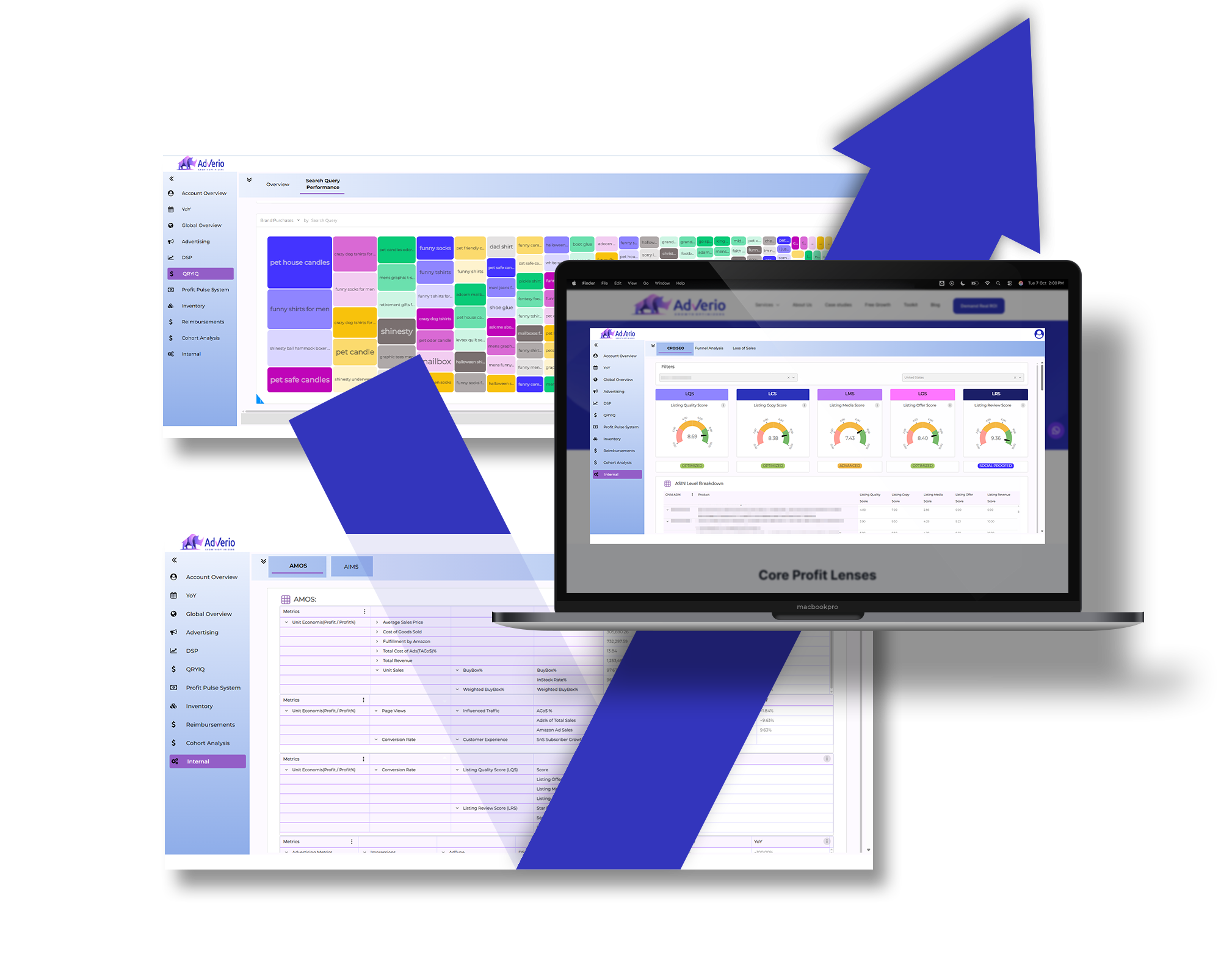
Adverio business intelligence dashboard showing SKU level profit and advertising performance
1

Instrument

Connect ad, retail, catalog, pricing, and review data into one governed dataset.

2

Interpret

We normalize, score, and surface do and do-not plays with guardrails.

3

Implement

We launch structured tests across ads, listings, and pricing, then track lift against Incrementality and GEAR.

What to do

Decide who executes before you start. Keep your team, or hand it over. Both work, and the instrumentation is identical either way.

What to avoid

Don't instrument everything at once. Connect what the first three decisions need, then widen.


6
Section six

From Insight to Action, One Play

Signal

Branded spend at 62%. Generic rank is sliding.

Action

Reallocate 20% to top-five generics where CRO:SEO is 8+ and Buy Box stability is confirmed.

Guardrails

Pause if TACoS rises more than two points or CVR drops more than 10%.

Watch

Incremental sales, rank movement, and GEAR lift inside 21 to 30 days.

The Decision Grid

DecisionOwnerWhat it protects
Reallocate branded budget into genericsMedia leadIncrementality of total spend
Fund or freeze a query by GEAR deltaMedia leadContribution margin per query
Fix or hold a PDP before scalingCatalog and creativeCart-add and purchase share
Anchor or pull spend on Buy Box volatilityOps and pricingMeasurability of every downstream read
Kill or repair a profit-leaking SKUFinance and catalogMargin at the item level
Widen the instrumented datasetAnalyticsEvery decision made after it

Every row gets a name attached before the first test runs. If you want the wider picture of how these seats work together, see our growth services.

The engagement

How Adverio Runs This

Six lenses, three marketplaces, and one P&L isn't a checklist problem. It's a governance problem.

Adverio owns the governance seat and the execution behind it. Every play routes into Amazon PPC management, content, and pricing. When the numbers say stop, we stop, and we name the number that said it.

Outcomes operators ask for

  • Lower net CAC by pre-loading research clicks and retargeting when CVR spikes.
  • Grow category share by shifting 15 to 25% from branded defense to qualified generics.
  • Protect margin with Buy Box guards and price-elasticity rules.
  • Ship fewer, bigger listing fixes that materially move conversion.
  • Deliver board-ready reporting, with growth framed in profit context.

BI Essentials

Dashboards plus monthly playbook review. Built for teams that execute internally but want strategic oversight and prioritization clarity.

BI plus Execution

We implement ad reallocations, CRO changes, and pricing adjustments, then iterate weekly, reporting lift tied directly to Incrementality and margin impact.

The receipts

Proven at Scale

Levtex Home bedding listing imagery
+1,119%profit surge · 51 months

Levtex Home

Softlines, Home and Kitchen, Bedding

Explore case study

See dozens more

Questions

FAQs

How is this different from dashboards?

Dashboards visualize activity. We model incrementality, contribution margin, and capital allocation impact, then name the SKU, the query, and the spend line that changes.

We already have Looker or Power BI. Why you?

Those are visualization tools and they do that job well. We layer intelligence consulting onto your existing infrastructure, so the output is a decision you can act on.

What access do you need?

Ad platforms, retail analytics, catalog data, pricing history, and return data. We normalize and operationalize it.

How fast do we see signal?

Directional shifts appear within 15 to 30 days. Compounding lift builds across 60 to 90 days.

Can you work across Amazon, Walmart, and Target?

Yes. Amazon, Walmart, and Target all score on the same six lenses.

Pricing?

Depends on catalog complexity and scale. We model expected profit upside before engagement.

Quick answer

The short version

Score every marketplace decision against contribution margin, not revenue. That is what tells you which SKU to fix, which query to fund, and which spend to stop. Directional shifts appear within 15 to 30 days and compounding lift builds across 60 to 90 days.

If your team debates what to do next every week, the debate is the symptom. You're paying for a scoreboard and calling it intelligence.

Put My Data Behind One Decision Layer

One call, and you keep the read either way.